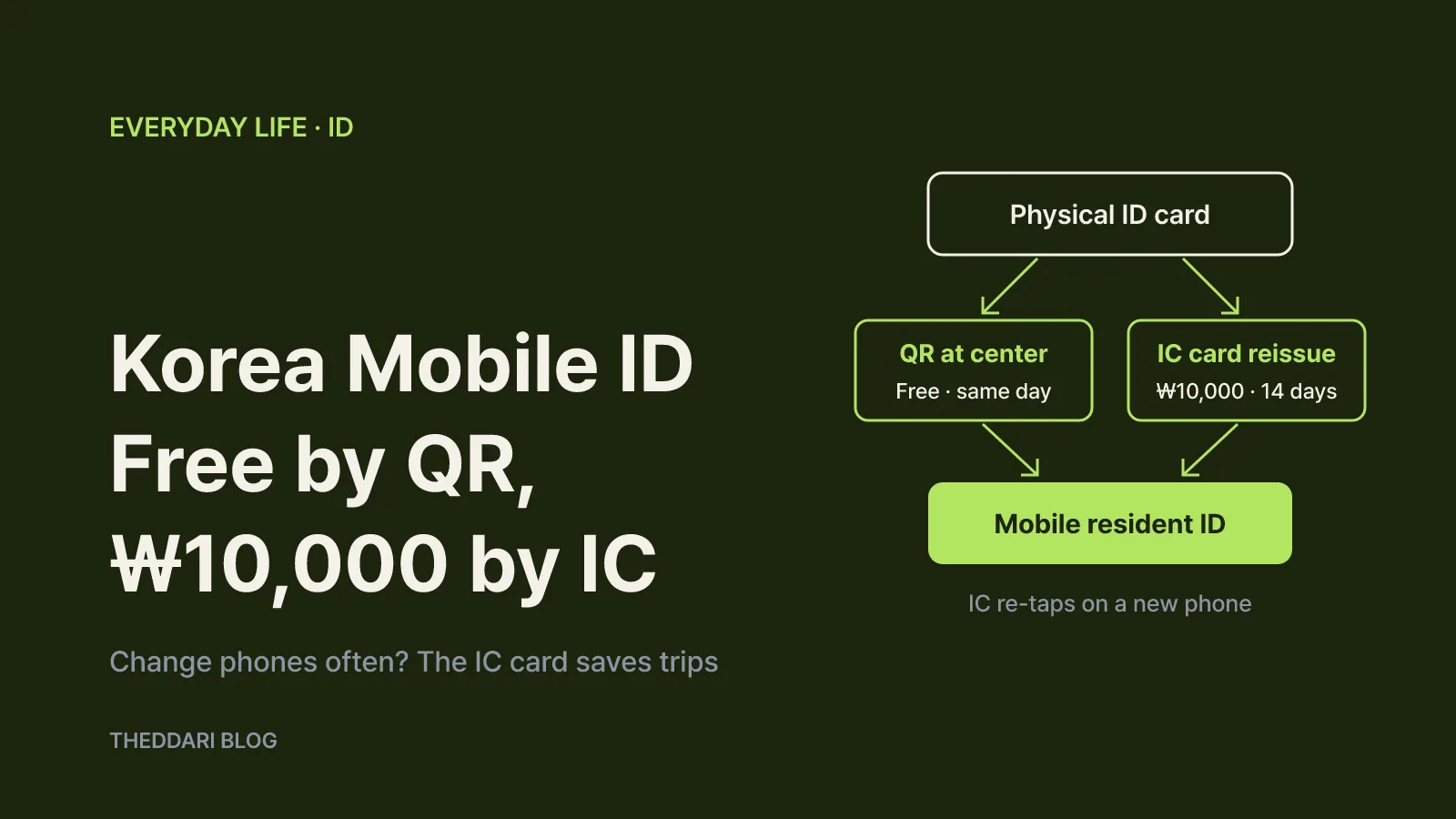
As of November 2026, there are two ways to put your Korean resident registration card on your phone. Take your physical card to any local community service center (eup, myeon or dong office), scan a one-time QR code, and the mobile card is issued free of charge the same day. Alternatively, have your card reissued as a version with an integrated circuit (IC) chip and tap it against the back of your phone, which costs ₩10,000 for the reissue. If you want a single visit and no fee, choose QR. If you would rather never queue at a counter again when you change phones, the IC route makes more sense. The rest of this guide walks through both procedures using the responsible agencies' own instructions.
How the QR and IC routes differ
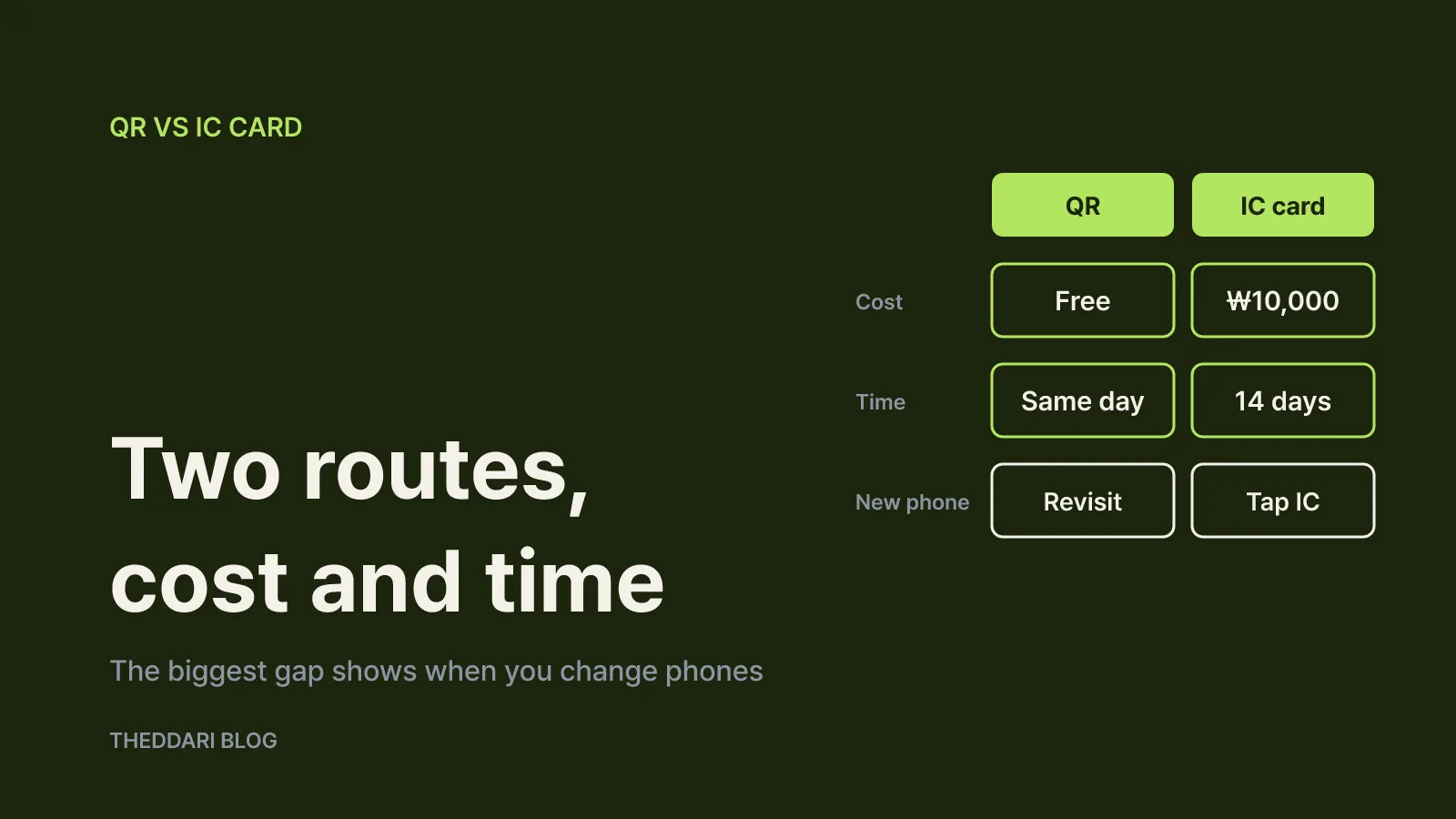
The official Mobile ID issuance guide says anyone who holds a resident registration card can get the mobile version. That card is the starting point. What changes is how the physical card gets linked to your phone.
QR issuance happens at a community service center counter. You fill in an application, an official checks your identity, and you photograph a one-time QR code with the government's Mobile ID app. According to a Q&A published on Korea.kr, the government's policy briefing portal, this route is free. The trade-off is spelled out in the same Q&A: if you got your mobile card by QR, you have to go back to the community service center when you replace your smartphone.
IC card issuance starts with a new physical card that contains a chip. Once you have it, you tap it on the back of your phone to verify yourself, and the mobile card is created. The Ministry of the Interior and Safety (MOIS) resident card page lists the reissue fee as ₩10,000 with an IC chip and ₩5,000 without one. In other words, the chip adds ₩5,000 to the standard reissue fee, which matches the Korea.kr breakdown of ₩5,000 for reissue plus ₩5,000 for the chip.
← Swipe to see more
| QR issuance | IC card issuance | |
|---|---|---|
| Cost | Free | ₩10,000 for a reissue (free for first-time applicants) |
| Visits | One visit to a community service center | Apply and collect in person, or receive the card by registered mail |
| Time | Same day at the counter | 14 days in total for card production and delivery (excluding weekends and holidays) |
| New phone | Return to the center and scan a new QR code | Tap the IC card on the new phone |
The first-time exemption matters. MOIS lists the fee for a new card, issued when a citizen turns 17, as free, and Korea.kr also notes that first-time applicants pay nothing. If someone in your household is applying for their first card, choosing the IC-chip version at that point avoids paying for it later.
Step by step: free QR issuance
You can use any nearby community service center, regardless of where your address is registered. The Mobile ID guide lists these steps:
- Visit a community service center with your physical resident registration card. The guide explicitly says the physical card is required, so check your wallet before you leave.
- Complete the mobile resident registration card (re)issuance application. Hand it in at the counter so an official can confirm your identity.
- Install the Mobile ID app on your phone. Doing this while you wait saves time at the counter. After installing it, you complete phone-based identity verification.
- Scan the QR code as instructed by the official. The code is single-use, so it cannot be reused later or scanned by someone else.
- Confirm the card appears in the app. That is the end of the process.
The slowest part of the procedure is usually app installation and verification, so bring a phone registered in your own name that can receive verification texts, and know your app store password. Counters operate during weekday office hours.
Step by step: IC card issuance
The IC route adds a card replacement before the mobile step. The Mobile ID guide lists three things to bring:
- One photo taken within the last six months, 3.5 × 4.5 cm
- ID (for a replacement, your current resident registration card)
- The ₩10,000 fee
You can apply online through Gov24 or in person at a community service center. MOIS says the application can be filed at any eup, myeon or dong office nationwide and that you pick a collection method on the form:
- In-person collection at the office you chose. A family member aged 17 or older in the same household, a spouse, or a lineal relative can collect it on your behalf with their own ID. However, if you applied through Gov24 and did not verify your identity at a center before collection, proxy pick-up is not allowed.
- Registered mail, which carries a ₩3,800 postage fee. MOIS notes that mail delivery usually arrives at least four to five days earlier than in-person collection.
MOIS puts the total time at 14 days for in-person collection, excluding weekends and public holidays, with one extra day for mountain and island areas. If you need ID for a fixed date, apply well ahead.
Once the card arrives:
- Install the Mobile ID app.
- Tap the IC card on the back of your phone to verify yourself. Because this works by near-field communication, NFC needs to be switched on.
- Confirm that issuance is complete.
MOIS says that with a chip-enabled card you can request issuance or reissuance of the mobile card through your phone without visiting a community service center. You pay ₩10,000 and wait about two weeks, but you avoid return trips afterwards. It is also a chance to update an old photo on the physical card.
Changing or losing your phone
This is where the two routes diverge most. The Mobile ID reissue guidance splits holders into two groups:
- IC card holders tap the card on the new smartphone and verify themselves. It can be done at home.
- Holders of a card without a chip either apply for an IC card or go back to a community service center and scan a QR code at the counter.
If you upgrade your phone every year or two, the one-off ₩10,000 may pay for itself in saved trips. If you keep phones for a long time and live near a center, returning for a QR scan is a small cost. A lost phone is handled the same way. If the physical card itself is lost, you need a physical reissue first, and at that point you can choose whether the new card includes a chip.
Where it works and what to watch for
The Mobile ID guide states that the IC resident card has the same legal effect as the existing card and can be used as ID at public institutions, financial institutions and private services. The Korea.kr Q&A also describes the mobile resident card as an ID that can be used at banks.
Do not confuse it with the verification feature in the telecom carriers' PASS app. Korea.kr says PASS is not an ID card but a mobile resident registration and driver's licence verification service. For strict checks such as a bank counter, the card issued in the government Mobile ID app is the safer choice.
When a public office needs a copy of your ID, Korea.kr says the mobile card offers an authenticity check and copy-saving service. Screenshots are not a workaround: the card uses screen-capture blocking, dynamic images and a motion response when the phone is shaken. The government also says personal data and usage history are stored only on your own phone, in its secure area. Keep a screen lock on your device and reissue promptly if it goes missing.
Note that this guide covers the resident registration card held by Korean citizens. The Mobile ID service lists separate mobile cards, including one for foreign resident registration cards, which follow their own procedures.