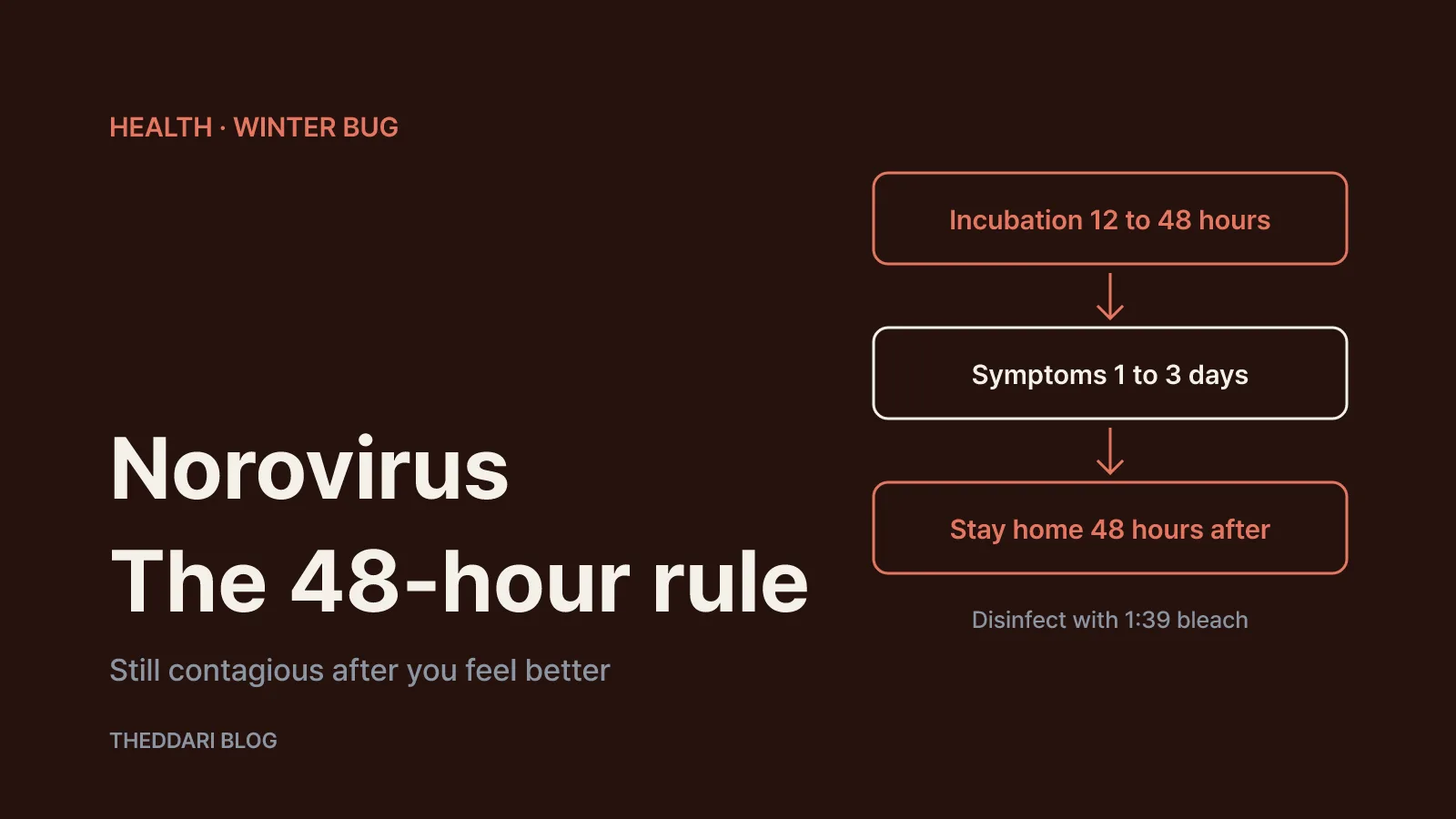
As of November 2026, the short answer from Korea's disease control agency (KDCA) and the U.S. CDC is the same: norovirus symptoms usually begin 12 to 48 hours after exposure and most people improve within one to three days, but you can still spread the virus for at least two days after symptoms stop. That is why the KDCA advises people to stay out of daycare, school and work for 48 hours after the last episode of vomiting or diarrhea. For cleanup, soap-and-water handwashing and chlorine bleach do the heavy lifting; alcohol hand sanitizer alone does not work well against this virus.
This guide is written for families living in Korea, where norovirus season runs from November through April, and it notes where U.S. guidance uses different numbers. According to the KDCA's national health information portal, viruses accounted for 54% of pathogens found in Korea's 2024 hospital surveillance of intestinal infections, and norovirus alone made up 29%.
Norovirus symptoms, incubation period and how long you stay contagious
The KDCA lists diarrhea, vomiting and stomach pain as the main symptoms. Nausea and upper-abdominal pain are common, and some people get a low fever lasting one to three days, a headache or body aches. Because the incubation period is 12 to 48 hours, the meal or contact that made you sick may be a day or two back, not last night's dinner.
The virus spreads through the fecal-oral route in three main ways: eating contaminated food or water (shellfish such as oysters and clams grown in contaminated water are a classic source), direct contact with a sick person, and touching surfaces soiled by vomit or stool and then touching your mouth. Droplets from vomiting can also spread it, so treat the whole area around a vomiting episode as contaminated.
The contagious window is longer than most people expect. The KDCA says infectiousness can remain for at least two days after symptoms disappear. The CDC's prevention guidance adds that the virus can show up in vomit or stool before you feel sick, and can stay in stool for two weeks or more after you feel better. Feeling well again is not the same as being non-infectious, so keep handwashing strict for a while after recovery.
Norovirus is especially stable at low temperatures (around 0 to 4°C) and survives well on dry surfaces, which, together with more time spent indoors, helps explain the winter peak. There is no norovirus vaccine; among the viruses that cause acute gastroenteritis in Korea, the KDCA notes that only rotavirus is vaccine-preventable.
Dehydration warning signs and when to see a doctor
There is no antiviral drug for norovirus, and antibiotics do not help. Treatment focuses on replacing the fluids and electrolytes lost through vomiting and diarrhea, so dehydration is the thing to watch. The KDCA lists five signs:
- Noticeably less urine than usual
- A very dry mouth and throat
- Dizziness when standing up
- Crying with few or no tears in children
- Unusual drowsiness, or an exaggerated reaction to stimulation
If these appear, start treating dehydration without delay. Adults 65 and older, young children and people with weakened immune systems are at higher risk, and the KDCA notes that severe diarrhea in children under five can occasionally become serious.
If the person can drink, oral rehydration solution (ORS) is the preferred way to replace fluids; in Korea, ORS powder is available at pharmacies with a prescription. Sports drinks and fruit juice can help with mild dehydration but may not replace lost minerals adequately. Avoid caffeine and alcohol, which can make dehydration worse. Small, frequent sips are easier to keep down than large amounts. Clear or severe dehydration needs intravenous fluids at a clinic or hospital. Once diarrhea eases, restart with bland food such as rice porridge. Blood in the stool is not typical of viral gastroenteritis, which the KDCA says usually shows no blood or white cells in stool, so get that checked.
How to clean up norovirus vomit and diarrhea with bleach
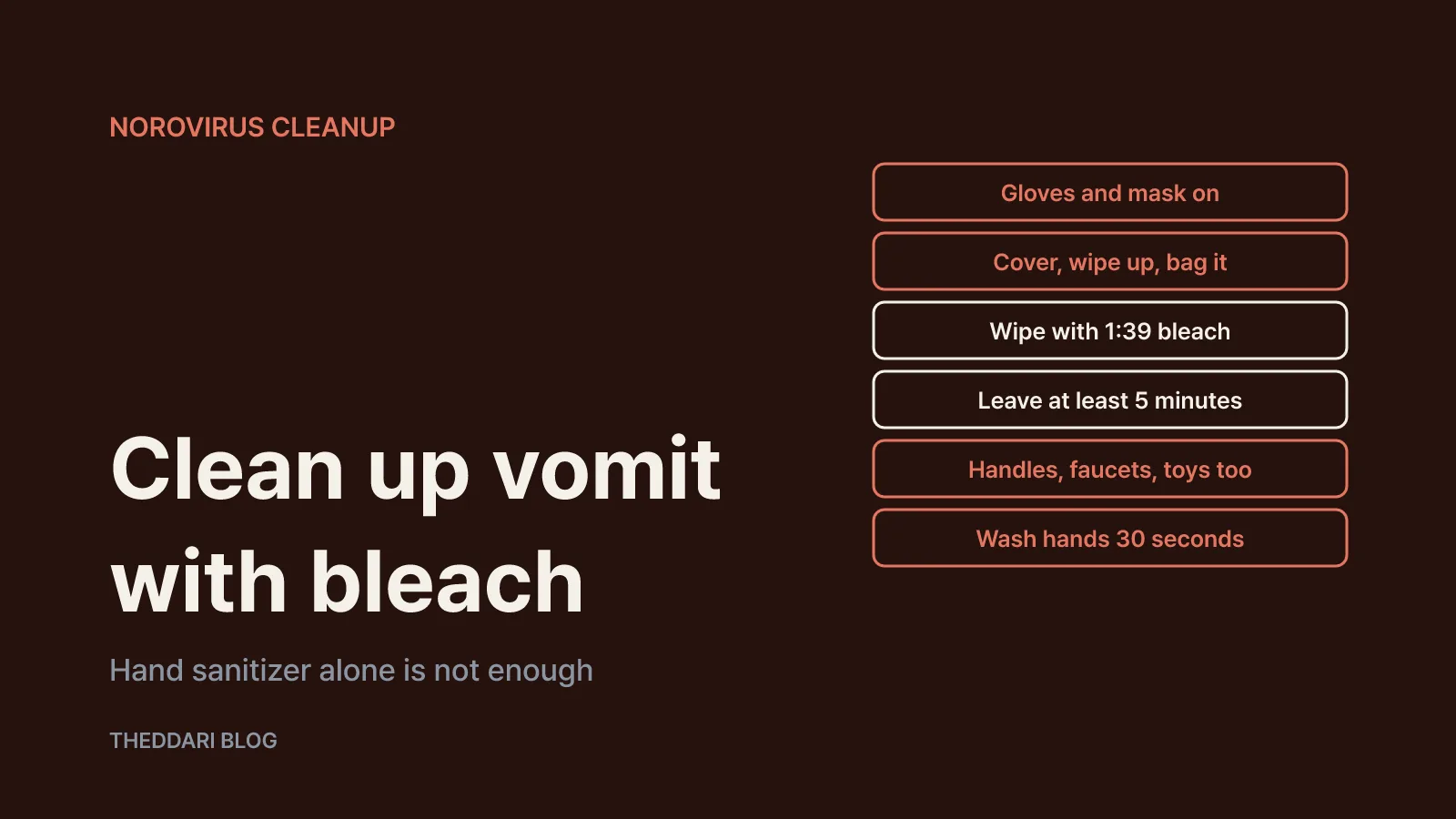
Korea's KDCA prevention and management rules call for disinfecting vomit, touched surfaces and used items with household bleach diluted 1 part bleach to 39 parts water. In practice that is 25 ml of bleach plus 975 ml of water to make one liter. The CDC expresses the target as a chlorine concentration of 1,000 to 5,000 ppm, which it describes as 5 to 25 tablespoons of household bleach (5% to 8%) per gallon of water, or an EPA-registered product labeled for norovirus. Check your product's label, because strengths vary.
- Protect yourself. Put on rubber or disposable gloves and a mask, and keep children and other family members out of the area.
- Remove the mess. Cover it with paper towels, wipe from the outside in, and seal everything in a plastic trash bag.
- Apply diluted bleach and wait. Wipe the area and its surroundings with the solution. Both the KDCA portal and the CDC say to leave it for at least five minutes before rinsing.
- Widen the zone. Wipe high-touch surfaces such as door handles, faucets, toilet flush levers and toys.
- Clean again and ventilate. The CDC recommends a final clean of the whole area with soap and hot water. Open a window.
- Wash your hands. The KDCA standard is soap and running water for at least 30 seconds; the CDC says at least 20 seconds.
For soiled clothes and bedding, remove them right away without shaking. The KDCA recommends washing at 70°C or higher, or rinsing in a 1:266 bleach solution for at least five minutes (roughly 15 ml of bleach in 4 liters of water). The CDC similarly advises hot water on the longest available cycle and drying at the highest heat setting. Dilute bleach only with water and never mix it with other cleaners.
The 48-hour rule for school, daycare and work
The KDCA's first rule when someone gets sick is to stay away from daycare, school and work for at least 48 hours after symptoms disappear. The clock starts at the last episode of vomiting or diarrhea, not at the first symptom. If the last bout was Monday night, the earliest return is Wednesday night.
Food handlers and caregivers need to be especially careful. The KDCA says people should not cook or handle food, or work in restaurants, schools, childcare centers or long-term care facilities, for at least two days after recovery. The CDC gives the same two-day (48-hour) minimum before preparing food or caring for others. At home, hand cooking duties to someone who has not been sick.
- Keep the sick person in a separate room and, if possible, a separate bathroom.
- Close the toilet lid before flushing to limit droplet spread.
- Use separate towels, and wash dishes with detergent and hot water.
- Disinfect all toys and items near where vomiting or diarrhea happened.
- Tell your child's daycare or school if they become ill so staff can watch other children and disinfect shared spaces.
Preventing norovirus from oysters and other winter foods
The KDCA advises cooking food to a core temperature of 85°C for at least one minute. Rinse oysters and clams under running water and cook them through; oysters labeled for cooking (가열조리용) must not be eaten raw. The CDC's U.S. guideline is an internal temperature of at least 145°F for shellfish, and it warns that quick steaming does not heat food enough and that contaminated food can look, smell and taste normal. Wash fruit and vegetables, drink boiled water when in doubt, sanitize knives and cutting boards, and keep separate tools for vegetables, meat and fish. With no vaccine available, handwashing, thorough cooking, proper bleach cleanup and the 48-hour pause are your best protection this winter.