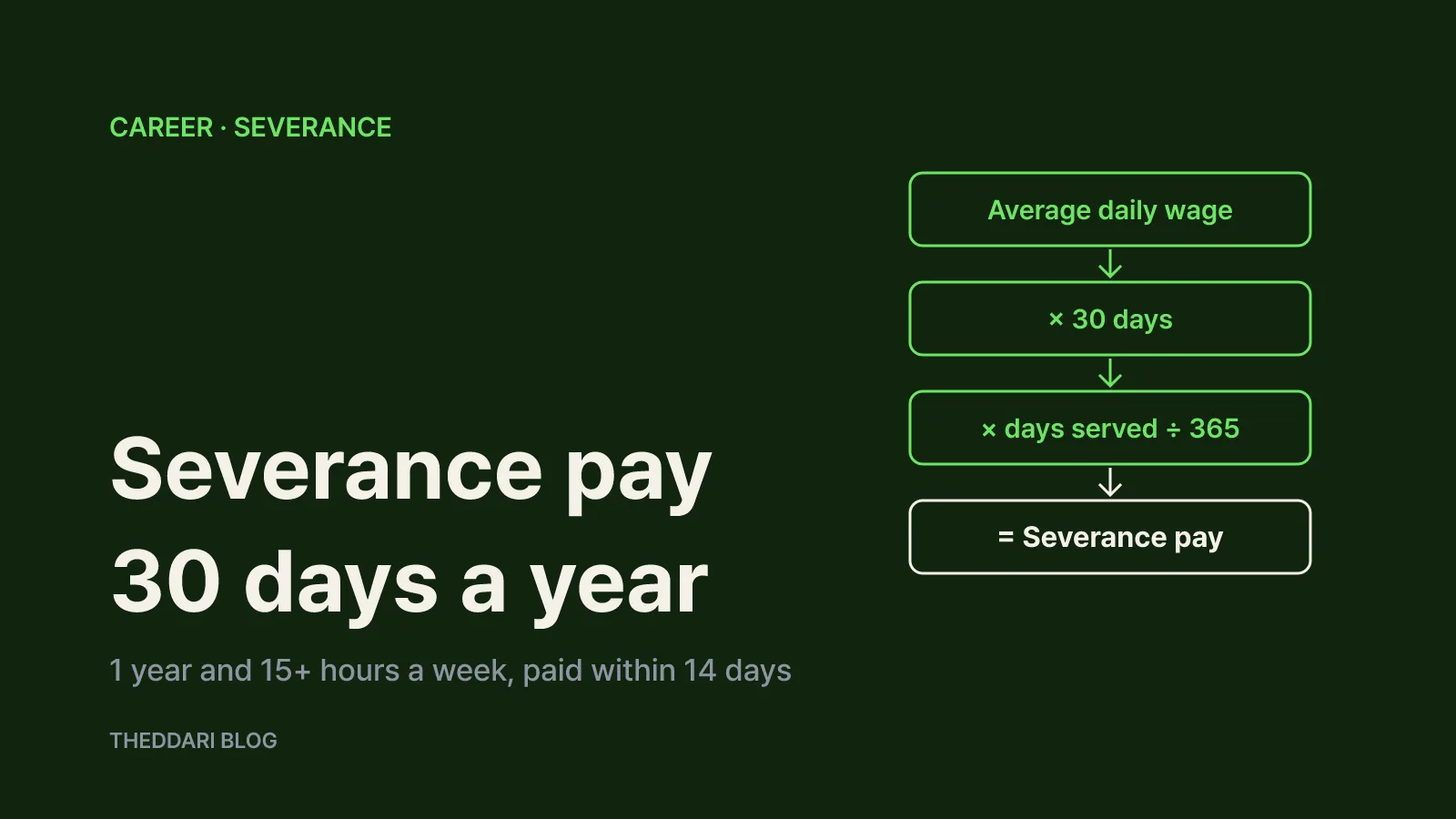
As of November 2026, an employee in South Korea is entitled to statutory severance pay (퇴직금, toejikgeum) after working for the same employer for at least 1 year, provided their scheduled working hours averaged 15 hours or more per week over each four-week period. The amount is average daily wage × 30 days × (days of service ÷ 365), and the employer must pay it within 14 days of the employee leaving. This guide follows Korean law as summarized by the Ministry of Government Legislation's Easy Law severance page and the worked example in the Ministry of Employment and Labor's official severance calculator. It applies to employment in Korea, not to severance practices in other countries.
Who qualifies: 1 year and 15 hours a week
Korea's Employee Retirement Benefit Security Act excludes two groups from retirement benefits: people with less than 1 year of continuous service, and people whose scheduled hours averaged under 15 per week across four weeks. If you are outside both exclusions, you qualify. Your job title matters less than these two tests, so contract workers and part-timers can qualify too (continuous service rules).
"Continuous service" runs from the day the employment contract starts until it ends. A few situations cause most of the confusion:
- Probation and internships count if you were working under the employer's direction. If an internship rolled straight into a permanent role with no gap, the two periods are added together.
- Renewed fixed-term contracts are combined. Courts have also treated short gaps between contracts as part of continuous service when there was a good reason tied to the nature of the work, such as school vacations or seasonal breaks.
- A contract ending on a holiday: for a contract running from January 2 to January 1 of the next year, where January 1 is a non-working day, the employment relationship still exists on that day. The leaving date becomes January 2 and severance is owed.
- Leave of absence approved by the employer counts. Personal leave, such as leave for overseas study, may be excluded if a collective agreement or the company's rules of employment say so.
- Hours that move above and below 15 a week: periods under 15 hours are removed, and the remaining periods are added up.
The formula and how to find your average daily wage
The legal minimum is 30 days' worth of average wages for every year of continuous service. A company may pay more under its own rules, but not less.
The average daily wage is the total wages paid in the three calendar months before the leaving date, divided by the number of calendar days in that period. The ministry's calculator asks you to enter the leaving date as the day after your last working day, and to use pre-tax figures.
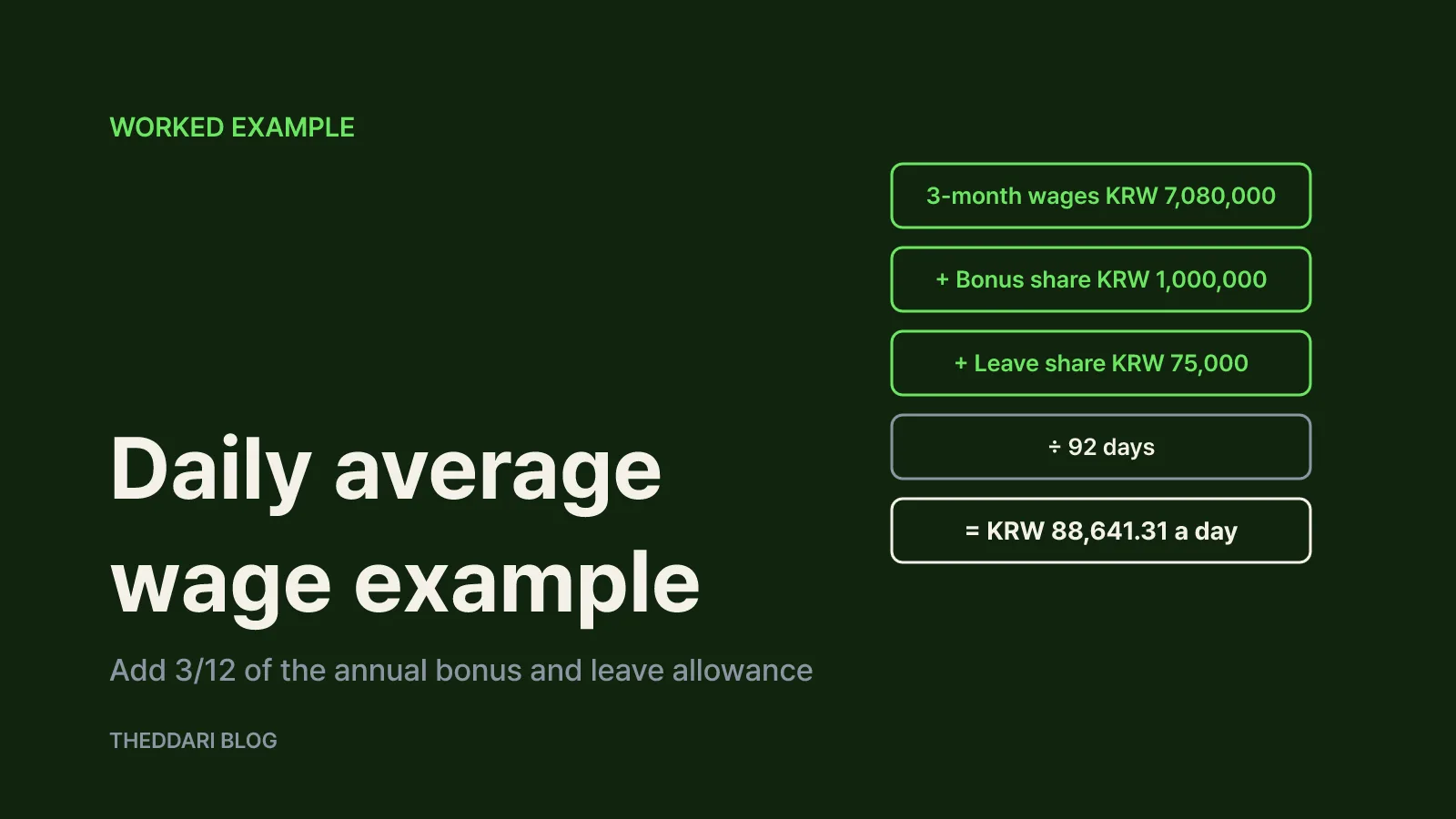
Bonuses and annual-leave allowances are easy to forget. The calculator adds 3/12 of the annual bonus total and 3/12 of the annual-leave allowance to the three-month wage total. Here is the ministry's own worked example:
← Swipe to see more
| Item | Example value |
|---|---|
| Days of service | 1,080 days |
| Monthly base pay / other allowances | KRW 2,000,000 / KRW 360,000 |
| Annual bonus total | KRW 4,000,000 |
| Annual-leave allowance | KRW 300,000 (KRW 60,000 × 5 days) |
| A. Wages for the last three months | KRW 7,080,000 |
| B. Bonus share (× 3/12) | KRW 1,000,000 |
| C. Leave allowance share (× 3/12) | KRW 75,000 |
| Calendar days in the period | 92 days |
| Average daily wage | KRW 88,641.31 |
The average daily wage is (7,080,000 + 1,000,000 + 75,000) ÷ 92 = KRW 88,641.31. Multiplying by 30 and by 1,080 ÷ 365 gives roughly KRW 7,868,434. That final figure is my own arithmetic using the same formula, and rounding can shift it by a few won.
Severance is taxed as retirement income, so the amount you receive is net of that tax. The ministry points to the National Tax Service's Hometax retirement income tax calculator for the tax side.
Periods removed from the average, and the ordinary-wage floor
If leave or a shutdown falls inside the final three months, the average could be artificially low. Korean labor rules therefore remove the following periods, and any pay received during them, from both the day count and the wage total:
- The first three months of probation
- Business shutdowns caused by the employer
- Maternity leave and miscarriage or stillbirth leave
- Time off to recover from a work-related injury or illness
- Parental leave, and periods of reduced hours for childcare
- Strikes, slowdowns and lockouts
- Leave for military service (unless wages were paid)
- Employer-approved leave for a non-work injury, illness or other reason
If the leave lasted more than three months, the first day of the leave is treated as the reference date and the three months before it are used instead. In the ministry calculator, these periods go into the "excluded period" field.
Finally, there is a floor. If the average wage comes out lower than your ordinary wage (the regular, fixed pay for your scheduled work), the ordinary wage is used instead. Check this if unpaid absences reduced your last three months of pay.
The 14-day deadline, IRP transfers and 20% late interest
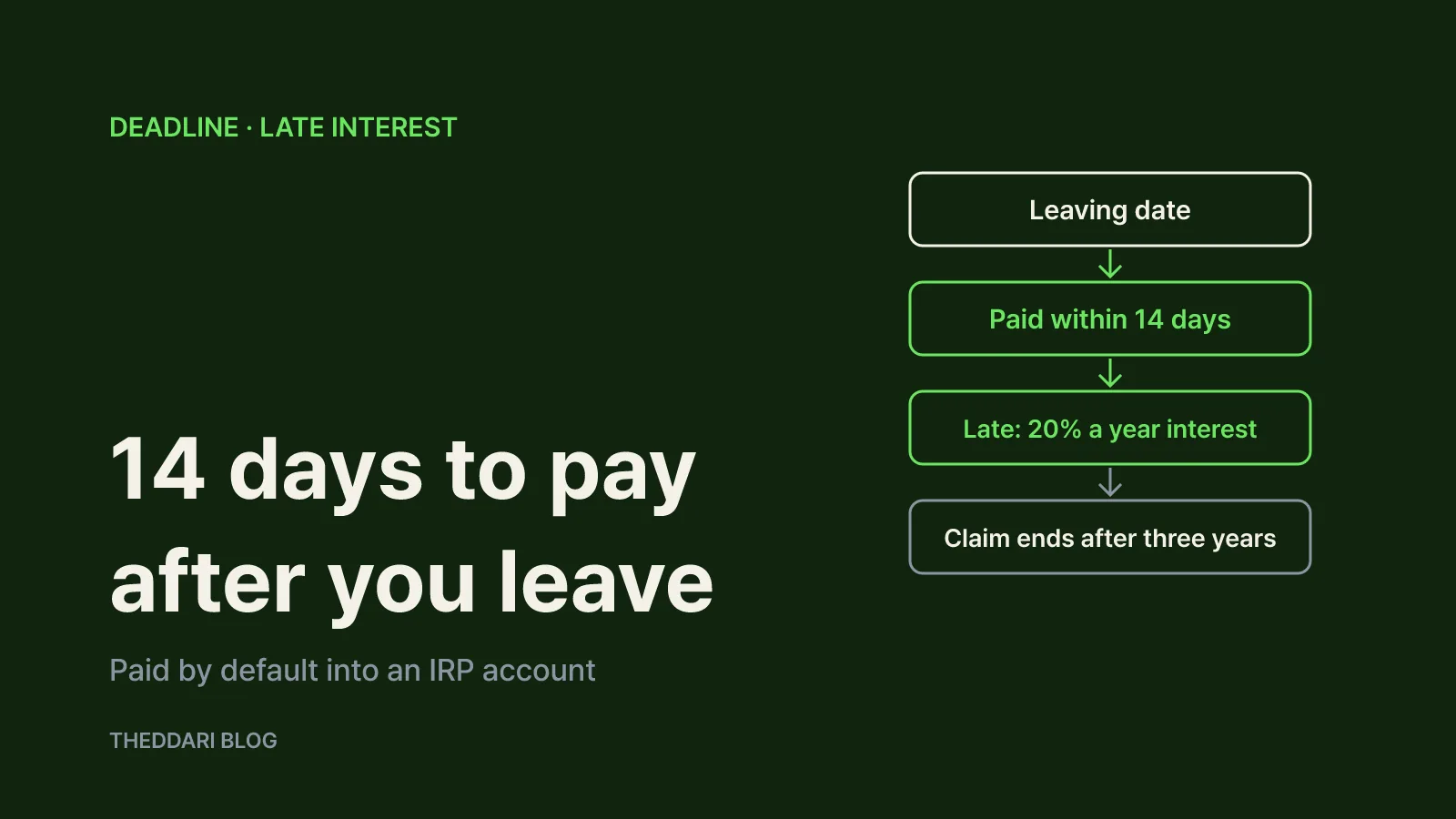
The employer must pay severance within 14 days of the employee leaving. The two parties may agree to extend this when there are special circumstances. Failing to pay without such an agreement can lead to up to three years in prison or a fine of up to KRW 30 million, although prosecution cannot proceed against the worker's expressed wishes.
Payment is normally made by transfer to an Individual Retirement Pension (IRP) account that you designate; if you do not name one, it goes to an IRP in your name. A direct payment is allowed when you leave at age 55 or older, when the amount is at or below a threshold set by the labor minister, when the worker has died, or when a foreign worker on a work-eligible visa leaves Korea after the job ends.
Late payment carries interest. After the 14-day window, the employer owes 20% a year on the unpaid amount until the day it is paid (late interest rules). A ministry interpretation states that agreeing to a later payment date does not by itself cancel this interest. Exceptions apply while specific situations continue, such as natural disasters, court rehabilitation or bankruptcy proceedings, or a genuine dispute before a court or labor commission.
Your claim also has a time limit: the right to severance expires after three years if it is not exercised, counted from the leaving date (claim period). A demand for payment, a seizure or provisional attachment, or the employer's acknowledgment of the debt interrupts the clock.
"Severance included in salary" clauses and a pre-exit checklist
Some contracts say severance is already built into the monthly salary. Korea's Supreme Court held in 2010 (case 2007Da90760) that such advance-payment agreements generally violate mandatory law and are void, so the employee can still claim severance on leaving. The same ruling, however, said money paid under the label of severance must be returned as unjust enrichment. Read your contract and payslips carefully before raising the issue.
Before you leave a job in Korea:
- Fix your dates. Confirm your start date and last working day; the leaving date is the day after.
- Collect pay records. Gather payslips for the last three months, the previous year's bonus total and any leave allowance paid.
- Mark excluded periods. Note any parental leave, maternity leave or employer-caused shutdown inside those three months.
- Run the numbers. Enter everything into the ministry calculator and compare it with the company's figure, including the ordinary-wage check.
- Open an IRP if needed. If you are under 55 and staying in Korea, tell the employer which IRP account to use.
- Watch the 14 days. If nothing arrives and no extension was agreed, request payment in writing, then consider filing a petition with the regional labor office.