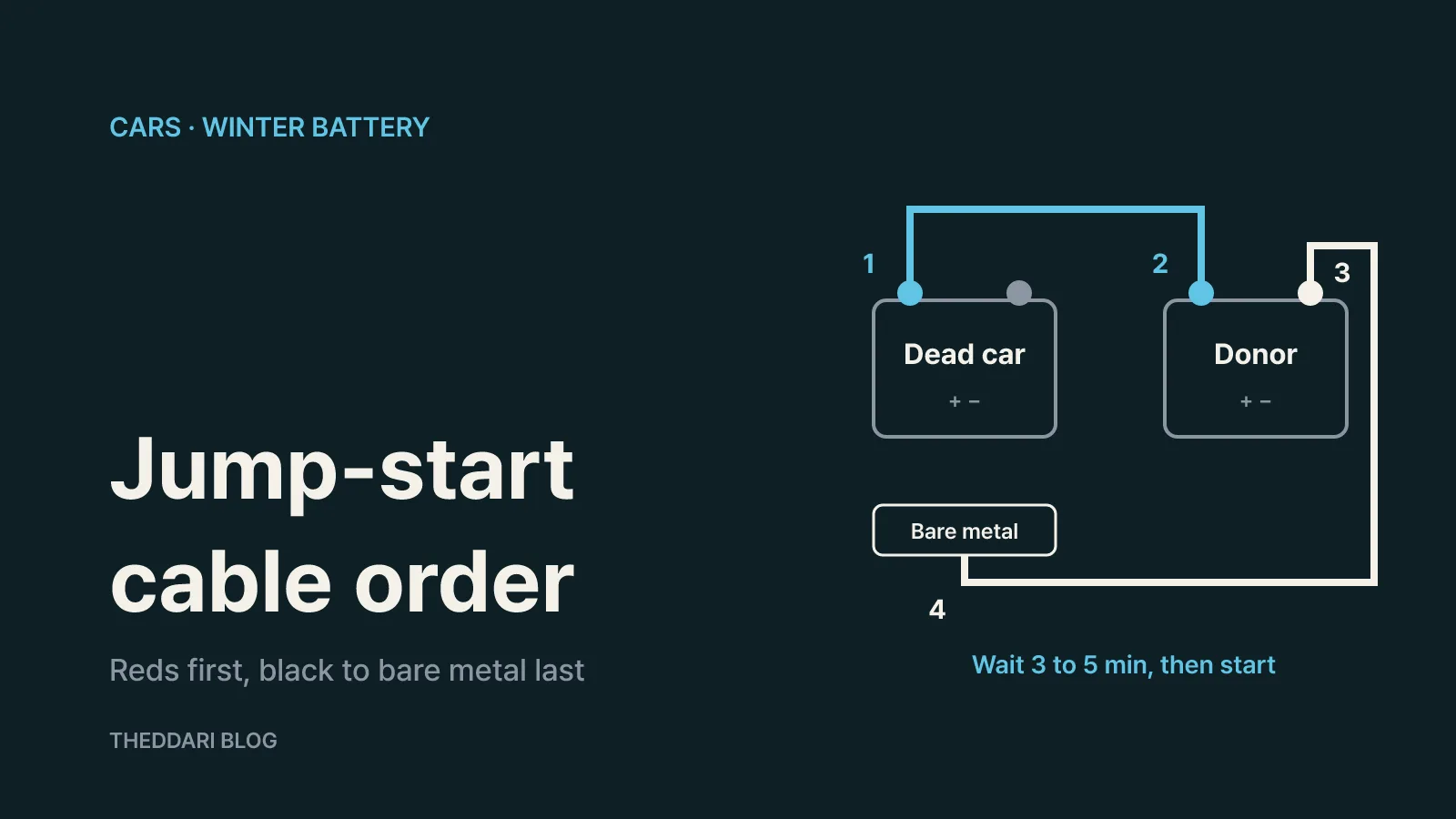
As of November 2026, the jumper cable order recommended by both AAA and Kia's 2026 Tasman owner's manual is the same: red clamp to the dead battery's positive (+), red clamp to the donor battery's positive (+), black clamp to the donor battery's negative (-), and the last black clamp to clean, unpainted metal on the dead car. Start the donor car first, let it run for 3 to 5 minutes, then try the dead car. Once it starts, remove the cables in exact reverse order and keep driving for 20 to 30 minutes so the alternator can recharge the battery.
The first cold snap of the season is when many drivers press the start button and hear nothing but a click. Rushing the cable order is how a five-minute fix turns into sparks or damaged electronics. Below is the full sequence: what to check before you start, how to connect and disconnect, how long to wait, and how to read a failed jump.
Before you jump: when not to try
A jump-start is simple, but a few checks come first. AAA and Kia's manuals agree on these points:
- Damaged battery: If the case is cracked, the sides are bulging, or there is a strong rotten-egg smell, do not jump it. AAA describes that smell as a warning sign of leaking sulfuric acid and potentially explosive hydrogen gas. The battery needs replacing.
- Frozen battery: Kia's manual warns that a frozen battery, or one low on electrolyte, can rupture or explode during a jump-start. After several days of hard frost, check this before anything else.
- Voltage: Both vehicles must use 12-volt batteries. AAA notes that connecting a 24-volt commercial truck system to a car can cause immediate, expensive damage.
- Vehicle setup: Turn both ignitions completely off, put both cars in park (or neutral) and set the parking brakes. Switch off headlights, heater fan and audio on the dead car.
- Jewelry: Remove rings and watches. A tool bridging the positive terminal and a metal ring can cause a severe burn or a short circuit.
- Protection: Wear safety glasses and gloves. Battery electrolyte contains dilute sulfuric acid; Kia advises rinsing skin or eyes with clean water for about 15 minutes and then seeing a doctor.
Location matters too. AAA advises against jumping a car on a busy highway without room to work clear of traffic, or when darkness or fog limits visibility. In those cases, call roadside assistance instead.
Jumper cable order: two reds first, black to bare metal last
Park the cars close enough for the cables to reach, but leave a few inches between the bodies. Open both hoods and locate the terminals before you begin. Then connect in this order:
- Red clamp 1 to the positive (+) terminal of the dead battery
- Red clamp 2 to the positive (+) terminal of the donor battery
- Black clamp 3 to the negative (-) terminal of the donor battery
- Black clamp 4 to clean, unpainted, solid metal on the dead car, such as a thick bolt on the engine block
The last step is the one people get wrong. Completing the circuit can create a small spark, and a battery can vent explosive gas. Grounding the final clamp away from the battery keeps that spark away from any fumes. Kia's manual states plainly that connecting the negative cable directly to the dead battery risks an explosion.
Before starting anything, check that the cables are not draped over belts or cooling fans, which can begin moving the moment an engine starts. Keep the red and black clamps from touching each other at all times.
Cable quality also matters. AAA says cheap, thin cables are a frequent point of failure, especially in below-freezing weather or with larger V6 and V8 engines, and recommends a heavy-duty set of six-gauge, 16-foot cables. Frayed insulation or corrosion inside the clamps will limit how much current gets through.
Start the donor car and wait
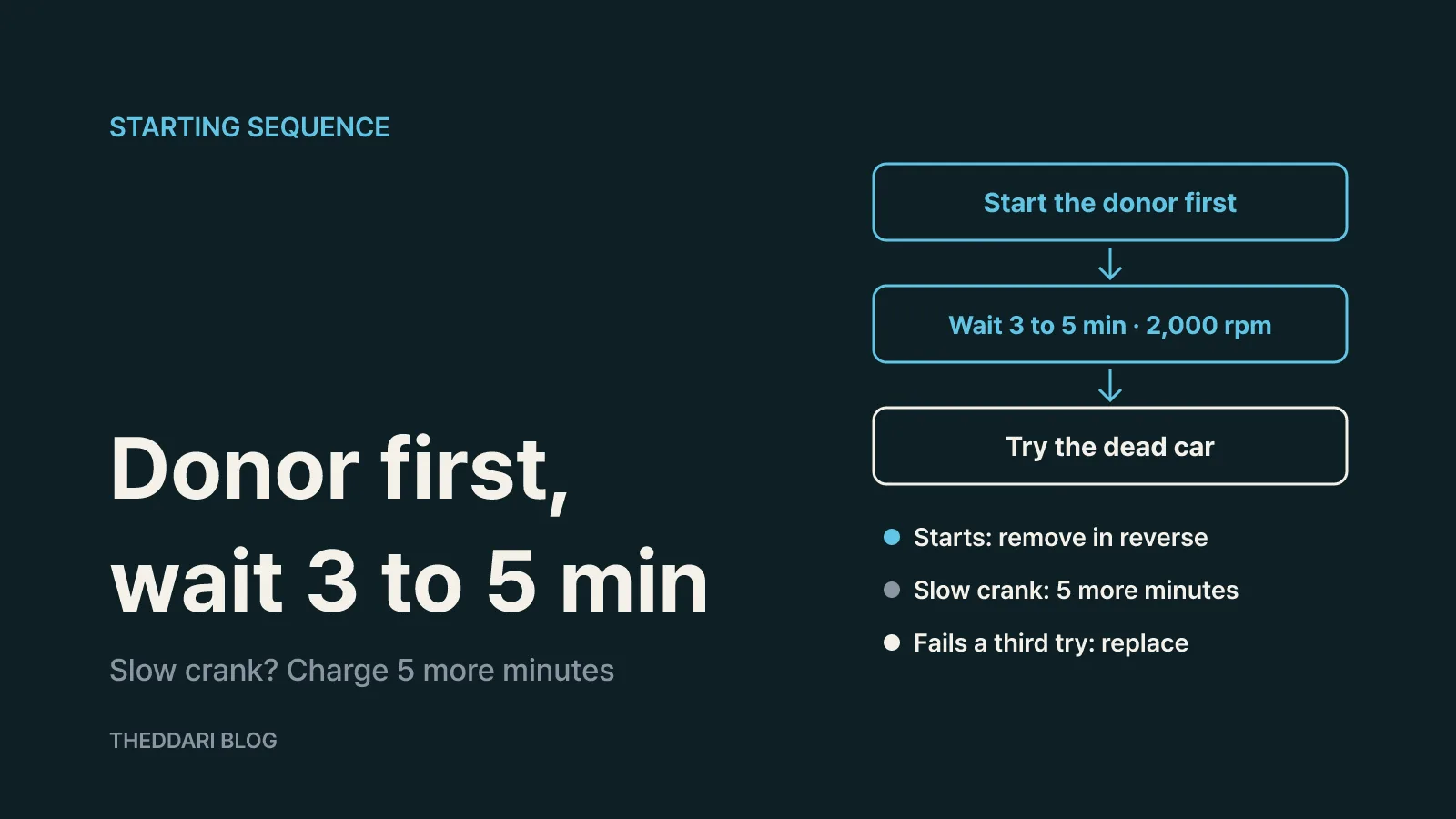
With everything connected, start the donor car first. Its alternator does the real work, sending current through the cables to the dead battery. AAA recommends giving it 3 to 5 minutes before you try the dead car. Kia's Tasman manual says to hold the donor engine at about 2,000 rpm or higher for a few minutes. Revving slightly above idle helps the alternator charge faster, which is useful on a cold morning.
Then try the dead car. You will usually see one of three outcomes:
- Starts right away: The jump worked. Move on to disconnecting and driving.
- Slow, struggling crank: That is progress. Stop cranking, let the donor charge for another 5 minutes, then make one more attempt.
- Still dead after a third try: AAA says the battery has likely failed completely and needs replacing.
The whole process normally takes 10 to 15 minutes, including the initial 3-to-5-minute charge. Avoid long, repeated cranking; pausing to charge between attempts is easier on the starter and the battery.
After it starts: disconnect in reverse and drive 20 to 30 minutes
Do not pull the cables the instant the engine catches. AAA suggests leaving both cars running and connected for another 3 to 5 minutes to let the electrical system settle. Then remove the clamps in the exact reverse order:
- Black clamp from the ground point on the jumped car
- Black clamp from the donor's negative terminal
- Red clamp from the donor's positive terminal
- Red clamp from the jumped car's positive terminal
Hold the loose clamps apart so they cannot touch each other or the bodywork.
A successful jump does not mean a charged battery. AAA says a continuous drive of 20 to 30 minutes is usually enough, and recommends keeping high-load items such as the air conditioner and rear defroster off during that drive. Kia's manual also says not to switch the engine off for a while after a jump, and warns that the car may not restart depending on how long it ran and how deeply the battery was drained.
Idling in a parking lot for a few minutes is rarely enough. If your battery is more than three years old or has been struggling, AAA says it may not hold a charge overnight, so the smart move is to drive straight to a shop for a proper battery test.
Jump didn't work? Diagnose by sound
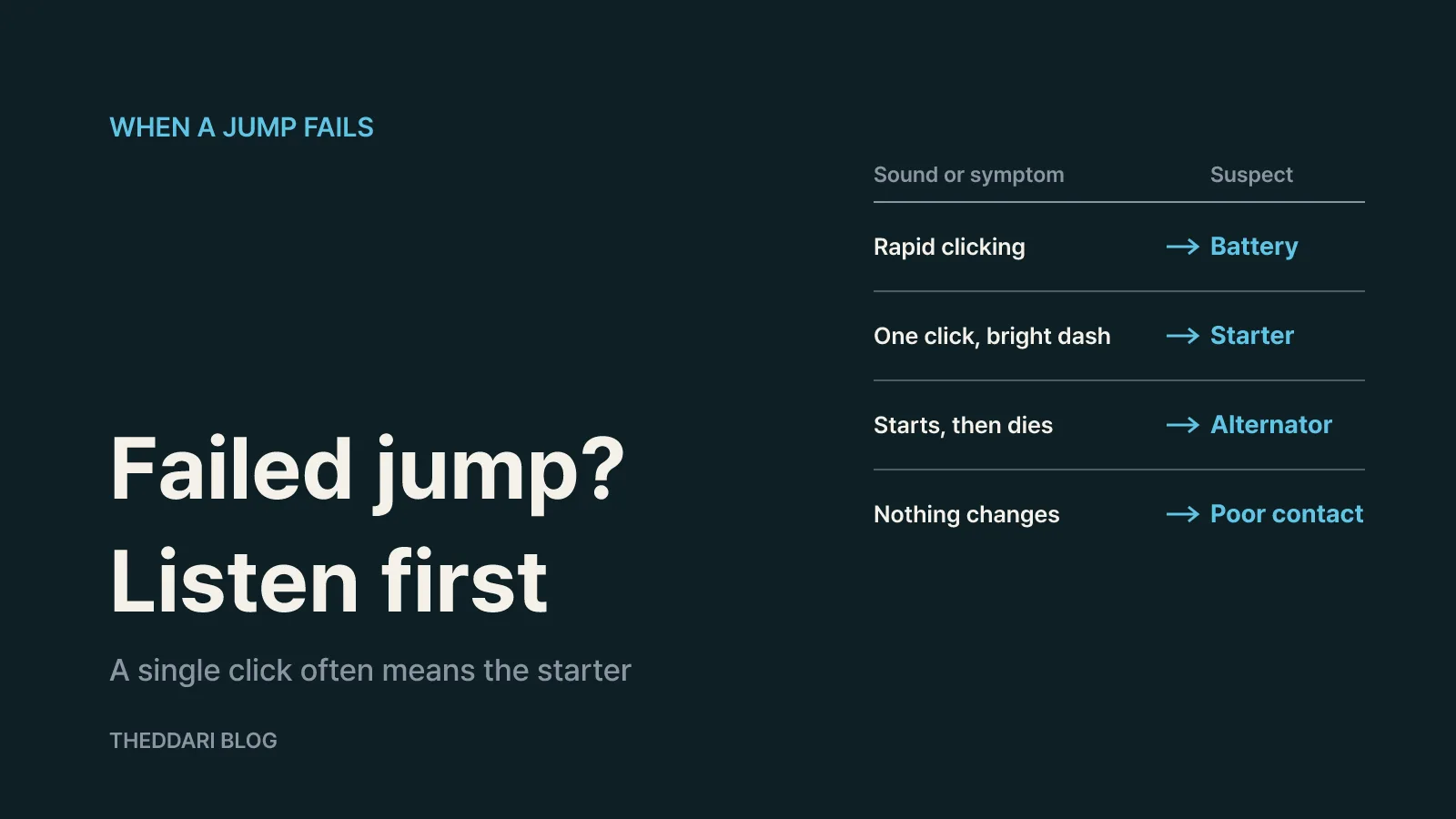
When a jump fails, the noise the car makes tells you a lot. Based on AAA's troubleshooting guidance:
- Rapid clicking: Usually a battery problem. Give it more charging time and recheck the connections.
- A single click with bright dashboard lights: Points to a failing starter motor rather than the battery. Jumping will not fix it; it needs a mechanic.
- Starts with a jump, then dies after a short drive: A classic sign the alternator is not recharging the battery.
- Nothing changes at all: The most common cause is a poor connection. Even a thin layer of whitish-blue corrosion on the terminals can block current. Disconnect safely, scrub the posts with a wire brush and try again.
A battery with a shorted internal cell, or one that is simply too old, cannot store energy no matter how much current you send. If these checks do not solve it, stop guessing and call for professional help. Kia's manual likewise advises a dealer inspection when the cause of the discharge is unclear.
Hybrids, EVs and cars with remote jump terminals
Newer vehicles add a few twists:
- Do not use a hybrid as the donor: Kia's manual warns against jump-starting with a hybrid vehicle because it can damage the hybrid's lithium-ion auxiliary battery. AAA adds that most hybrid and electric vehicles have complex electronics that can be destroyed by jump-starting another car.
- Dedicated jump terminals: The Kia Tasman has separate charging terminals on the passenger side of the engine bay, and its manual says not to clamp onto the 12-volt battery terminals directly. On vehicles like this, follow the numbered (+) and (-) terminals in the manual's diagram, and remove the negative clamp first when disconnecting.
- EVs still have a 12-volt battery: An electric vehicle can be stranded by a flat 12-volt battery too. Kia's manual for its SW1K electric van line lists the same connection order and warnings.
The most reliable step is to look up the "jump-starting" section of your own owner's manual before you clamp anything. Many manufacturers publish model-year manuals online, so you can check from your phone.
Prepare before winter
Knowing the order helps, but avoiding the dead battery in the first place is easier:
- Check the battery's age: AAA puts typical battery life at three to five years and suggests testing once a battery passes three years. Do it before the first hard freeze.
- Know the spec: Your owner's manual lists the exact battery group size and Cold Cranking Amps (CCA) your car needs.
- Clean the terminals: Corrosion is a common reason jumps fail. If you see whitish-blue powder, have the terminals cleaned.
- Pack a kit: Keep heavy-duty jumper cables, gloves and safety glasses in the trunk.
- Shut things off: Before you leave the car, make sure lights and accessories are off.
In short: two reds first, black to bare metal on the dead car last, wait 3 to 5 minutes, disconnect in reverse, then drive 20 to 30 minutes. Remember those four steps and a cold-morning dead battery becomes a short delay rather than a crisis.