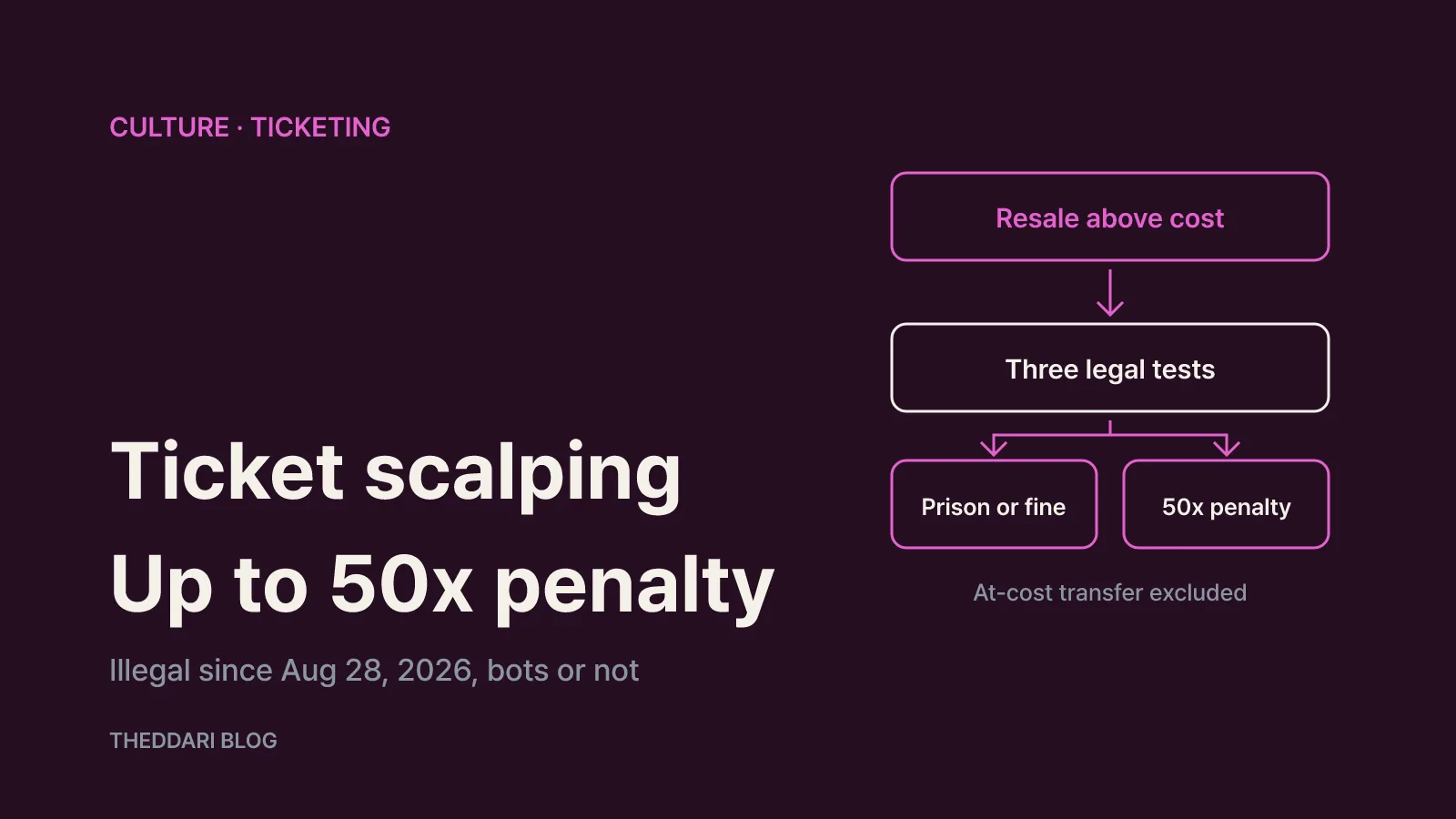
As of November 2026, reselling a Korean concert, musical or professional sports ticket for more than you paid, habitually or as a business, is illegal whether or not you used a booking bot. Amended versions of Korea's Performance Act and National Sports Promotion Act took effect on August 28, 2026. People found guilty of unfair purchasing or unfair resale face up to one year in prison or a fine of up to 10 million won, and resellers can separately be hit with an administrative penalty of up to 50 times their sales (Korea.kr policy briefing). On the other hand, a fan who passes on a single ticket at or below the price they paid does not meet the legal definition of unfair resale. With year-end concert season under way, here is how the rules work for buyers, sellers and anyone who wants to report a tout.
What changed on August 28, 2026
The earlier rules only banned reselling tickets that had been bought with a macro program. Korea added macro-scalping bans to the Performance Act in March 2024 and to the sports law in September 2024, but enforcement depended on proving that a bot was used (Lawl Law Firm legal note). In-person touting outside venues was already covered by the 1973 Minor Offenses Act, with fines of up to 200,000 won, but that law could not reach online listings.
The amendments promulgated in February 2026 close that gap by banning two separate acts:
- Unfair purchasing: buying tickets from the original seller for the purpose of resale by technically bypassing security measures or otherwise circumventing or disrupting the fair purchase process
- Unfair resale: selling or brokering tickets, without the consent of the ticket seller, habitually or as a business, at a price above what you paid
Neither definition mentions macros. A ticket booked by hand can still fall under the law if the conditions are met. The amendments also introduced administrative penalties, whistleblower rewards and confiscation of profits, and put duties on ticketing sites and resale or secondhand platforms. According to Etoday's report, platforms must verify buyers' identities for online sales, run a reporting function for suspicious listings and restrict the visibility of listings flagged by the designated reporting bodies or investigators.
The public response was immediate. The Ministry of Culture, Sports and Tourism says more than 68,000 reports came in between the effective date and October 1, roughly 2,000 a day and 17 times the previous year's rate. Of about 45,000 valid reports, 30,000 led to listings being hidden in cooperation with platforms (Korea.kr).
The three conditions for unfair resale, and why face-value transfers differ
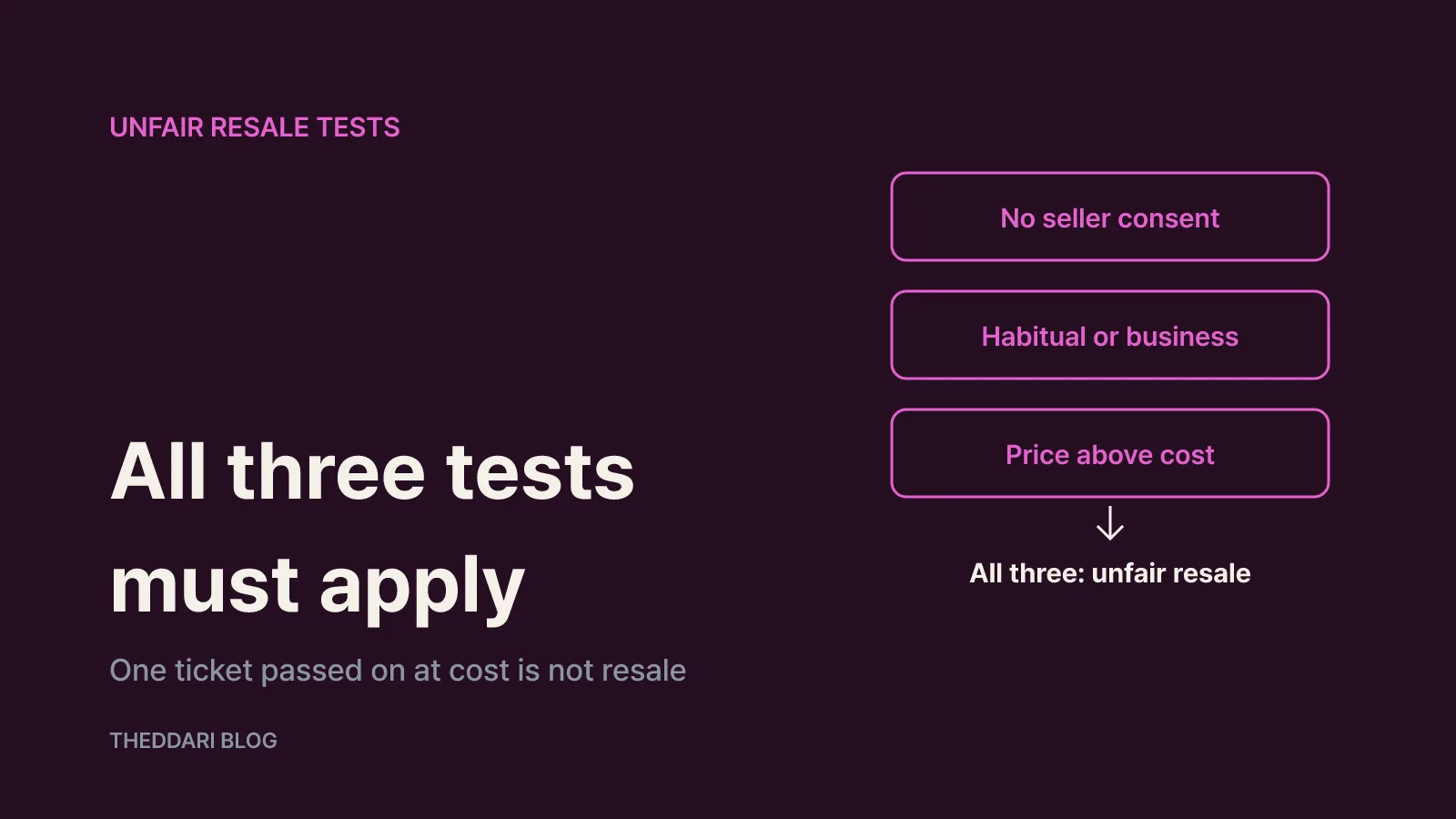
The question most fans ask is simple: if I can't go, can I sell my ticket? Unfair resale requires all three of the following:
- No seller consent: the sale happens outside any official transfer or resale channel allowed by the ticketing site or promoter
- Habitual or business activity: repeated selling, or selling to make money
- A price above your cost: you charge more than you actually paid
Passing on one ticket at cost or below fails the third condition. The government's Q&A states that the law only regulates habitual or business sales above the purchase price, so ordinary audience members are unlikely to become offenders. Neither law contains a provision punishing people who buy from scalpers (Lawl Law Firm).
There are still a few traps worth knowing:
- A single sale is not automatically safe. Whether one resale counts as habitual or business activity can be contested. The enforcement decree also allows a penalty of up to five times the sale amount for a single ticket where the minister designates such cases by public notice.
- Relabeling the markup does not help. Selling at face value but charging a separate "service fee", "booking fee" or an overpriced merchandise bundle is what the ministry calls a variant sale. After legal advice, including from the Ministry of Government Legislation, it says such deals are judged by their substance, and four variant sellers were among the first people referred to police in October.
- Ticketing terms are separate from the law. Even a lawful face-value transfer can get a ticket cancelled or entry refused if the ticketing site restricts transfers. Official transfer features, or cancelling and letting the seat return to sale, are the safest options.
Unfair purchasing is complete at the moment of buying. Besides bots, using other people's accounts or dodging per-person purchase limits to collect tickets for resale can qualify. Booking normally to attend yourself is not unfair purchasing, because there is no resale purpose.
Penalties: prison or fines, a 2x to 50x surcharge, and confiscation
Sanctions come in three layers that can be imposed independently:
← Swipe to see more
| Sanction | Who | Scope |
|---|---|---|
| Criminal penalty | Unfair buyers and resellers | Up to 1 year in prison or a fine of up to 10 million won |
| Administrative penalty | Unfair resellers | 2x to 50x the sale amount, scaled by tickets and value under the decree |
| Confiscation | Unfair buyers and resellers | Profits confiscated, or their value collected if confiscation is impossible |
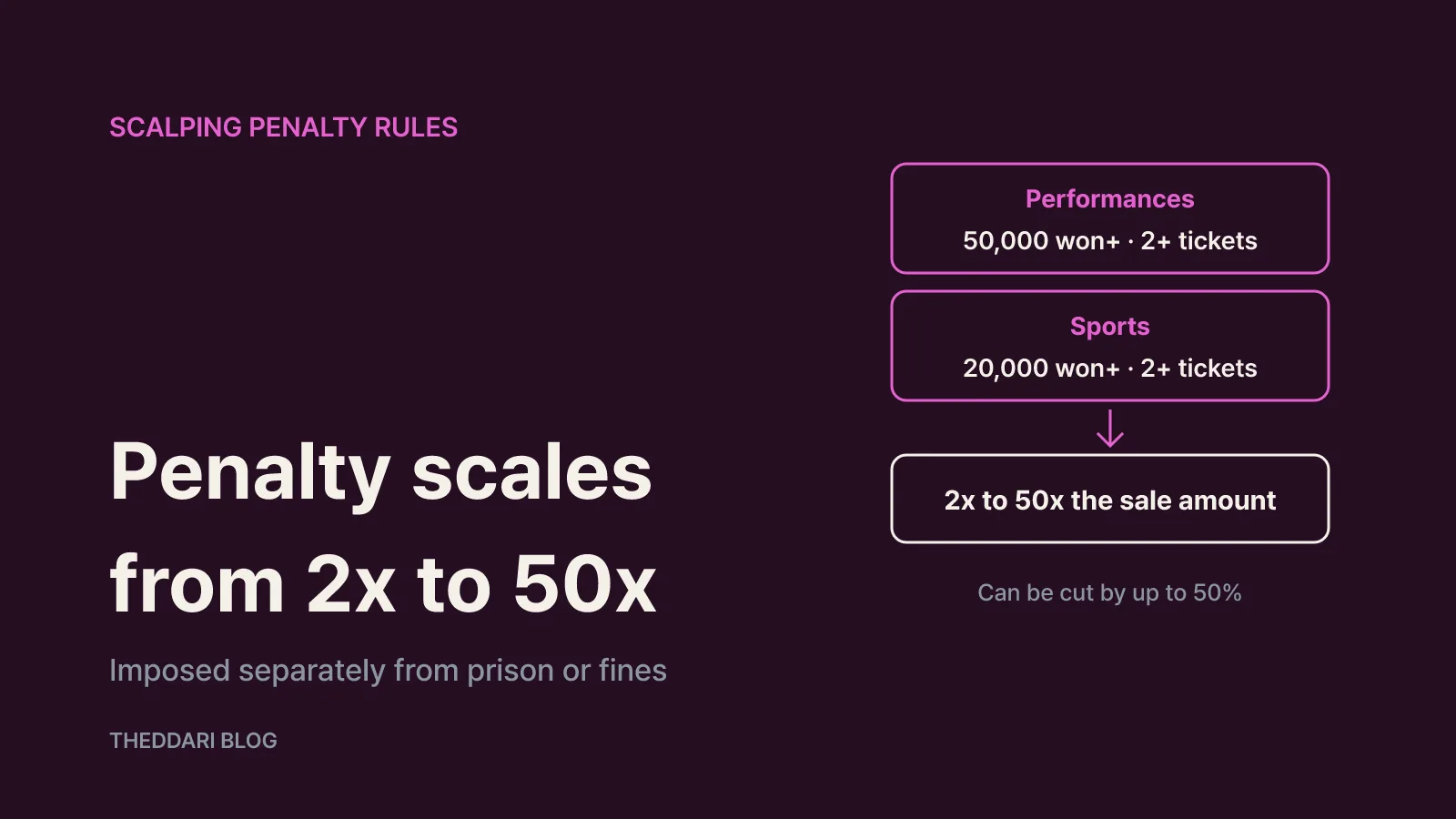
The decree also sets a starting threshold. Per Etoday, penalties apply to unfair resale of performance tickets totaling 50,000 won or more across two or more tickets, and sports tickets totaling 20,000 won or more across two or more tickets. The multiplier rises with the sale amount and number of tickets, up to 50x. It can be cut by up to 50% where the gain was minor or the seller cooperated fully with the investigation.
Because the surcharge is administrative and the prison term or fine is criminal, one does not cancel the other. Anyone who used bots or borrowed accounts to get around a booking system may also face a computer-related obstruction of business charge under the Criminal Act, which carries up to five years in prison or a fine of up to 15 million won (Lawl Law Firm).
Enforcement is already under way. On October 6 the ministry made its first referral under the new law, sending 170 suspects to investigators: 121 in pro sports and 49 in performances. Their listings covered an estimated 11,000 tickets worth 1.03 billion won, and 115 of them (68%) were reported over posts on the resale platform TicketBay. One person had offered more than 1,000 tickets across several listings (Korea.kr).
Movie tickets and accommodation are outside this law
The amended laws cover admission, viewing, discount and exchange tickets for performances and sporting events. The government's Q&A says K-pop concerts and pro baseball games are covered, while movie tickets and accommodation vouchers are not. Performances include music, dance, theater, musicals and traditional Korean music.
Film is on a separate track. Etoday reports that the Korean Film Council accepts reports about movie scalping on an ongoing basis, and that the ministry plans to amend the film promotion law to tackle scalping, particularly for premium-format screens. Touting tickets in person at stations or venues still falls under the Minor Offenses Act.
Timing matters too. Macro-based scalping can be reported even if it happened before August 28, 2026, but unfair purchasing or resale without a macro is generally reportable only for transactions after that date. Rewards can only be paid for reports filed after the law took effect.
How to report scalping and claim a reward
Reports are accepted online only, through the performance and sports scalping reporting portal. The handling agency depends on the category, so pick the right one first:
- Performances: Korea Creative Content Agency, inquiries at 1533-1329
- Sports: Korea Sports Promotion Foundation, inquiries at 02-410-1913
Before filing, save evidence of the markup: the listing itself, contact or payment details the seller gave, and any messages you exchanged. A full-screen capture that shows the posting time and site address makes it easier to explain what happened if the listing is later deleted. Depending on the case, a report can lead to data requests to platforms, information being passed to investigators, or a notice to hide the listing.
Rewards can reach 50 million won for reporting unfair purchasing, and up to 50% of the penalty imposed for reporting unfair resale. The law says rewards "may" be paid, so filing a report does not guarantee money, and a resale reward depends on a penalty actually being imposed.
Year-end concert checklist for fans
Demand for year-end concerts and musicals is intense, and resale listings multiply. Whether you are buying or passing a ticket on, run through this list:
- If you need to give up a ticket: check the official transfer feature or cancel and rebook first. If you transfer directly, charge no more than you paid and add no fee-style markup.
- If you are thinking of buying resale: buyers are not punished, but fake or double-sold tickets are hard to recover money from, and tickets identified as unfairly traded may be cancelled under the ticketing site's terms.
- If you spot a repeat seller: someone listing many shows above face value can be reported through the portal with screenshots.
- If the cancellation fee stings: an official cancellation is often the safer route than an informal resale. Check the ticketing site's fee schedule by deadline.
In short, Korean law treats a one-off face-value handover very differently from habitual resale at a markup. Remember the three tests, seller consent, habitual or business activity, and a price above cost, and you can tell which side of the line a deal falls on.