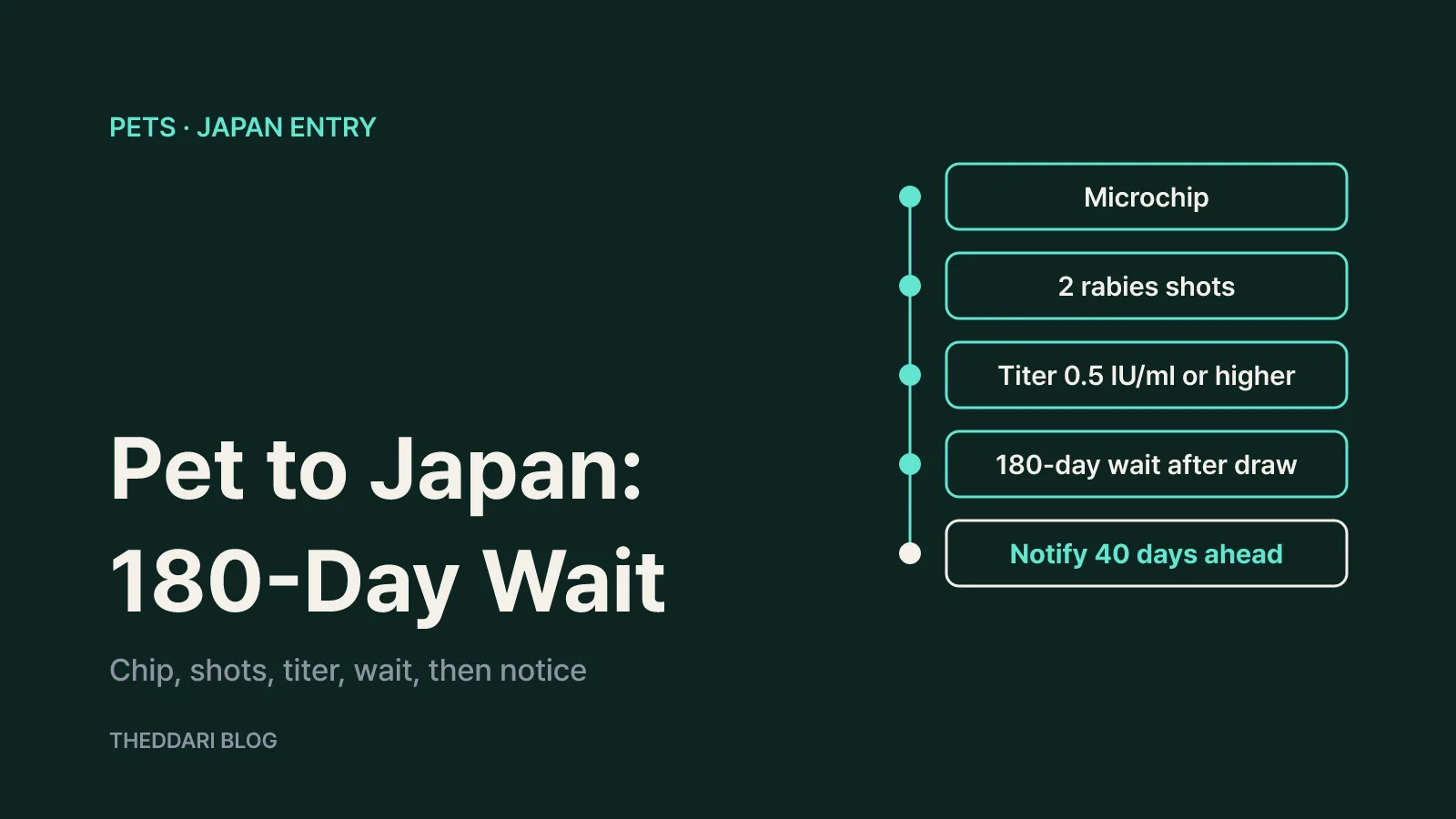
As of November 2026, bringing a dog or cat into Japan from a country Japan has not designated as rabies-free, which includes South Korea, the United States and most of the world, means completing six steps in a fixed order: microchip, at least two rabies vaccinations, a rabies antibody (titer) test of 0.5 IU/ml or higher, a 180-day wait from the blood draw, advance notification at least 40 days before arrival, and a vet inspection plus government health certificate within 10 days of departure. Starting from scratch, the minimum is roughly 210 days from the first vaccination to arrival. Miss a step and your pet can be held in quarantine at the airport for up to 180 days or sent back. This guide follows Japan's Animal Quarantine Service (AQS) rules for non-designated regions and its official FAQ, with the South Korean export steps added for readers leaving from Korea.
The five entry conditions for non-designated regions
Japan only treats six places as designated regions: Iceland, Australia, New Zealand, the Fiji Islands, Hawaii and Guam. Every other origin falls under the stricter non-designated procedure. It does not matter whether your pet flies in the cabin, as checked baggage or as cargo; the AQS FAQ states that quarantine procedures are the same regardless of transport mode.
1. Microchip. The chip must meet ISO 11784 and 11785 (a 15-digit, numbers-only code) and must be implanted before, or on the same day as, the first rabies shot. If your pet already has a registration chip, confirm it is ISO-compliant and that a standard clinic reader picks it up. AQS currently does not accept numbers starting with 900 202, and it has flagged cases where different animals received the same number among some chips starting with 900, so contact the quarantine office at your arrival airport as soon as your travel timing is set.
2. Two or more rabies vaccinations. The first shot must be given at 91 days of age or older (birth date counts as day 0) and after the microchip. Some countries vaccinate from 12 weeks, but under Japanese rules a shot given before day 91 is invalid. The second shot must come at least 30 days after the first and within the first shot's duration of immunity. Only inactivated (killed) or recombinant vaccines are accepted; live and RNA rabies vaccines are not. The effective period here means how long immunity lasts, not the expiry date printed on the vial.
3. Rabies antibody test. Blood must be drawn after the second shot (the same day is allowed) and tested at a laboratory designated by Japan's Ministry of Agriculture, Forestry and Fisheries. The titer must be at least 0.5 IU/ml, and the result is valid for two years from the blood draw. The owner pays for the test. Errors in the microchip number, sampling date or titer cannot be corrected on the issued report, even by the vet; you would need to ask the lab for a reissue.
4. The 180-day wait. Your pet may arrive only after 180 days have passed since the blood draw, counting the draw date as day 0. The arrival date must also fall within the vaccine's immunity period and the two-year validity of the titer result. Japan sets 180 days because it matches the rabies incubation period.
5. Advance notification. Notify the AQS office at your planned port of entry at least 40 days before arrival, online through NACCS or by emailing the notification form. Once reviewed, AQS issues an approval for import inspection; save or print it, because airlines and your home country's quarantine office may ask to see it. Notifications filed later than 40 days out are, in principle, not accepted.
Working out your earliest arrival date

The fastest possible schedule pairs the microchip with the first shot, then pairs the second shot with the blood draw. For a pet older than 91 days that starts on November 11, 2026, the dates look like this:
- November 11, 2026 (day 0): microchip and first rabies vaccination
- December 11, 2026 (day 30): second vaccination and titer blood draw
- By April 30, 2027: file advance notification (40 days before arrival)
- Within 10 days of departure: vet clinical inspection and government health certificate
- June 9, 2027 or later: earliest arrival in Japan (day 180 counted from the blood draw)
That is about seven months end to end. It also sets a minimum age: 91 + 30 + 180 days means a pet must be at least 301 days old, roughly ten months, before it can enter Japan without detention.
Build in a buffer. If the titer comes back below 0.5 IU/ml, your pet must be retested, and the 180 days restart from the date of the blood draw that actually passes. The AQS FAQ advises talking to your vet about whether to wait and retest or give an additional shot first. It is safer to have the passing lab report in hand before you book flights.
You can file the notification before your flight is fixed by entering an estimated flight or 'to be determined', then updating it. However, AQS will not accept changes that move the arrival date earlier, add animals, swap in a different animal or alter anything after the scheduled arrival date, so choose a realistic date.
If your pet is already vaccinated
Adult dogs and cats that receive regular rabies boosters may not need to start over. Three things must all be true: the vaccinations were given after the microchip, there are at least two of them, and each booster was given before the previous one's immunity expired, with no gap at all. If so, you can go straight to the blood draw and start the 180-day count from that day.
A booster given after the previous immunity lapsed does not count as an additional vaccination, and you must restart from the first shot. Vaccinations given before the microchip are invalid in principle. AQS does describe an exception under specific conditions, but it asks owners to contact it in advance before relying on it.
Collect paperwork early. The export certificate has to list each vaccination date, effective period, vaccine type, product name and manufacturer. If your clinic records are missing a product name, that is much easier to fix months ahead than days before departure.
If an earlier titer result has passed its two-year validity, you may not need another 180-day wait. AQS says a new test is enough as long as immunity has been continuous since the first vaccination, the new blood draw is at least 180 days after the first one, and the new titer is 0.5 IU/ml or higher. A single day of lapsed immunity voids the earlier results.
The last 10 days: vet inspection and health certificate
Within 10 days before boarding, a veterinarian must examine your pet and confirm no clinical signs of rabies; dogs are also checked for leptospirosis. Japan recommends its Form AC, which covers identity details, microchip number and implant date, vaccination details, titer sampling date and lab, and the inspection result.
The form must then be endorsed by the exporting country's government veterinary authority. In South Korea that is the Animal and Plant Quarantine Agency (APQA). According to the Korean government's policy briefing, you get a health certificate from your vet, book a visit through APQA's pet export reservation system, then attend with your documents and your pet, because officers scan the microchip. Korea's Gov24 service page lists the certificate fee as 10,000 won per application for dogs and cats; vet and titer fees are separate.
Japan requires original certificates. Pencil, erasable ink, correction fluid and correction tape are all rejected, and certificate defects can lead to detention of up to 180 days or return. AQS encourages owners to email a copy for checking in advance. Pet food containing meat or other livestock products cannot be brought into Japan.
Arrival inspection and detention in Japan
On arrival, take your pet in its crate or carrier to the Animal Quarantine counter in the baggage claim area before customs. Bring the original government certificate, the titer report and an import inspection application (not needed if filed through NACCS). When everything is in order, quarantine is completed within 12 hours and the inspection itself usually takes under an hour. Inspection by AQS officers is free.
If the only shortfall is the waiting period, your pet is detained for the remaining days of the 180. Other failures can mean up to 180 days of detention or return. Owners pay for transport to the facility, daily care, utilities and vet visits. The FAQ is explicit that age or illness does not shorten or waive detention, and home quarantine is not allowed.
Dogs may enter only through 11 airports (New Chitose, Narita, Haneda, Chubu, Kansai, Osaka Itami, Kobe, Kitakyushu, Fukuoka, Kagoshima and Naha) or 8 designated seaports. Cats arriving elsewhere need prior contact with AQS. AQS also notes that imported dogs must be registered with the local municipality within 30 days and vaccinated against rabies yearly under Japanese law.
Coming home to South Korea
Keep the import quarantine certificate Japan issues on arrival; it cannot be reissued and you will need it to leave. AQS asks owners to apply for an export inspection at least 14 days before departing Japan.
Back in Korea, visit the APQA office at the airport. Officers review the certificate, match the microchip and do a clinical check. Skipping this entry inspection can bring a fine of up to 3 million won, according to the policy briefing. Before you leave, check APQA's country-specific guidance for the return leg too.