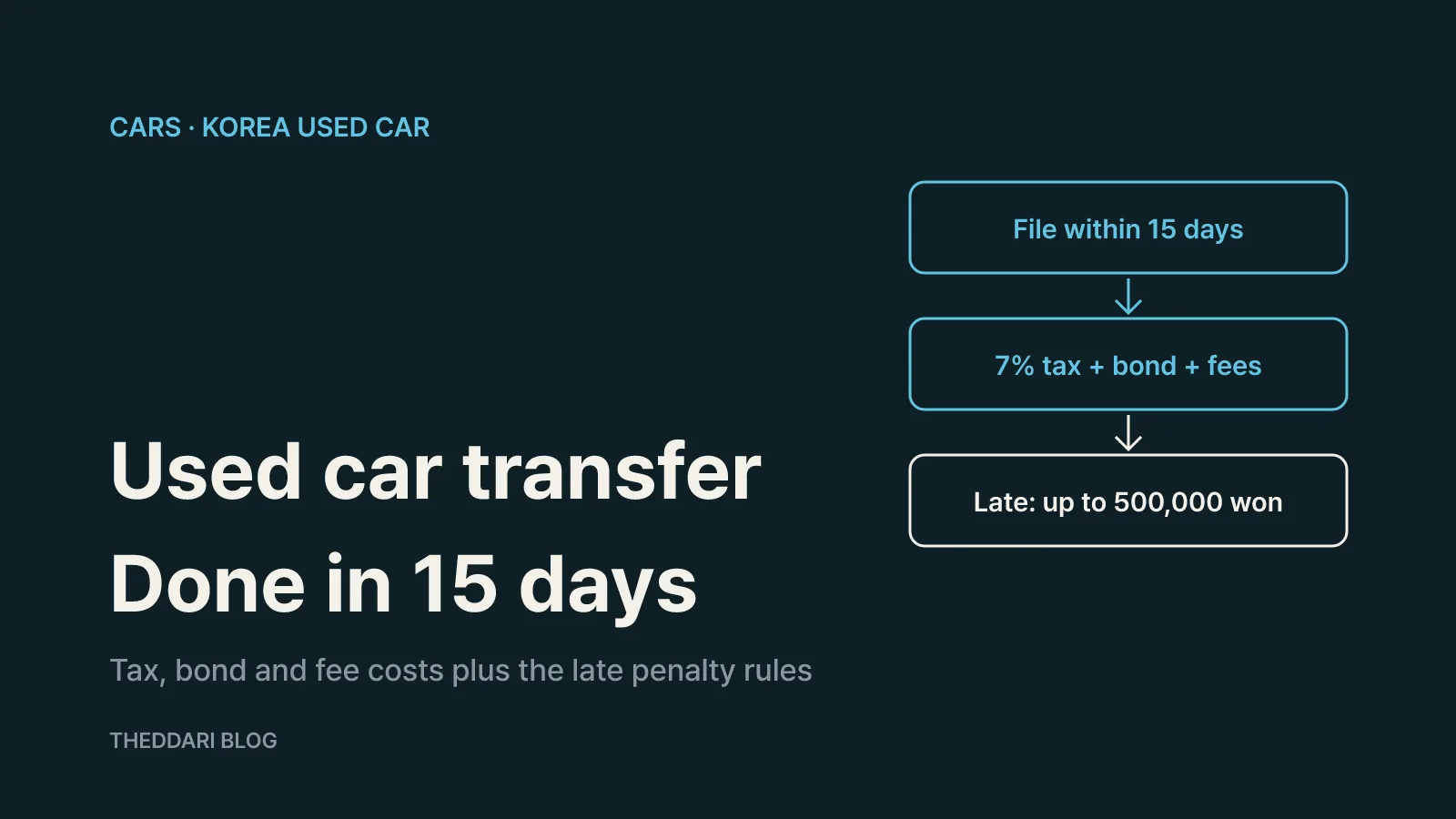
As of November 2026, anyone who buys a used car in Korea must file the ownership transfer registration within 15 days of the purchase date. The bill is made up of acquisition tax (7% of the taxable value for a private passenger car), a local government bond, a 1,000 won revenue stamp fee (1,500 won if you file outside your home region), a 3,000 won stamp tax, and new plates if your number changes. Miss the deadline and the penalty starts at 100,000 won and rises by 10,000 won a day after the first ten days, up to 500,000 won.
This guide is built on the official Car365 transfer guide run by the Ministry of Land, Infrastructure and Transport and the Korea Transportation Safety Authority, notices from the vehicle registration offices of Sejong, Seocho-gu (Seoul), Wonju and Gimhae, and the text of Article 67 of the Restriction of Special Local Taxation Act. The rules apply to cars registered in Korea, whether the buyer is a Korean citizen or a foreign resident with an alien registration card.
Deadlines: 15 days for a sale, 20 for a gift, 6 months for inheritance
The filing window depends on how you acquired the car. The Sejong guide and the Seocho-gu registration page list the same periods.
← Swipe to see more
| How you got the car | Deadline |
|---|---|
| Purchase | Within 15 days of the purchase date |
| Gift | Within 20 days of receiving it |
| Inheritance | Within 6 months from the end of the month in which the owner died |
| Other reasons | Within 15 days of the event |
In a private sale, the buyer files the transfer. If you bought from a licensed dealer, Car365 treats it as a separate dealer-sale type with its own transfer certificate form, and dealers often handle the filing. Ask the dealer when they will file and when you will receive the new registration certificate. Either way, write the purchase date clearly on both the contract and the transfer certificate so there is no argument about when the 15 days started.
Late penalties: 100,000 won rising to a 500,000 won cap
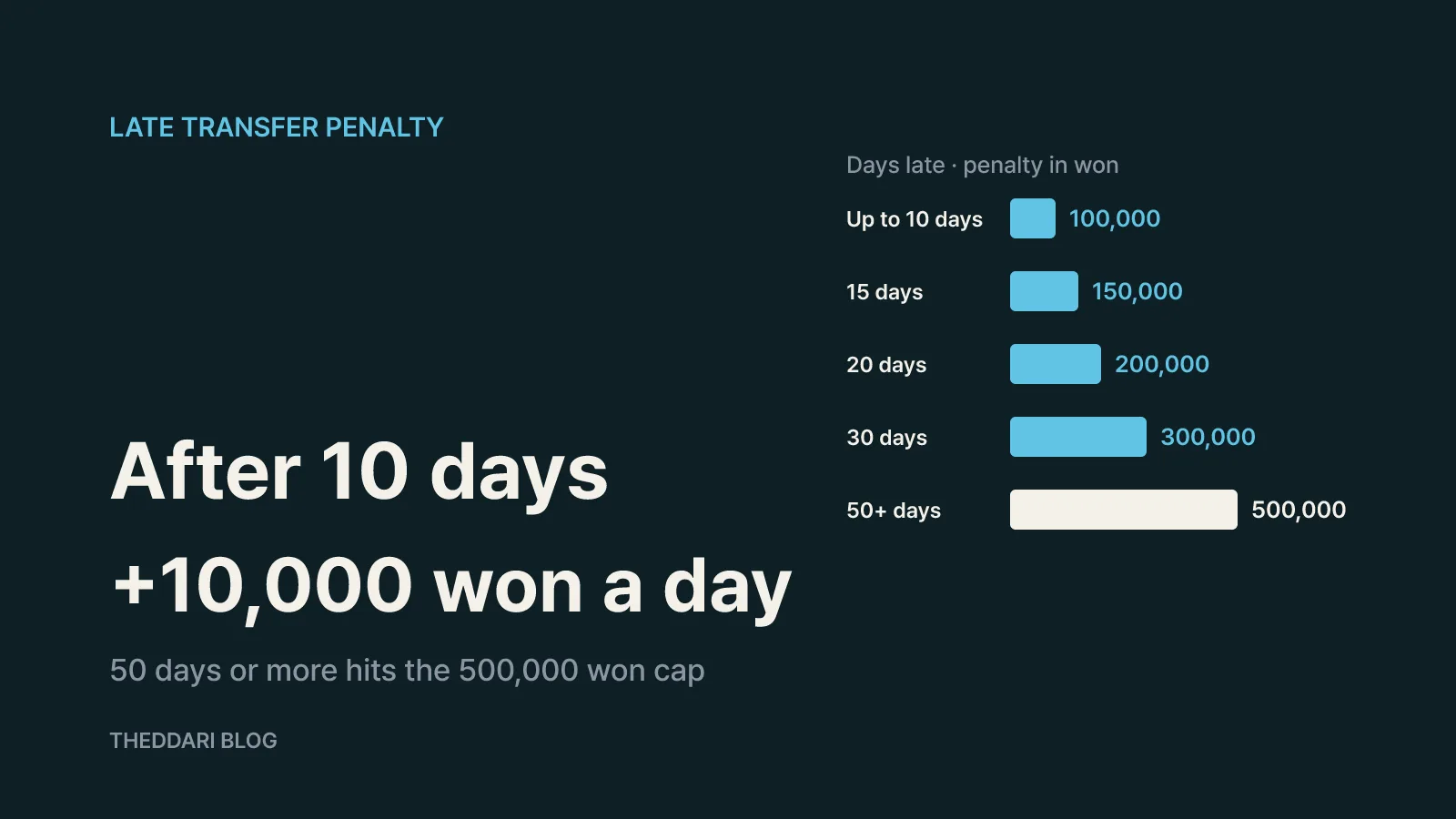
Local registration offices describe the late-filing charge as a penalty with a fixed schedule:
← Swipe to see more
| Days late after the deadline | Penalty |
|---|---|
| Up to 10 days | 100,000 won |
| 15 days | 150,000 won |
| 20 days | 200,000 won |
| 30 days | 300,000 won |
| 50 days or more | 500,000 won (cap) |
The first ten days cost a flat 100,000 won. After that, each extra day adds 10,000 won until the total reaches the 500,000 won ceiling.
Sellers have a stake too. Until the buyer registers, the car stays in the seller's name, so tax and fine notices for that period can still land in the seller's mailbox. Sejong lists a seller-initiated transfer: the seller can file using the transfer certificate, a seal certificate and a copy of the buyer's resident registration record. Without the transfer certificate, a court judgment confirming ownership is required, so sellers should keep a copy of the signed certificate.
What the transfer costs
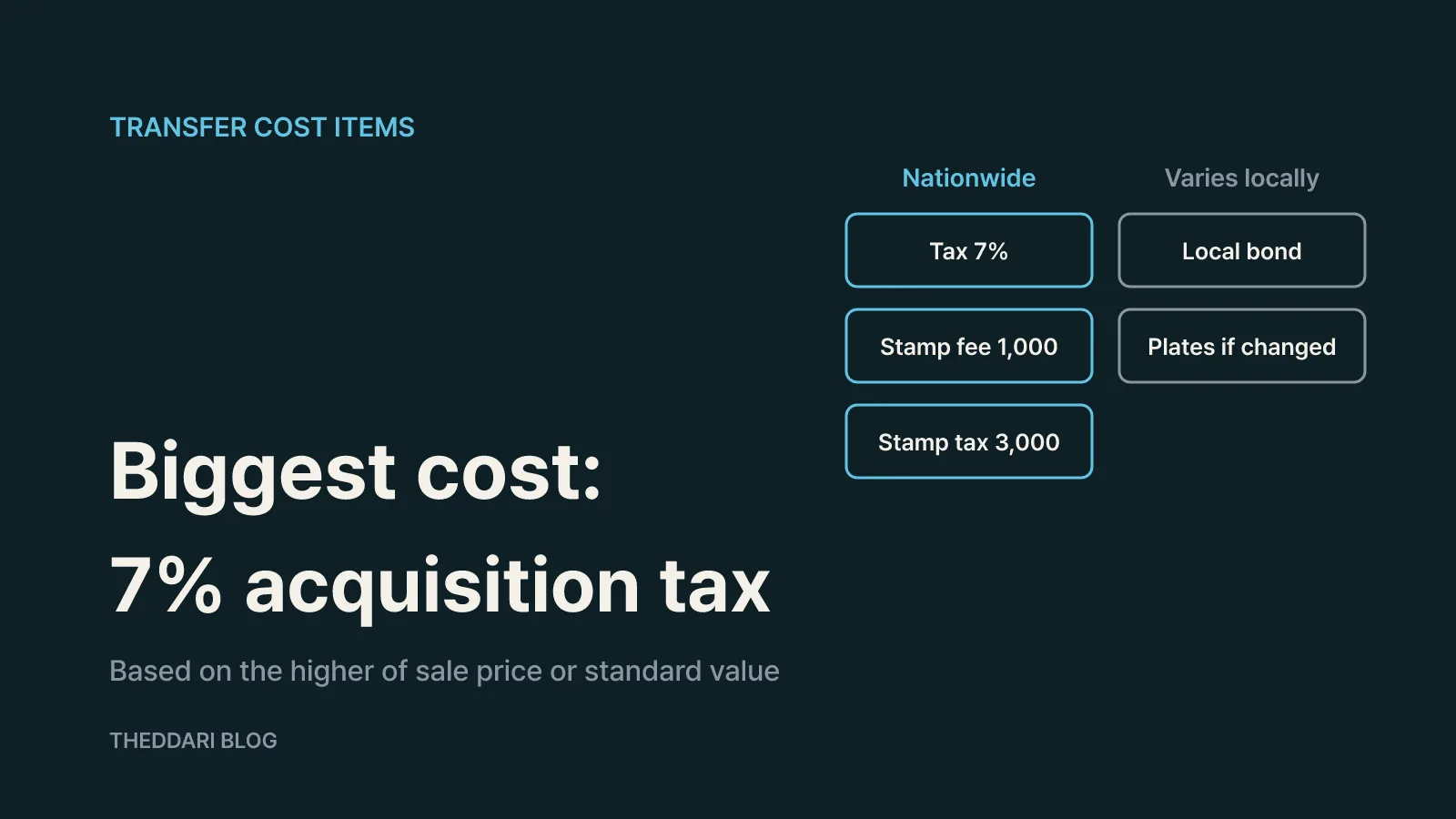
There are five possible cost lines. Some are national, others depend on the local ordinance where the car is registered.
← Swipe to see more
| Item | Rule | Note |
|---|---|---|
| Acquisition tax | 7% private passenger, 5% private van/truck, 4% commercial | Applied to the taxable value |
| Local bond | Set by provincial ordinance by vehicle type and engine size | Can be sold back at a discount on the spot |
| Revenue stamp fee | 1,000 won same region, 1,500 won other region | Registration office fee |
| Stamp tax | 3,000 won | National stamp tax |
| Plates | Only if the number changes | Varies by office |
The key figure is the taxable value. Wonju's vehicle registration office explains that for a transfer it is the higher of the actual sale price and the government's standard value for that model and age. Writing a low price on a contract between friends does not lower the tax if the standard value is higher. Standard values shrink each year through a published depreciation table, so the age of the car matters a lot.
Bonds are a purchase of local government debt at registration. In Wonju (Gangwon regional development bonds), a private passenger car transfer requires 4% of the taxable value for 1,600 cc and above and 6% for 2,000 cc and above, and 1.5% for private vans of 1,000 cc and above. Seocho-gu lists 6% for passenger cars in Seoul, payable in cash only. Most buyers sell the bond back immediately, so the real cost is the discount, not the full bond amount. When you file online through Car365, only the immediate discount sale is available.
Plates cost extra only when your number changes. Seocho-gu lists a 15,000 won number-change registration tax plus plate fees such as 7,500 won for standard painted plates or 21,000 won for film-type plates. Old regional-format plates must be swapped for national-format ones.
A worked example: a private 1,800 cc passenger car bought for 12 million won, with a standard value below that price, carries 840,000 won in acquisition tax (7%). Filing in your home region adds 1,000 won plus 3,000 won. Then add the bond discount for your region and any plate costs. Car365 has a registration cost calculator you can run before paying.
Light cars: up to 750,000 won off the acquisition tax
Article 67 gives private light passenger cars a break until December 31, 2027: if the acquisition tax is 750,000 won or less, it is waived, and if it is higher, 750,000 won is deducted. Using the car commercially within one year of purchase triggers repayment. According to Gimhae, a light car means under 1,000 cc and no more than 3.6 m long, 1.6 m wide and 2.0 m high; a car modified beyond those limits loses eligibility. The break covers acquisition tax only, so stamp fees and plate costs still apply.
Documents for buyer and seller
Based on the Seocho-gu and Sejong checklists:
- Both: the transfer application form showing current mileage, and one vehicle transfer certificate completed by seller and buyer together (signed if attending in person, stamped if a proxy attends).
- Seller: ID, the registration certificate (can be omitted if lost), current mileage, and if not attending, a seal certificate for vehicle sale or a personal signature confirmation stating the buyer's name, ID number and address.
- Buyer: ID (an alien registration card for foreign residents), and proof of mandatory insurance in the buyer's name. Insurance must be in place before the transfer is accepted. A proxy needs a power of attorney plus a seal certificate or a copy of the buyer's ID.
Filing online with Car365
Private party-to-party sales can be filed on Car365 using simple authentication, mobile phone verification or a financial or joint certificate. The new registration certificate is issued online. Key conditions:
- Mandatory insurance must be confirmed before you apply.
- All costs are paid by virtual bank account only, with no credit cards, by 5 p.m. on the same day.
- Applications are accepted 24 hours a day, but processing finishes only on weekdays between 9 a.m. and 6 p.m.
- Local tax is calculated by the owner's registered address.
You must visit an office instead for gifts and inheritance, joint ownership, cars with seizures or liens, corporate or business vehicles, cars with a commercial history, tax-exempt applicants or exempt vehicles such as hybrids and EVs, if you want to hold the bond rather than discount it, and trucks of 2.5 tons or more. Car365 also suggests checking for unpaid expressway tolls on the car before you file.
A quick checklist
- Before signing, check the registration record for seizures or liens.
- Record the same date, price and mileage on the contract and transfer certificate.
- Buy insurance in your name the day you take the car.
- Estimate tax and bonds with the Car365 calculator and compare the sale price with the standard value.
- File online or at your local registration office and pay the same day.
- Collect the new certificate, change plates if needed, and tell the seller the transfer is done.