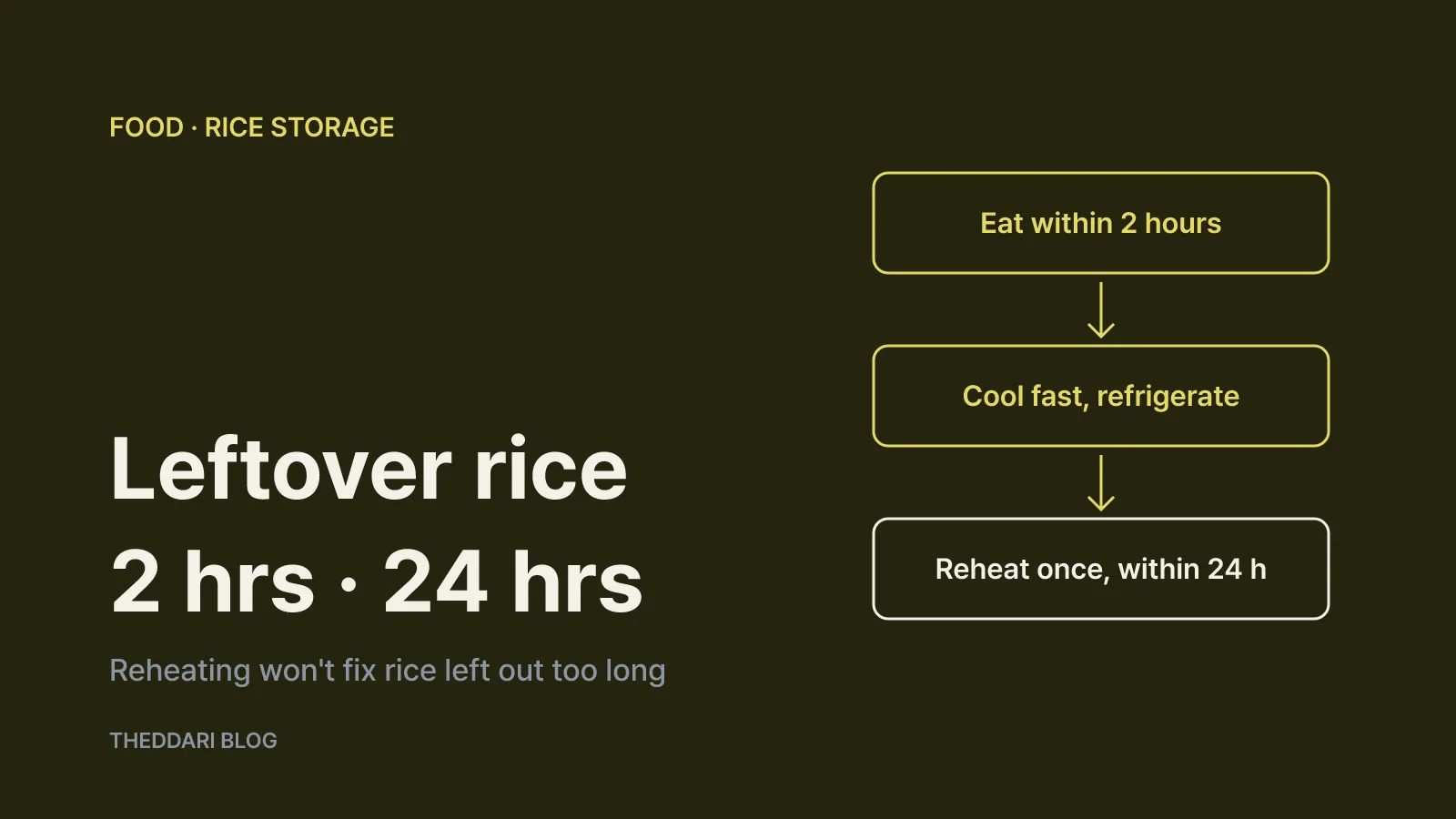
As of November 2026, the short answer is this: eat cooked rice within 2 hours, or cool it quickly and refrigerate it, then eat it within 24 hours and reheat it only once until it is steaming hot all the way through. The UK Food Standards Agency goes a step further and says leftover rice should ideally be chilled within 1 hour. The reason rice gets its own rules is a bacterium called Bacillus cereus, and the uncomfortable truth behind so-called fried rice syndrome is that reheating cannot always rescue rice that sat out too long.
I cover everyday cooking and food storage, and rice is the leftover people most often treat casually: a pot left on the counter after dinner, a takeaway container that sits in the bag until morning, a rice cooker switched off with the lid closed. This guide compares guidance from the UK Food Standards Agency (FSA), the USDA Food Safety and Inspection Service and Korean food safety bodies, which recently issued a public reminder on exactly this question.
Why leftover rice is different: Bacillus cereus and fried rice syndrome
According to the FSA, uncooked rice can contain spores of Bacillus cereus, and those spores can survive cooking. Spores are a tough, dormant form of the bacterium. Once the rice is cooked and left in a warm kitchen, surviving spores can germinate, multiply and produce toxins. The FSA puts it plainly: the longer cooked rice is left at room temperature, the more likely it is that the bacteria or toxins will make it unsafe to eat.
In November 2026, Korea's Food Safety Information Service published consumer guidance on the same problem, reported by Korea Food & Medicine News. It explains that the nickname "fried rice syndrome" comes from outbreaks linked to restaurants that cooked rice, left it at room temperature and later used it for fried rice. The agency notes that most B. cereus illness is relatively mild and resolves on its own, but that it can occasionally lead to serious health problems.
The key detail is the emetic (vomiting-type) toxin known as cereulide. Korean guidance describes it as highly heat-resistant and difficult to remove by ordinary reheating. That is why the FSA stresses that reheated rice is not the problem in itself; the problem is how the rice was stored before it was reheated. Stir-frying leftover rice over high heat does not change that logic.
How long can cooked rice sit out? A simple timeline
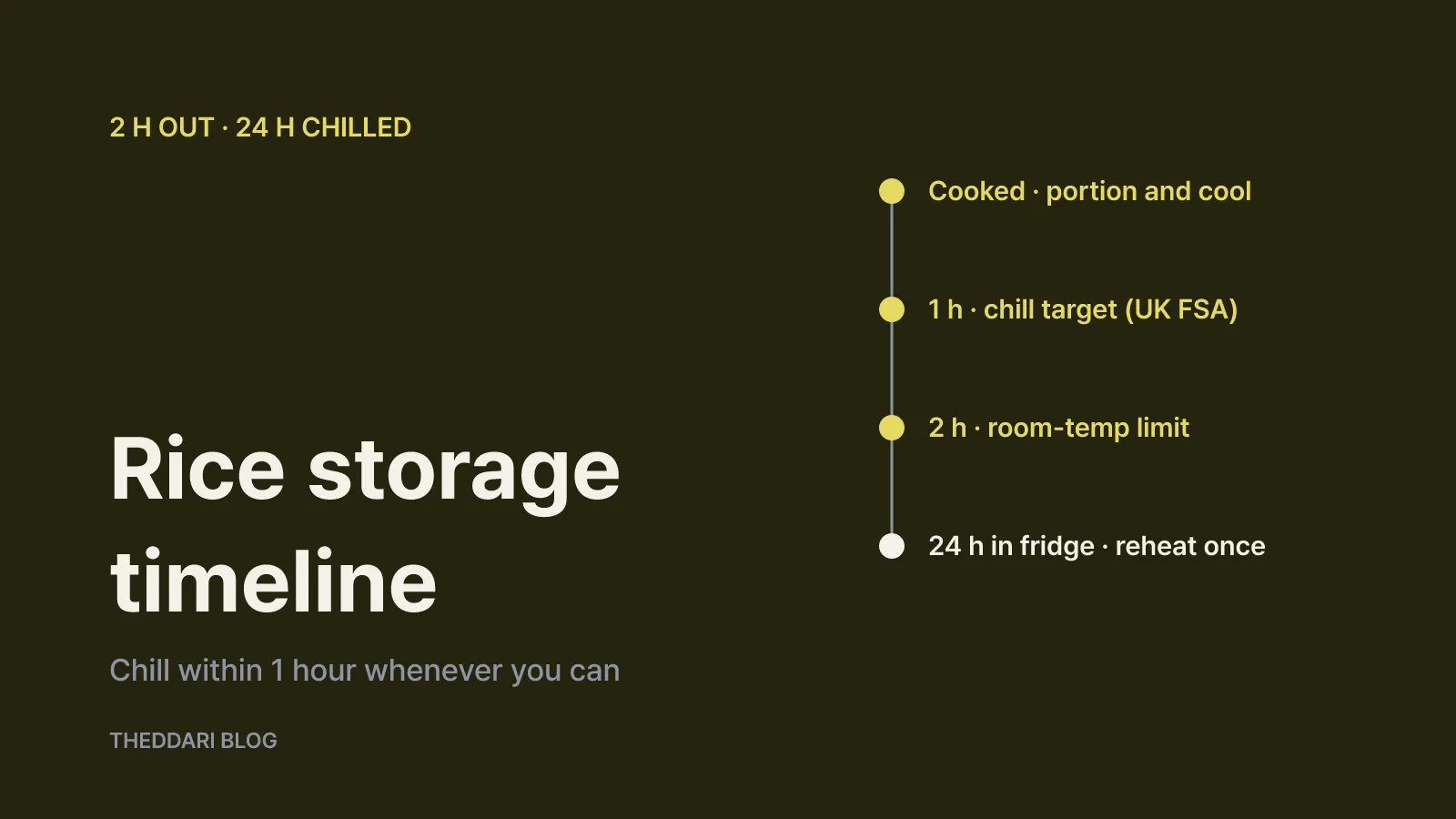
The agencies phrase their advice differently, but they point in the same direction: keep rice either hot or cold, and minimize the time it spends warm.
← Swipe to see more
| Time after cooking | What to do | Guidance |
|---|---|---|
| Right after cooking | Serve what you will eat; start cooling the rest | Korea, UK FSA |
| Within 1 hour (ideal) | Get leftovers into the fridge or freezer | UK FSA |
| Within 2 hours (maximum) | Eat it, or have it chilled at fridge temperature | Korea, USDA |
| Within 24 hours of chilling | Eat it, reheating only once | Korea, UK FSA |
| After 24 hours in the fridge | Throw it away | Korea, UK FSA |
The 2-hour limit matches the USDA's general rule for perishable food: discard anything left at room temperature for more than 2 hours, or more than 1 hour when the temperature is above 90°F, such as at a summer picnic. Korea's guidance gives the same 2-hour window for cooked food.
The 1-hour target is the FSA's stricter rice-specific advice. A practical way to combine them: never go past 2 hours, and aim for 1 hour whenever you can.
The 24-hour limit is where rice really differs from other leftovers. USDA says general leftovers can be kept in the fridge for 3 to 4 days, but both the FSA and Korean guidance set a much shorter limit for cooked rice. If you are cooking rice for fried rice two days from now, freeze it instead.
Temperature matters as much as time. USDA describes 40°F to 140°F as the zone where bacteria grow rapidly, and says hot food should be held at 140°F or warmer. Korea's Food Safety Korea portal uses an equivalent 5°C to 60°C danger zone. A rice cooker actively keeping rice hot is outside that zone; a rice cooker that has been switched off and left closed is slowly cooling right through it. The FSA specifically says not to leave rice to cool in the rice cooker, steamer or pan.
How to cool rice fast
Getting rice into the fridge is only half the job. A deep tub of rice packed tightly can stay warm in the center long after the outside feels cold. These steps come straight from the agencies' advice:
- Portion it. The FSA and Korean guidance both say dividing rice into smaller portions helps it cool faster.
- Use shallow containers. USDA recommends dividing large amounts of food into shallow containers. Spread rice in a thin layer rather than a mound.
- Use a cold water bath. The FSA suggests placing the container of rice in cold water to cool it before covering and freezing. Use a sealed container so water stays out.
- Do not wait for it to reach room temperature. USDA says hot food can go directly into the refrigerator, or be chilled in an ice or cold water bath first.
- Label the time. A strip of tape with the date and time makes the 24-hour rule easy to follow.
Takeaway rice deserves extra care. The FSA advises eating it shortly after purchase or delivery, because some businesses pre-cook rice and reheat it before serving. If you then refrigerate the leftovers and reheat them at home, that may be the second reheat.
Reheating rice safely: once, and steaming hot
When you reheat chilled rice, heat it all the way through. USDA advises reheating leftovers to 165°F, checked with a food thermometer. Korea's guidance sets a core temperature of 75°C held for at least 1 minute. Without a thermometer, use the FSA's test: the rice should be steaming hot all the way through, with no cool spots.
Microwaves heat unevenly. USDA recommends covering the dish, rotating or stirring the food partway through, and checking the temperature in several places. For rice, sprinkling a spoonful of water over it and covering the bowl helps it heat evenly.
Reheat rice only once. Both the FSA and Korean guidance are explicit. Taking out only the portion you plan to eat avoids the cycle of reheating, refrigerating and reheating again.
Keep the limits of reheating in mind. Proper reheating is the last step for rice that was stored correctly. It is not a way to make rice that sat out overnight safe again, because heat-stable toxin that has already formed may survive.
Freezing rice, thawing it, and when to throw it out
If you will not eat leftover rice within 24 hours, freeze it. The FSA says that cooling rice quickly in small portions and getting it into the freezer within an hour of cooking stops bacteria multiplying and producing toxin. Flat, single-serving packs freeze and thaw faster, and you only take out what you need.
To thaw, the FSA recommends defrosting rice in the fridge, then reheating it until steaming hot and eating it immediately. USDA lists the refrigerator, cold water and the microwave as safe thawing methods. Leaving frozen rice on the counter for hours puts it back in the danger zone.
Discard rice in any of these situations:
- It sat at room temperature for more than 2 hours, including overnight on the stove or in a switched-off rice cooker.
- It has been in the fridge for more than 24 hours.
- It has already been reheated once.
- You cannot remember when it was cooked or how long it sat out.
Do not rely on smell or appearance. Rice that was stored poorly can look and smell normal and still carry toxin. The reliable signals are time and temperature. Cooking closer to the amount you need, and portioning leftovers before you clear the table, prevents most fried rice syndrome risk at home.