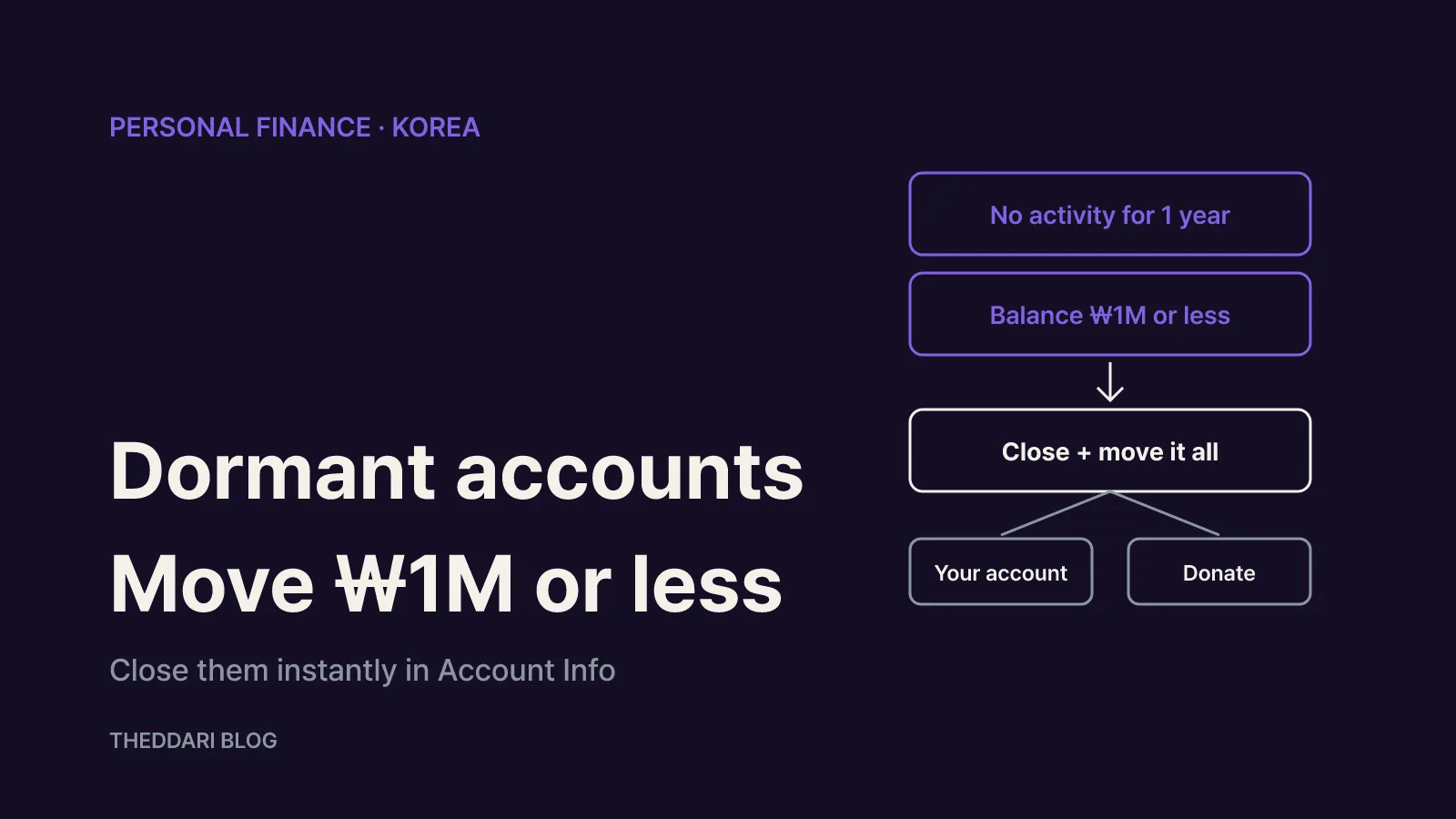
As of November 2026, the fastest way to find forgotten money in Korean bank accounts is Account Info (계좌정보통합관리서비스), a shared service run by the Korea Financial Telecommunications & Clearings Institute (KFTC) at payinfo.or.kr and in its mobile app. It lists accounts held in your name across participating banks, savings institutions and brokerages. Any account with no deposits or withdrawals for at least one year and a balance of ₩1 million or less can be closed on the spot, with the full balance sent to another account in your name (KFTC Account Info FAQ). Two limits matter before you start: the service is only for Korean nationals aged 19 or older, and every closure is processed in real time and cannot be reversed.
The scale is not trivial. Korea's Financial Services Commission (FSC) and Financial Supervisory Service counted ₩18.4 trillion in "hidden financial assets" at the end of June 2025, including ₩7.5209 trillion in deposits and savings, ₩5.8506 trillion in insurance payouts and ₩2.906 trillion in unused card points (FSC press release, September 2025). During the 2025 nationwide campaign (September 15 to October 31), consumers reclaimed ₩1.6329 trillion, and 66.0% of that went through online or mobile channels (FSC press release, February 2026). The lookup and refund services stay open after the campaign ends.
One, three and five years: how idle money is classified
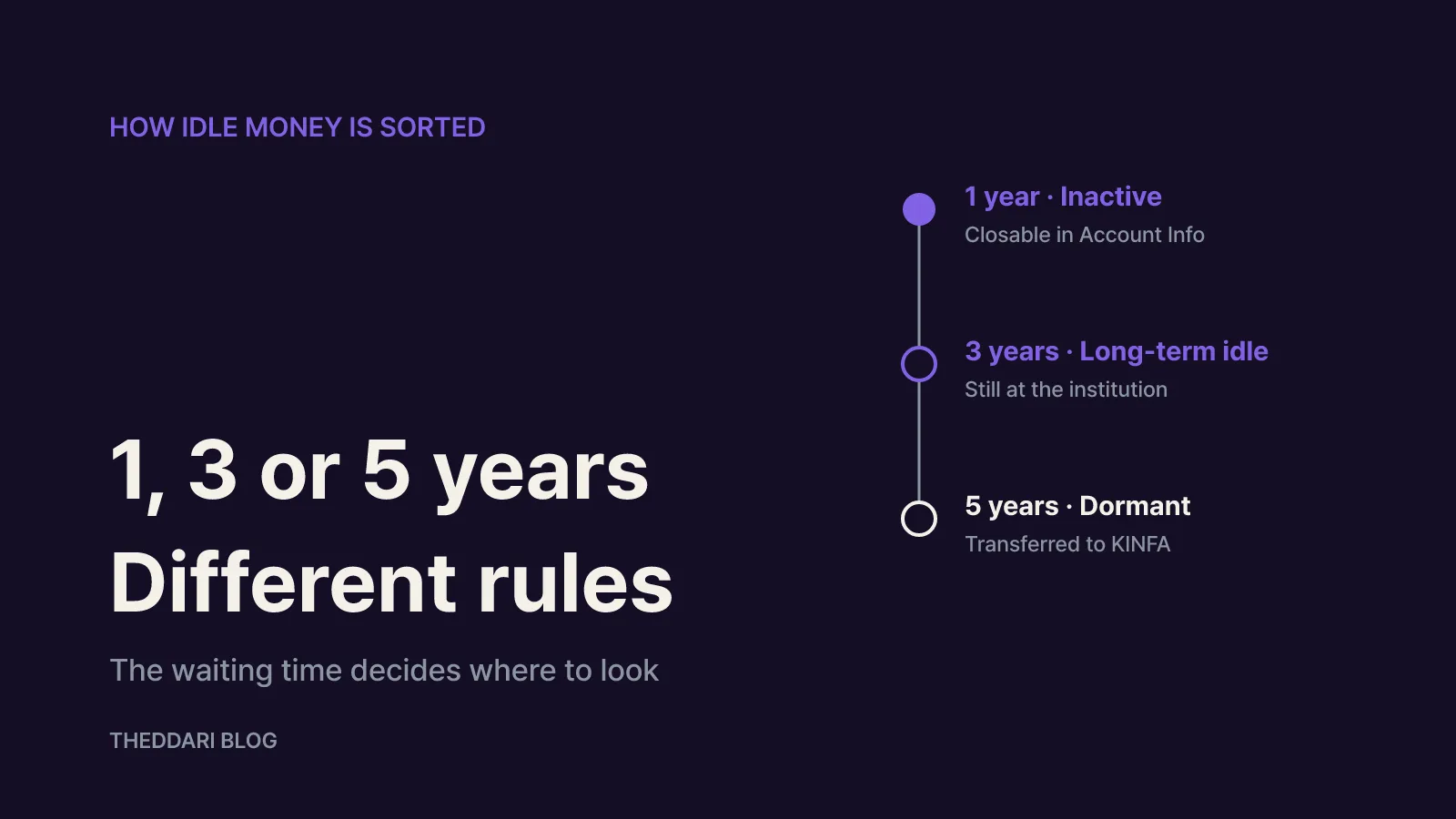
Korean sources use several labels for neglected money, and each one points to a different place to look.
One year is the Account Info threshold. An account with no deposit or withdrawal activity for a year is classed as inactive. For products with a maturity date, such as time deposits and installment savings, the clock starts at maturity: the account becomes inactive one year after it matures. Inactive accounts holding ₩1 million or less are the ones you can close online. KFTC says it chose one year because Korean financial companies commonly restrict online banking, automatic transfers and similar services after a year of non-use.
Three years is the line for what regulators call long-term untouched assets: deposits, insurance money, trusts and brokerage cash with no transactions other than interest for three years, or three years past maturity. The financial company still holds this money.
Five years is when an ordinary bank deposit becomes legally dormant because the claim period has run out. Insurance payouts reach that status three years after a policy lapses, is cancelled or matures. Dormant money of this kind can be transferred to the Korea Inclusive Finance Agency (KINFA, 서민금융진흥원) under the Act on Support for Ordinary People's Financial Life, but the original owner can still claim it.
Waiting has a cost. The FSC notes that deposits and insurance money typically earn a declining rate after maturity and stop earning interest once the claim period expires, and that long-neglected accounts are more exposed to misuse such as embezzlement. Cleaning up at the one-year stage is the simplest option.
Which accounts Account Info can close
Eligibility comes first. Account Info serves individual Korean nationals aged 19 or over. Corporations, unincorporated groups, Koreans residing abroad and foreign nationals are excluded. According to the KFTC FAQ, it covers 19 banks, 7 non-bank institutions and 23 securities firms; the current list is on the site under the participating institutions menu. If you are a foreign resident, accounts in your name will not appear, so contact the bank that holds the account directly.
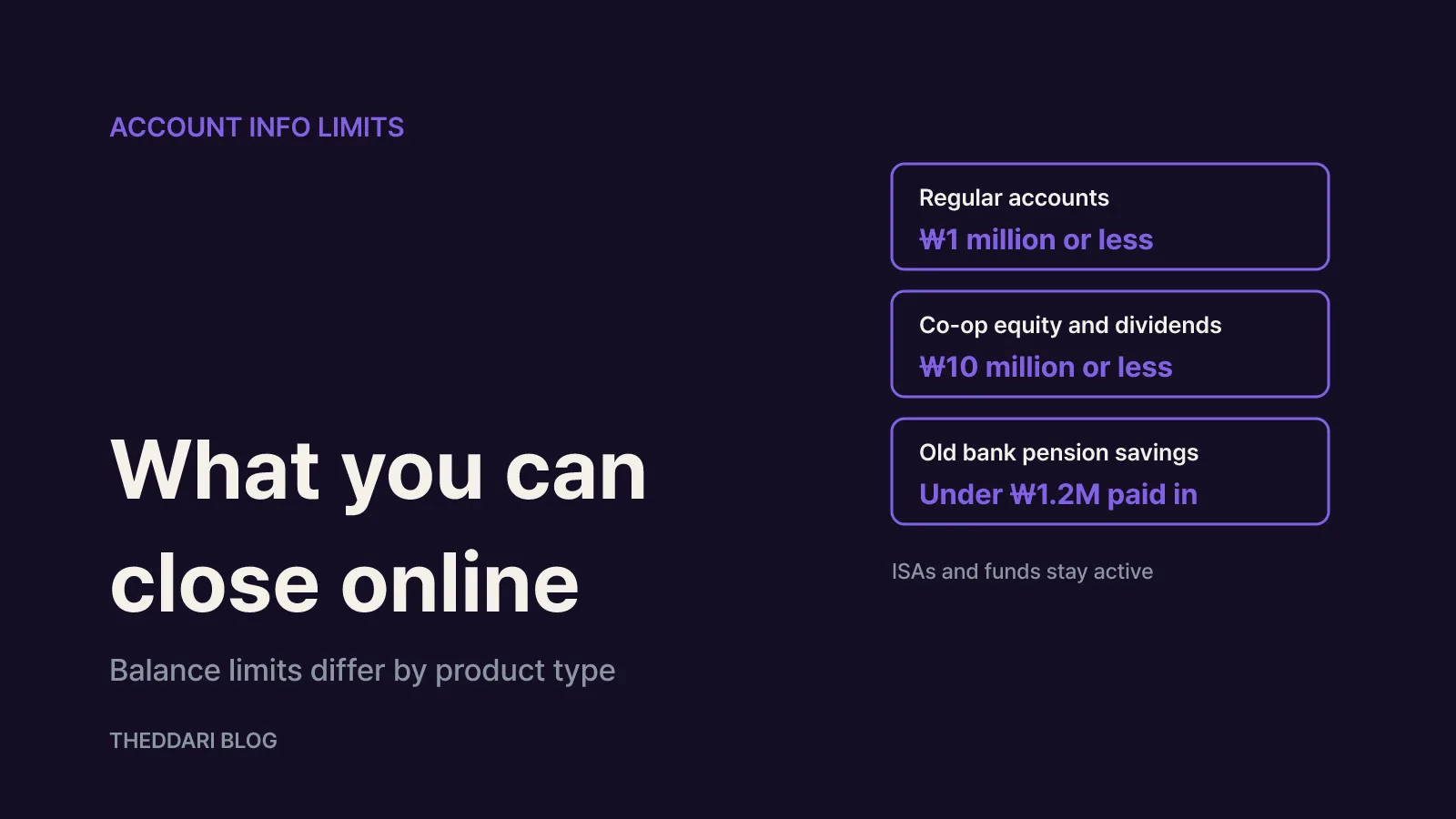
There are three closure categories:
← Swipe to see more
| Category | Balance limit | Inactivity rule |
|---|---|---|
| Regular accounts | ₩1 million or less | No deposits or withdrawals for 1 year (or 1 year after maturity) |
| Unpaid member equity and dividends at cooperatives | ₩10 million or less | Payable by the cooperative |
| Old-style bank personal pension savings | Less than ₩1.2 million paid in | 1 year after the final payment date |
The cooperative category covers equity and dividends left behind at agricultural, fisheries and credit cooperatives, forestry cooperatives and community credit cooperatives (Saemaul Geumgo). People who joined a local cooperative and later moved away are the typical finders here.
Some products are always treated as active, however long they sit untouched: loan-linked accounts, housing subscription savings, checking (current) accounts, funds, ISAs, undelivered "people's shares" and tax-favored products. At brokerages, tax-advantaged accounts such as pension savings, accounts still holding stocks or funds, and wrap, trust or discretionary accounts are also always active. That is why a housing subscription account never shows a closure button.
Inactive accounts above ₩1 million still appear in the list, but you have to withdraw from them through that institution's own online banking or a branch.
Step by step, and when the service is open
You need a financial certificate or joint certificate (Korea's digital banking certificates) and a phone registered in your name. Login combines your resident registration number, the certificate and a phone check through either your carrier or your bank. The app can be registered on only one device per person.
- Open the account overview and choose banks, non-bank institutions or securities firms to see how many accounts you have at each.
- Tap an institution to view details such as opening date, last transaction date and balance, then select the request button next to an eligible account.
- Pick a destination. You can send the money to a demand deposit account in your own name or donate it to KINFA. A brokerage destination must be a general trading or CMA account; joint accounts and accounts with an issued balance certificate cannot receive the transfer.
- Check the estimated payout. Moving money to a different institution may incur the closing institution's transfer fee. If the fee would push the payout below zero, send it to another account at the same institution or donate it.
- For time deposits and installment savings, if the phone number the bank has on file differs from the one you verified at login, you must agree to update it. This step follows Korea's anti-voice-phishing law, and the request cannot proceed without it.
- Sign with your certificate. Most results appear immediately; if a transfer shows as in progress, check the results menu on the next business day.
Opening hours are listed inconsistently. As of November 2026, the FAQ says lookups run daily from 00:30 to 23:30 and closures from 09:00 to 22:00 on business days, with securities accounts and old bank pension accounts limited to 09:00–16:00. A notice box at the top of the same site lists closures as 09:00–17:00 on business days. Submitting on a weekday between 9 a.m. and 4 p.m. satisfies every version. The KFTC help line is 1577-5500.
Donations fund KINFA's small-loan programs for people with low credit or income. They show up automatically in the National Tax Service's year-end tax settlement service, and KINFA (1397) can issue a separate receipt.
Accounts that cannot be closed online or do not appear
Even when the button is active, KFTC lists cases that need a branch visit or are legally blocked: accounts linked to other products, accounts under payment suspension, seizure or pledge, accounts flagged for loss, fraud, death or bankruptcy, accounts locked by too many password errors, phone-banking-linked accounts, accounts with an issued balance certificate or loan agreement, and non-real-name accounts. KFTC treats an account as non-real-name if its last transaction predates Korea's real-name financial transaction system of August 12, 1993; take ID to the branch to verify and close it.
Some accounts never show up at all: security-locked accounts, joint accounts, accounts of deceased persons or adults under guardianship, cooperative equity passbooks, accounts in the name of minors or foreigners, marketable instruments such as CDs (except passbook CDs) and RPs, retirement pension accounts, and dormant deposits already transferred to KINFA. If one institution holds more than 30 of your accounts, detailed lookup is limited and you need to ask a branch.
Reclaiming deposits that are already dormant
Deposits that passed the five-year mark and moved to KINFA can be checked through the dormant deposits and insurance menu in Account Info or through KINFA's own dormant deposit service. Once a request is accepted, KFTC says the money arrives in your chosen account within 10 minutes.
Online claims through Account Info are limited to ₩10 million or less, made by the account holder aged 19 or over. Minors, larger amounts, and heirs or representatives must visit the original financial institution or a KINFA support center. The name on the dormant deposit must match the name on the receiving account; if a legal name change creates a mismatch, request a correction in person. KINFA's call center number is 1397.
Check insurance and card points, and ignore refund texts
Bank accounts are only part of the picture. In the 2025 campaign, card points were the largest refunded category at ₩630.9 billion, followed by securities (₩403.7 billion), deposits (₩338.8 billion) and insurance (₩257.9 billion). Account Info's card menu shows unused points and can convert them to cash.
The FSS consumer portal (fine.fss.or.kr) offers the same integrated lookup plus links to sector-specific search sites. Unclaimed interim or maturity insurance benefits do not appear in the integrated lookup, so check the insurance associations' service at cont.insure.or.kr. Dividends tied to physical share certificates that were never re-registered are searched through the Korea Securities Depository.
Finally, be wary of messages about refunds. The FSC states that financial companies and related agencies do not ask for ID or account passwords by text or email, do not request transfers for refund fees and do not send separate web links. Ignore any text with a "claim your hidden money" link and use only an app you installed yourself or an address you typed in.
The practical order is simple: look up every account in Account Info, move inactive balances of ₩1 million or less to your own account on a weekday afternoon before 4 p.m., then check the dormant deposit and card point menus. Because closures are final, make sure none of the accounts you select still receives salary or pays automatic transfers.