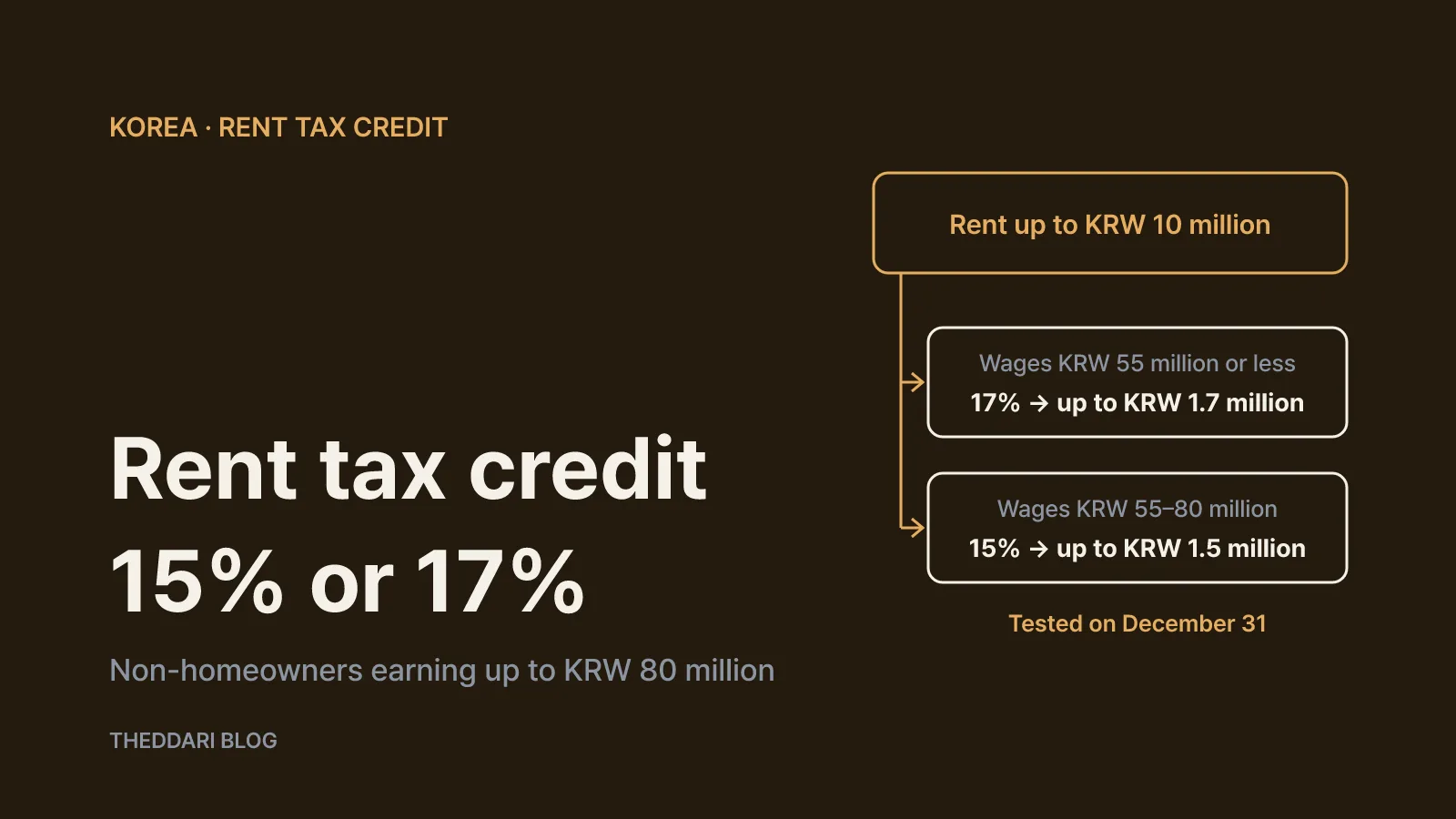
As of November 2026, salaried workers in Korea who rent their home can claim a tax credit of 15% or 17% of the monthly rent they paid, on up to KRW 10 million of rent per year, through the year-end tax settlement (yeonmal jeongsan) handled by their employer in early 2027. The credit is available to employees with total wages of KRW 80 million or less (and a combined income amount of KRW 70 million or less) who head a household that owns no home on December 31. If your total wages are KRW 55 million or less, the rate is 17%, worth up to KRW 1.7 million; above that, it is 15%, worth up to KRW 1.5 million (National Tax Service guide).
The key date is December 31, the last day of the tax year. Buying a home or leaving your registered address unchanged before that date can wipe out a full year of credit. This guide also separates the current rules from the government's August 2026 reform proposal, which raises the cap to KRW 12 million but does not apply to rent paid in 2026.
Who qualifies: four tests applied on December 31
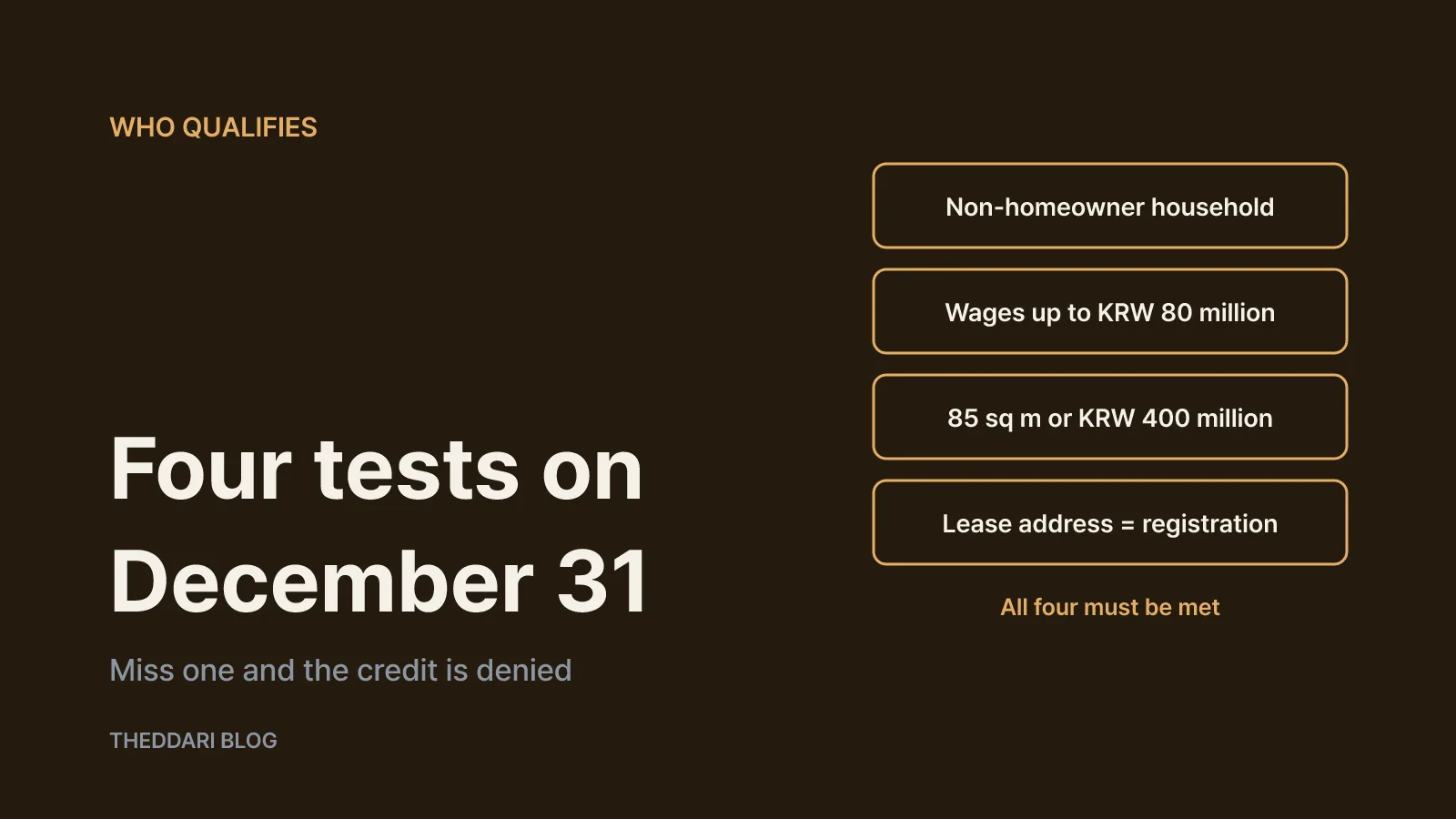
The National Tax Service (NTS) set out the requirements in its January 2026 press guidance on common year-end settlement mistakes. They break down into four tests.
- Household test: on December 31 you must be the head of a household that owns no housing. A household member other than the head can claim instead if the head is not taking housing-related deductions or this credit. Registered foreign residents who meet the statutory conditions are also included, so this is not limited to Korean nationals.
- Income test: total wages of KRW 80 million or less, and a combined income amount of KRW 70 million or less. If you have side income, check both figures.
- Housing test: the rented home must be within the national housing size standard (85 square meters of exclusive floor area, or 100 square meters in certain areas outside the capital region), or have a government standard value of KRW 400 million or less on the contract date. Residential officetels and gosiwon rooms are included. Meeting either the size or the value condition is enough.
- Contract and address test: the lease must be in your name or the name of a dependant you claim, and the address on the lease must match your resident registration. In practice, you must have filed your move-in report (jeonip singo) at that address.
The home-ownership test applies to the whole household, not just to you. If someone in your registered household owns a home, you cannot claim even if you personally pay the rent.
How to calculate the credit
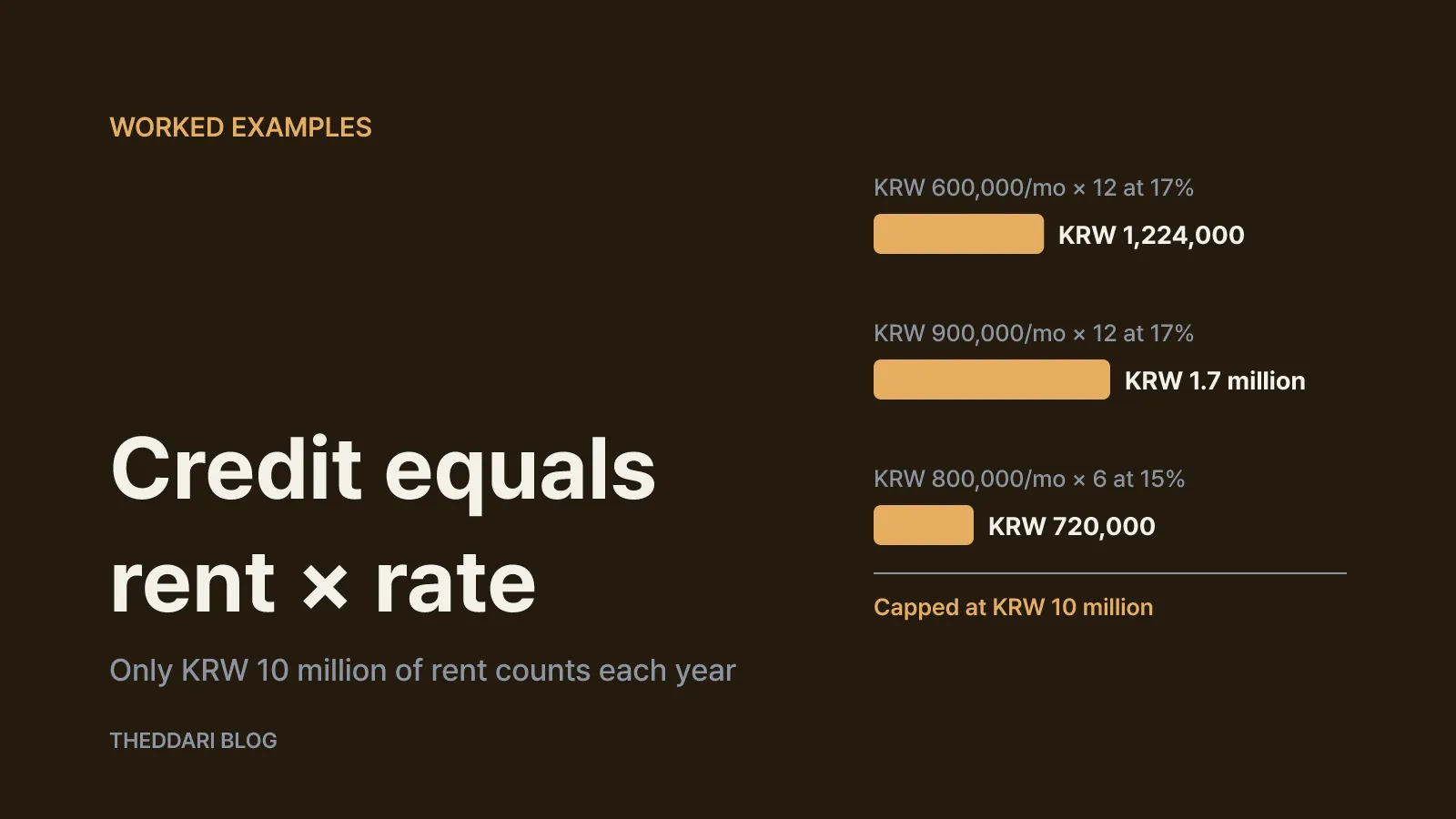
The formula is: eligible rent (capped at KRW 10 million a year) × credit rate.
← Swipe to see more
| Band | Total wages | Combined income amount | Rate | Maximum credit |
|---|---|---|---|---|
| Lower | KRW 55 million or less | KRW 45 million or less | 17% | KRW 1.7 million |
| Upper | Over KRW 55 million up to KRW 80 million | KRW 70 million or less | 15% | KRW 1.5 million |
Both income limits matter. Even if your wages are KRW 55 million or less, the rate drops to 15% if your combined income amount exceeds KRW 45 million.
Three worked examples:
- Rent of KRW 600,000 a month for 12 months, wages of KRW 40 million: KRW 7.2 million × 17% = KRW 1,224,000.
- Rent of KRW 900,000 a month for 12 months: KRW 10.8 million paid, but only KRW 10 million counts. The credit is KRW 1.7 million in the lower band or KRW 1.5 million in the upper band.
- Moved in July, paying KRW 800,000 a month for 6 months, wages of KRW 65 million: KRW 4.8 million × 15% = KRW 720,000.
Because this is a tax credit, it is subtracted from the tax you owe rather than from your income. If your tax liability is already smaller than the credit, the excess is not paid out. Maintenance fees are not rent; if your lease lists them separately, count only the rent portion.
Common reasons claims are rejected
The NTS highlighted several recurring errors:
- The household owns a home on December 31. Renting for most of the year does not help if you hold a home at year-end. If you are buying, check whether the completion and registration date falls before or after December 31.
- No move-in report. If your registered address differs from the lease address, the credit is denied. Keeping your address at a family home while renting near work is a typical case.
- You do not live there. The NTS example is a parent renting an officetel for a university student child while living elsewhere. The parent cannot claim, even though they pay the rent.
- A one-home household renting near a new workplace. The NTS FAQ states that heads and members of a household owning one home cannot claim this credit, even after a job transfer.
If you cannot take the credit, the NTS describes a fallback: apply on Hometax for a housing rent cash receipt with your lease and payment records. After review by the tax office, the rent can be counted toward the card and cash-receipt spending deduction. You cannot claim the same rent under both schemes.
Some combinations are allowed. For a part-deposit, part-rent lease (banjeonse) partly funded by a jeonse loan, an employee with wages of KRW 80 million or less can claim both the loan repayment deduction and the rent credit.
Documents and filing steps
Rent paid to private landlords usually does not appear in the simplified Hometax data, so you normally submit evidence to your employer. The NTS lists three documents:
- A copy of your resident registration (deungbon), showing your address and household.
- A copy of the lease contract, showing the tenant name, address, rent and term.
- Proof of payment, such as bank transfer records or deposit slips.
Then enter the landlord details, address, lease term and annual rent in your employer's year-end settlement system, attach the documents and check that the credit appears on your withholding receipt. If it was missed, you can still claim it when filing your own income tax return in May, or later through a refund claim. Claims that do not meet the tests are reviewed in the NTS's annual second-half checks, which covered more than 80,000 workers last year, and underpaid tax comes with penalties.
The 2026 reform proposal: KRW 12 million and 17% for young renters
The 2026 tax reform plan announced in August 2026 by the Ministry of Finance and Economy would:
- raise the eligible rent cap from KRW 10 million to KRW 12 million a year, and
- apply a 17% rate to young people regardless of wage band, through 2029.
Hankyoreh reported that the changes were announced to take effect from next year and that "young" means age 34 or under. Rent paid in 2026 is still calculated under the current KRW 10 million cap. The plan is a government proposal that must pass the National Assembly, so confirm the final law before planning around it. If enacted as proposed, the maximum credit would rise from KRW 1.7 million to KRW 2.04 million at 17%, and from KRW 1.5 million to KRW 1.8 million at 15%.
What to do before December 31
- File your move-in report if you have moved but not updated your address.
- Check any home purchase timeline against December 31.
- Agree within the household who claims housing-related tax benefits.
- Pay rent by bank transfer for the remaining months and keep records of earlier payments.
- Check the name on the lease matches you or a dependant you claim.
For questions, the NTS year-end settlement guide and its call center (126 from any phone in Korea) are the official points of contact.