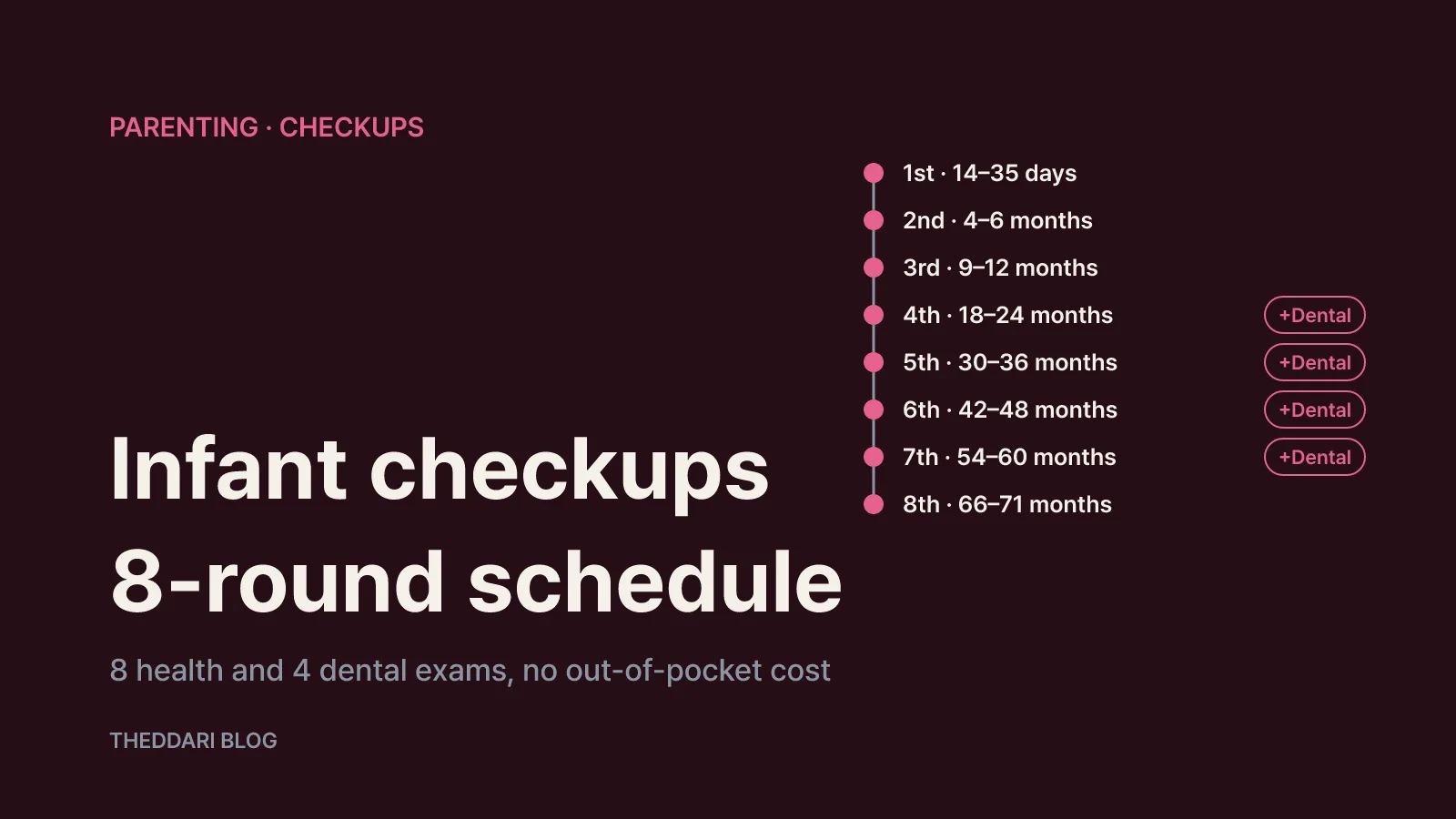
As of November 2026, Korea's national infant and toddler health screening program (영유아 건강검진) gives every covered child eight general health checkups and four dental checkups between 14 days and 71 months of age, with no out-of-pocket cost. Each checkup has a fixed age window, so the most reliable way not to miss one is to turn those windows into calendar dates from your child's birthday. This guide cross-checks the National Health Insurance Service (NHIS) infant checkup page against the government's Easy-to-Find Law Information Q&A and walks through the schedule, date lookup, preparation, what is examined, and what happens after a developmental screening result.
The Korean infant checkup schedule: 8 health exams and 4 dental exams
According to the NHIS, the program covers children from 14 days to 71 months old, and children are selected for each round based on age. These are the official windows:
← Swipe to see more
| Round | Health checkup | Dental checkup |
|---|---|---|
| 1st | 14–35 days | None |
| 2nd | 4–6 months | None |
| 3rd | 9–12 months | None |
| 4th | 18–24 months | 18–29 months |
| 5th | 30–36 months | 30–41 months |
| 6th | 42–48 months | 42–53 months |
| 7th | 54–60 months | 54–65 months |
| 8th | 66–71 months | None |
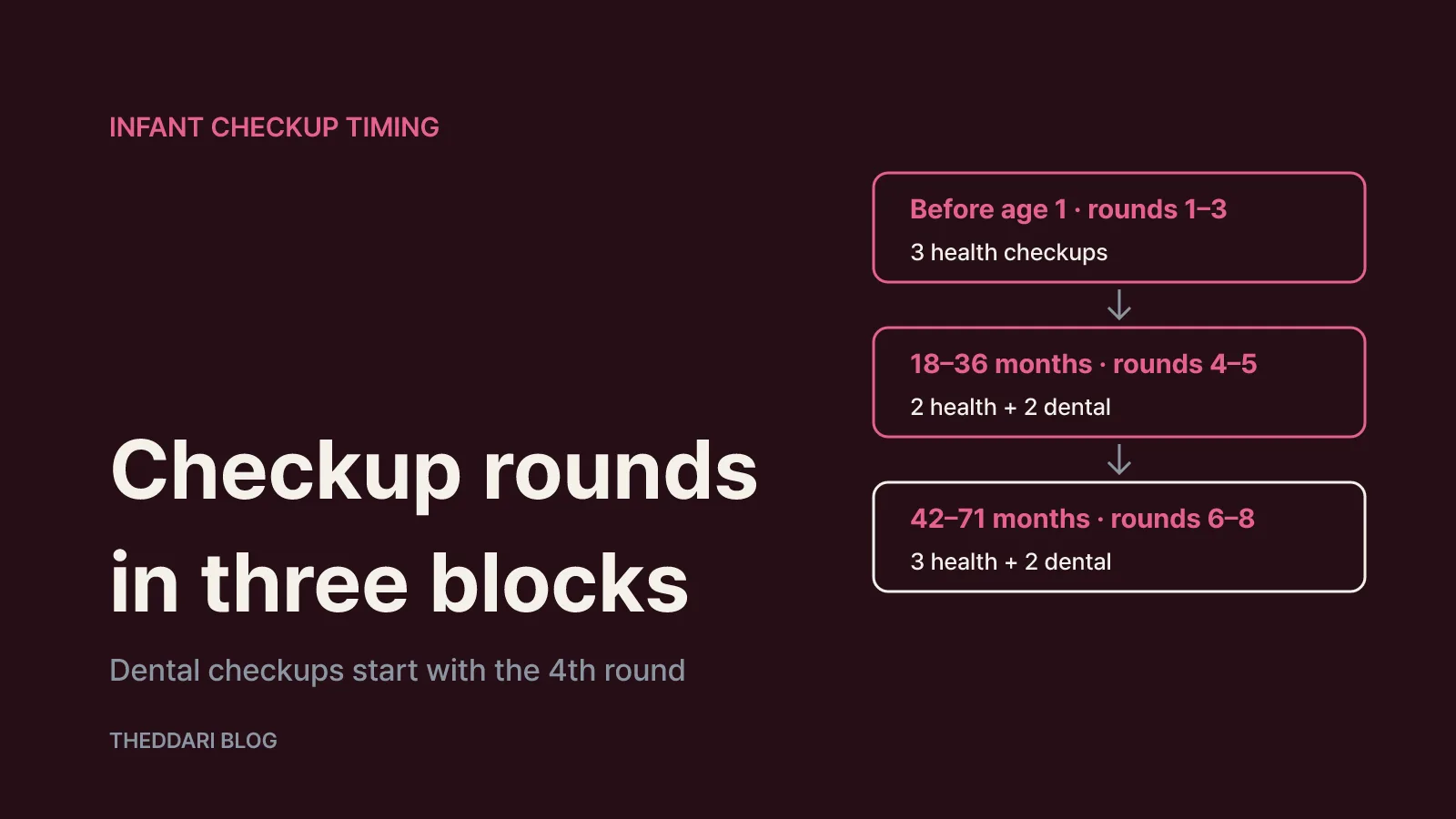
It helps to think of the schedule in three blocks. Before the first birthday there are three health checkups (rounds 1–3). Rounds 4 and 5 (18–36 months) bring two health checkups and two dental checkups. Rounds 6 to 8 (42–71 months) bring three health checkups and two more dental checkups. Dental screening starts alongside the 4th health checkup.
Three details catch many parents out. First, only the 1st round is counted in days: 14–35 days is roughly three weeks, often while you are still recovering or leaving a postpartum care center. Second, each dental window is longer than the matching health window. The 4th health checkup closes at 24 months, while the first dental checkup stays open until 29 months. Whether one clinic can do both on the same visit varies, so ask when you book. Third, there are gaps with no health checkup at all, such as 13–17 months and 25–29 months, which is exactly when the next start date slips out of mind.
On cost, the NHIS page lists no patient charge. For National Health Insurance members the NHIS pays the full amount, and for Medical Aid recipients the central and local governments pay. Checkups are available at designated infant screening clinics nationwide.
How to work out and confirm your child's checkup dates
The NHIS sends the infant checkup notice electronically to the employee-insured parent or the head of household, and follows up by post if the electronic notice is not opened. The Easy-to-Find Law Q&A adds that for self-employed (regional) members the notice may be printed on the household's insurance premium bill. So not receiving a letter in your child's name does not mean your child is not eligible; it may simply have gone to the other parent or the head of household.
You can estimate the windows by adding months to the birth date. For a baby born on March 10, 2026, the 2nd checkup (4–6 months) opens around July 10, 2026, and the 3rd checkup (9–12 months) opens around December 10, 2026. The 4th health checkup and the first dental checkup open at 18 months, around September 10, 2027.
The tricky part is the closing date. The official windows are expressed in months, so a deadline you calculate yourself can differ by a few days from the system's date. Check the exact dates on the NHIS website or The Health Insurance app under Child Health > Infant Health Checkup > Infant checkup eligibility lookup, and call the NHIS call center on 1577-1000 if anything is unclear.
My practical advice is to book within the first two weeks of each window. A cold or fever often means postponing, and if you book near the end you have no room to reschedule. Respiratory illness makes winter postponements especially common, so if a window closes between December and February, move earlier.
What to bring and how to fill in the questionnaires
The Easy-to-Find Law Q&A says the guardian should bring the checkup notice and identification. Before the exam, following the clinic's instructions, you complete the infant health questionnaire, the infant dental questionnaire and the Korean Developmental Screening Test for Infants and Children (K-DST). Both the questionnaire and the K-DST form can be filled in ahead of time on the NHIS website.
Do the developmental form at home. The NHIS Ilsan Hospital national checkup center guide notes that it includes behavior items you need to try with your child at home. The same guide sets out three rules:
- Use the form that matches your child's age in months on the day of the checkup. A child in the 9–12 month window who is examined at 9 months uses the 8–9 month form.
- For babies born before 37 weeks of gestation, use corrected age up to the 24-month checkup.
- A baby born three months before the due date who is 18 months old on the checkup day subtracts three months and uses the 14–15 month form.
Skipping the corrected-age step can make a premature baby look delayed compared with peers, so double-check it. The same center says a visit can take anywhere from 30 minutes to 2 hours. Times differ between clinics, but leave plenty of room, avoid your child's usual nap time, and bring the baby handbook with vaccination records.
What each checkup looks at
Per the NHIS, every round includes a history and physical exam, body measurements and health education. Measurements cover height, weight (body mass index) and head circumference. The history and exam includes hearing and vision questions, a vision test, a whisper hearing test and a vaccination record check; the whisper test is listed at the 6th round and the vaccination check at the 8th.
Developmental screening and counseling run from the 3rd round through the 8th, six times in total. Rounds 1 and 2 do not include developmental screening. Health education topics shift with age and include injury prevention, nutrition, sudden infant death syndrome prevention, oral health, toilet training, screen media exposure, emotional and social development, hygiene, school readiness and sleep.
The NHIS also lists the target conditions. Measurements look for growth delay, overweight and obesity, and abnormal head size. Vision checks look for amblyopia, strabismus, myopia and astigmatism. Developmental screening looks for signs of intellectual disability, autism spectrum disorder, cerebral palsy, language disorders and behavioral disorders. The dental checkup consists of an oral questionnaire and exam plus oral health education for parent and child, and looks for problems such as tooth decay.
The clinic gives the results directly to the guardian after the exam, and you can also view them on the NHIS website under the infant checkup results menu. The Ilsan Hospital guide notes that results can be submitted to a childcare center, which is useful if your daycare asks for them.
Developmental screening results and the assessment subsidy
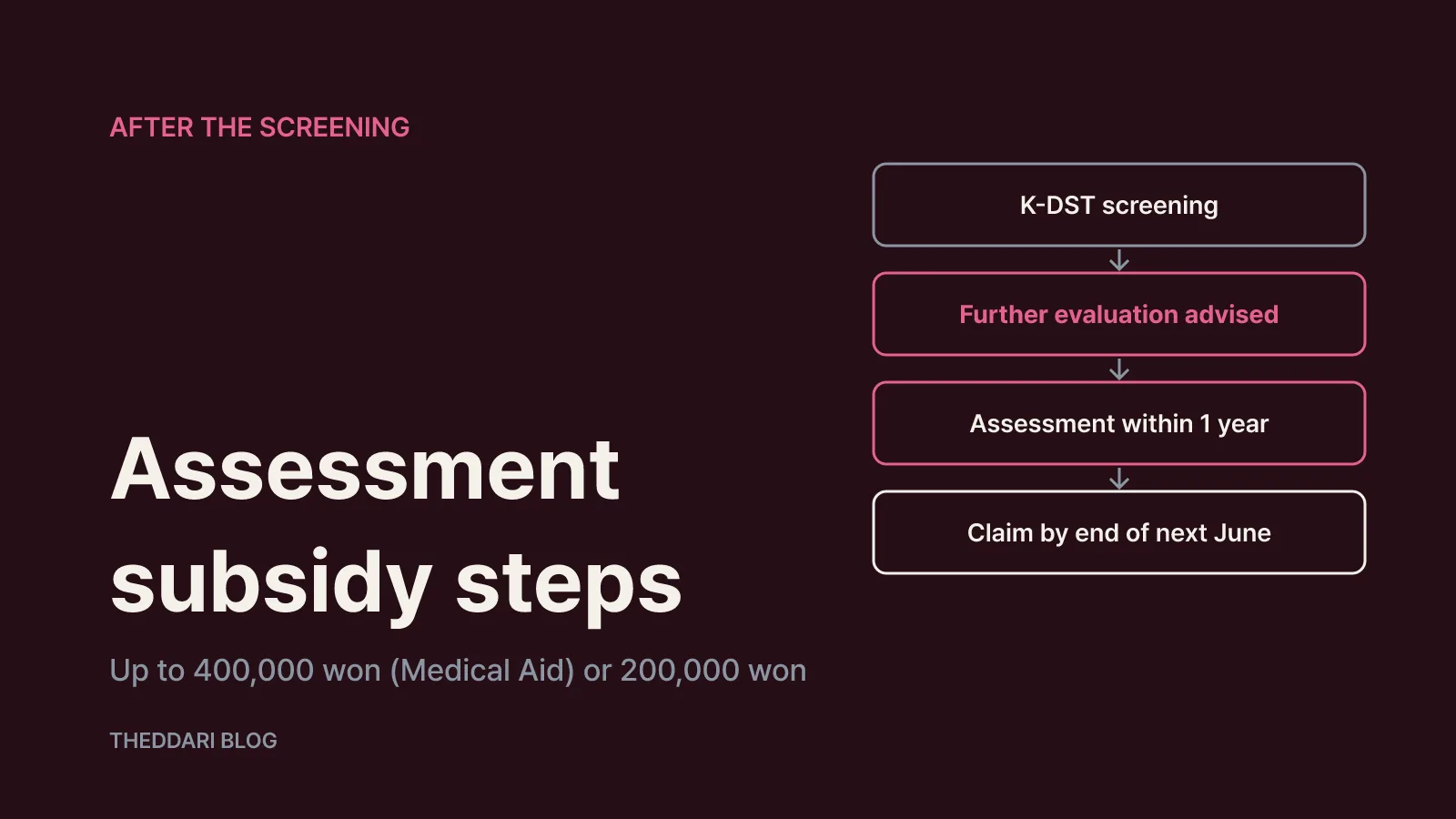
According to the NHIS webzine, developmental screening happens six times between 9 and 71 months and covers six areas: gross motor, fine motor, cognition, language, social skills and self-care. Results fall into four categories: good, follow-up needed, further evaluation advised, and ongoing management needed. Further evaluation advised (심화평가 권고) means a delay compared with peers is suspected and a detailed assessment is needed for an accurate diagnosis. A screening is not a diagnosis, so talk through the result with the examining doctor before deciding next steps.
Children with that result can get help with the cost of a detailed developmental assessment. The Gov24 service page, last updated May 13, 2026, sets out the terms:
- Eligibility: children rated further evaluation advised in the infant checkup developmental screening
- Amount: up to 400,000 won for Medical Aid recipients and near-poverty households, and up to 200,000 won for other National Health Insurance members
- Deadlines: have the detailed assessment within 1 year of the checkup date, then apply by the end of June of the year after the assessment
- How: after receiving the NHIS developmental result notice by post or text, get assessed at a designated institution and apply at the public health center for your registered address
- Documents: proof of eligibility (Medical Aid or near-poverty certificate, or health insurance card), the infant checkup result notice, the assessment result notice or a medical certificate showing the method and result, the claim form, the medical bill receipt and a copy of your bank book
For example, an assessment done in November 2026 must be claimed by the end of June 2027. Keep the receipt and result notice from the day of the assessment, and check with your local health center before visiting because some ask for extra paperwork such as an itemized bill. General questions go to the Ministry of Health and Welfare call center on 129.
A checklist so you never miss a round
- Add the start dates of all eight health checkups and four dental checkups to your phone calendar, based on the birth date.
- Confirm the real windows in the NHIS eligibility lookup and follow the NHIS dates if they differ from yours.
- Book within two weeks of each window opening, and ask whether the dental checkup can be done at the same clinic.
- Complete the questionnaire and K-DST form by the day before, using age on the checkup day, and corrected age up to 24 months for babies born before 37 weeks.
- On the day, bring the checkup notice, your ID and the baby handbook.
- Keep the result notice, and if further evaluation is advised, get assessed within 1 year and claim before the end of June the following year.
With more than one child, keep a separate schedule for each. If a window has already closed, do not assume either way whether that round can still be done; ask the NHIS call center first.