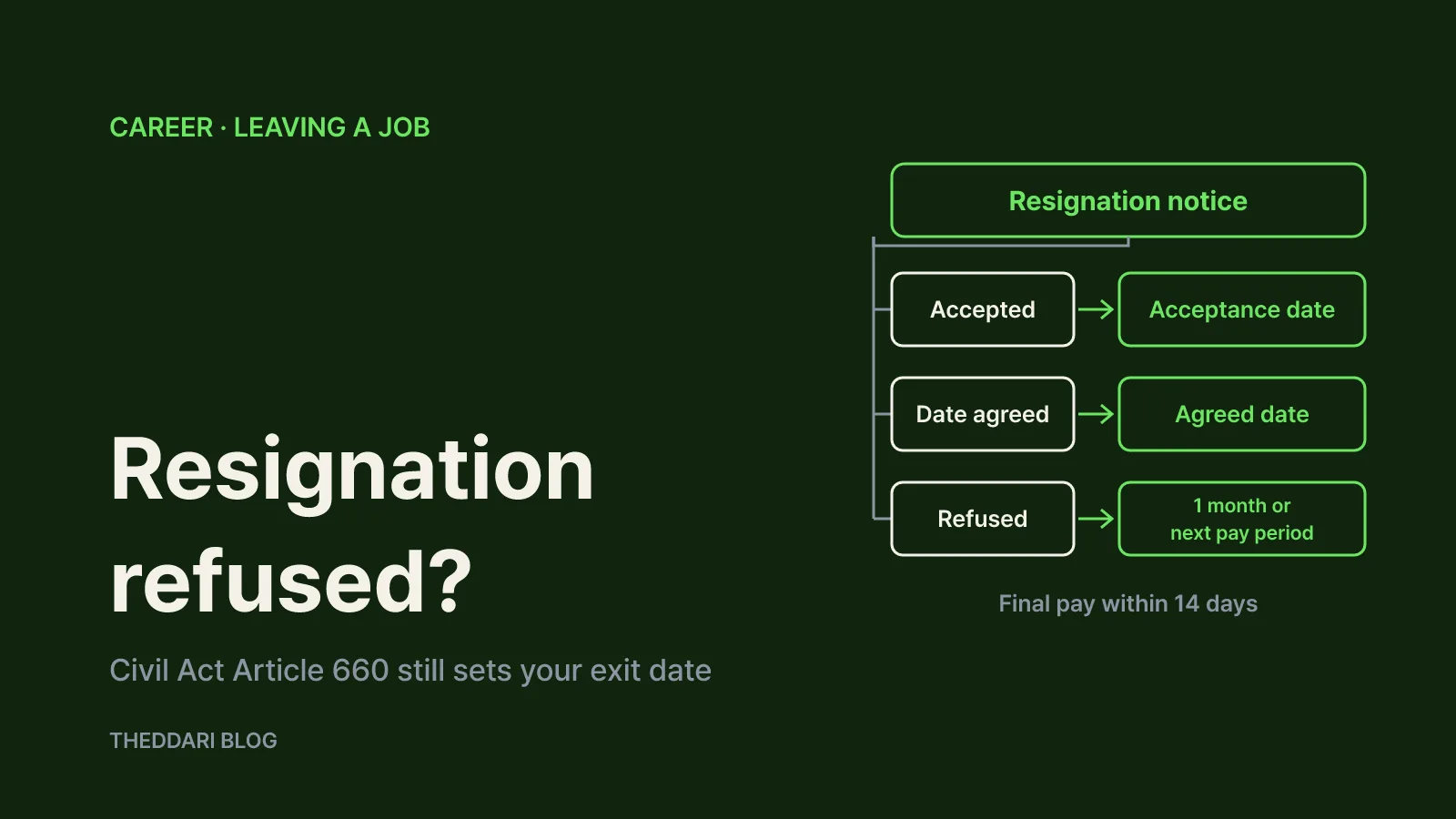
As of November 2026, the short answer is that a Korean employer cannot stop you from leaving simply by refusing to accept your resignation letter. If your employment contract has no fixed term, Article 660 of the Civil Act says your notice takes effect once one month has passed from the day the employer received it. If your pay is set by period, such as a monthly salary, the notice takes effect after the pay period following the one in which it was received. Until that date, however, the contract is still alive, and so is your duty to show up for work.
This question comes up often among foreign professionals and anyone changing jobs around year end in Korea. A manager might say you cannot leave until a replacement is hired, or that company rules require two months' notice. Knowing the statutory date gives you a firm reference point before you negotiate a start date with your next employer.
Three ways a resignation takes effect in Korea
Korea's Labor Standards Act regulates dismissal in detail, but it does not separately regulate an employee's own resignation. The Ministry of Employment and Labor (MOEL) states this directly in an online counselling reply: labor statutes contain no separate provisions on resignation other than dismissal, so the general contract rules of the Civil Act apply. That leaves three routes.
The employer accepts. When the company accepts your resignation, the contract ends by mutual agreement. MOEL notes that if the employer accepts the letter, the resignation takes effect on the date of acceptance (or on any end date both sides set). This is how most resignations end in practice.
You agree on a date. If you propose a last working day and the company agrees, or you settle on a different date together, that becomes your exit date. When you already have an offer with a fixed start date, locking in this agreement in writing is the safest move.
The employer refuses or stays silent. This is where Article 660 matters. Paragraph 1 says either party may give notice of termination at any time when no employment period was agreed. Paragraph 2 says termination takes effect when one month has passed from the date the other party received the notice. Paragraph 3 says that where pay is fixed by period, termination takes effect after the pay period following the one in which notice was received.
A company's claim that it has a good reason not to accept does not change the outcome. In MOEL interpretation No. 371 of 9 January 2013, the ministry replied that the employment relationship ends either through the employer's acceptance or through the lapse of the Article 660 period, and that termination takes effect even if there is a reasonable ground for not accepting the letter. Hiring a successor or completing a handover is something to negotiate, not a legal veto.
One limit: this rule assumes a contract without a fixed term. If you are on a fixed-term contract, other provisions and your contract terms come into play, so check the contract period before relying on the calculation below.
How to calculate your last day on a monthly salary
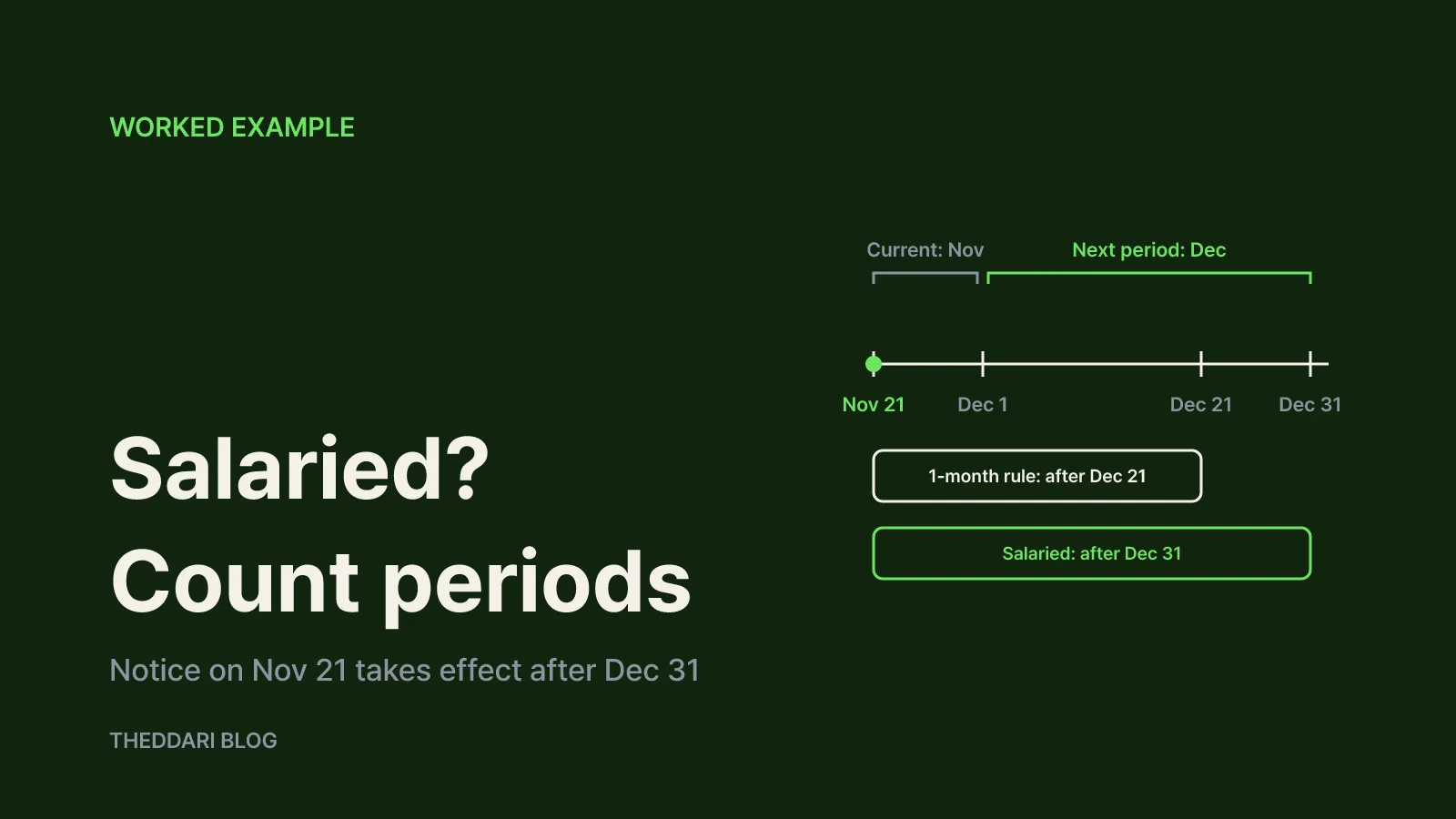
The common point of confusion is whether the one-month rule or the pay-period rule applies. MOEL's reply explains that where wages are set as a periodic amount and paid on a regular date, resignation is processed once the pay period following the period of notice has passed. If you are salaried, plan around Paragraph 3.
The "current period" is the wage calculation period that contains the day your notice reached the employer. Look at your payslip or contract to see whether that period runs from the 1st to the last day of the month or, say, from the 21st of one month to the 20th of the next. What matters is the calculation period, not the payday.
Here is a worked example. Your wage period runs from the 1st to the end of each month. You hand in your resignation on November 21 and the company refuses to accept it. The current period is November, and the next period is December. Termination therefore takes effect only after December 31. Under the one-month rule in Paragraph 2, the same notice would take effect once December 21 had passed, so the two methods differ by roughly ten days.
Timing within the month changes the wait. Notice given early in a period means you wait for the rest of that period plus one full period, which can approach two months. Notice given at the very end of a period means you mostly wait for just the next one. If you have already decided to leave, submitting near the end of your wage period shortens the statutory wait.
The clock starts when the company receives your notice. A verbal comment to a team lead is hard to date. Send your resignation by email, internal e-approval system or another method that leaves a timestamp, and address it to someone with HR authority.
What to do during the notice period
While you wait for the statutory date, your contract remains valid. MOEL states that both parties must continue to perform their contractual duties during the notice period, and that failing to come to work counts as unauthorized absence, which may create liability for damages for breach of contract and may also lower your average wage.
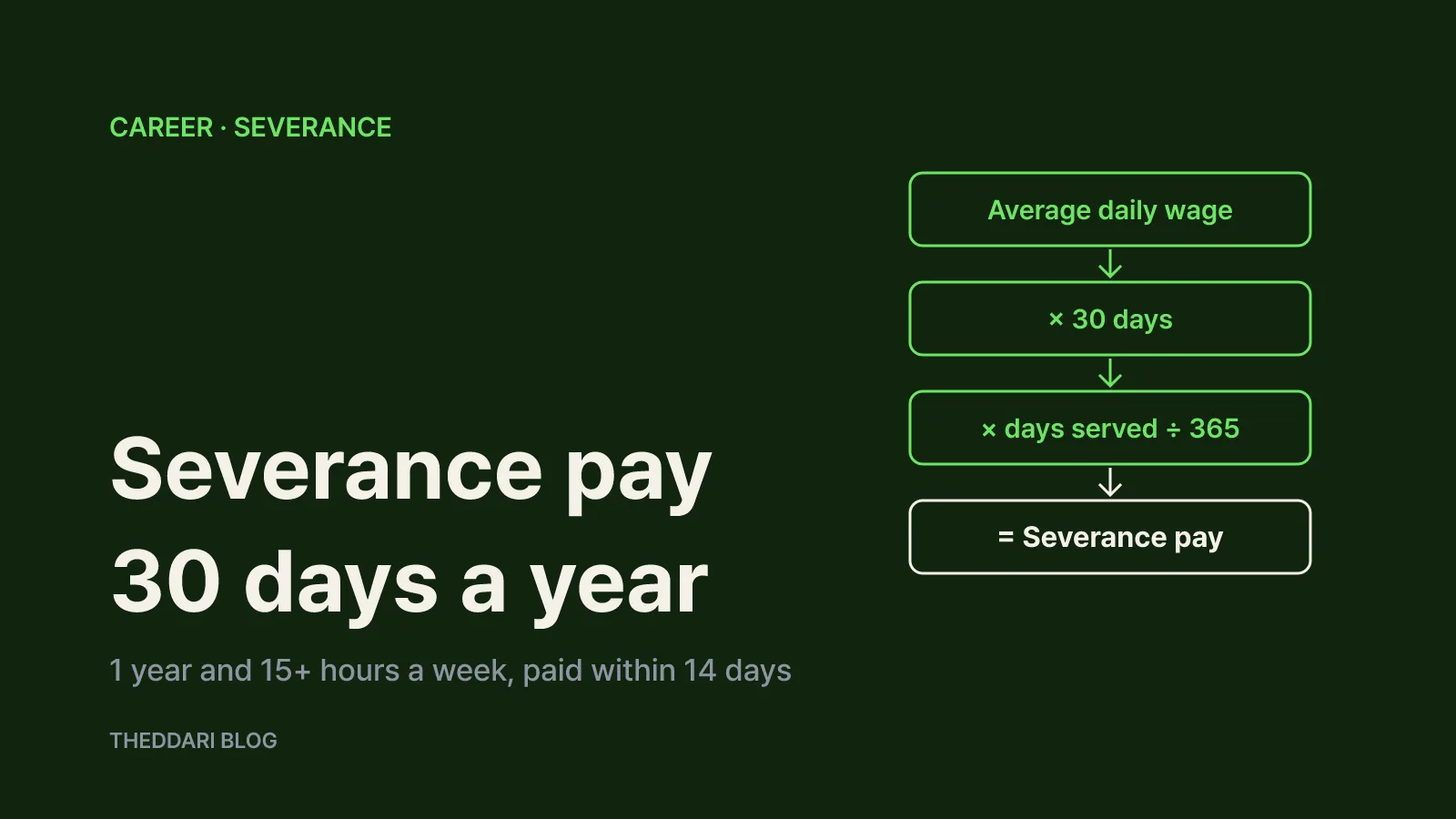
A lower average wage can affect your severance pay, because severance in Korea is calculated from wages in the period just before leaving. Walking out the day after you resign because "it will take effect anyway" can therefore cost you money.
Practical steps during this period:
- Keep a dated copy of your resignation notice.
- Record the company's refusal in writing, even a short email.
- Keep working normally until the effective date.
- Negotiate leave use, handover scope and an earlier exit date in writing.
- Give your next employer a start date based on the statutory effective date.
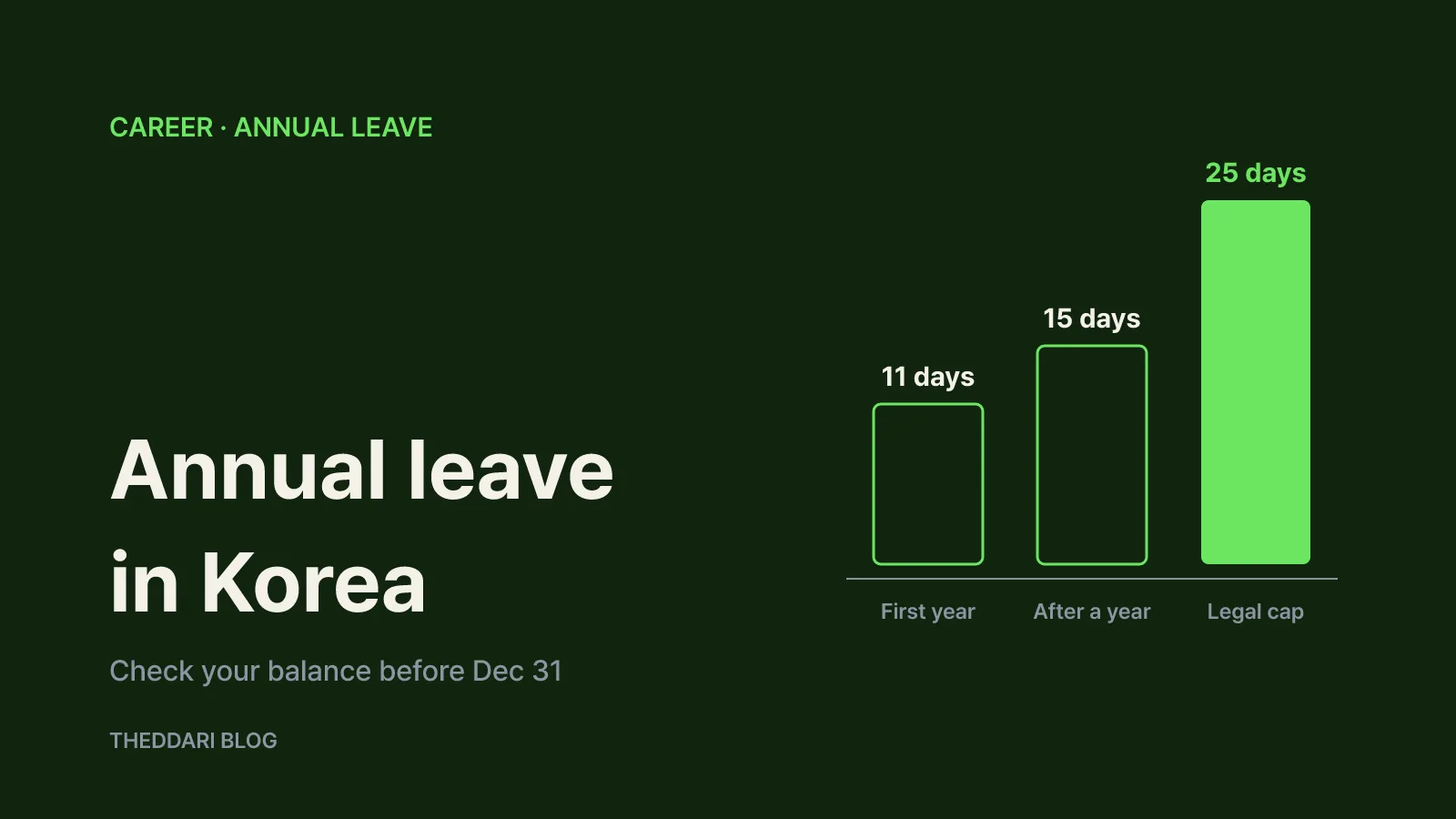
Using remaining annual leave to shorten your physical time at the office is worth raising, but leave timing usually requires coordination with the employer. Request it in writing and keep the reply. Offering a concrete handover plan often persuades a company to agree to an earlier date.
The 14-day final pay deadline after you leave
Once your last day is fixed, the next deadline is final settlement. Article 36 of the Labor Standards Act requires the employer to pay wages, compensation and all other money and valuables within 14 days after the reason for payment arises when an employee retires or dies. The deadline can be extended only by agreement between the parties under special circumstances, so if your employer asks for more time, put the new date in writing.
Final settlement may include pro-rated wages for the last month, severance pay and payment for unused annual leave. Before leaving, confirm how the last salary will be calculated, where severance will be paid (including any retirement pension account) and how many leave days remain. Mark day 14 on your calendar.
If the exit date itself was disputed, count the 14 days from the effective date calculated under Article 660. Your dated notice makes that easy to show. If payment does not arrive, you can consult or file a petition with the regional labor office; MOEL's main helpline is 1350.
Checklist before you hand in your notice
- Check whether your contract has a fixed term. Article 660 applies to contracts without one.
- Find your wage calculation period on your payslip and work out when the following period ends.
- Read any company rule on resignation notice and decide which exit date you will propose.
- Deliver your notice to someone with HR authority by a method that records the date.
- Plan attendance and handover through the statutory effective date, whether or not the letter is accepted.
- List the payments due within 14 days of leaving and confirm each one arrives.
The statutory date is a floor for negotiation, not the goal. Most resignations end with an agreed date, so use what you know to propose a reasonable one. For civil disputes over the effect of a resignation or claims for damages, MOEL directs workers to the Korea Legal Aid Corporation at 132.