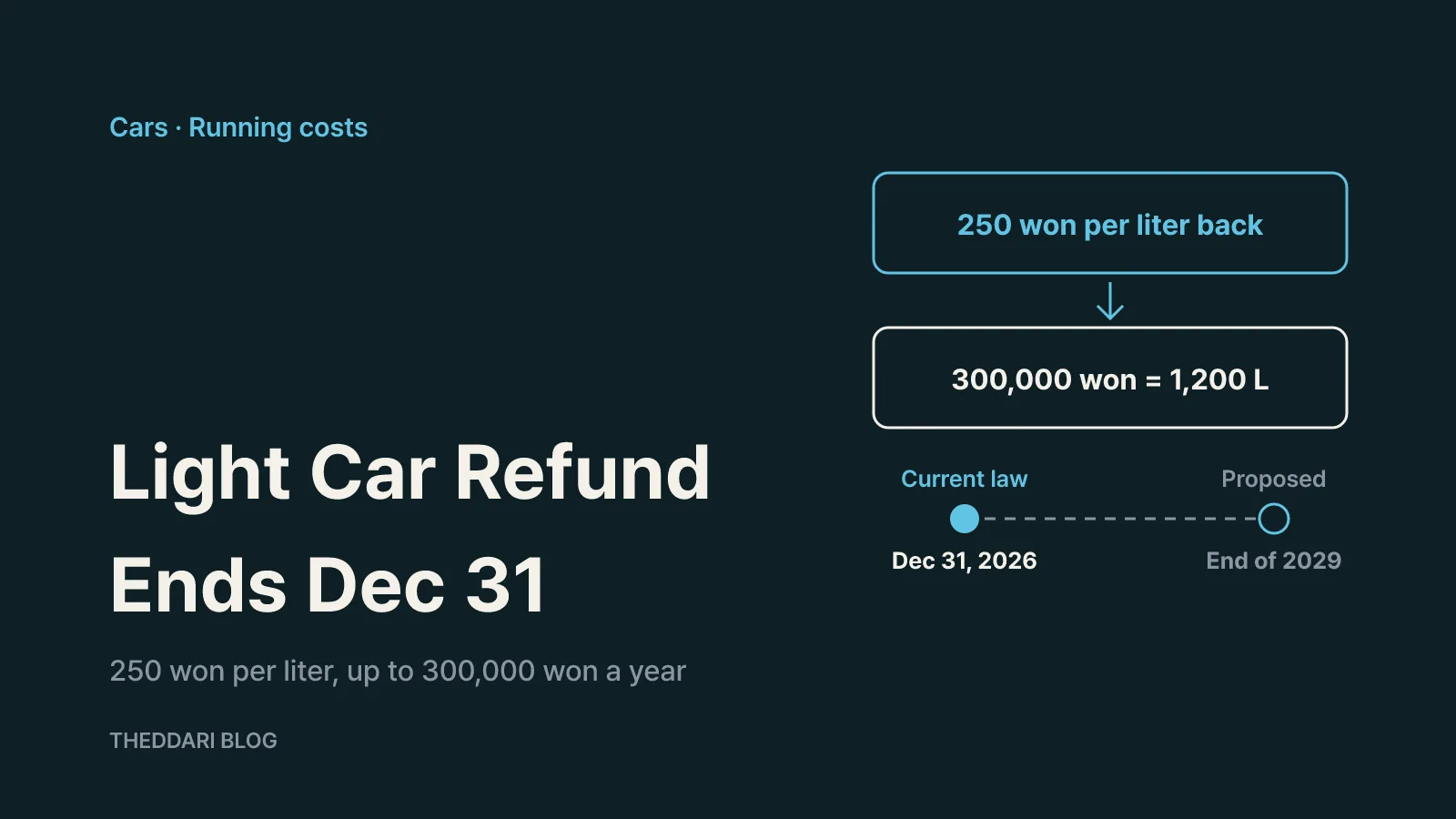
As of November 2026, Korea's light car fuel tax refund returns 250 won per liter of gasoline or diesel, capped at 300,000 won a year, and the law currently covers only fuel purchased by December 31, 2026. The government's 2026 tax reform package proposes extending the program to the end of 2029, but until the National Assembly amends the law, December 31 is the only confirmed end date. If you own a qualifying light car (a gyeongcha, under 1,000cc) and do not yet have the dedicated refund card, the practical question is whether you can still capture the last few weeks of this year's fill-ups.
When I break down running costs, I check the statute and official guidance before any card marketing. This guide is based on Article 111-2 of the Restriction of Special Taxation Act (version in force from September 18, 2026), the Korea Policy Briefing summary of the 2026 tax reform proposals, and the Government Call Center 110 explainer.
What the current law actually guarantees
The statute sets four things. The refund is the individual consumption tax on the fuel: 250 won per liter for gasoline and diesel, and the full individual consumption tax charged on butane (LPG) (Article 111-2(3)). The annual cap is delegated to a presidential decree, and official guidance describes it as 300,000 won per year (110 explainer). The refund applies to fuel bought for that vehicle through December 31, 2026 (Article 111-2(1)). And you must hold a refund fuel purchase card issued by a card company designated by the National Tax Service, from one card company only (Article 111-2(4)).
← Swipe to see more
| Item | Current rule |
|---|---|
| Gasoline / diesel | 250 won per liter |
| LPG (butane) | Full individual consumption tax charged |
| Annual cap | 300,000 won |
| Deadline | Fuel bought by Dec 31, 2026 |
| How you get it | Pay with the refund fuel purchase card |
This is not a lump sum paid at year end. The discount is applied each time you pay at the pump with the card: a credit card bills you the fuel price minus the per-liter amount, and a debit (check) card withdraws less from your account (110 explainer). The card company then claims the tax back from the tax office (Article 111-2(5)). Fuel you already paid for with an ordinary card is not refunded retroactively.
Who qualifies: the one-car test is per household
The vehicle must be a light car with engine displacement under 1,000cc. The law leaves vehicle details to the decree (Article 111-2(1)), and government guidance frames eligibility around light passenger cars and light vans (110 explainer). Your vehicle registration certificate shows the displacement and vehicle type.
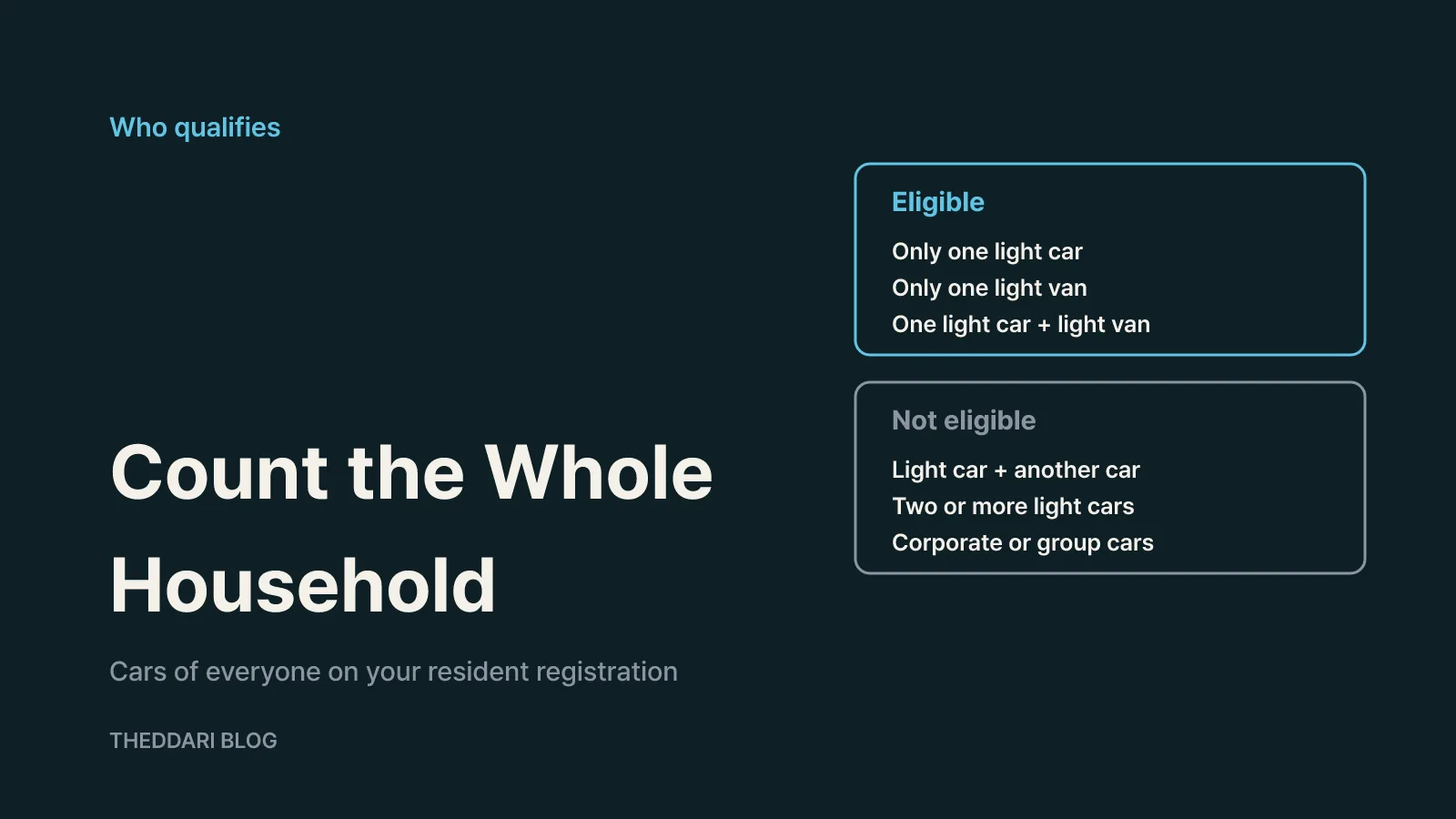
The part that trips people up is ownership. The test counts vehicles owned by you and the family members listed with you on the same resident registration. According to the 110 explainer:
- Eligible: the household owns only one light passenger car, only one light van, or exactly one of each.
- Not eligible: you already receive fuel subsidies as a person with a disability or a national merit recipient; the car is corporate or a group vehicle in a personal name; the household owns two or more light passenger cars or two or more light vans; a light passenger car is owned alongside another passenger car; or a light van is owned alongside another van.
So if you share a resident registration with a relative who owns a mid-size sedan, your single light car does not qualify. Two people who each drove a light car and then register their marriage become a two-light-car household, which can disqualify both under the current rule. That gap is one of the things the government now wants to fix (Policy Briefing). Households change through moves and marriages, so recheck before you keep using an older card.
How many liters fill the 300,000 won cap
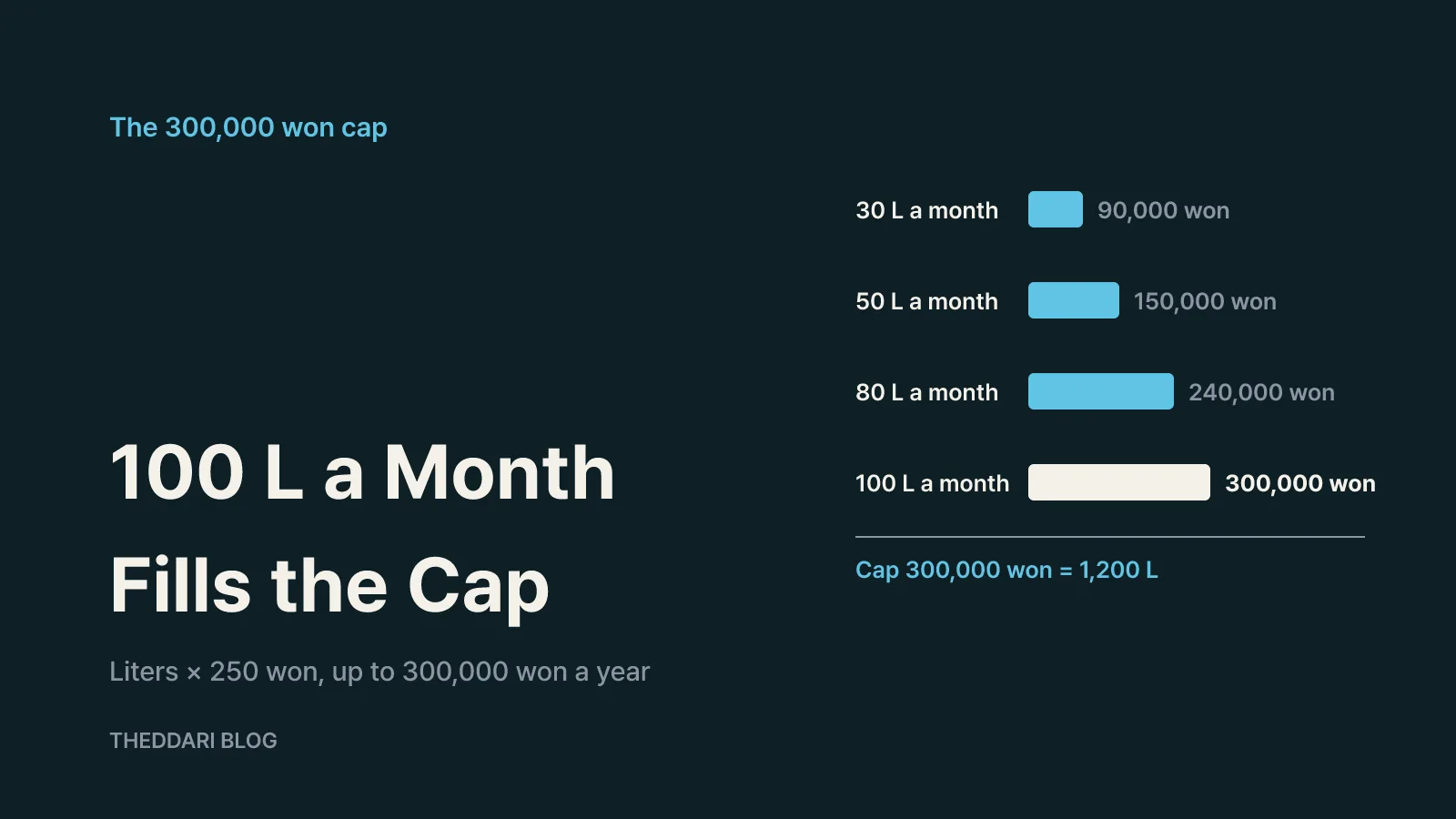
For gasoline or diesel the math is simple: 300,000 ÷ 250 = 1,200 liters a year bought with the card.
← Swipe to see more
| Monthly fuel | Yearly fuel | Yearly refund |
|---|---|---|
| 30 L | 360 L | 90,000 won |
| 50 L | 600 L | 150,000 won |
| 80 L | 960 L | 240,000 won |
| 100 L | 1,200 L | 300,000 won (cap) |
The cap only bites if you buy around 100 liters a month or more, so most commuter cars run out of fuel purchases before they run out of cap. There is no reason to drive more to "use up" the limit, because you are only refunded on fuel you actually pay for. From November 20 to December 31 there are roughly six weeks left; at 30 liters a week that is 180 liters, or 45,000 won. Official guidance describes the cap as annual and does not mention carrying unused room into the next year (110 explainer). For LPG cars the per-liter amount depends on the tax charged, so check the deduction on your card statement.
What to do before December 31
- Count household vehicles. List every car registered to anyone on your resident registration, split into passenger cars and vans. If any exclusion above applies, do not apply.
- Apply with one card company. The 110 explainer (written March 2025) lists Lotte Card, Shinhan Card and Hyundai Card, with applications online, by phone (Lotte 1899-9955, Shinhan 080-800-0001, Hyundai 1577-6982) or at a branch, using copies of your vehicle registration and ID (110 explainer). Check current annual fees and spending conditions on the application page.
- Allow time for verification and delivery. Eligibility is checked with the tax authorities before issuance, so a late-December application may leave little or no time to use the card this year.
- Use only that card, only for your light car. The deduction applies only to purchases on the card.
- Existing cardholders: check your year-to-date total in your card statement or with customer service.
The National Tax Service consultation line is 126.
After 2026: the proposed extension to 2029
The government's 2026 tax reform package proposes extending the light car fuel tax refund, still capped at 300,000 won a year, to the end of 2029, and letting a household that ends up with two light cars through marriage claim the refund for one of them (Policy Briefing). The briefing itself labels these as proposals: a tax bill takes effect only after the National Assembly passes it and the law is amended.
The statute text I checked on the national law database (in force from September 18, 2026) still reads "until December 31, 2026" (Article 111-2(1)). If no amendment is promulgated, fuel bought from January 1, 2027 will not qualify under this article. The final deadline or amounts could also differ from the government proposal, so confirm the year-end result through National Tax Service or card company notices. There is no need to cancel your card now; decide after the outcome is known.
Card rules: the 40% penalty and the duty to return
The penalties are heavier than most drivers expect (Article 111-2(6)–(10)):
- Using the fuel for anything other than that car: the refunded tax is clawed back plus a 40% penalty, and you are removed from the program from the date this is discovered.
- Lending or transferring the card: the holder is removed, and anyone who uses a transferred card pays the refunded tax plus 40%.
- Using it after you stop qualifying: if you sell the car or your household gains another vehicle, return the card to the card company immediately. Using it afterward triggers the same refund-plus-40% collection.
For example, 100,000 won refunded while ineligible becomes 140,000 won owed. Filling up a relative's car even once can count as non-qualifying use, so treat the card as dedicated to your own light car.