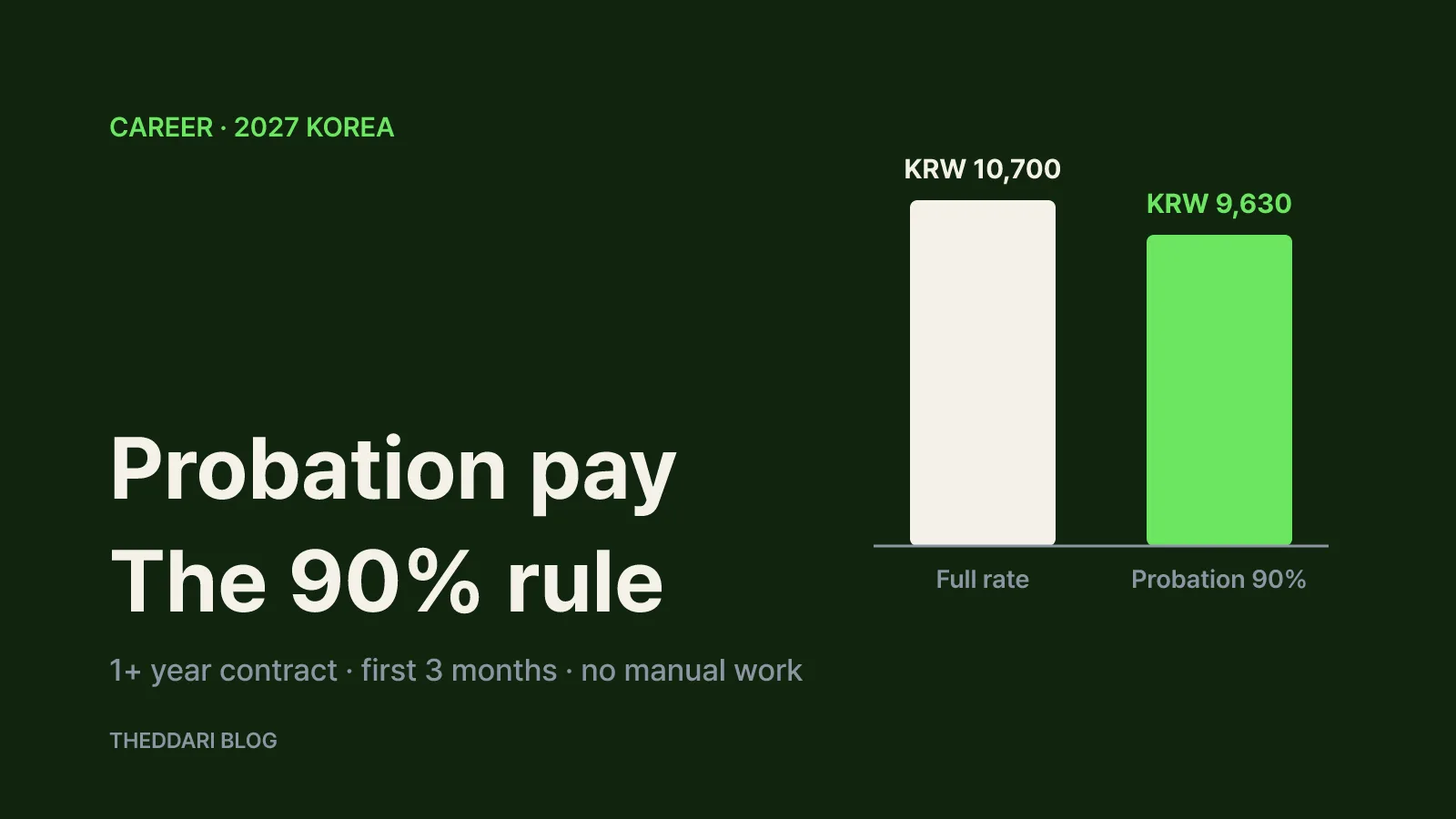
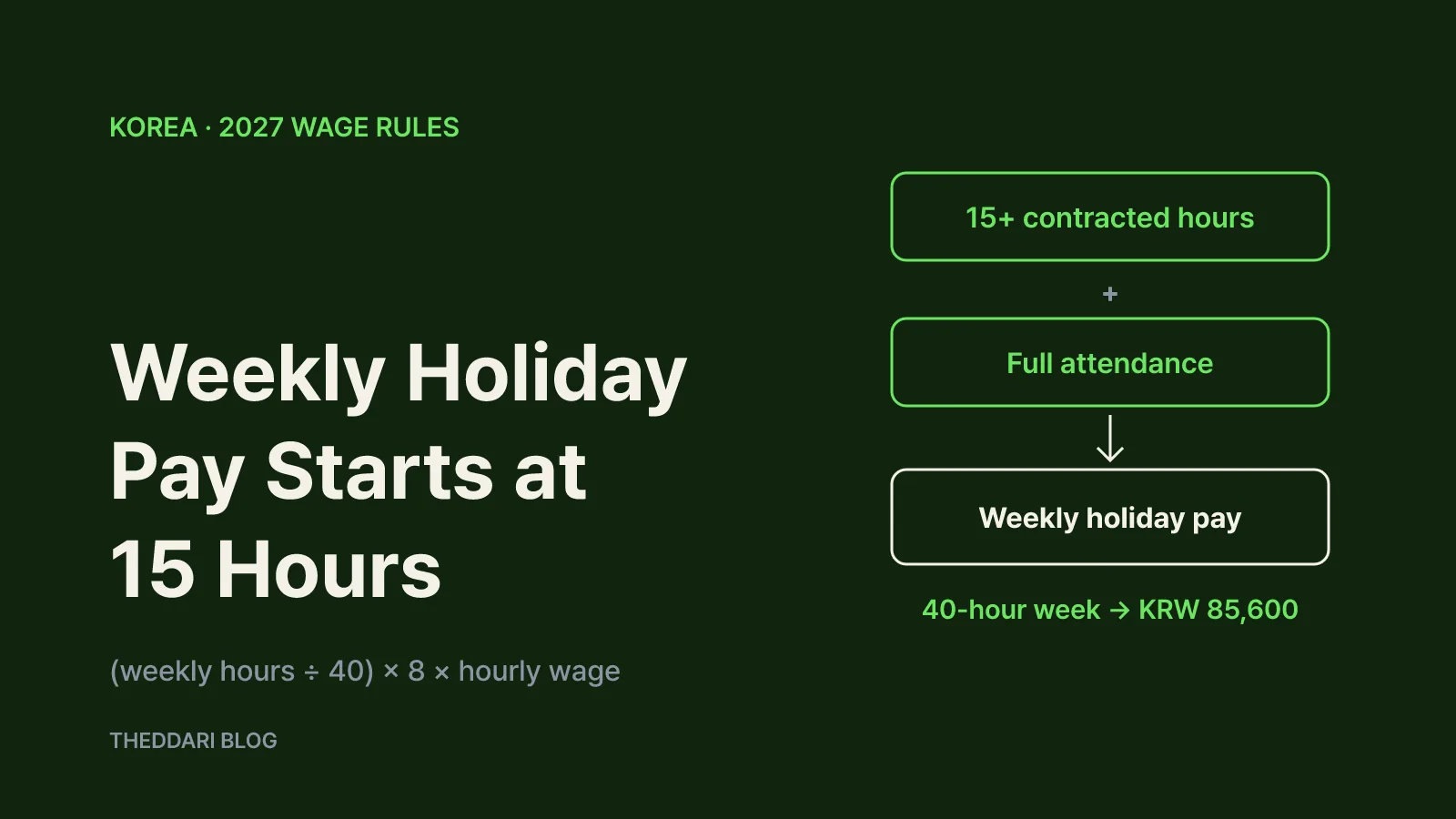
As of November 2026, the short answer is this: in South Korea, an employee earns weekly holiday pay (juhyu sudang) when their employment contract sets at least 15 contractual working hours per week and they attend every workday scheduled for that week. The amount is (weekly contractual hours ÷ 40) × 8 × hourly wage, capped at eight hours. From January 1, 2027, the national minimum wage is KRW 10,700 per hour, according to the Ministry of Employment and Labor. At that rate, a full-time worker on 40 hours a week is owed KRW 85,600 of weekly holiday pay. A 15-hour contract earns KRW 32,100; a 14-hour contract earns nothing.
If you are a foreign student, working-holiday visitor or anyone taking a part-time job in Korea, this is the line item most likely to be missing from your payslip. It is a statutory entitlement under Korea's Labor Standards Act, not a bonus, and it applies to part-timers as well as full-time staff. The guide below follows the ministry's own counseling answers: check eligibility, run the numbers, then look at the exceptions.
The three conditions for weekly holiday pay
The Ministry of Employment and Labor summarises eligibility in three parts (1350 counseling answer), based on Article 55(1) of the Labor Standards Act and Article 30(1) of its Enforcement Decree:
- You are an employee under the Labor Standards Act. Part-time, fixed-term and hourly workers all count if they work under an employer's direction. Workplaces with fewer than five employees are also covered by the weekly paid holiday rule.
- Your contractual working hours average 15 or more per week over four weeks. "Contractual working hours" (sojeong geunro sigan) means the hours both sides agreed to when signing, within the legal limits of 8 hours a day and 40 hours a week.
- You attended every contractual workday that week. If your contract says Monday, Wednesday and Friday, showing up on those three days is perfect attendance.
The second condition causes the most confusion. The test is the hours in your contract, not the hours you actually worked. If your contract says 12 hours and your manager asks you to cover 20 hours one week, that week does not automatically trigger holiday pay; the ministry treats the extra time as additional work to be paid separately. Equally, if your contract says 20 hours and you are sent home early on a slow day, eligibility is still judged on the 20 contracted hours.
The attendance condition is narrower than it sounds. The ministry defines an absence as a scheduled day on which the worker voluntarily did not work. Arriving late or leaving early is not an absence, so it does not cancel or reduce that week's holiday pay. Days off caused by the employer, public holidays and statutory leave are not treated as absences either.
The formula and 2027 amounts
The ministry calculates the payment as "one day's contractual hours × hourly wage." Where daily hours vary, or where the worker is part-time, one day is treated as hours proportional to a 40-hour week (online counseling answer). That gives a single working formula:
Weekly holiday pay = (weekly contractual hours ÷ 40) × 8 × hourly wage
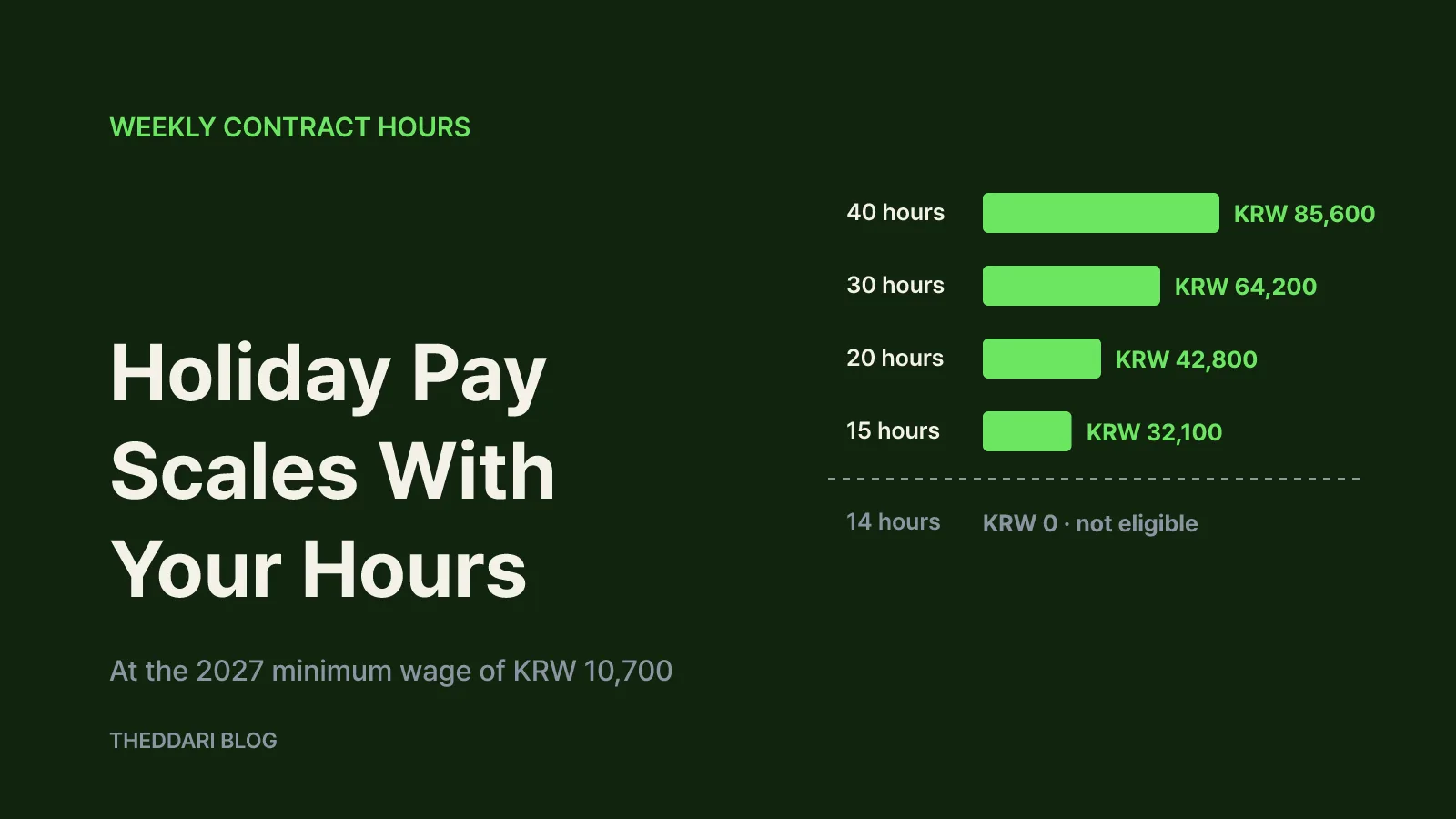
At the 2027 minimum wage of KRW 10,700:
← Swipe to see more
| Weekly contract | Paid holiday hours | Weekly holiday pay |
|---|---|---|
| 40 hours (8 h × 5 days) | 8 | KRW 85,600 |
| 30 hours (6 h × 5 days) | 6 | KRW 64,200 |
| 20 hours | 4 | KRW 42,800 |
| 18 hours (Mon/Wed/Fri, 6 h each) | 3.6 | KRW 38,520 |
| 15 hours | 3 | KRW 32,100 |
| 14 hours | Not eligible | KRW 0 |
One pattern is worth remembering. Once you qualify, holiday pay always adds 20% to the wages for the hours you worked, because (h ÷ 40 × 8) ÷ h = 0.2. A minimum-wage worker who qualifies therefore takes home the equivalent of KRW 12,840 per hour worked in 2027. A 15-hour week pays KRW 160,500 plus KRW 32,100, or KRW 192,600 in total; a 14-hour week stops at KRW 149,800.
The ministry's own example for a Monday-Wednesday-Friday worker on six-hour shifts in a five-day workplace computes one day as 18 hours × 4 weeks ÷ 20 days = 3.6 hours, which is identical to 18 ÷ 40 × 8. For someone who works the same hours every day, such as six hours a day for five days, one day's contractual hours simply equal the daily shift.
For 2026 wages, swap in the 2026 minimum wage of KRW 10,320; a 40-hour week then yields KRW 82,560.
When your hours change week to week
Shift and rota work often means contractual hours vary by week. In that case the ministry tells employers to average the previous four weeks at each weekly holiday to decide whether the 15-hour threshold is met. During the first one to three weeks, average over only the weeks completed so far. From week five, divide the previous four weeks' total by four.
Suppose your rota sets 12, 20, 16 and 18 hours across four weeks. The total is 66 hours, an average of 16.5, so you clear the threshold. Using that average, week four's holiday pay would be 16.5 ÷ 40 × 8 = 3.3 hours. Contract formats differ between workplaces, so check how your contract records weekly hours before relying on a calculation like this.
Cases where pay is not owed or is often misunderstood
The ministry's counseling answers point to these situations:
- Under 15 hours a week: Workers averaging fewer than 15 contractual hours per week over four weeks are excluded; Article 18(3) of the Labor Standards Act disapplies the weekly holiday rule.
- A week with an absence: Voluntarily missing any scheduled day removes that week's holiday pay. Lateness and early departure do not count.
- The week you leave: The entitlement assumes the employment relationship lasts the full seven-day week. If your employment ends before the seventh day, the ministry's view is that no holiday pay arises for that week. Still being on the books on the seventh day, even a day off, counts as a full week.
- Contracts shorter than seven days: A two- to four-day gig does not generate weekly holiday pay.
- The week you start: It arises after you complete a full seven days.
- A week taken entirely as annual leave: Leave counts as attendance, but if you did not actually work any day that week, the ministry says holiday pay need not be paid.
- Approved surveillance or intermittent work: Roles such as certain security posts, where the employer holds ministry approval, are excluded from the holiday rules.
Salaried staff, payslips and what to do if you were underpaid
Salaried employees rarely see a separate line because the payment is built into the monthly salary. The ministry's monthly minimum wage of KRW 2,236,300 for 2027 is based on 209 hours a month, which converts a 40-hour week plus 8 paid holiday hours into a monthly figure. To test a salary, divide it by 209 and compare the result with the hourly minimum. A 40-hour salary below KRW 2,236,300 in 2027 falls short of the minimum once holiday pay is included.
Hourly workers should look for a separate "weekly holiday pay" item on their payslip or a statement that it is included in the hourly rate. If it is bundled in, divide the rate by 1.2: in 2027, an all-in rate below KRW 12,840 deserves a second look.
If you believe you were underpaid, work through these steps:
- Find the weekly contractual hours and workdays in your employment contract.
- Check each week for voluntary absences and confirm you were employed for the full seven days.
- Calculate each week with the formula and keep timesheets, rotas and bank records.
- Show the calculation to your employer and ask for the shortfall.
- If that fails, call the ministry's 1350 helpline or file a petition with the regional labor office.
Wage claims in Korea expire after three years, so older shortfalls are worth raising promptly. The ministry notes that its counseling answers are general guidance, and fact-specific disputes are decided by the regional labor office.