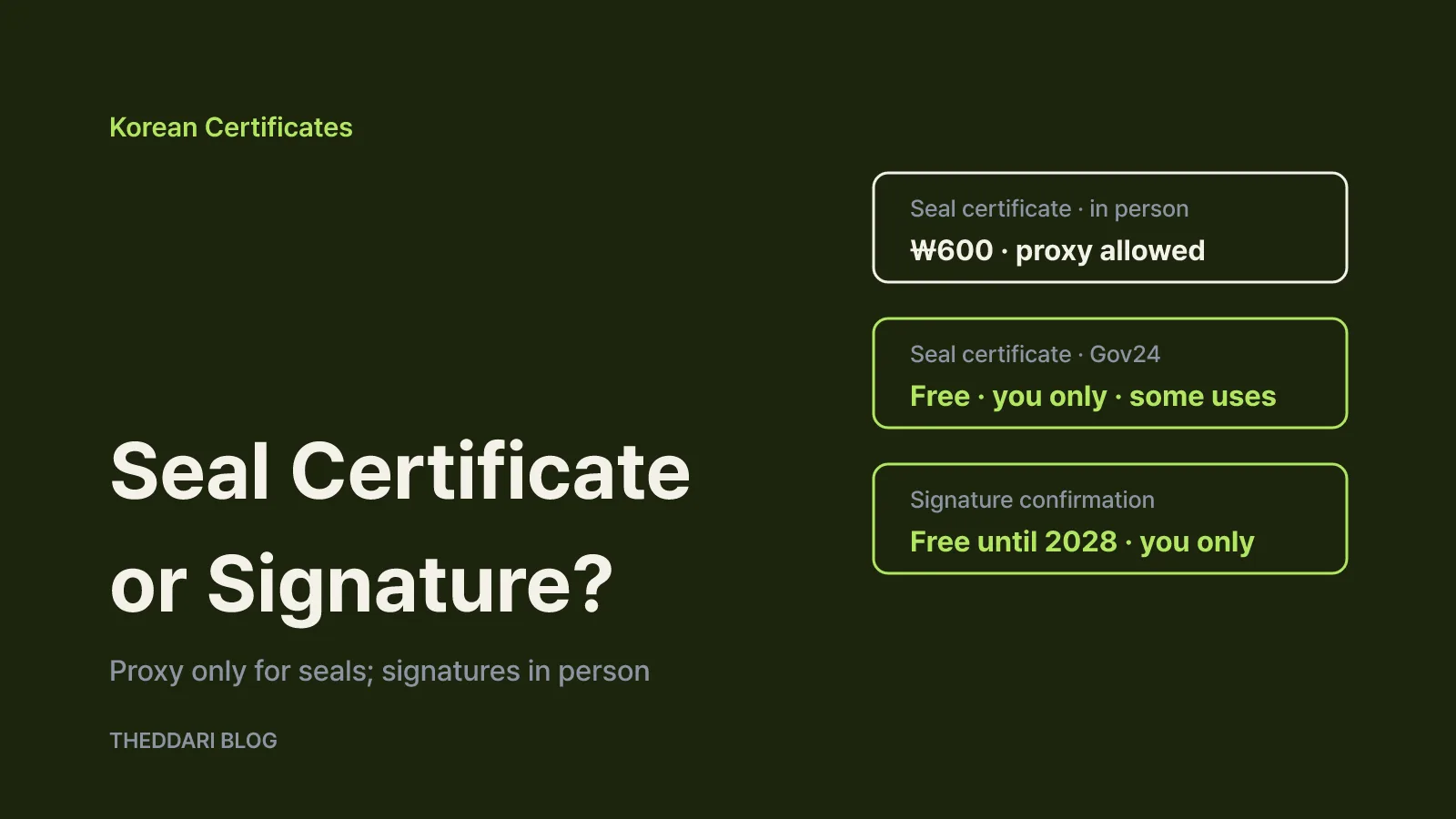
As of November 2026, the short answer is this: a Korean seal certificate (ingam jeungmyeongseo) costs ₩600 per copy at a community service center and nothing when you print it yourself on Gov24, and a proxy holding a power of attorney can collect it at the counter. A signature confirmation (bonin seomyeong sasil hwaginseo) carries the same legal effect, normally costs ₩600, but is free until December 31, 2028. The catch is that you must appear in person and sign on an electronic pad; nobody can request it for you (Gov24 signature confirmation guide).
This guide is for anyone who has been asked for an "ingam" while selling a car or apartment in Korea, signing a power of attorney, or handling paperwork for a parent. It covers which document to choose, when the online route works, and what a proxy has to bring.
How the two documents differ
Both documents prove that a stamp or a signature on a contract or power of attorney really reflects your own intention. Under Article 13 of the Act on Confirmation of Personal Signatures, when a law or transaction calls for a seal certificate, submitting a signature confirmation counts as submitting a seal certificate, and signing the related document counts as stamping your registered seal (Michuhol-gu signature confirmation guide).
The differences lie in preparation and issuance:
← Swipe to see more
| Item | Seal certificate | Signature confirmation | Electronic signature confirmation |
|---|---|---|---|
| Prior step | Register your seal at your local office | None | One-time approval for the issuing system |
| Who can apply | You or a proxy | You only | You only |
| Where | In person; some uses on Gov24 | In person at an issuing office | Dedicated website |
| Fee | ₩600 in person, free on Gov24 | ₩600, waived until Dec 31, 2028 | Free |
| Processing | Immediate (within 3 working hours) | Immediate (within 3 working hours) | Immediate |
Fees and eligibility follow the Gov24 seal certificate page and the signature confirmation page. The signature confirmation waiver runs from April 2, 2024 to December 31, 2028, so check the fee again if you need one in 2029 or later.
The most practical difference is the registered seal. A seal certificate only exists if you registered a physical stamp at your address's community service center beforehand, and you must stamp that same seal on the document you submit. A signature confirmation needs no prior registration; an ID card is enough. If you never registered a seal or lost it, the signature route saves a trip.
When Gov24 issues a seal certificate for free
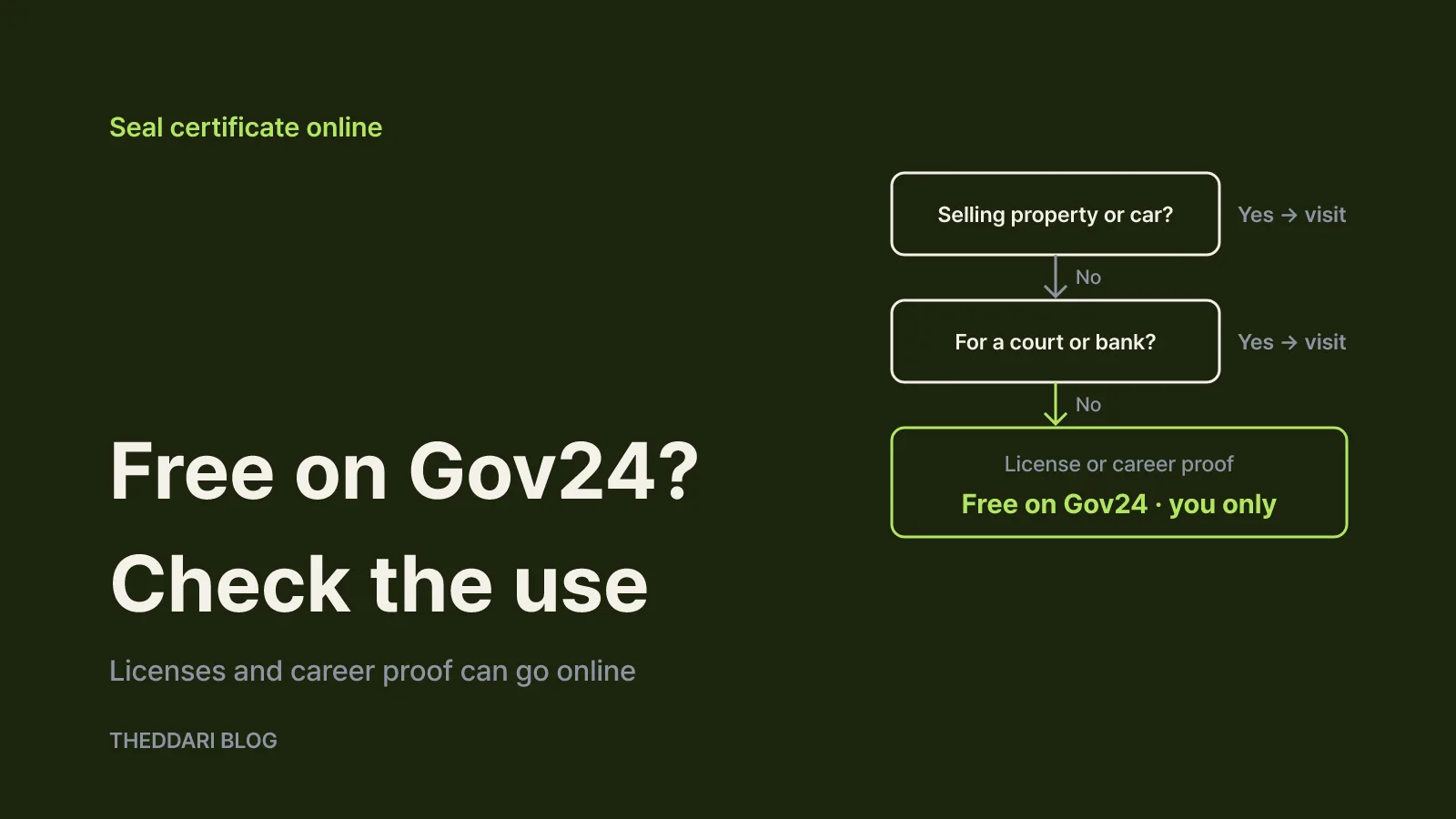
Online issuance began with a pilot on September 30, 2024 and became a regular service from November 1, 2024. According to the Ministry of the Interior and Safety, it covers only general-purpose certificates that are not for selling real estate or a vehicle and not for submission to a court or financial institution. Typical eligible uses are license applications, proof of career history and subsidy applications (Korea.kr policy briefing).
You still need the counter for:
- Real estate sale certificates
- Vehicle sale certificates
- General-purpose certificates going to a court, such as for property registration, collateral or deposits
- Certificates going to a bank or other financial institution, such as for a loan
The same briefing reported 29.84 million seal certificates issued in 2023: 1.34 million for real estate sales (4.5%), 1.82 million for vehicle sales (6.1%) and 26.68 million general-purpose (89.4%). The government expected about 5 million a year, roughly 20% of the general-purpose volume, to move online. In other words, most situations still require a visit.
To apply online:
- Open Gov24 on a PC. You do not need a Gov24 membership.
- Complete combined authentication: a joint certificate or financial certificate plus mobile phone identity verification.
- Enter the purpose and the receiving organization.
- You are notified by the government's notification service or text message, and the printout can be used right away.
Online copies carry a 16-digit document number and a barcode so the recipient can verify them on Gov24. Only the seal holder can apply online; a proxy cannot.
Getting a seal certificate in person, alone or by proxy
You can apply at any city, county or district office, community service center or branch office nationwide, regardless of your registered address. The fee is ₩600 per copy (Gov24 seal certificate page).
If you go yourself, show one valid ID: resident registration card, driver's license, disability registration card showing a resident registration number, passport, or a veterans' registration card. Foreign residents show an alien registration card (or permanent residence card); overseas Koreans with a domestic residence report show that report card.
If someone goes for you, they need:
- Their own ID
- A power of attorney on Form 13 of the Enforcement Decree of the Certification of Seal Impressions Act
- Your ID
The form can be downloaded from the Gov24 service page. For a minor or an adult under guardianship, bring the IDs of both the applicant and the legal representative or guardian plus the consent form; limited and adult guardians also submit a guardianship registration certificate.
For a Korean national living abroad, the power of attorney must be confirmed by the Korean embassy or consulate with jurisdiction over the place of residence. For a real estate sale certificate, add a confirmation from the head of the tax office covering the last domestic address or the property location. Because these papers travel internationally, start well before the closing date.
Requesting a signature confirmation and avoiding mistakes
There is no application form. Bring your ID to a city, county or district office or community service center. The steps listed by Michuhol-gu are:
- Visit in person and verify your identity with your ID, or by fingerprint if the ID is not sufficient.
- Sign the prescribed form, writing your name legibly enough for a third party to read.
- Fill in the purpose and the delegate, if someone will submit it for you, and receive the confirmation.
- Submit it to the recipient.
Ask the recipient in advance exactly what to write in the purpose field, especially for a sale. A minor applies with the legal representative's ID and a consent form (Form 1 of the signature act's enforcement decree); a minor without ID only needs the representative's ID. A person under limited guardianship adds the guardian's ID, the consent form and a registration certificate, and a Korean national abroad selling real estate needs a tax office confirmation (Gov24 signature confirmation guide).
Above all, proxy issuance is not possible. If you are hospitalized or overseas, prepare a seal certificate through a proxy instead.
Where the electronic signature confirmation fits
The electronic version is free and self-issued through its own website, but the first use requires a visit to a community service center to apply for system approval. Michuhol-gu notes that the organizations accepting it are limited to public bodies (Michuhol-gu guide). For a bank, insurer or private buyer, bring a paper signature confirmation or a seal certificate instead.
Which one to choose in common situations
- License application or career proof: print a seal certificate on Gov24 for free and state the purpose and recipient accurately.
- Selling a home or car: online is not available. Ask the buyer or registration agent which document they accept, then visit for a seal certificate (₩600) or a signature confirmation (free until December 31, 2028).
- Bank loan or insurance claim: Gov24 seal certificates are excluded. Get either document at the counter.
- Collecting papers for a parent: choose the seal certificate, with Form 13 and both IDs.
- No registered seal: if you can go in person, the signature confirmation is the faster route.
Before you leave, ask the recipient three things: which document they accept, whether there is an issue-date limit, and what belongs in the purpose field. For policy questions, the ministry's Resident Division is at 044-205-3151; for Gov24 help, call 1588-2188.