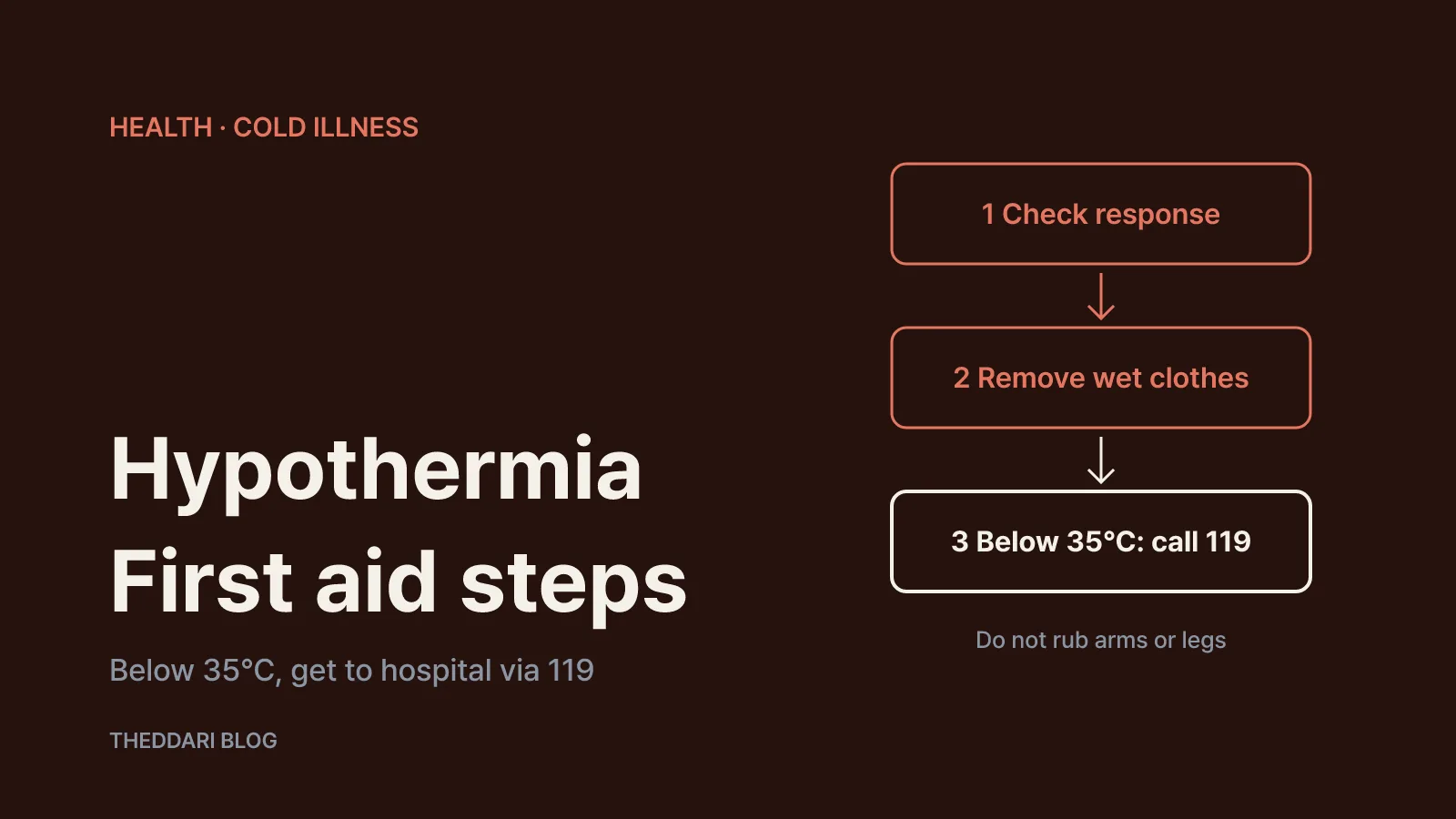
As of November 2026, the short answer is this: if someone has been out in the cold and is shivering, slurring their words, unusually tired or confused, treat it as possible hypothermia. Get them somewhere sheltered, take off wet clothing, wrap them in a dry blanket and call emergency services. The NHS defines hypothermia as a dangerous drop in body temperature below 35°C (normal is around 37°C) and treats it as a medical emergency. Korea's disease agency gives the same threshold: if body temperature appears to be under 35°C, keep warming the person on the spot and send them to hospital by calling 119, according to the KDCA National Health Information Portal.
This guide puts two public sources side by side: the Korea Disease Control and Prevention Agency (KDCA), which runs a winter emergency-room surveillance system for cold-related illness, and the UK's NHS. Where they agree, the advice is straightforward. Where they word things differently, I point it out so you can act sensibly in the moment. The emergency number used here is Korea's 119; in the UK the NHS directs people to A&E or 999.
Hypothermia symptoms to watch for
The KDCA lists chills, fatigue, confusion, memory problems and difficulty speaking as typical signs. The NHS adds detail: shivering; pale, cold and dry skin; lips or skin turning blue or grey; slurred speech; slow breathing; and tiredness or confusion. Most people will not have a thermometer handy, so a practical rule is to combine two observations. The person has been exposed to cold, and their speech or behavior is not normal. When both are true, act as though it is hypothermia.
Babies and older adults look different
Infants do not always shiver. The KDCA notes that babies under one year may have bright red, cold skin or may barely move. The NHS describes a hypothermic baby as cold to the touch, floppy, unusually quiet and sleepy, and possibly refusing to feed. Red cheeks do not mean a baby is warm enough.
Older adults, especially those living with dementia or other cognitive impairment, may not say they feel cold or think to add layers. A slow, vague or muddled manner may be the first clue. Korea's latest winter data shows why this group deserves extra attention.
What Korea's 2025–26 winter data shows
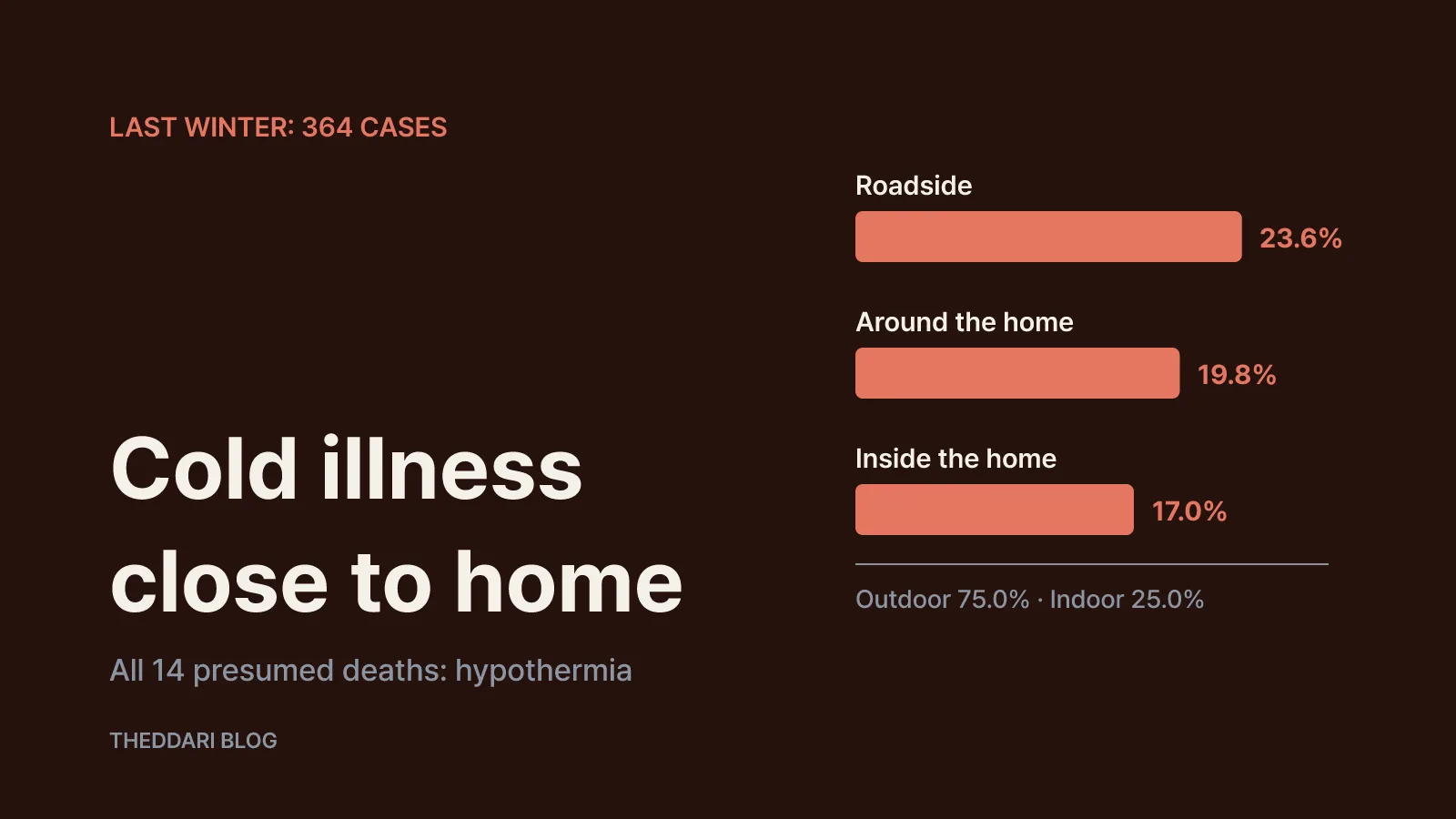
According to a KDCA press release dated March 10, 2026, emergency departments reported 364 cases of cold-related illness between December 1, 2025 and February 28, 2026, including 14 presumed deaths. That is 1.09 times the previous season's patient count (334) and 1.75 times its deaths (8). As of December 1, 2025, 512 emergency medical institutions took part in the surveillance system.
- Hypothermia dominates. It accounted for 79.7% of cases (290 people), and all 14 presumed deaths were attributed to hypothermia rather than frostbite or other local cold injuries.
- Age matters most. People aged 65 and over made up 57.4% of patients (209) and 78.6% of presumed deaths (11). Those aged 80 and over alone accounted for 32.4% of patients (118) and 57.1% of presumed deaths (8).
- Cognitive impairment. Five of the 14 presumed deaths (35.7%) involved dementia or another cognitive impairment.
- Men were affected more often. Men were 64.6% of patients (235) and women 35.4% (129).
Where and when it happened
Three in four cases happened outdoors: 75.0% (273) versus 25.0% indoors (91). The most common locations were the roadside (23.6%, 86), the area around the person's home (19.8%, 72) and inside the home itself (17.0%, 62). Among people 65 and over, the order shifted to around the home (27.3%, 57), roadside (24.4%, 51) and at home (22.0%, 46). In other words, most cases were not on mountains or ski slopes but within everyday routines.
Timing clustered in the morning: 20.9% of cases (76) occurred between 6 and 9 a.m., and 15.7% (57) between 9 a.m. and noon. The KDCA links this to temperatures that fall overnight. Gyeonggi Province had the largest share of patients (19.5%, 71), while Gangwon had the highest rate per 100,000 residents (2.1), followed by North Gyeongsang (1.7) and North Chungcheong (1.5).
Hypothermia first aid, step by step
The KDCA stresses that people nearby noticing early is what matters most. If you find someone who may be hypothermic:
- Check responsiveness. If they do not respond or are drowsy and confused, call 119 straight away.
- Move them out of the cold. Indoors is best; any sheltered spot out of the wind helps.
- Remove wet clothing. Change them into dry clothes, then wrap them in a dry blanket or sleeping bag. The NHS says to make sure the head is covered.
- Warm the trunk. The KDCA suggests placing heat packs or a warm water container in the armpits and on the abdomen, and says hugging the person is also effective if nothing else is available.
- Offer a warm drink only if fully awake. The NHS recommends a warm, non-alcoholic drink and something sugary such as chocolate for people who are fully alert. If they are drowsy or unconscious, do not try to make them drink; focus on keeping them warm until help arrives.
- Stay with them. Keep talking so they stay awake, and do not leave them alone.
- Below 35°C means hospital. The KDCA says mild cases may only need a blanket, but if body temperature seems to be under 35°C the person should go to hospital by ambulance. If you cannot tell, choose the hospital.
Three things not to do
The NHS lists actions that will not help and could make things worse: do not use a hot bath, hot water bottle or heat lamp to warm the person; do not rub their arms, legs, hands or feet; and do not give them alcohol.
The two agencies word one point differently. The KDCA mentions heat packs or a warm water container on the armpits and belly, while the NHS advises against hot water bottles. What both agree on is the core message: do not try to warm someone quickly by rubbing their limbs or putting them in a hot bath. Wrap the body, concentrate warmth on the trunk, and hand over to paramedics as quickly as possible.
Frostbite first aid: 38–42°C water for 20–40 minutes
Frostbite is a local cold injury to part of the body, most often fingers, toes, ears or the face. Skin may first hurt or turn red. The KDCA says to suspect frostbite if any one of these is present: skin that turns white or yellowish-grey, skin that feels abnormally hard, or reduced sensation.
The KDCA's first aid sequence is:
- Move the person to a warm place, remove wet clothing and wrap the whole body in a warm blanket.
- Immediately soak the affected area in warm water of about 38–42°C for 20–40 minutes. Unaffected areas that end up in the water only need a temperature that feels comfortable.
- For ears or the face, apply warm, damp cloths and change them often.
- Place clean, dry gauze between fingers and toes to absorb moisture and stop them sticking together.
- Raise the affected area slightly to reduce pain and swelling.
- If the legs or feet are affected, do not let the person walk even after thawing; carry them on a stretcher.
- Get them to hospital promptly. Rewarming at home is not the end of treatment.
If someone has both hypothermia and frostbite, deal with the life-threatening problem first: check responsiveness, call 119 and warm the whole body. Treat the frostbitten area afterward.
Who is most at risk, and a winter checklist
The KDCA's hypothermia risk groups are older adults living alone, infants and young children, people experiencing homelessness, anyone who falls asleep outdoors after alcohol or drugs, people with cardiovascular or cerebrovascular disease, and people with high blood pressure. Frostbite risk rises with circulation problems and when people cannot dress properly for severe cold.
Based on the data and agency guidance above, a practical checklist looks like this:
- Before going out: check the wind chill and cut back outdoor activity on very cold days. Because cases peaked in the morning, consider delaying early outings.
- Clothing: wear thin layers plus gloves, a scarf and a hat. Change out of wet clothes or shoes right away.
- At home: keep indoor temperatures adequate. In Korea last winter, 17.0% of cases happened inside the home.
- Alcohol: avoid walking home alone or dozing outdoors after drinking.
- Family members with dementia: check their clothing and room temperature, and watch for solo outings in the cold. Five of last winter's 14 presumed deaths involved cognitive impairment.
In the last season, Korea's cold-illness surveillance ran from December 1 to the end of February, with daily case updates on the KDCA website. Check the KDCA site for this winter's schedule and figures. For transparency on dates: the KDCA first aid page I read was updated on June 2, 2026, and the NHS hypothermia page shows a last review date of June 2023.