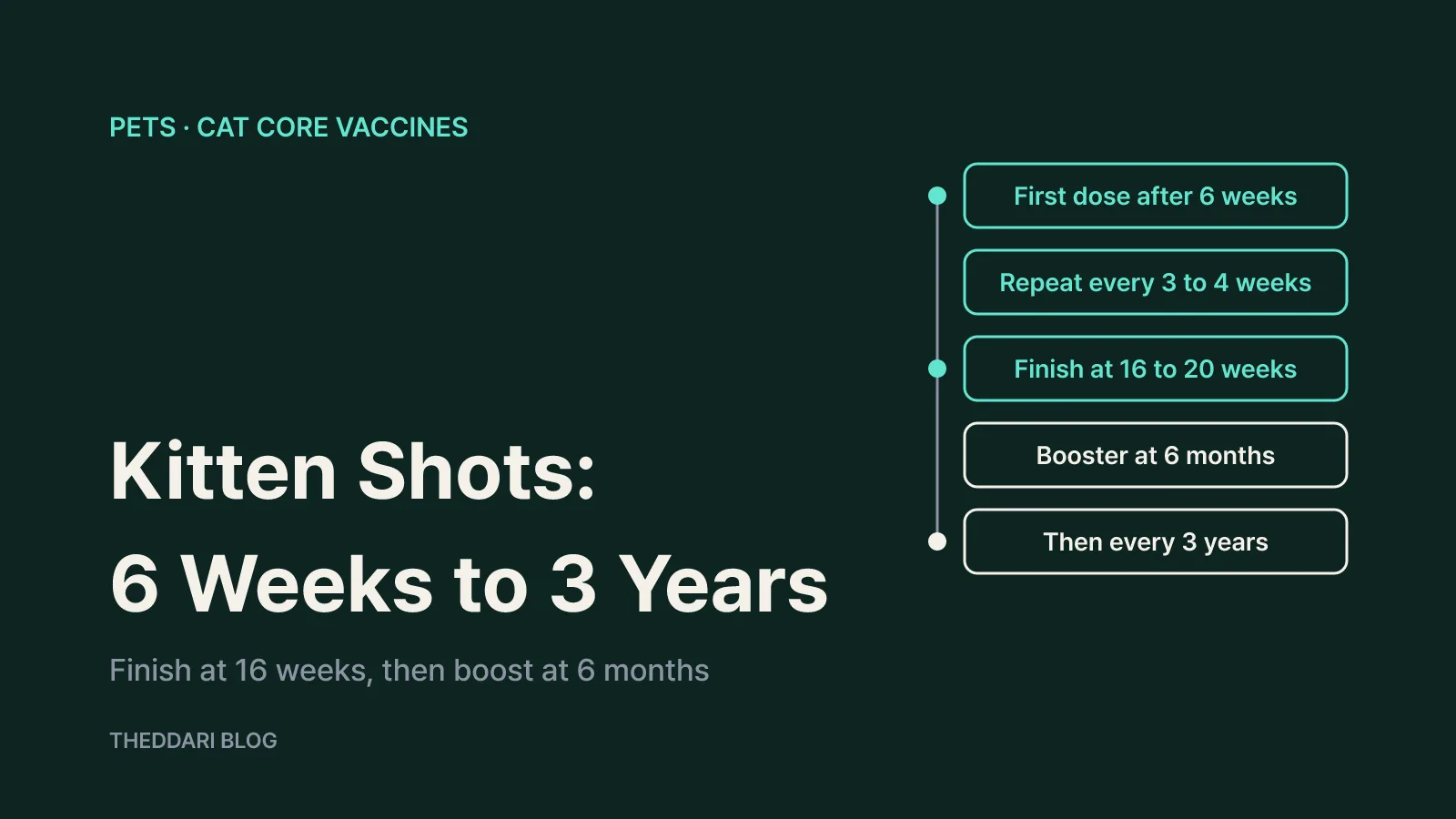
As of November 2026, the short answer is this: a kitten's core combination vaccine (feline panleukopenia, feline herpesvirus-1 and feline calicivirus, often sold as FVRCP) should start no earlier than 6 weeks of age and be repeated every 3 to 4 weeks until the kitten is 16 to 20 weeks old. The joint 2020 AAHA/AAFP Feline Vaccination Guidelines then recommend considering another dose at about 6 months instead of waiting until the first birthday, followed by revaccination every 3 years. Feline leukemia (FeLV) and rabies run on separate clocks, which is where most owners lose track.
There is no fixed number of "kitten shots." What matters is the age at the first dose, the gap between doses, and whether the final kitten dose lands at 16 weeks or later. Use this guide to build the calendar, then confirm the plan with the veterinarian who examines your cat.
The FVRCP kitten series: start after 6 weeks, finish at 16 to 20 weeks
The AAHA/AAFP task force lists FHV-1, FCV, FPV, rabies and FeLV (for cats younger than 1 year) as core vaccines for pet cats, and the guidelines overview adds that core vaccines are for every cat with an unknown vaccination history. The first three are usually given together in one injection.
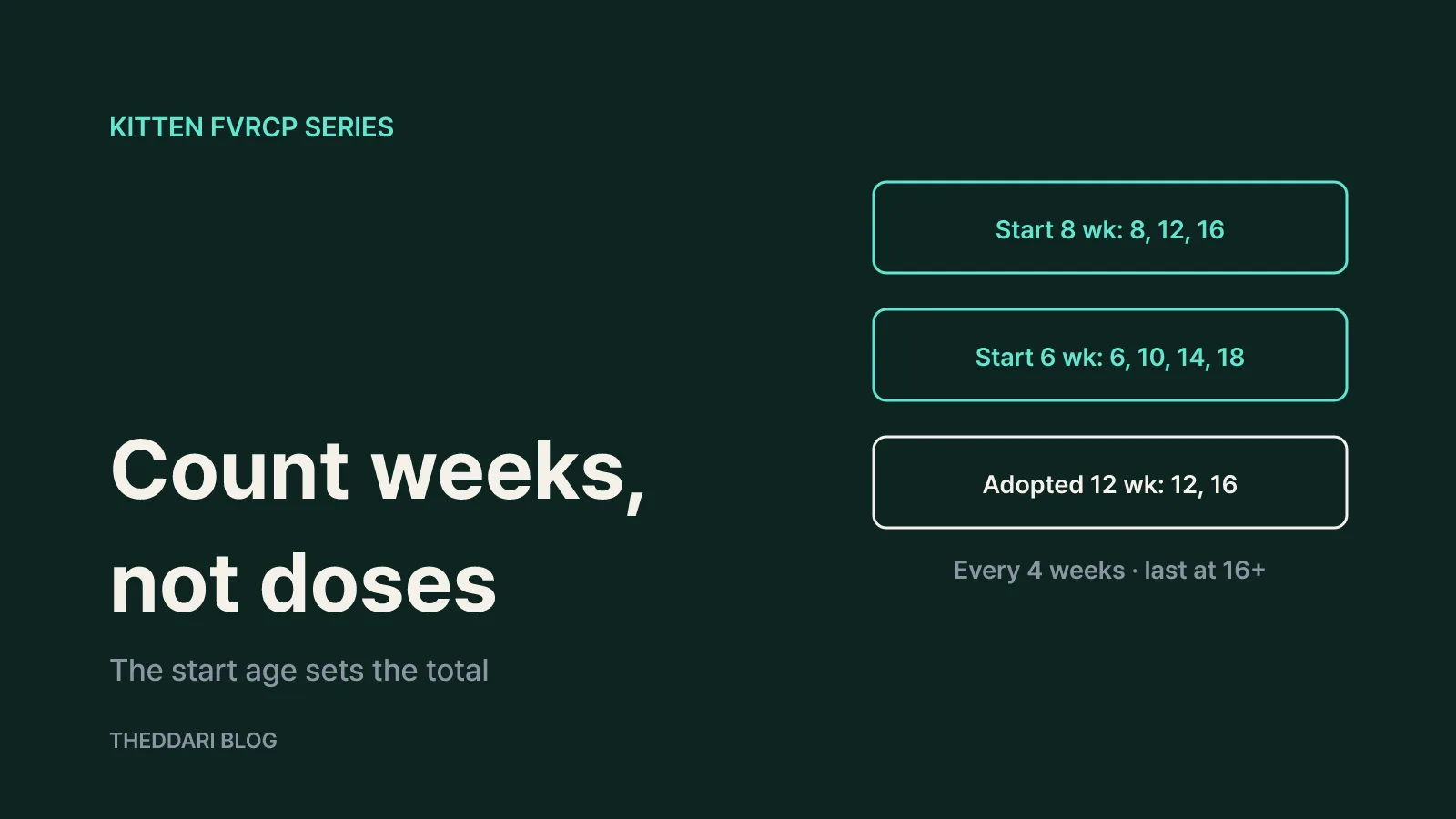
The reason for repeated doses is maternal antibody. Antibodies a kitten receives from its mother can block a vaccine, and nobody knows exactly when they fade in a given kitten. Spacing doses 3 to 4 weeks apart until 16 to 20 weeks makes sure at least one dose arrives after that interference is gone. That is why the total count depends on when you start:
- Start at 8 weeks, every 4 weeks: 8, 12 and 16 weeks. Three doses meet the 16-week mark.
- Start at 6 weeks, every 4 weeks: 6, 10, 14 and 18 weeks. Stopping at 14 weeks would leave no dose after 16 weeks.
- Adopted at 12 weeks, every 4 weeks: 12 and 16 weeks, then move on to the 6-month dose.
When you log shots, write the kitten's age in weeks next to each date. It makes it obvious whether the last dose was late enough, and it helps the clinic decide what to do if a gap stretched beyond 4 weeks.
The 6-month booster and the 3-year rhythm after it
Finishing the kitten series does not jump you straight to a 3-year cycle. The guidelines suggest considering revaccination at about 6 months of age rather than 1 year. A minority of kittens may still carry maternal antibody at their last kitten dose and fail to respond; the 6-month dose narrows that window of susceptibility.
After that, injectable core vaccines, whether modified-live or inactivated, are repeated every 3 years. Intranasal versions are different: they are given annually. Ask which type your clinic uses and note it in the record, because it changes the next due date.
The guidelines also point out a practical catch. If the combination booster is given at 6 months, young cats will need an additional visit for their annual FeLV and rabies revaccination. Each vaccine counts from its own reference point, so in the first year keep a separate "next due" line for each one.
FeLV and rabies follow their own timelines
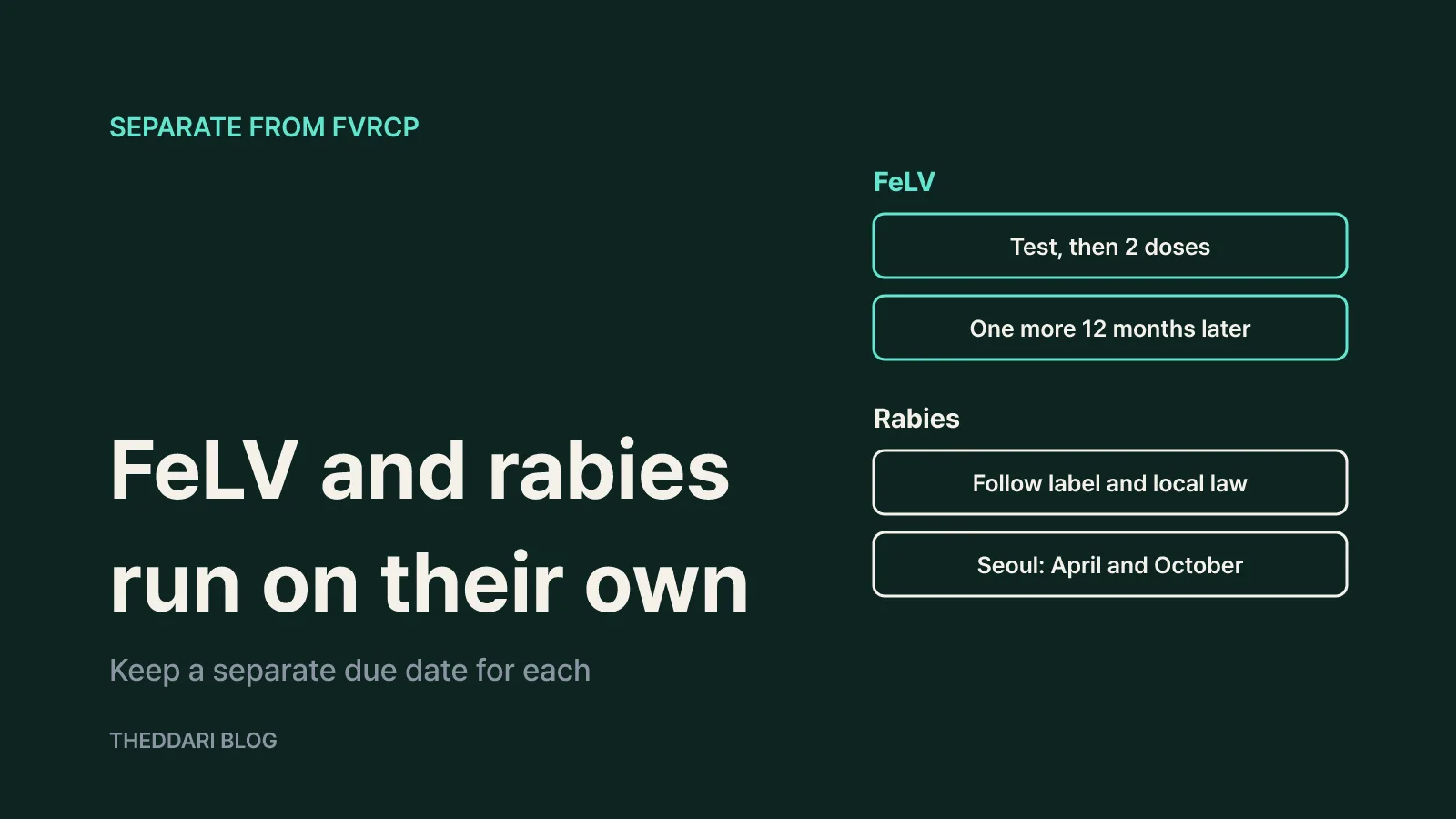
FeLV can start as early as 8 weeks: two doses 3 to 4 weeks apart. A cat first vaccinated after 16 weeks also gets two doses 3 to 4 weeks apart. The next dose comes 12 months after the last dose of the series. From there, cats that keep meeting FeLV-positive cats or cats of unknown status, indoors or outdoors, are revaccinated every year, while lower-exposure adults may be spaced to every 2 to 3 years where the product label allows. FeLV is core for cats under 1 year and non-core for low-risk adults, and the guidelines call for an FeLV antigen test before vaccinating.
Rabies has no universal week-by-week chart. The rule is to follow the vaccine label and local law. Where regulations permit, the task force recommends a 3-year interval using a vaccine labeled for 3 years. If you live in Korea, district offices run subsidized rabies clinics: the Seodaemun-gu rabies vaccination page says the program covers all of Seoul every April and October, applies to dogs and cats aged 3 months or older, and charges owners 10,000 won. The 2026 autumn round ran from October 16 to October 31, so it has ended; watch for the spring notice or book a regular appointment.
Adult or rescued cats with no vaccine records
Do not assume a rescued or rehomed adult was vaccinated. The guidelines treat a cat with an unknown history as a core-vaccine candidate and set a separate starting plan for cats older than 16 weeks:
- Modified-live injectable FVRCP: one or two doses. Cats coming from a high-risk environment may benefit from two doses 2 to 4 weeks apart.
- Inactivated injectable FVRCP: two doses 3 to 4 weeks apart.
- FeLV: test first, then two doses 3 to 4 weeks apart and another dose 12 months later.
After that, the combination vaccine moves to the 3-year rhythm and FeLV follows exposure risk. The task force recommends reviewing each cat's lifestyle risk at least once a year. A new cat in the home, balcony or garden access, or a first boarding stay are all reasons to revisit non-core options, which include FeLV for adults, Chlamydia felis and Bordetella bronchiseptica.
Boarding, pregnancy and vaccine type
Planning to board your cat over the holidays? Work backward from the drop-off date. The guidelines say revaccination 7 to 10 days before boarding or other high-exposure, stressful situations may be warranted, particularly if the cat has not been vaccinated in the preceding year. A shot the day before check-in does not give that lead time.
Modified-live vaccines should be avoided in pregnant queens and in kittens younger than 4 weeks because of a theoretical risk of cerebellar hypoplasia; inactivated products are described as likely safer during pregnancy. For cats infected with FeLV or FIV, inactivated vaccines may be preferred, but the guidelines stress that vaccination should not be skipped, since infected cats can develop more severe disease if exposed to panleukopenia or respiratory viruses.
Intranasal vaccines work quickly, which helps in high-risk settings, but they can cause short-lived sneezing or other respiratory signs. An intranasal product containing only FHV-1 and FCV gives no panleukopenia protection, so an injectable FPV dose still has to be planned.
What to bring and ask at the vet visit
A few notes make the appointment faster and prevent scheduling gaps:
- Birth date or estimated age in weeks, the anchor for the 16-week and 6-month targets.
- Previous dates and products, including injectable or intranasal, modified-live or inactivated.
- Lifestyle: indoor only, other cats at home, outdoor access, planned boarding.
- FeLV test status, which is needed before starting FeLV vaccination.
- Three separate due dates: combination vaccine, FeLV and rabies.
On the day, ask three questions: How many weeks old is my kitten for this dose? Is the final kitten dose scheduled at 16 weeks or later? When is the 6-month booster? Those answers cover most of the gaps the guidelines are designed to close.