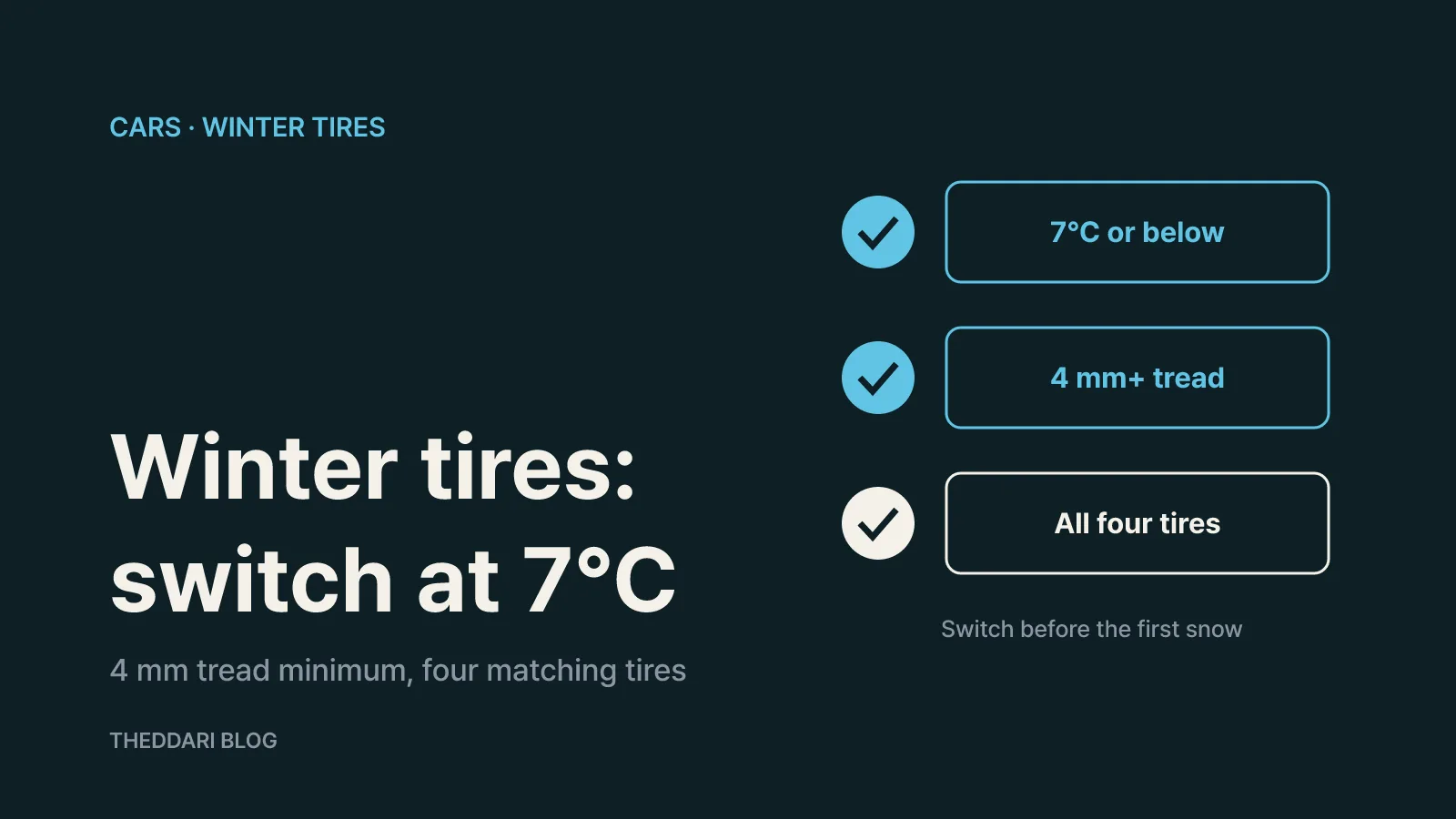
As of November 2026, the most widely repeated answer from tire makers and road safety agencies is simple: put winter tires on when the air temperature falls to 7°C (about 45°F) or below, not when the first snow arrives. Transport Canada explains that below 7°C, all-season and summer tires begin to lose elasticity, leading to less traction, and Hyundai's Korean owner's manual tells drivers to fit snow tires or approved chains when the temperature is 7°C or lower. Michelin uses the same line in reverse: once it is 7°C or warmer, swap back to your summer set.
The short checklist: change when it gets cold, fit four matching tires, make sure each has at least 4 mm (5/32 inch) of tread for snow, look for the three-peak mountain snowflake symbol, and keep pressures topped up through the season. The sections below explain the reasoning behind each step. Local rules differ, so always confirm the requirements where you drive and the specifications in your own owner's manual.
Timing: temperature matters more than the first snowfall
Most drivers wait for a snow forecast, but rubber chemistry does not wait. Hankook Tire describes how tire rubber hardens and loses grip as temperatures drop, and says its winter compounds are formulated so they do not readily harden at 7°C and below. That means a cold, dry morning can already be outside the comfort zone of a summer or all-season tire, even with no snow in sight.
In practice, a sensible trigger is when your commute temperatures start sitting below 7°C most days. Booking early also avoids the rush at tire shops the day after the first storm. In spring, reverse the logic: when temperatures stay above 7°C, take the winter set off. The Tire and Rubber Association of Canada (TRAC) notes that dedicated winter tires should be removed in the non-winter seasons because the tread compound is much too soft for summer driving.
If your car left the factory on summer performance tires, this matters even more. Hankook points out that carmakers who ship vehicles on summer tires themselves recommend switching to winter tires once temperatures drop to 7°C or below.
Some places turn the advice into law. According to TRAC, Quebec has required winter tires on passenger vehicles from December 1 to March 15 since 2008, and certain mountain highways in British Columbia require tires marked with the three-peak mountain snowflake or M+S between October 1 and March 31. Ontario requires insurers to offer a premium discount to drivers with four winter tires installed.
How much shorter do winter tires stop?
Winter tires differ in two ways: a softer compound and a tread full of sipes, the fine slits that bite into snow and ice, plus wide grooves that clear slush and water. Hankook says these features reduce the water film that forms as snow and ice melt under the tire.
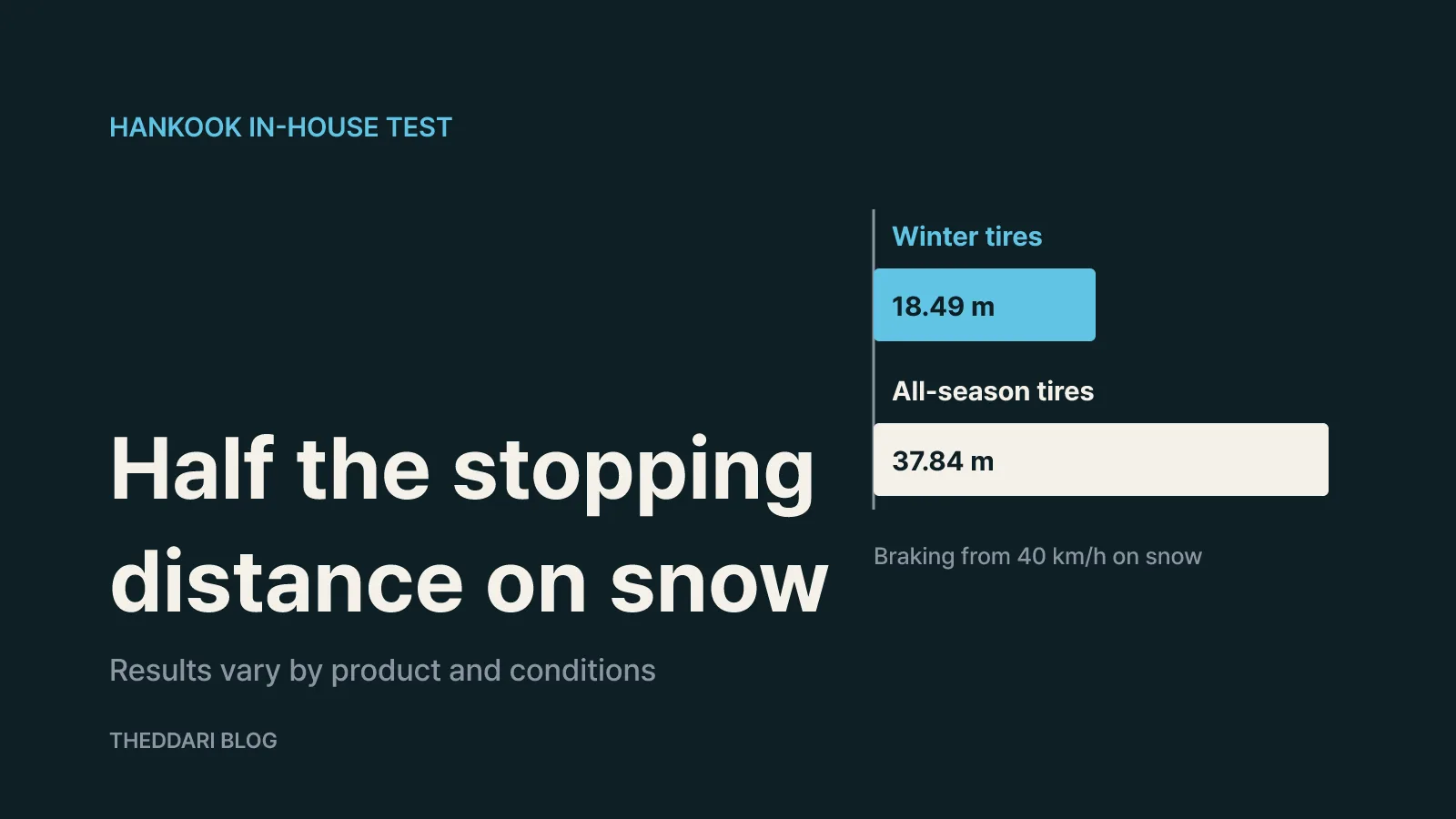
The effect shows up in stopping distance. In Hankook's own published test, braking from 40 km/h (about 25 mph) on snow took 18.49 m with winter tires versus 37.84 m with all-season tires, roughly half the distance. On ice from 20 km/h, the winter tire stopped about 14% shorter. These are one manufacturer's test conditions, so treat them as an illustration rather than a guarantee for every product. TRAC cites research from the Traffic Injury Research Foundation finding that, just below freezing, stopping distances with winter tires can be as much as 30% shorter than with all-season tires.
Winter tires are not magic. Hankook notes that snowy and icy roads can be four to eight times more slippery than normal pavement, and Hyundai's manual warns that on dry roads snow tires have less friction than standard tires, so braking distances can increase. Keep extra following distance even on clear winter days.
Can you reuse last winter's set? Checking the 4 mm line
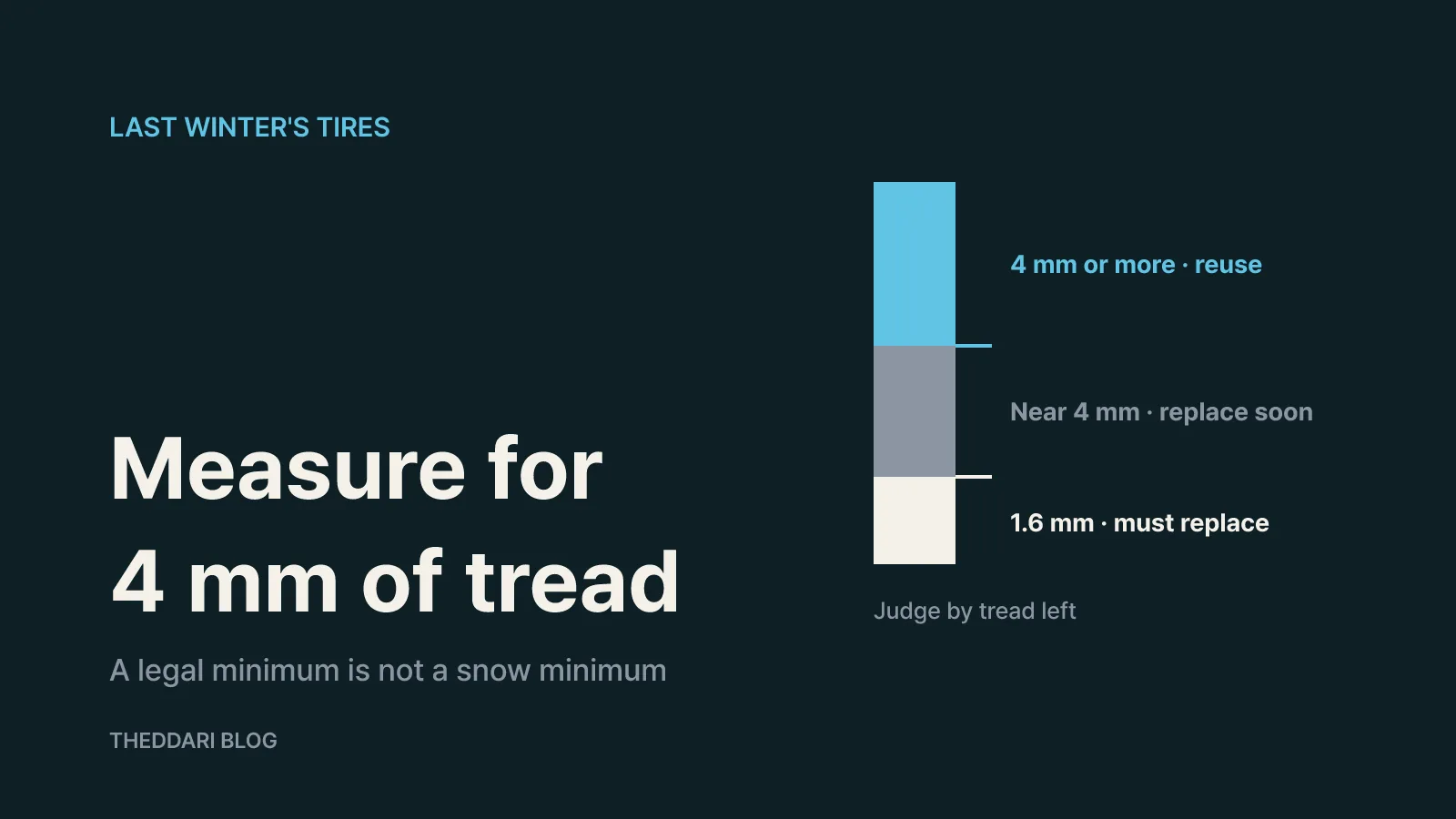
Before remounting stored winter tires, measure what tread is left. A legal minimum is not the same as a safe winter minimum. Michelin notes that in Korea the legal wear limit is 1.6 mm (roughly 2/32 inch), but that only marks the point where a tire must come off the car.
For snow, the bar is higher. Transport Canada says don't use tires worn close to 4 mm (5/32) of tread depth on snow-covered roads, and notes that tires worn close to 2 mm tread-wear indicators have less traction. A simple way to decide:
- 4 mm or more: good to go for another winter.
- Close to 4 mm: snow performance is fading; budget for a replacement.
- At the legal limit: replace regardless of season.
Use a tread depth gauge and measure the inner, center and outer grooves on all four tires so you also catch uneven wear. Check sidewalls and groove bottoms for cracks too. Michelin says a cracked tire will not perform properly even if it has not reached the wear limit, and recommends replacing tires every 10 years as a precaution even if they look fine.
Reading the sidewall: 3PMSF versus all-season
When shopping, look for the three-peak mountain snowflake (3PMSF) symbol. Transport Canada says tires with it meet specific snow traction performance requirements and are designed for severe snow. TRAC adds that the symbol requires passing the ASTM F-1805 traction test on medium-packed snow.
An "all-season" label does not mean winter-rated. TRAC states that conventional all-season tires do not carry the 3PMSF symbol and do not meet the snow traction requirements to be considered winter tires. Some all-weather or all-terrain tires do carry the symbol: they clear the minimum snow standard while remaining usable in warmer months. For the best winter performance, though, TRAC recommends dedicated winter tires. Since 2022 there is also a separate Ice Grip symbol for tires that pass an ISO test on ice.
A practical rule: if you regularly face heavy snow or mountain roads, start with dedicated winter tires; if you drive mostly in cold but rarely snowy cities, a 3PMSF-marked all-weather tire is worth comparing. Either way, the size and specification must match your vehicle's standard fitment.
Why you should fit all four, not just two
Fitting winter tires only on the drive axle is a common cost-cutting move, and both manufacturers and regulators advise against it. Hankook explains that winter tires on the front only can cause oversteer in hard cornering, while rear-only fitment can push the nose wide into understeer. A grip mismatch between axles makes the car harder to predict exactly when it starts to slide.
Transport Canada recommends sets of four with the same type, size, speed rating and load index, and says not to mix different tread patterns or internal construction. If depths differ slightly, put the deepest-tread tires on the rear, and mount directional tires the right way round. Hyundai's manual likewise calls for snow tires on all four wheels in the same size and specification as the standard tires.
When the shop fits them, confirm:
- The size matches the tire information label on the driver's door edge or door post.
- All four are the same model and tread pattern.
- Directional tires point the correct way.
- Pressures are set to the recommended value afterwards.
Pressure, storage and the spring swap
Cold air shrinks. TRAC says tires can lose about 1 psi for every 5°C drop in temperature and advises checking at least monthly with a reliable gauge. Transport Canada warns that pressure set in a warm garage will read low outside below zero, so check when the tires are cold. Michelin suggests measuring after less than 3 km of driving.
Do not lower pressure to gain grip; Hankook calls this a definite mistake. Underinflation raises rolling resistance and hurts fuel economy. Use the figure on the door label and never exceed the maximum printed on the sidewall.
For the off-season set, Michelin's storage guidance boils down to:
- A clean, dry, ventilated spot out of sunlight and weather.
- Away from chemicals, solvents, oils, heat sources, flames and ozone sources such as transformers or electric motors.
- Stacks no taller than 1.2 m.
- If space is tight, many tire shops offer seasonal storage.
Inspect for cracks, embedded objects and wear before storing, so you know next autumn whether the set is worth remounting.
If you have to use snow chains
If snow arrives before your winter tires do, chains are the fallback, but Hyundai's manual recommends snow tires over chains where possible because radial tires have thin sidewalls that metal chains can damage. If you do use them:
- Fit them on the drive wheels stated in your manual; the rear-wheel-drive model in Hyundai's manual, for example, takes chains on the rear.
- No metal chains on aluminum wheels. That manual specifies wire chains no thicker than 12 mm or textile chains, depending on wheel size.
- Stop somewhere flat and quiet, switch on hazard lights and set out a warning triangle.
- Stay at or below 30 km/h (about 19 mph) or the chain maker's limit.
- Recheck after 0.5 to 1 km, and stop immediately if you hear the chain striking the body.
- Remove them before bare pavement to avoid damage.
The same manual also advises against setting the parking brake in severe cold, since it can freeze, and warns EV drivers not to change regenerative braking levels abruptly on slippery roads.
A quick plan for this week
- Check the forecast: are commute temperatures settling below 7°C?
- Measure all four stored winter tires: at least 4 mm and no cracks?
- If buying, match your standard size and look for the 3PMSF symbol.
- Fit four matching tires and set pressure to the door-label value.
- Recheck cold pressure monthly through winter.
- If you rely on chains, confirm the correct wheels and chain type in your manual.