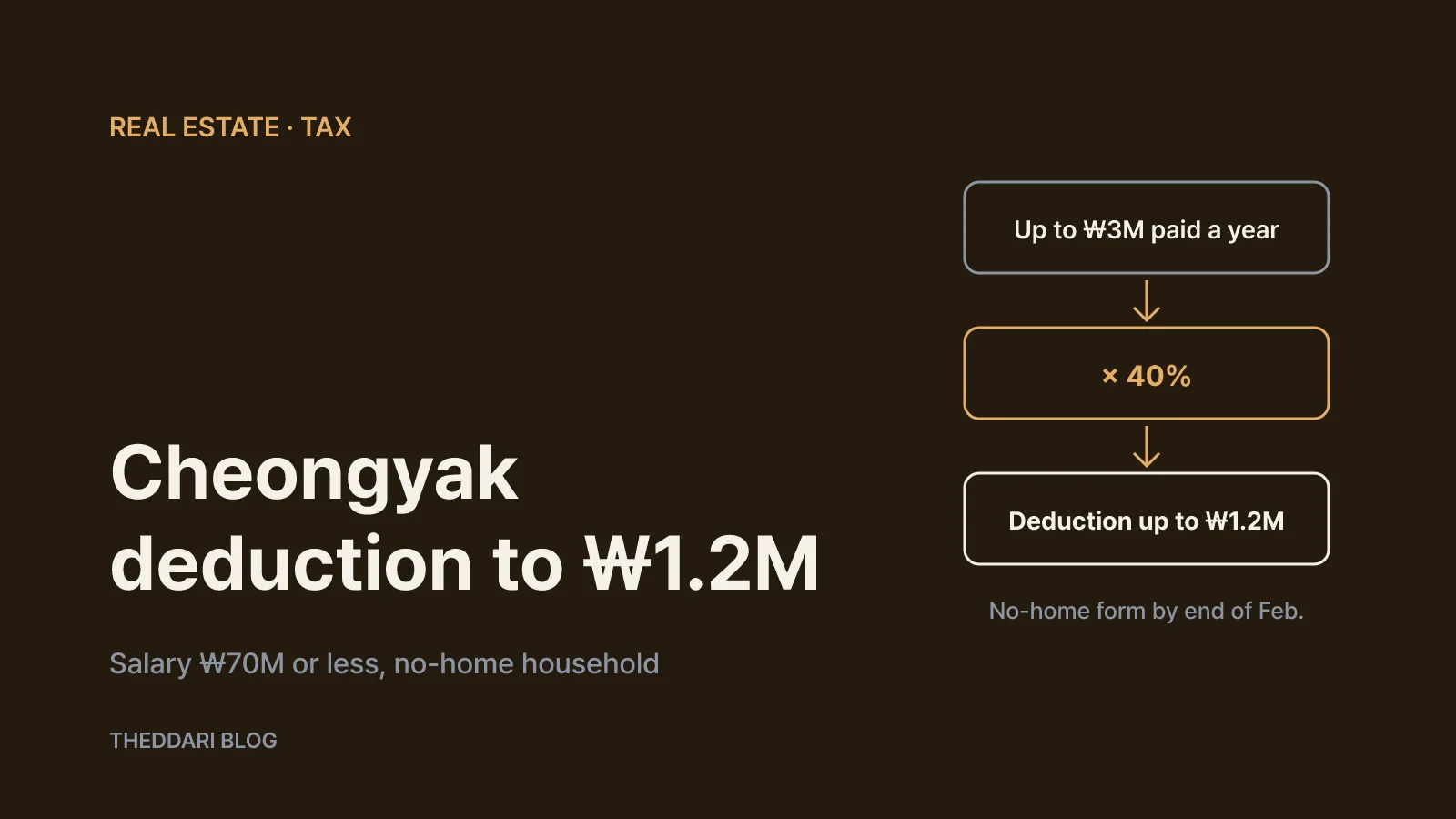
As of November 2026, money you pay into a Korean housing subscription account (cheongyak account, officially the Housing Subscription Comprehensive Savings Account) can reduce your taxable income if three things are true: your total salary for the year is ₩70 million or less, nobody in your household owned a home at any point in that tax year, and you are either the registered head of household or the head of household's spouse. The deduction is 40% of what you paid in during the calendar year, counting up to ₩3 million, so the maximum is ₩1.2 million. You also have to file a bank form called the no-home confirmation by the end of February of the following year.
This guide is aimed at salaried workers in Korea, including foreign residents who hold a cheongyak account and file through their employer's year-end tax settlement. It follows the bank disclosures and National Tax Service (NTS) guidance linked below and walks through eligibility, the math, registration and the cases where the deduction is lost or recovered.
Who qualifies for the cheongyak income deduction
KB Kookmin Bank's deduction guide, which cites Article 87 of the Restriction of Special Taxation Act, lists requirements that must all be met. NH NongHyup Bank's product terms state the same conditions.
← Swipe to see more
| Requirement | Rule | Where to check |
|---|---|---|
| Income | Resident with wage income, total salary ₩70M or less for the tax year (daily workers excluded) | Total salary line on your withholding receipt |
| Housing | Household owned no home during the tax year | Ownership history of every household member |
| Status | Head of household or the head's spouse | Resident registration copy |
| Registration | No-home confirmation filed with the bank by end of February the next year | Deduction registration status in the bank app |
Income. The test uses total salary as shown on your wage withholding receipt, not your contract figure. A year with a large bonus can push you over the line even if your base pay did not change. People with only business income cannot use this deduction because it is tied to wage income.
Household, not individual. Korea defines the household broadly here. According to KB's guide, it includes you, your spouse, and the lineal ascendants, descendants and siblings of you or your spouse who live at the same address and share living expenses. Your spouse counts as part of your household even if you live apart. So if a parent on your registration or a spouse living elsewhere owns a home, you fail the test. Because the rule refers to the whole tax year, buying and selling a home within the same year also disqualifies that year.
Head of household or spouse. An adult child registered under a parent's household is a household member, not the head, and cannot claim this deduction. Spouses of the head are covered, so in a dual-income couple the partner who is not the head can claim the deduction for payments into an account in their own name. You cannot claim payments made into someone else's account.
Registration. Holding the account is not enough. Banks issue the year-end payment certificate only to customers who have filed the no-home confirmation. KB notes one exception: holders of the older cheongyak jeochuk product are not required to file the form and can claim the deduction if they meet the other requirements.
How the deduction is calculated
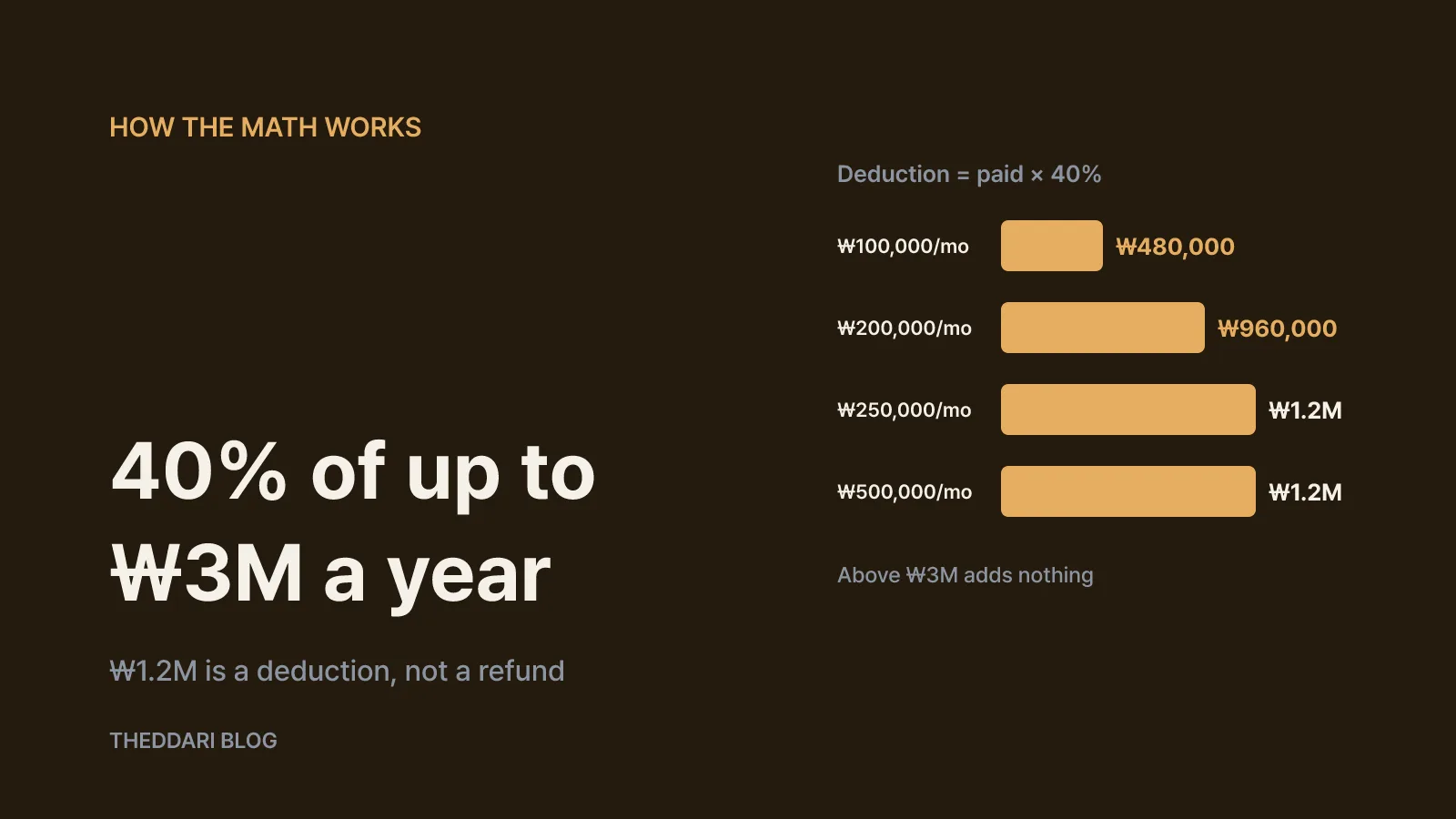
The amount that counts is what you actually deposited between January 1 and December 31. KB states that prepaid and late installments are counted in the year they are deposited. For payments made on or after January 1, 2024, the annual cap is ₩3 million and 40% of that gives the ₩1.2 million ceiling. Before 2024 the cap was ₩2.4 million, with a maximum deduction of ₩960,000.
← Swipe to see more
| Paid in the year | Counted | Deduction (40%) |
|---|---|---|
| ₩100,000 × 12 = ₩1.2M | ₩1.2M | ₩480,000 |
| ₩200,000 × 12 = ₩2.4M | ₩2.4M | ₩960,000 |
| ₩250,000 × 12 = ₩3M | ₩3M | ₩1.2M |
| ₩500,000 × 12 = ₩6M | ₩3M | ₩1.2M |
The ₩1.2 million is an income deduction, not a refund. Your actual tax saving is roughly that amount multiplied by the marginal rate of your tax bracket, so two people with the same deduction can see different results. Anything above ₩3 million still builds your subscription balance but adds nothing to the deduction.
If you also deduct repayments on a jeonse or rental deposit loan, there is a shared cap. The NTS guidance on rental loan repayment deductions says the cheongyak deduction (payments × 40%) plus the rental loan deduction (repayments × 40%) cannot exceed ₩4 million a year combined. Claiming the full ₩1.2 million on your account leaves ₩2.8 million of room for the loan deduction.
The same NTS page says a household member can claim the rental loan deduction only when the head of household is not claiming the rental loan, mortgage interest or housing subscription deductions. If the head claims the cheongyak deduction, other household members may lose access to the rental loan deduction, so decide within the household who claims what before year-end settlement.
Registering the no-home confirmation and claiming it
The no-home confirmation is a bank form, not a certificate from a community service center. KB says it can be filed at a branch, through internet banking or in the mobile app, and that once registered it stays in place until you ask to cancel it. Menu names differ by bank, but the steps look like this:
- In your bank app, open the housing subscription section and find the income deduction registration status.
- If you are not registered, submit the no-home confirmation for income deduction purposes. You confirm your household composition and no-home status.
- Before December 31, check how much you have paid this year and decide whether to top up toward ₩3 million.
- During your employer's year-end settlement, check whether the payment shows in the simplified data. If not, download the year-end payment certificate from the bank and submit it.
- If you missed registration, file the form by the end of February of the following year. For 2026 payments, that means the end of February 2027.
A caution about lump sums in December: the deduction follows the deposit date, but subscription eligibility follows the separate Rules on Housing Supply. NH says accounts with prepaid or late installments can see their recognition date and priority date pushed back, and that for national housing applications only up to ₩250,000 per installment is recognized once a monthly payment exceeds ₩100,000. Because ₩250,000 × 12 equals the ₩3 million cap, paying ₩250,000 each month is the simplest way to line up both rules.
When the deduction is lost or clawed back
Closing the account can remove the current year's deduction or trigger repayment of past benefits. Based on NH's terms:
← Swipe to see more
| Situation | Result |
|---|---|
| Closing mid-year for any reason other than winning a national-size home or converting to a Youth Housing Dream account | That year's payments are not deductible |
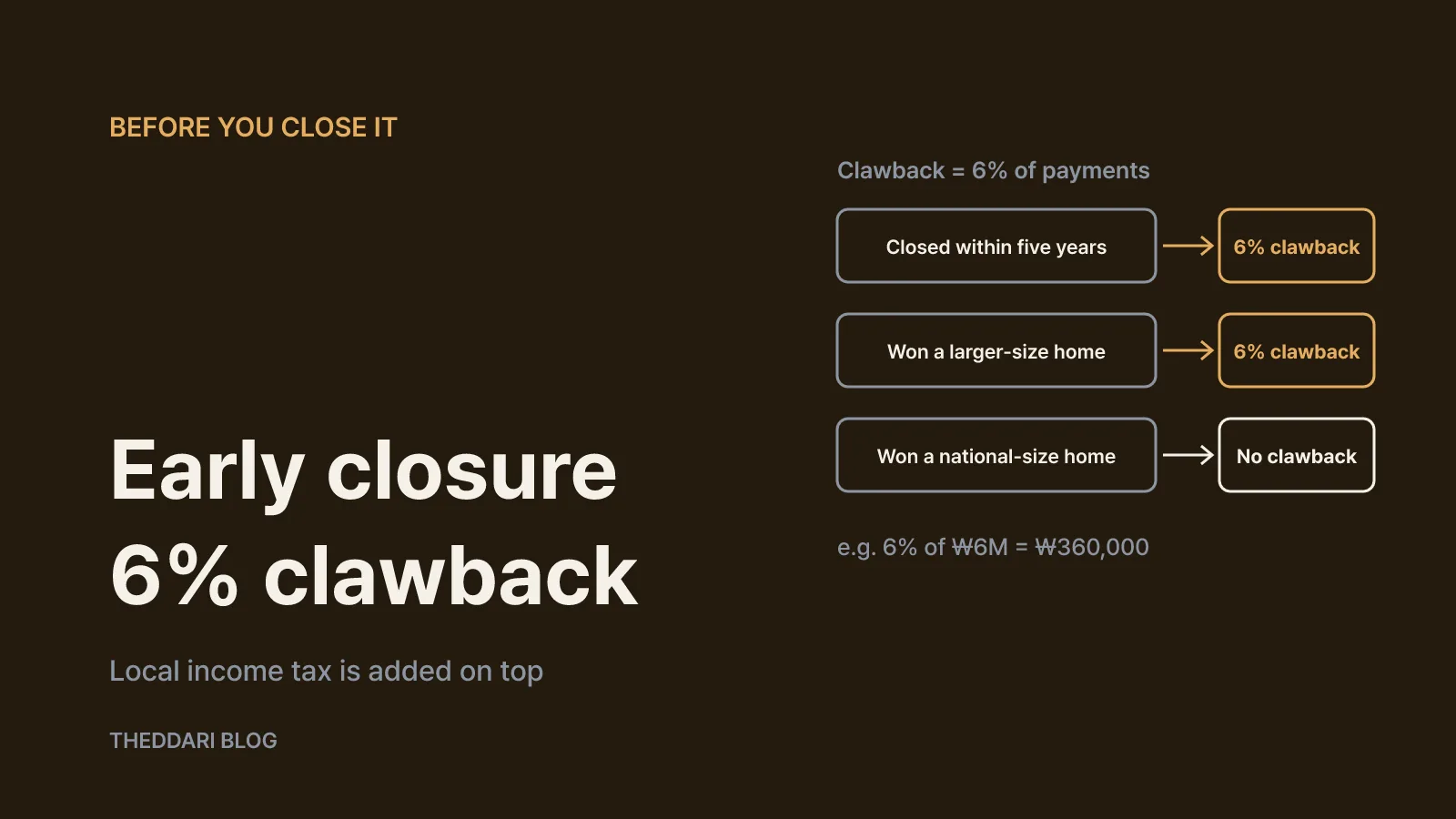
| Closing after winning a home larger than national housing size | Clawback, regardless of how long you held the account |
| Closing within five years of opening (except national-size win, special early closure or Youth Housing Dream conversion) | Clawback |
The clawback equals 6% of the cumulative payments (capped at ₩3 million per year) made from the first deducted year onward, plus local income tax. For example, if you registered, paid ₩3 million in each of two years and then closed the account in its fourth year for an ordinary reason, the clawback would be 6% of ₩6 million, or ₩360,000, plus local income tax.
If you are thinking about closing the account for cash, first check whether five years have passed since opening and whether your reason fits an exception, then ask the bank for an estimate. Converting to a Youth Housing Dream account avoids both penalties, but KB notes that the converted principal is excluded when calculating the deduction cap for the new account.
The sunset proposal and a December checklist
This is a time-limited tax incentive. According to a Newsis report from August 18, 2026, the deduction began in 2010, gained a sunset clause in 2017 and, after two extensions, was set to expire at the end of 2028. The government's 2026 tax reform proposal removes the sunset and makes the deduction permanent. The proposal still has to pass the National Assembly, so check the final law. Either way, 2026 payments follow the rules described above.
Before December 31, run through this list:
- Will your total salary for the year be ₩70 million or less?
- Has every household member, including a spouse living elsewhere, gone the whole year without owning a home?
- Are you the head of household or the head's spouse on your resident registration?
- Is your account registered for the deduction at your bank?
- How much have you paid this year, and how far are you from ₩3 million?
- Does your combined cheongyak and rental loan deduction stay within ₩4 million?
- Are you planning to close the account within five years of opening it?
One failed condition removes the whole deduction, so confirm eligibility before adding money for tax purposes.