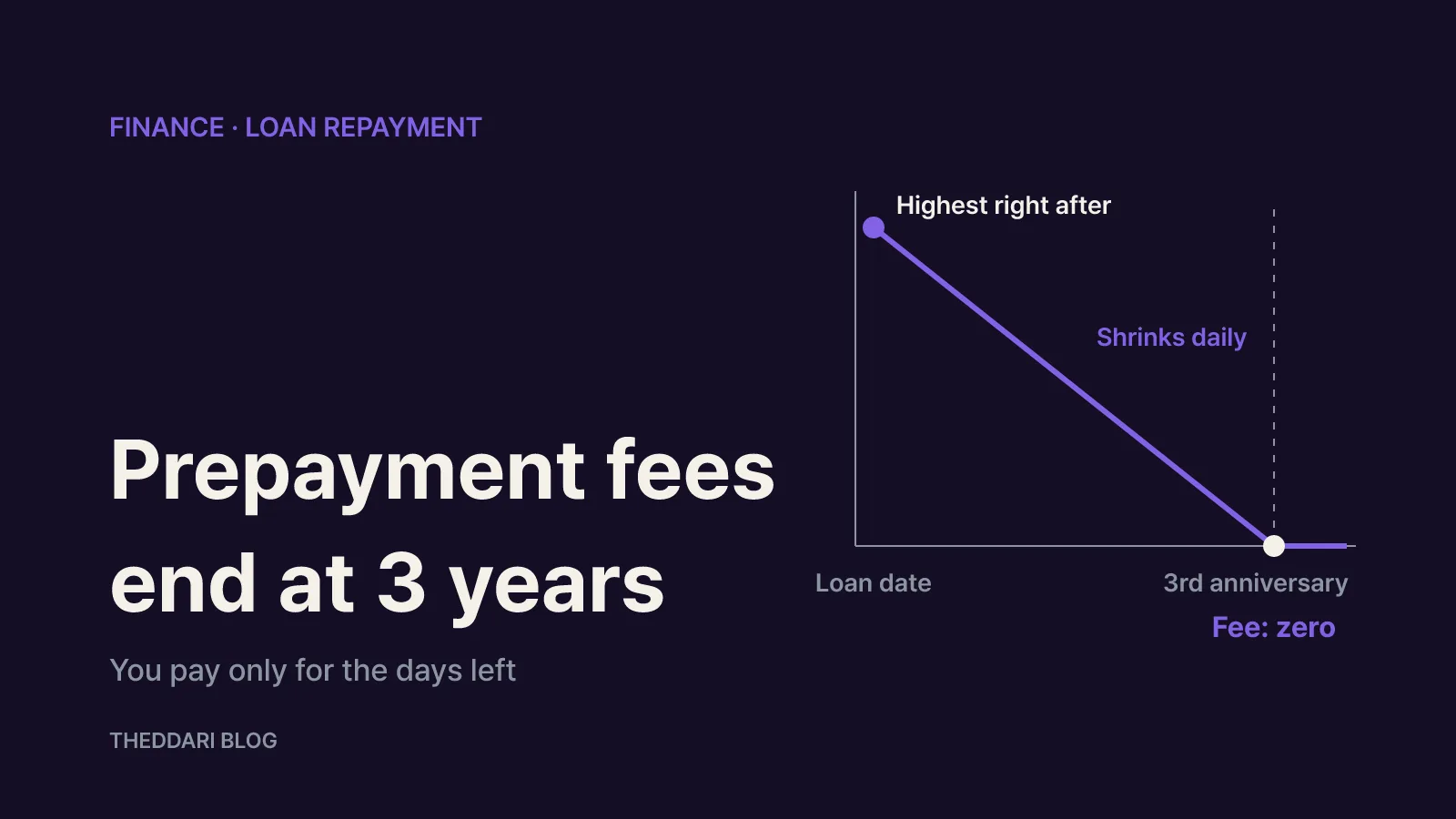
As of November 2026, the short answer is this: in South Korea, a bank may charge a prepayment (early repayment) fee only if you repay principal within three years of the loan date. After that, the fee is zero. Most banks calculate the fee as prepaid principal × fee rate × (remaining days ÷ loan term), and if the loan term is longer than three years, the third anniversary of the loan date is treated as the maturity date for this calculation. The fee therefore starts at its highest right after you borrow and shrinks every day until it disappears.
This guide is for anyone holding a Korean mortgage, jeonse (lump-sum lease deposit) loan or personal credit loan who is thinking about paying it down with a year-end bonus or refinancing into a cheaper product. It draws on the Financial Services Commission (FSC) announcements and a bank's official fee disclosure, and it applies only to loans from Korean financial institutions.
When Korean lenders can charge a prepayment fee
Korea's Financial Consumer Protection Act bans prepayment fees in principle. According to the FSC press release of January 2025, Article 20(1)(4)(b) of the Act allows an exception only when the borrower repays within three years from the loan date. If your loan is older than three years and it came from an institution covered by the Act, such as a commercial bank, savings bank, life or non-life insurer, or a credit union (Shinhyup), the lender cannot charge the fee.
In July 2024 the FSC amended the supervisory regulation (Article 14(6)(9)) so that the fee may cover actual costs only. Two categories qualify:
- Opportunity cost from disrupted fund management, such as lost interest while the lender looks for a new borrower, or the interest gap when it re-lends at a lower rate.
- Administrative and origination costs, such as stamp duty, appraisal fees, collateral registration costs, lease investigation fees and loan brokerage fees.
Adding any other item on top of these is treated as an unfair business practice under the Act. The new framework took effect on January 13, 2025, for loans signed from that date.
There are important exceptions. The FSC Q&A explains that community credit cooperatives (Saemaul Geumgo) and the mutual finance arms of the National Agricultural, Fisheries and Forestry cooperatives are not covered by the Financial Consumer Protection Act, so the reform is not mandatory for them. Credit unions operate as separate legal entities, so rates can differ by branch union. Syndicated loans such as project financing may not follow the published rates. The FSC also notes that credit card companies waive prepayment fees on card loans.
The prepayment fee formula, step by step
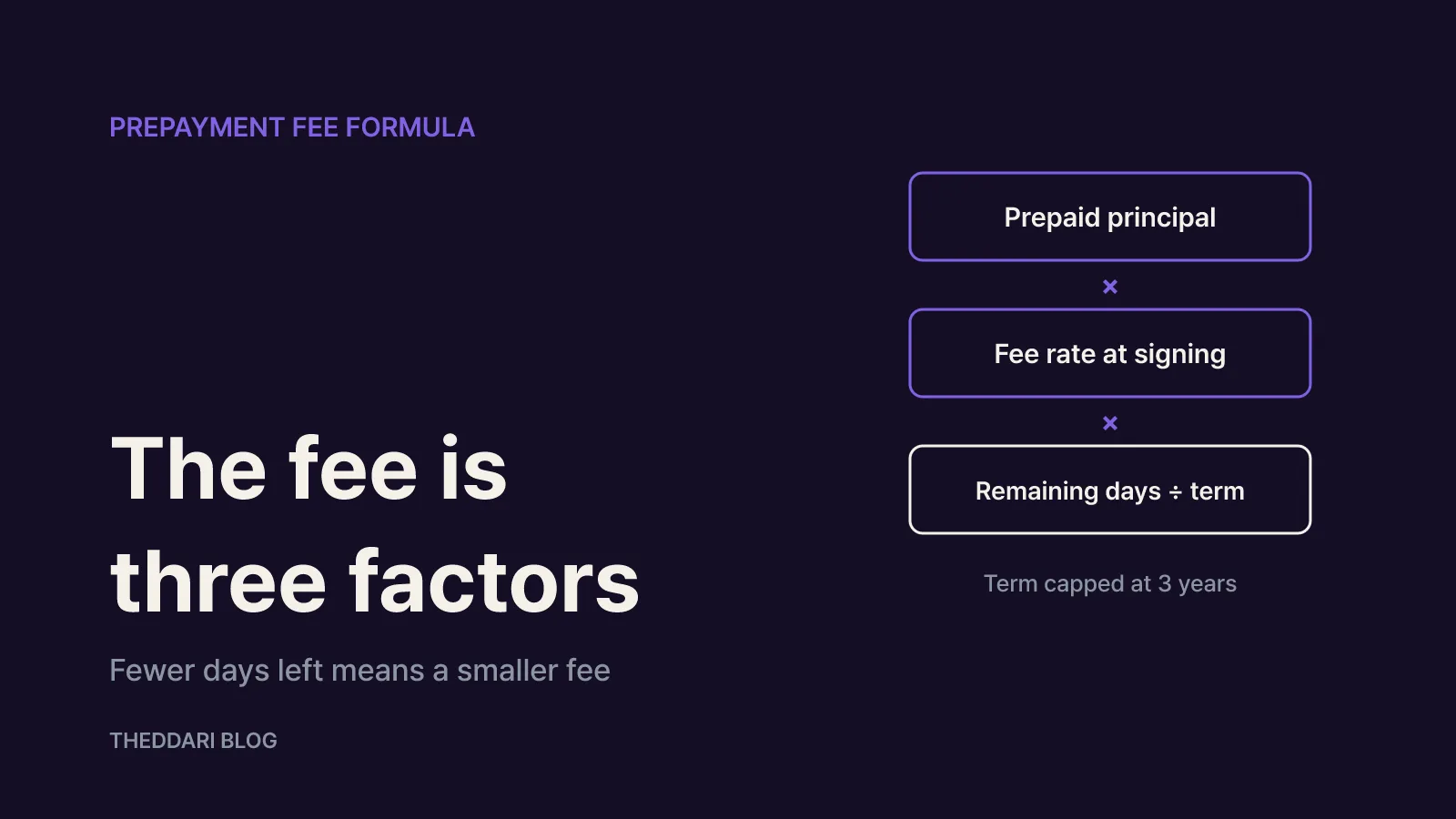
KB Kookmin Bank's loan fee disclosure sets out the standard formula:
Prepayment fee = prepaid principal × fee rate × (remaining days ÷ loan term)
- Prepaid principal is only the amount you repay early, not your whole balance.
- Fee rate is the rate published when you signed the loan. KB states it is fixed at the contract date for new loans, refinancing and re-lending, and does not change if your interest rate or collateral changes later.
- Remaining days run from the repayment date to the maturity date.
- Loan term runs from the loan date to maturity, but if the term exceeds three years, the third anniversary of the loan date is treated as maturity.
That last rule means a 30-year mortgage is treated like a three-year loan for fee purposes. The ratio of remaining days to loan term starts close to one and falls to zero on the third anniversary.
Example 1: a fixed-rate mortgage taken out in 2026
For real-estate-secured loans newly issued from January 1, 2026, KB's rate for the fixed-type category is 0.75%. Suppose you borrowed on March 2, 2026, and repay ₩100 million on March 2, 2027.
- Deemed maturity: March 2, 2029
- Loan term: 1,096 days (the window includes February 29, 2028)
- Remaining days: 731
- Fee: ₩100,000,000 × 0.75% × 731 ÷ 1,096 ≈ ₩500,228
A quick mental shortcut: the maximum fee is 0.75% of ₩100 million, or ₩750,000, and you pay roughly two-thirds of it because two-thirds of the three-year window remains.
Example 2: a loan signed before January 13, 2025
Older contracts keep their original rate. KB lists 1.40% for fixed-type housing and real-estate-secured loans issued on or before January 12, 2025. If you borrowed on June 1, 2024, and repay ₩100 million on December 1, 2026:
- Deemed maturity: June 1, 2027; loan term 1,095 days
- Remaining days: 182
- Fee: ₩100,000,000 × 1.40% × 182 ÷ 1,095 ≈ ₩232,694
The rate is higher, yet the fee is smaller than in Example 1 because the three-year mark is close. Waiting a few months can cut the cost sharply. Exact amounts may differ by a few won depending on the bank's day-count and rounding rules, so check the fee inquiry screen in your banking app before you repay.
How to find the rate that applies to your loan
Your contract date decides the rate. According to the FSC Q&A, the reformed rates apply to contracts signed (including renewals) from January 13, 2025. Earlier contracts are not covered. A simple maturity extension in which key terms such as the amount and repayment conditions stay the same counts as effectively the same contract, so the old rate remains.
Rates are recalculated every year and published each January on the websites of the financial industry associations. That is why one bank can show several rate tables. KB's disclosure looks like this:
← Swipe to see more
| Issued | Real estate (variable) | Real estate (fixed-type) | Credit (variable) | Credit (fixed-type) |
|---|---|---|---|---|
| On or before Jan 12, 2025 | 1.20% | 1.40% | 0.60% | 0.70% |
| Jan 13 to Sep 11, 2025 | 0.58% | 0.58% | 0.02% | 0.02% |
| From Jan 1, 2026 | 0.55% | 0.75% | 0.11% | 0.18% |
For loans issued on or before January 12, 2025, the credit columns show KB's rate for its general "other loans" category. Guarantee-backed and other secured loans, including jeonse deposit loans, interim payment loans and car loans, have their own rates: 0.54% variable and 0.96% fixed-type for loans issued from January 1, 2026.
"Fixed-type" is broader than it sounds. KB's footnote says it covers loans where the rate reset cycle equals the loan term, or where the reset cycle or fixed-rate period is three years or longer. A 12-month credit loan that resets every 12 months therefore uses the fixed-type rate, and so does a hybrid mortgage with a fixed period of three years or more. Government fund products, Korea Housing Finance Corporation loans such as the Bogeumjari Loan, and special partnership products follow their own rules.
Why bank prepayment fees rose again in 2026
The first year of the reform brought big cuts. The FSC reported that the banking-sector average for fixed-rate mortgages fell from 1.43% to 0.56%, and for variable-rate credit loans from 0.83% to 0.11%.
In January 2026 several banks raised their rates again. Hinews reported, citing FSC data obtained by a National Assembly lawmaker, that bank household loan prepayment fee rates rose by an average of 0.05 to 0.14 percentage points. The data attributed the rise to the cost calculation window: a period of rising rates (October 2021 to September 2022) dropped out, and a period of mostly falling rates (October 2024 to September 2025) was added. When rates fall, a bank repaid early earns less when it re-lends, so the measured opportunity cost goes up. KB's fixed-type real-estate rate rose from 0.58% to 0.75%, the largest increase among the five major banks, and the FSC said it would check whether the rates were calculated properly. Because rates reset every January, check the new table before you sign a loan or refinance in 2027. A loan you already hold keeps the rate from its contract date.
Checklist before you repay early or refinance
- Find your loan date and the three-year mark. If the third anniversary is only weeks away, waiting may reduce the fee to zero.
- Identify your rate table by contract date (before January 13, 2025, during 2025, or from 2026) and by variable versus fixed-type.
- Estimate the fee with the formula, then confirm the exact amount in your bank's app on the day you plan to pay.
- Compare it with the interest you save. Moving ₩100 million to a loan that is 0.5 percentage points cheaper saves about ₩500,000 a year in simple terms. If the fee is similar, the first year is roughly a wash, and the new loan may restart its own three-year fee window.
- Check the new loan's costs, such as stamp duty and collateral fees, plus its own prepayment terms in the product description.
Partial prepayment is another lever, because the fee applies only to the principal you repay now. Whether a product waives fees on a set portion each year varies, so rely on your loan agreement. If your loan is from a Saemaul Geumgo or a cooperative mutual finance unit, do not assume the bank formula applies; read that lender's product terms first.