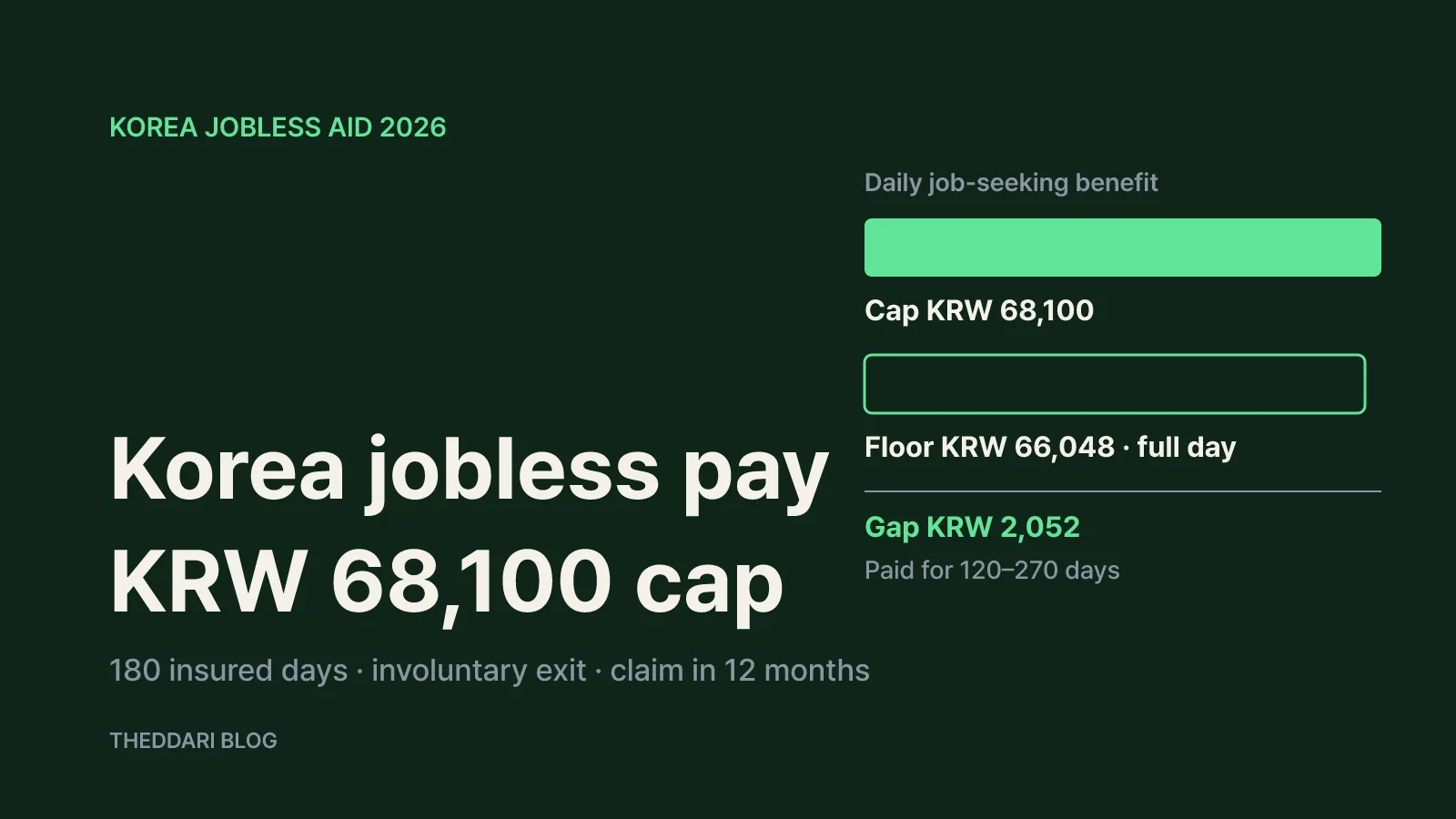
As of November 2026, South Korea's unemployment benefit — officially the job-seeking benefit (구직급여) paid through Employment Insurance — is capped at KRW 68,100 per day, with a floor of KRW 66,048 per day for someone who worked an eight-hour day. The formula is 60% of your average wage before leaving the job, but because the cap and floor are only KRW 2,052 apart, most claimants end up inside that narrow band. To qualify you generally need at least 180 insured days in the 18 months before leaving, an involuntary separation, and you must claim and use the benefit within 12 months of the day after you left. This guide covers the amounts, the eligibility tests, the payment-days table, the step-by-step application through a local Employment Center, the job-search reporting rules, and the reform plan announced for the system.
How much is Korea's unemployment benefit per day in 2026?
The daily amount is 60% of your average wage before separation, based on wages in the three months before you left. Two limits then apply:
- Daily cap: Article 68 of the Enforcement Decree of the Employment Insurance Act, amended on December 23, 2025, treats any base daily wage above KRW 113,500 as KRW 113,500. Sixty percent of that is KRW 68,100, up from the KRW 66,000 cap that had been in place since 2019.
- Daily floor: 80% of the hourly minimum wage in force when you left, multiplied by your contracted daily hours. According to a Ministry of Employment and Labor 1350 helpline answer, for people leaving in 2026 that works out to KRW 8,256 per contracted hour — KRW 33,024 for four hours, KRW 49,536 for six and KRW 66,048 for eight.
Both limits follow your separation date, not your claim date. Some pages on the Work24 portal, such as the personal benefits overview, still show the old KRW 66,000 cap, so rely on your own separation date and the Employment Center's calculation rather than a single figure on a summary page.
Over 30 days, the cap equals KRW 2,043,000 and the eight-hour floor KRW 1,981,440. A full-time worker earning about KRW 3 million a month will usually calculate below the floor and receive the floor; a high earner whose daily average exceeds KRW 113,500 stops at the cap no matter how much more they earned. Part-time workers should look at the hour-by-hour floor instead.
Who qualifies: 180 insured days and an involuntary exit
The Employment Insurance guidance lists four conditions for employees:
- At least 180 insured days within the 18 months before separation (24 months for ultra-short-hour workers), counted across all insured workplaces. Insured days are based on days you were employed and paid, so the count may not match six calendar months exactly.
- Willing and able to work but not yet employed.
- Actively looking for work throughout the claim.
- Involuntary separation — the reason for leaving must not fall under the disqualifying grounds in Article 58 of the Employment Insurance Act. Contract expiry, layoffs and recommended resignations are typical qualifying cases; dismissal for serious misconduct or quitting purely for personal reasons generally is not.
Artists need 9 insured months within 24 months, and platform or contract workers classed as labor-service providers need 12 months within 24. Work24 offers an eligibility pre-check tool if you are unsure.
How many days you can receive: 120 to 270
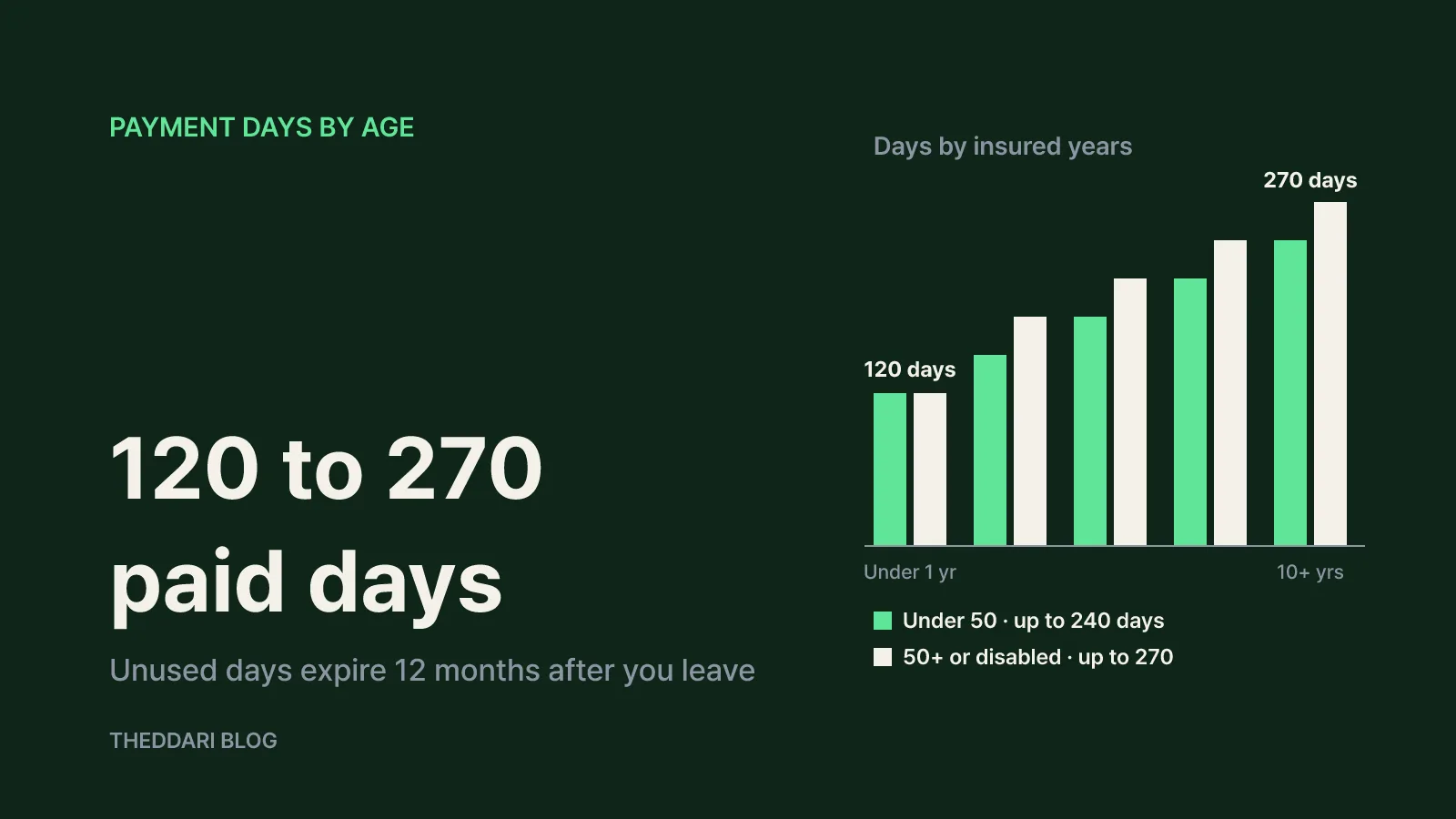
For separations on or after October 1, 2019, the number of payment days depends on age at separation and length of insured employment:
← Swipe to see more
| Age at separation | Under 1 yr | 1–3 yrs | 3–5 yrs | 5–10 yrs | 10+ yrs |
|---|---|---|---|---|---|
| Under 50 | 120 | 150 | 180 | 210 | 240 |
| 50+ or disabled | 120 | 180 | 210 | 240 | 270 |
The shortest award at the eight-hour floor is about KRW 7.93 million; the longest at the cap is KRW 18,387,000. But the 12-month claim window still applies: once 12 months pass from the day after separation, unused days are lost. Someone entitled to 270 days who waits four or five months may not be able to use them all. If illness, injury, caring for family or a spouse's overseas posting prevents job hunting, you can ask to extend the window by up to four years.
How to apply, step by step
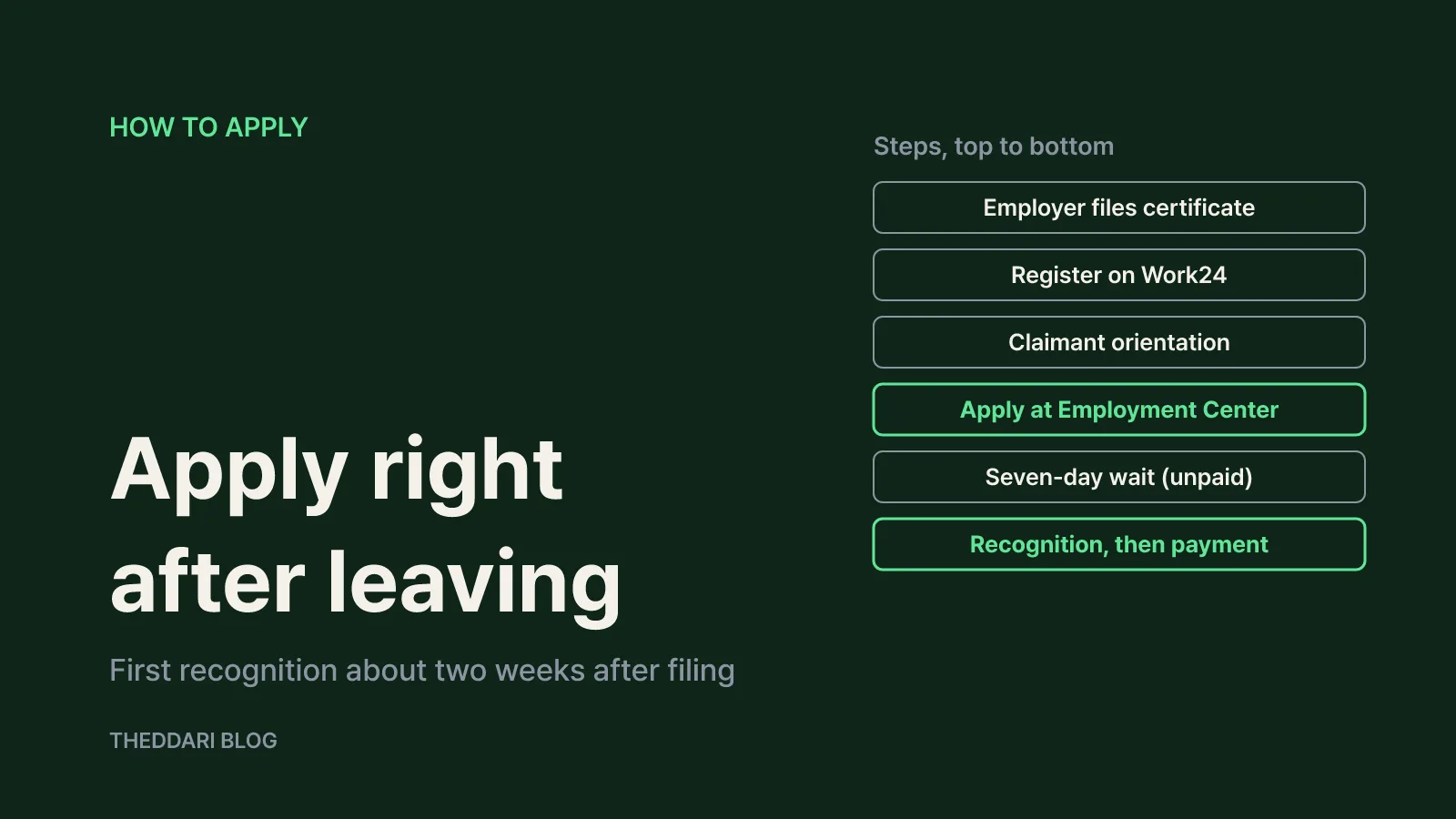
The official payment procedure runs as follows:
- Employer filings: your employer reports the loss of insured status to the Korea Workers' Compensation and Welfare Service and submits a separation certificate to the Employment Center. You can check whether it has been processed on Work24. Make sure the stated reason for leaving is accurate.
- Job-seeker registration: register yourself on Work24 (formerly WorkNet).
- Claimant orientation: a mandatory course before you apply, available online.
- Eligibility application at the Employment Center for your home address. If refused, you can request a review within 90 days.
- Seven-day waiting period: no benefit is paid for the first seven days after eligibility is recognized.
- Unemployment recognition: the first one is about two weeks after you file, then every one to four weeks you report your job-search activity to get paid for that period.
The clock runs from separation, not from when you get around to applying, so register and finish the orientation early.
Staying eligible while you claim
Missing a recognition date normally means no payment for that cycle, though you can reschedule for unavoidable reasons. If the center designates you for online recognition, submit through Work24 or the Employment Insurance app by 5 p.m. on the recognition day.
Accepted job-search activity includes applying to employers in person, by post or online, interviews at hiring events, a confirmed job starting within 30 days, approved vocational training, center-led job programs and documented self-employment preparation. Phone inquiries alone, printing job ads without applying, and sign-offs from relatives' businesses do not count.
You must report work or income during the claim — for example, taking a job of 60 or more hours a month (15+ hours a week), earning at least your daily benefit from side work, or registering a business. Failing to report can be treated as fraudulent receipt. If you find a job with at least half your payment days left and stay employed 12 months, you can claim half of the remaining days as an early reemployment allowance.
What may change: the six-day payment plan
Yonhap reported on September 1, 2026, that a labor-management task force under the Employment Insurance Committee agreed on a reform package:
- Pay the benefit on a six-day week (excluding unpaid holidays) instead of seven, keeping the total amount and the 120–270 day entitlement, which stretches the payment period by roughly three to six weeks.
- Link the cap to the floor, for example at 103% of the floor. With the 2027 minimum wage at KRW 10,700 an hour, the eight-hour floor would be KRW 68,480 — above today's KRW 68,100 cap.
- Exclude people earning KRW 3 million or more a month after reemployment from the early reemployment allowance (previously KRW 5.74 million).
- Raise employee and employer premiums by 0.1 percentage point each, from 1.8% to 2.0% combined.
This is an agreed direction; timing and which separation dates it covers depend on legislation. If you are leaving work around the turn of the year, check the ministry's notices, run Work24's benefit calculator, or call 1350, the ministry's helpline.