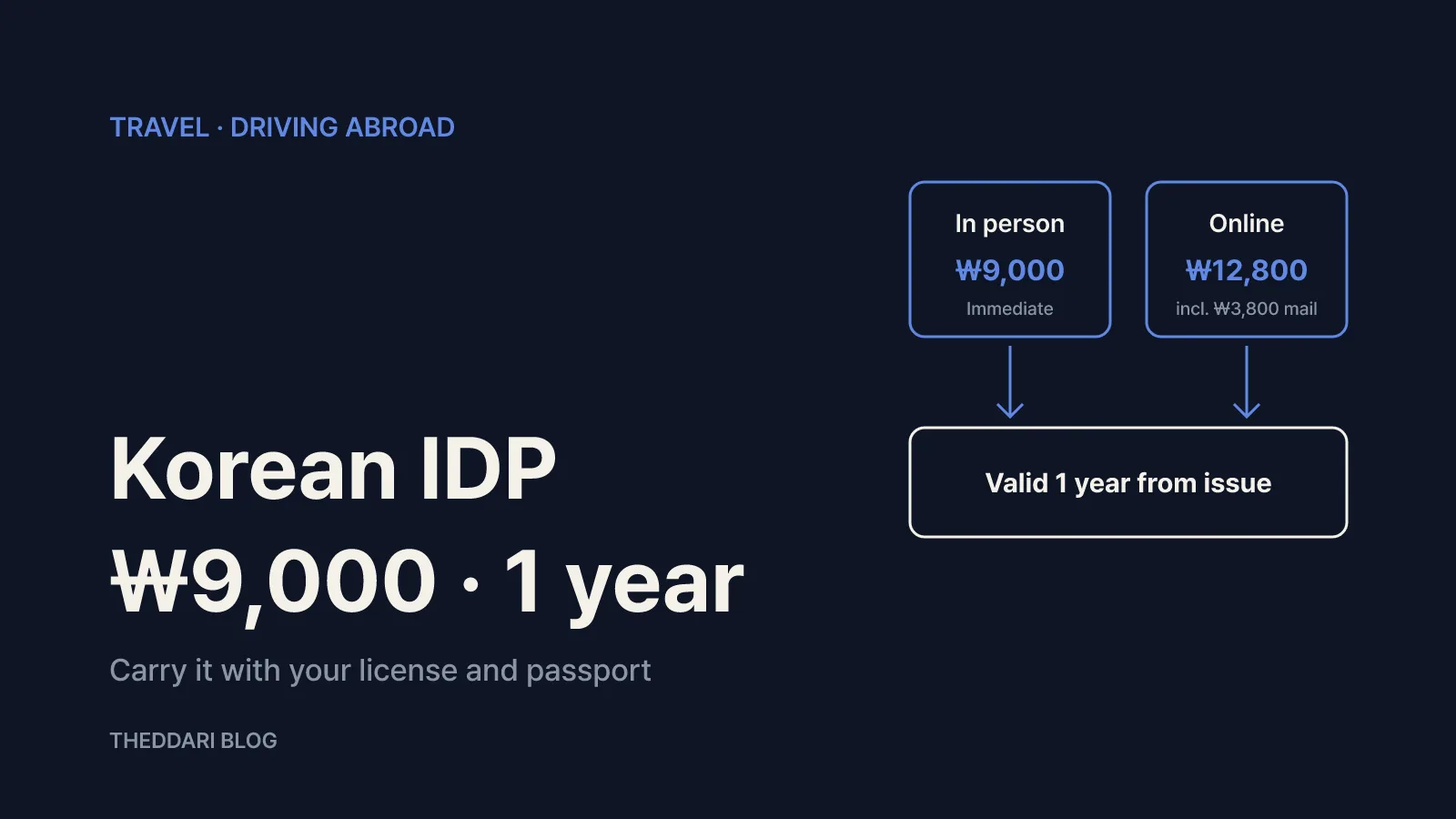
As of November 2026, an International Driving Permit (IDP) issued in South Korea costs ₩9,000 in person or ₩12,800 online (the ₩9,000 fee plus ₩3,800 for registered mail), and it is valid for one year from the date of issue. If you are flying within the next two weeks, the safest route is to walk into a driver's license test center, a participating police station, or the IDP desk at Incheon or Gimhae airport. If you have more time, you can apply on the Korea Road Traffic Authority's (KoROAD) Safe Driving portal and have the permit mailed to you. Abroad, the permit only works alongside your Korean license and your passport.
This guide is for anyone holding a Korean driver's license: Korean citizens planning a winter road trip, and foreign residents of Korea who converted their license here and now want to drive in Japan, the US or elsewhere. It is based on KoROAD's official IDP page and the Korean National Police Agency's service guide.
Korean IDP fees, validity and where to apply
The official fee is ₩9,000. Online applications add ₩3,800 for registered post, so the total charge is ₩12,800, a breakdown also reported in coverage of KoROAD's November 16, 2026 service update.
The permit is valid for one year from issue. One exception: if you apply while your Korean license is suspended, the IDP becomes valid from the day after the suspension ends and runs for one year from then. There is no renewal procedure listed, so plan to apply again after it expires.
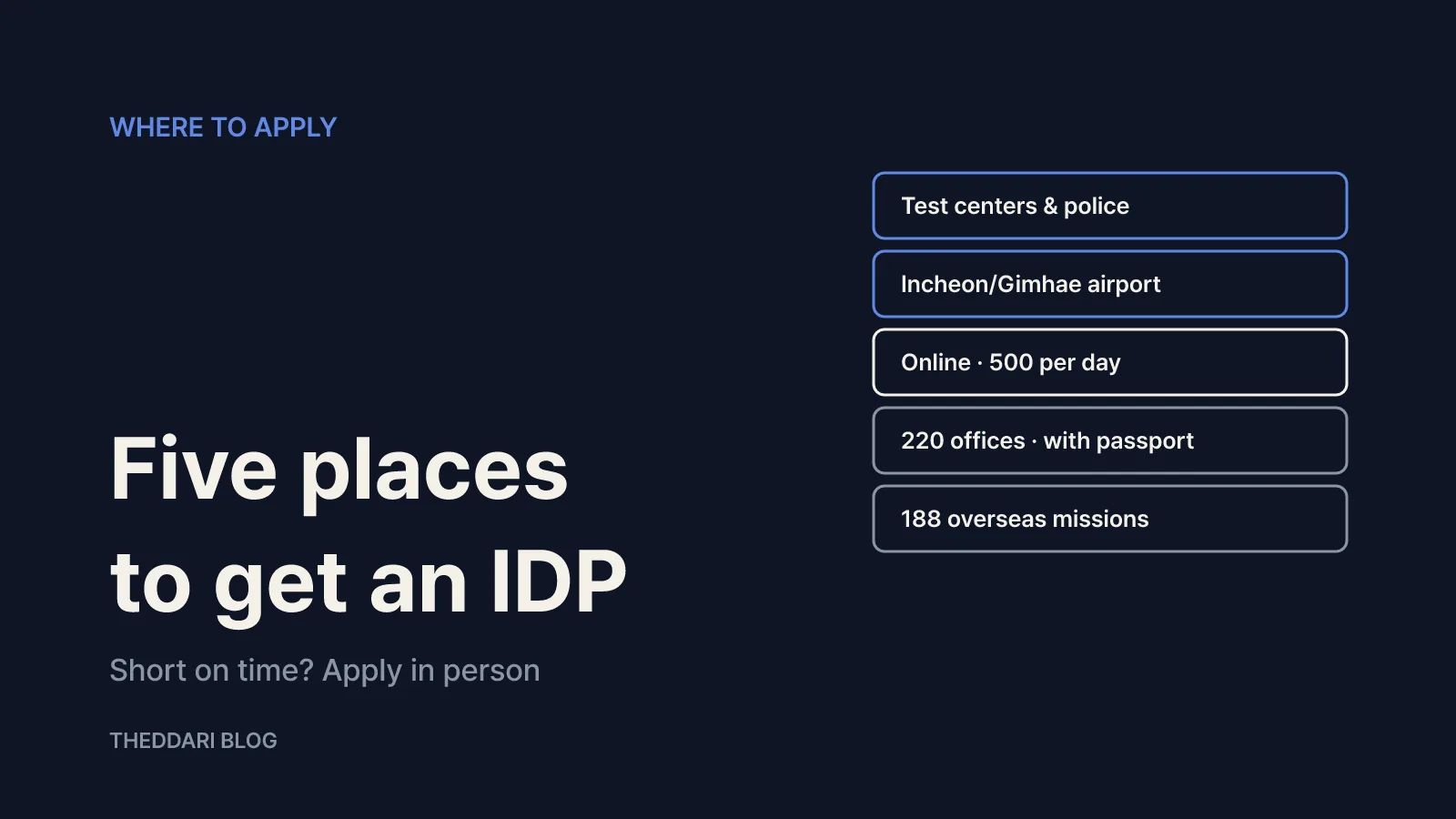
You can apply at:
- Driver's license test centers and police stations nationwide. In-person processing is listed as immediate (within three working hours).
- IDP centers at Incheon and Gimhae airports, useful on departure day.
- 220 local government offices partnered with KoROAD, but only when you are applying for a passport at the same time.
- Online via the Safe Driving portal, capped at 500 permits per day.
- 188 Korean diplomatic missions if you are already overseas.
Not every police station issues IDPs. KoROAD advises checking with the station before you go and bringing a credit or debit card.
Applying online: steps, photo rules and timing
The online service is open daily from 7:30 a.m. to 10 p.m., and KoROAD raised the daily cap to 500 applications from November 16, 2026. The process is:
- Log in to the Safe Driving portal and verify your identity.
- Choose the International Driving Permit option under license issuance.
- Confirm that your English name matches your passport.
- Upload a passport-style photo on a white background, taken within the last six months.
- Pay ₩12,800 and enter a delivery address in Korea.
The photo specification is strict: 3.5 × 4.5 cm, with the head measuring 3.2 to 3.6 cm from crown to chin. Only passport-standard photos are accepted, so reuse the digital file from your last passport or residence card photo rather than a casual selfie.
Timing matters. The police agency lists the official processing period for online applications to test centers as 14 days in total. Deliveries may arrive sooner, but if your flight is less than two weeks away, apply in person instead. During busy seasons the daily cap can also fill up.
New this month: in cooperation with the National Police Agency and the Overseas Koreans Agency, KoROAD started sending text messages to new IDP holders on November 16, 2026. They cover countries where the permit is usable, country-specific cautions, and documents you must carry while driving.
Applying in person: documents and proxy applications
For your own application, bring:
- Your passport (a copy is accepted)
- Your Korean driver's license
- One passport photo (3.5 × 4.5 cm, taken within six months)
Korean passport holders can skip the passport copy by consenting to an administrative data check. Foreign nationals holding a Korean license need their passport, Korean license, Alien Registration Card or Domestic Residence Report card, and one passport photo.
If you have lost your Korean license, KoROAD says an IDP can still be issued with other ID, but you must carry your Korean license when driving abroad, so you will need a replacement anyway.
A family member or friend can apply for you with your passport (copy accepted), your original Korean license, your photo, their original ID and a power of attorney, which can be downloaded from the KoROAD page. If you are already abroad, they must also submit your certificate of entry and exit records.
Rules that apply once you drive abroad
KoROAD lists several conditions that determine whether your permit is honored:
- Carry all three documents. In the US and most other countries, driving on an IDP without your Korean license and passport can be treated as unlicensed driving.
- Your English name must match your passport. A spelling mismatch can invalidate the permit, and KoROAD recommends signing it the same way you sign your passport.
- Watch the one-year-from-entry limit. Depending on the convention and local law, a permit may not be recognized once you have been in the country for more than a year, even if it has not expired.
- US and Canadian rules vary by state or province. KoROAD advises confirming through the embassy whether your IDP is accepted in each state you will drive through.
- Avoid look-alike documents. Products labeled "INTERNATIONAL DRIVING LICENSE" from unofficial issuers, such as the US-based IAA, are not valid IDPs. The genuine document is titled "International Driving Permit".
Driving in Japan: the Geneva Convention and the one-year rule
Japan is one of the most common destinations for Korea-issued IDPs. According to the Chiba Prefectural Police, Japan accepts only IDPs issued by a party to the 1949 Geneva Convention on Road Traffic in the format set out in Annex 9 or 10. Korea is a Geneva Convention party, so a Korean IDP qualifies.
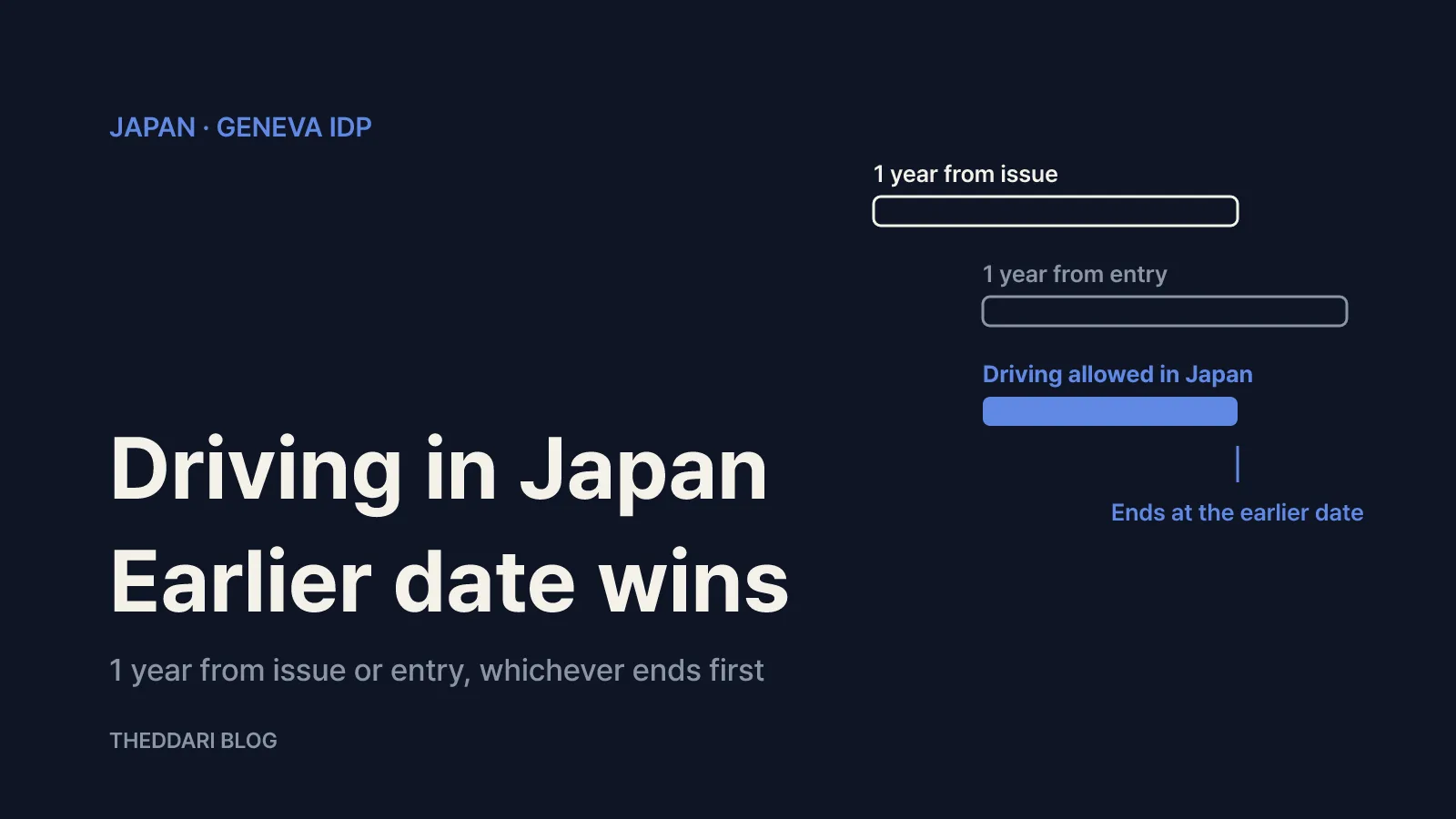
You may drive in Japan until whichever of these ends first:
- one year from the IDP's issue date, or
- one year from your date of entry into Japan.
For short-term visitors, the issue-date limit usually runs out first. If your permit expires midway through a rental, you cannot keep driving, so check that it is valid through your return date before booking.
There is an extra rule for people registered as residents in Japan. If you leave Japan and come back after less than three months abroad, that re-entry does not count as a new starting date, so an IDP obtained during that short trip cannot be used. This affects Japan-based residents who pop back to Korea to pick up a new permit.
Which vehicles your permit covers, and what blocks issuance
Your IDP shows vehicle categories based on your Korean license class:
← Swipe to see more
| Korean license | IDP categories |
|---|---|
| Class 1 Large | B, C, D |
| Class 1 Special (large tow truck, wrecker) | B, E |
| Class 1 Special (small tow truck) | B |
| Class 1 Ordinary | B |
| Class 2 Ordinary | B |
| Class 2 Small | A |
Holders of Class 2 motorized bicycle licenses and learner's permits are not eligible. Most drivers hold a Class 1 or Class 2 Ordinary license, which maps only to category B. If you plan to rent a motorbike or scooter abroad, note that category A corresponds only to the Class 2 Small (motorcycle) license, and check what the destination country requires.
Under Article 98-2 of the Road Traffic Act, unpaid traffic fines or penalties block issuance until they are settled. Check for outstanding fines before heading to the airport desk.
Pre-departure checklist
- Count the days to departure. Two weeks or more: apply online (₩12,800). Less: go in person (₩9,000).
- Clear any unpaid traffic fines.
- Match your English name and signature to your passport.
- Prepare a compliant photo: 3.5 × 4.5 cm, white background, taken within six months.
- Confirm acceptance at your destination via KoROAD's country list and the relevant embassy, state by state for the US and Canada.
- Compare validity with your trip dates: one year from issue, and in Japan also one year from entry, whichever comes first.
- Pack all three documents: IDP, Korean license and passport.