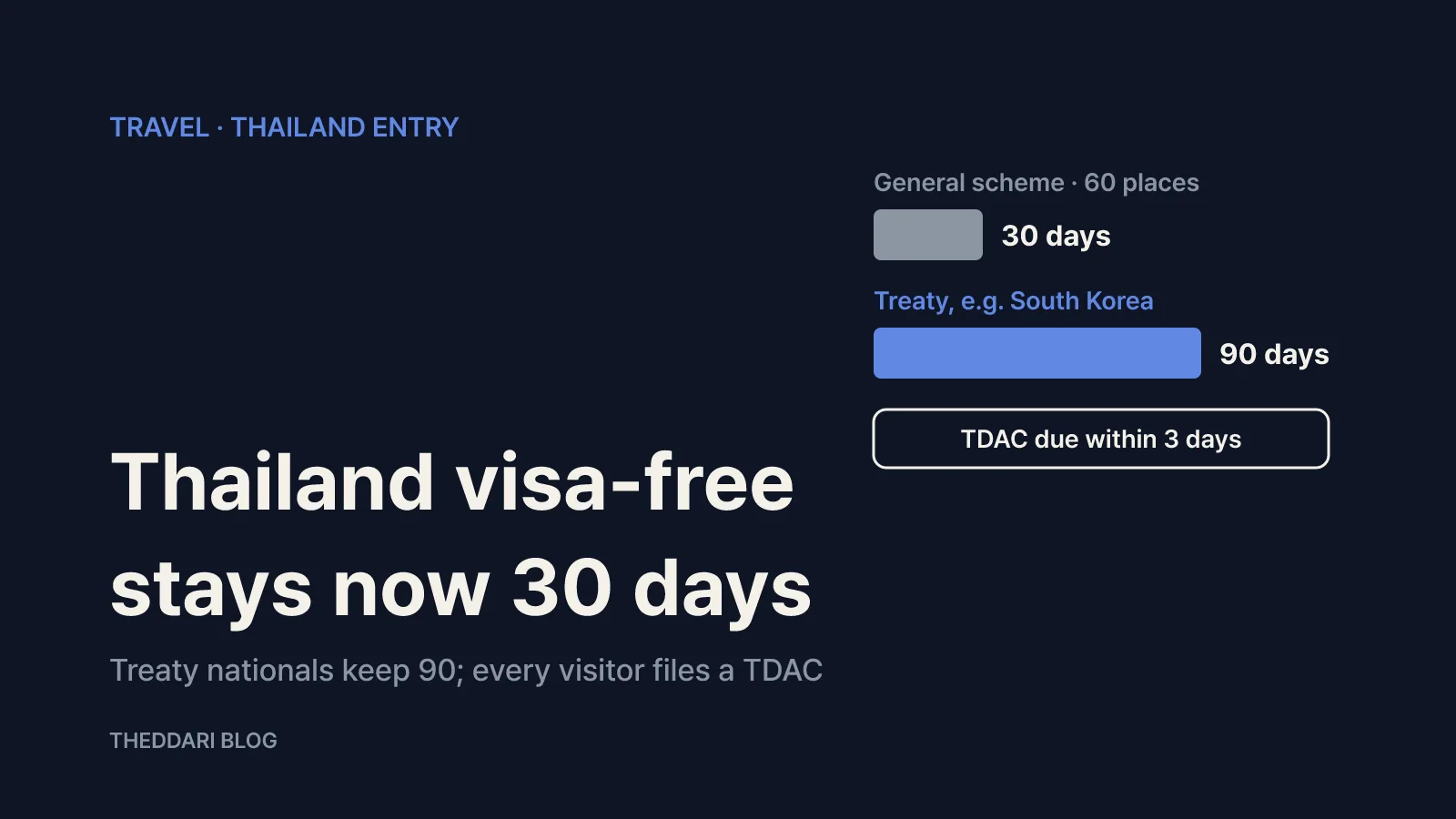
As of November 2026, travelers from the United States, the United Kingdom, Australia, Canada, Japan and most of Europe can stay in Thailand visa-free for up to 30 days, not the 60 days that applied before. Thailand's reorganised visa exemption scheme took effect on 15 September 2026. A handful of nationalities covered by bilateral agreements, including South Korea, Argentina, Brazil, Chile and Peru, still get 90 days. Whatever passport you hold, one requirement has not changed: every non-Thai traveler must file a free Thailand Digital Arrival Card (TDAC) on the official Immigration Bureau website within 3 days before arriving.
This guide draws on the Royal Thai Embassy in Doha's visa exemption list, updated 16 September 2026, the Korean Embassy in Bangkok's notice of 9 September 2026, the Immigration Bureau's TDAC user guide and the UK government's Thailand entry requirements. Thai rules can change at short notice, so recheck the update date on each page before you fly.
What changed on 15 September 2026
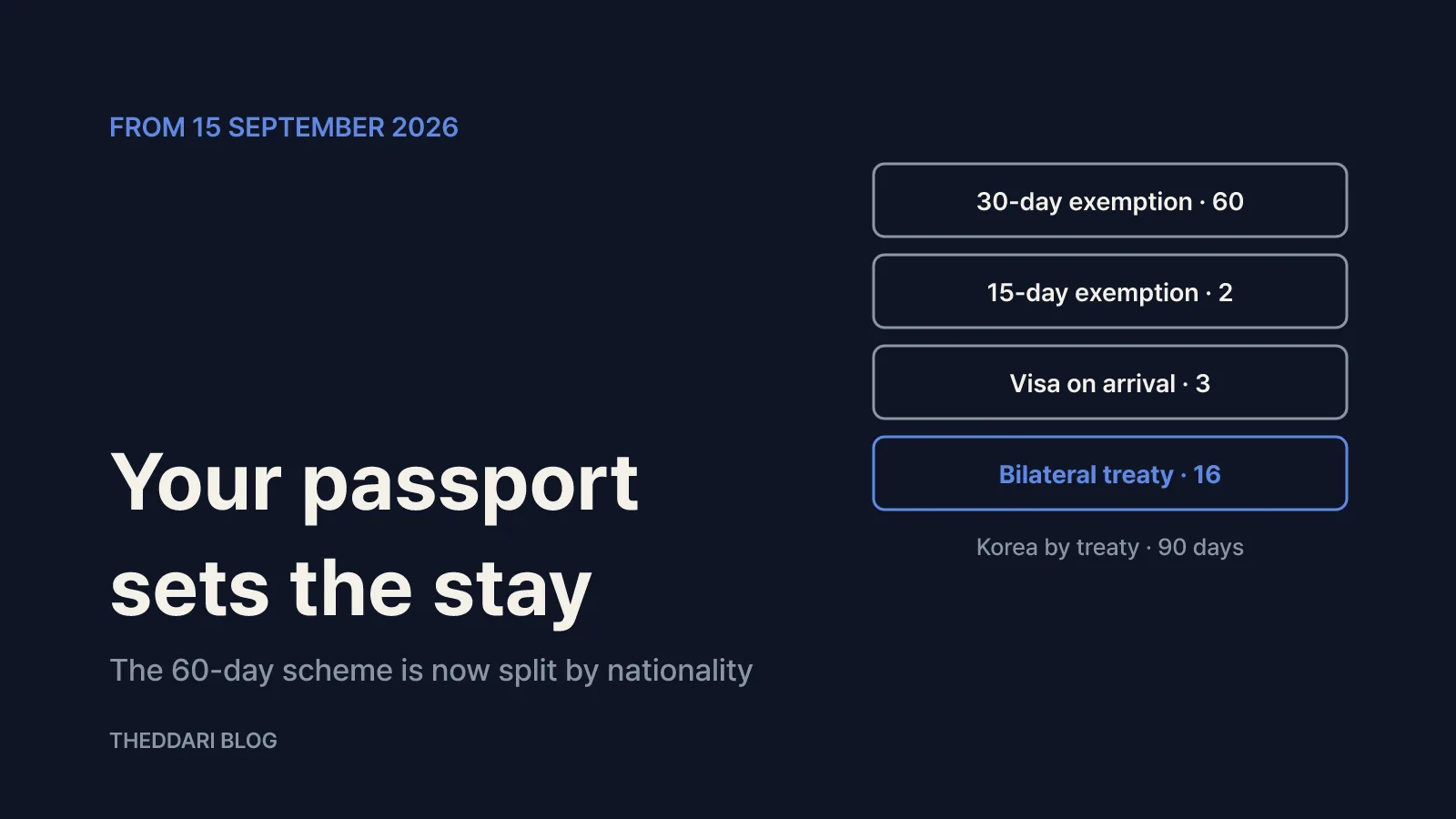
From July 2024 until September 2026, Thailand ran a single visa exemption scheme that let nationals of 93 countries stay for up to 60 days. According to the Korean Embassy's summary of the Thai Interior Ministry announcement, that scheme has been replaced by four tracks:
- A 30-day visa exemption for 60 countries and territories
- A 15-day visa exemption for 2 countries, Seychelles and Mauritius
- Visa on arrival for 3 countries, Azerbaijan, Belarus and Serbia, allowing up to 15 days for a 2,000 baht cash fee
- Visa exemption under bilateral agreements for 16 countries, with the length set by each agreement
The 30-day list on the Doha embassy page includes Australia, Canada, France, Germany, India, Ireland, Japan, New Zealand, Singapore, Taiwan, the United Arab Emirates, the United Kingdom and the United States. The UK government adds that visa-exempt entry now covers tourism only; conferences, meetings and other business activity need an appropriate visa arranged before travel. If you entered before 15 September 2026, you will usually keep the stay you were granted on arrival.
The second change concerns land borders. Visa-exempt tourists on the 30-day and 15-day tracks may enter through land or sea checkpoints only twice per calendar year. Nationals of Malaysia, Brunei, Indonesia and Singapore are exempt from that cap, and arrivals by air are not counted. If your itinerary loops through Laos, Cambodia or Malaysia by bus or train, count your crossings before you book.
Who still gets 90 days
The Doha embassy list shows five nationalities with 90-day stays under bilateral agreements: Argentina, Brazil, Chile, South Korea and Peru. For Koreans, the embassy's May 2026 notice explains that the 1981 Korea–Thailand visa waiver agreement remains in force and takes priority over Thailand's general visa exemption scheme. Korean passport holders who are not travelling for work can therefore stay for 90 days, regardless of the cut to 30 days.
Some headlines described this as Koreans gaining extra days. That is misleading: the 90 days is not new, it is the existing treaty term. What ended was the general 60-day scheme shared by many other countries.
Treaty-based travelers also fall outside the two-a-year land border cap. The Korean Embassy still warns that land border screening is expected to tighten and that an officer can refuse entry at their discretion, so frequent overland visitors should carry proof of their purpose, such as hotel bookings and an onward ticket.
Mixed-nationality groups should plan carefully. A Korean traveler and an American friend on the same flight receive different permissions: 90 days and 30 days respectively. Work out the limit for each passport separately, especially for long winter stays or a month-long base in Chiang Mai.
The TDAC: free, required on every entry, filed within 3 days
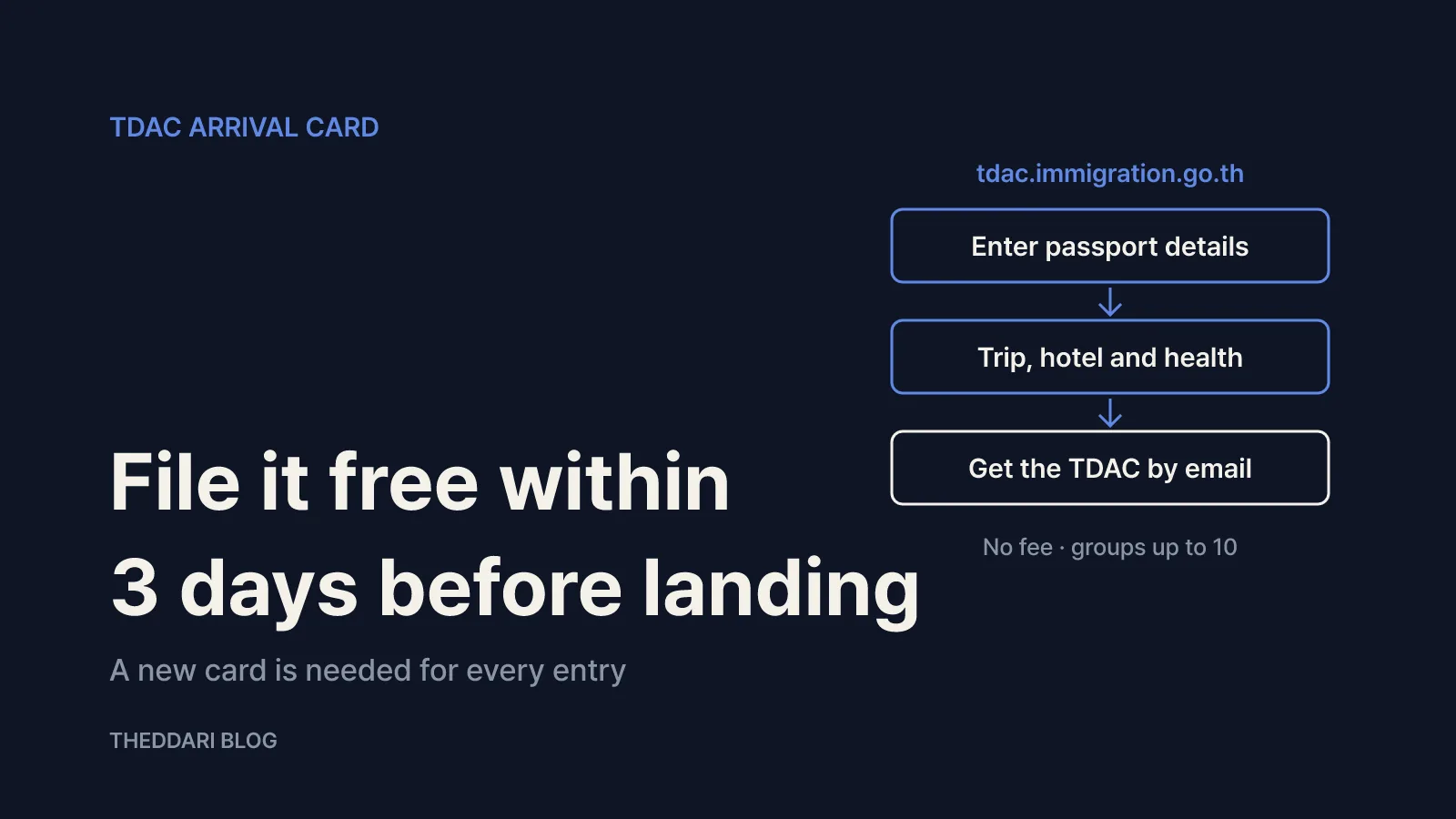
The TDAC replaced Thailand's paper arrival card on 1 May 2025. The Immigration Bureau guide says all non-Thai nationals must complete it online before entry, whether they arrive by air, land or sea. Visa-exempt visitors are not excused. The Royal Thai Embassy in Abuja summarises the key rules:
- Submit it within 3 days before you arrive in Thailand.
- Register again every time you enter; a TDAC from a previous trip cannot be reused.
- It is free. If a site asks you to pay, you are not on the official site.
- It is not a visa and cannot be used in place of one.
The only official address is tdac.immigration.go.th, and Thai government domains end in .go.th. Lookalike sites that charge processing fees can appear at the top of search results, and the Abuja embassy tells travelers not to pay. Type the address yourself rather than clicking an advert, because details entered on a third-party site may never reach the immigration system.
The window is counted from your arrival date in Thailand, not your departure date, so you cannot finish it a week early. If a long-haul journey leaves home more than three days before you land, file during your stopover instead.
Filling in the TDAC step by step
The official user guide lists these steps for an individual submission:
- Select "Arrival Card" on the official site.
- Enter personal and passport details. You can scan the passport's machine-readable zone (MRZ) or upload an image of it, but check the imported values every time.
- Add your trip and accommodation details.
- Answer the Ministry of Public Health questions. Extra questions appear if a country you visited in the two weeks before arrival, your boarding country, your nationality or your flight is on the ministry's list.
- Preview the form and use "Edit" to fix mistakes.
- Enter the email address where the card should be sent, accept the terms and submit.
- Download the card. You can download or print it again from the email during your stay.
Everything must be typed in English. Families can use group submission for up to 10 travelers at once, and the "Same as Previous Traveler" option copies shared trip and hotel details. Children are added one by one in the same way.
You can change submitted details before travel through "Update Arrival Card", searching by TDAC number, date of birth and nationality. That covers a new flight or a different hotel. You cannot change your full name as shown in the passport, your nationality or your date of birth; an error in any of those requires a fresh submission, so compare each letter against your passport before you press submit.
The confirmation email also tells you which queue to join. "AUTOMATED BORDER CONTROL - ELIGIBLE" in green means you may use the automated gates; "IMMIGRATION COUNTER - MANUAL PROCESSING" means you go to a staffed counter. Save that email offline on your phone.
What immigration may check, and the cost of overstaying
Visa-exempt does not mean unchecked. The Doha embassy lists a condition that visa-exempt travelers hold cash or the equivalent of 20,000 baht per person or 40,000 baht per family. The UK government cites a lower figure of 10,000 baht per person or 20,000 baht per family, alongside evidence of onward or return travel, and notes that British nationals have been refused entry for failing to show it. Because the published figures differ, carry proof of funds and an onward booking in both digital and paper form.
Extensions are at the immigration officer's discretion and must be requested before your permitted stay ends. According to GOV.UK, overstaying costs 500 baht per day up to a maximum of 20,000 baht, and it can lead to detention, deportation at your own expense and a re-entry ban of up to 10 years. Compare the date in your entry stamp with your return flight as soon as you clear immigration.
A pre-departure checklist
- Check each traveler's passport and work out their limit: 30 days for most Western passports, 90 days for treaty nationals such as Koreans.
- Count any land or sea crossings planned for the calendar year.
- Once you are within 3 days of arrival, file the TDAC at
tdac.immigration.go.th. Stop immediately if a payment screen appears. - Match your name, nationality and date of birth against your passport, then save the email and QR code on your phone.
- Pack proof of funds and an onward or return ticket.
- Recheck the embassy and GOV.UK pages a day before departure.
Finishing the TDAC at home or at your departure airport is the least stressful option. Airport Wi-Fi or a new SIM may not connect the moment you land, and filling in a form in the arrivals hall means queuing twice.