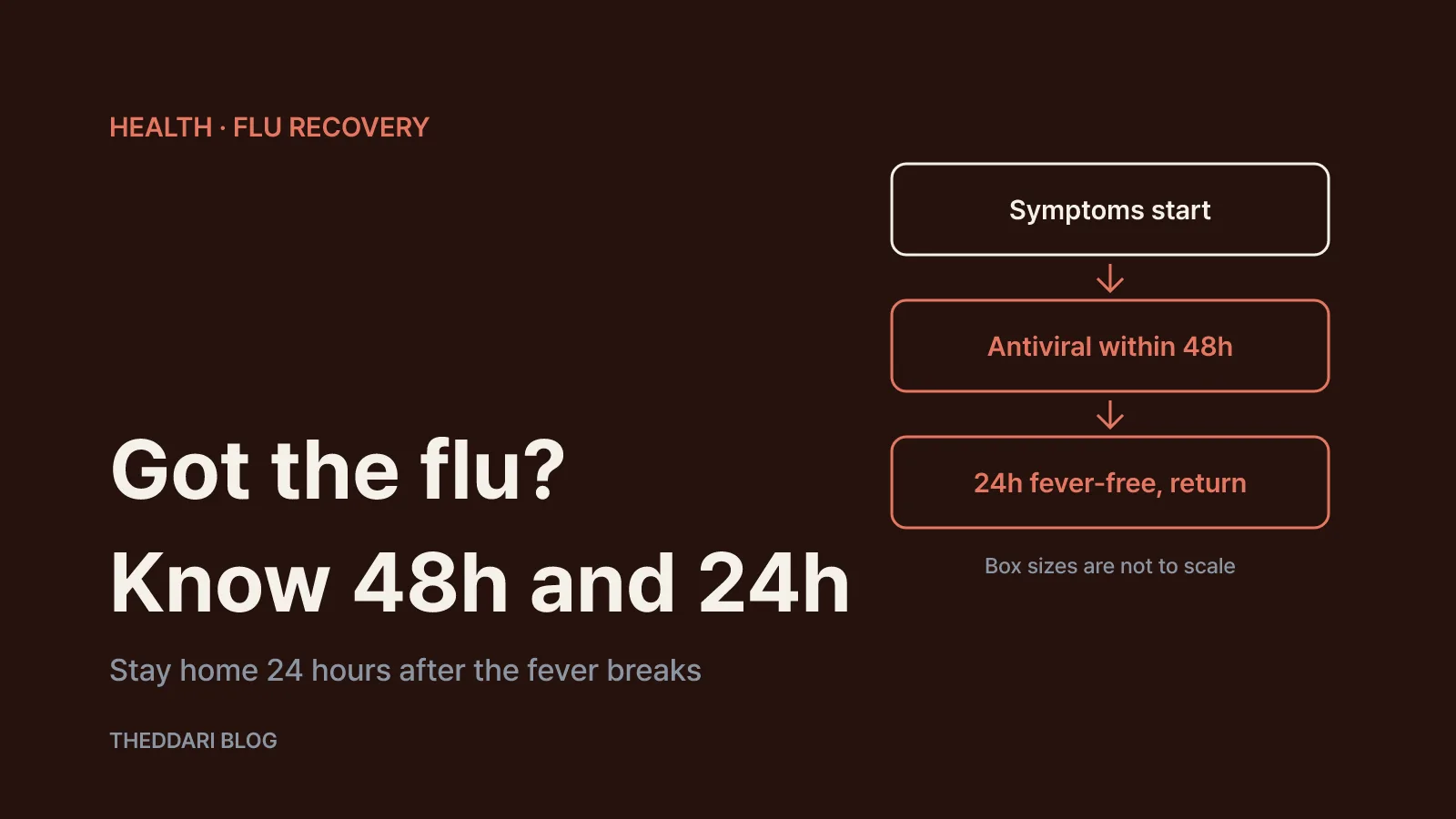
As of November 2026, if you catch the flu in Korea, two time windows matter most. Flu antivirals such as Tamiflu (oseltamivir) work best when started within 1 to 2 days (48 hours) of your first symptoms, and the Korea Disease Control and Prevention Agency (KDCA) advises staying home from school, daycare and work until you have been fever-free for at least 24 hours without fever-reducing medicine. If you did take a fever reducer, the KDCA says to keep watching for 2 days (48 hours) after the last dose. Because a national flu advisory is in effect, high-risk patients can get antivirals covered by National Health Insurance without a test if their doctor decides they need them.
This guide is based on KDCA press releases and the US Centers for Disease Control and Prevention (CDC) treatment page. Whether you take an antiviral, and for how long, is decided by the doctor who sees you, so it helps to arrive knowing when your symptoms began and what your temperature readings have been.
How bad is flu in Korea right now?
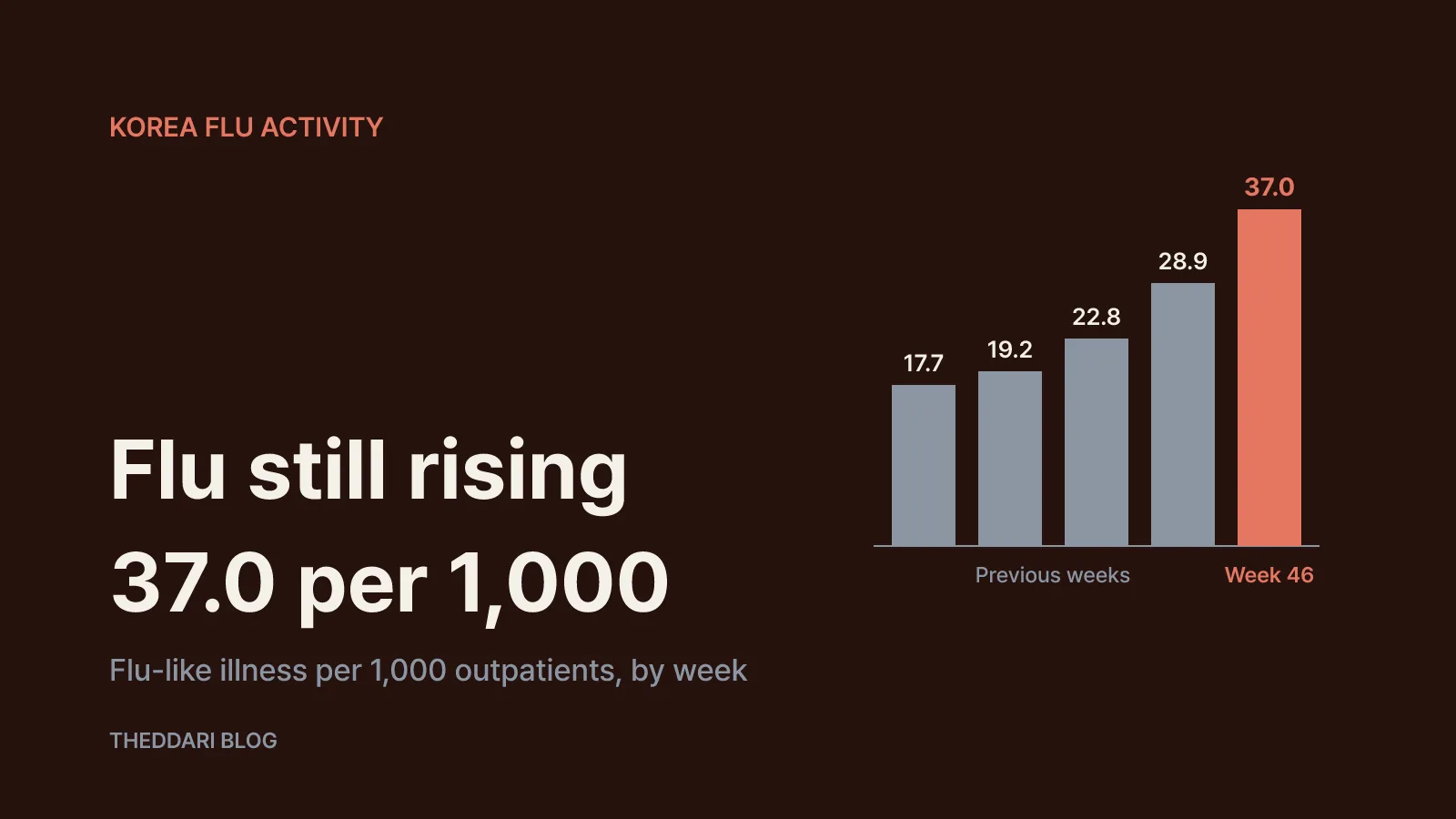
The KDCA declared its 2026-2027 influenza advisory on September 11, 2026, after clinics reported 25.3 influenza-like illness (ILI) patients per 1,000 outpatients in week 36 (Aug 30 to Sep 5), above this season's threshold of 12.9 (KDCA, Sep 11, 2026). Last season's advisory came on October 17, 2025, so this year started more than a month earlier. In Korean surveillance, an ILI patient is someone with a fever of 38°C or higher plus a cough or sore throat.
By week 46 (Nov 8 to 14), the rate had reached 37.0 per 1,000, rising for four weeks in a row: 17.7, 19.2, 22.8, 28.9 and then 37.0 (KDCA, Nov 20, 2026). School-age children are hit hardest, at 98.9 per 1,000 for ages 7 to 12 and 64.5 for ages 13 to 18.
Hospital data look serious too. Sentinel hospitals reported 926 flu admissions in week 46, about 1.5 times the previous week's 639, and 65.4% of those patients were 65 or older. The dominant strain is A(H1N1)pdm09, which matches this season's vaccine strain, and the KDCA found no mutations affecting antiviral resistance.
Flu symptoms vs. a cold
According to KDCA Q&A material, symptoms appear 1 to 4 days (2 days on average) after infection. Typical symptoms are fever, cough, headache, muscle aches, runny nose and sore throat, and children may also have nausea, vomiting or diarrhea (Korea.kr Q&A). The key difference from a cold is that fever and body aches tend to arrive suddenly and hard.
Fever and other whole-body symptoms usually last 3 to 4 days, while cough and sore throat can linger for several days after the fever breaks. A leftover cough is common, but keep covering coughs and wearing a mask while it lasts.
The KDCA lists adults 65 and older, children, pregnant women, people with lung or heart disease, people with certain chronic conditions and those with weakened immune systems as being at higher risk of complications such as pneumonia. Ear infections and bacterial pneumonia are the most common complications. If you are in one of these groups and develop a fever with cough or sore throat, see a doctor promptly rather than waiting it out. For emergencies such as ongoing shortness of breath, chest pain, confusion or seizures, call 119 or go to an emergency room.
When should you take Tamiflu, and is it covered?
The CDC says flu antivirals work best when started within 1 to 2 days of symptom onset and can shorten illness by about a day (CDC). Starting later can still help people at higher risk of complications or those sick enough to be hospitalized. Most otherwise healthy people with mild illness do not need antivirals, although they may still be prescribed them.
In Korea, two antivirals are covered by National Health Insurance: oral oseltamivir (Tamiflu and others) and inhaled zanamivir (Relenza Rotadisk). Coverage works in two ways:
- Confirmed by a test: a positive rapid antigen test or PCR qualifies for coverage at any time of year, advisory or not (Korea.kr Q&A).
- High-risk patients during an advisory: children, pregnant women or those within 2 weeks of giving birth, adults 65 and older, immunocompromised people and those with underlying conditions can be covered on symptoms alone if the doctor prescribes it, with no test required (KDCA, Sep 11, 2026).
If you are a healthy adult hoping for a prescription without a test, ask about testing and costs during your visit, since you may fall outside the coverage rules.
Per the CDC, oseltamivir and zanamivir are usually taken twice a day for five days. Zanamivir is an inhaled powder approved for ages 7 and up and is not recommended for people with asthma or COPD. Nausea and vomiting are the most common side effects of oseltamivir. Finish the course as prescribed even if your fever drops early. Also remember that antibiotics do not treat flu. Doctors use them only for bacterial complications such as ear infections or pneumonia.
The 24-hour fever-free rule for school and work
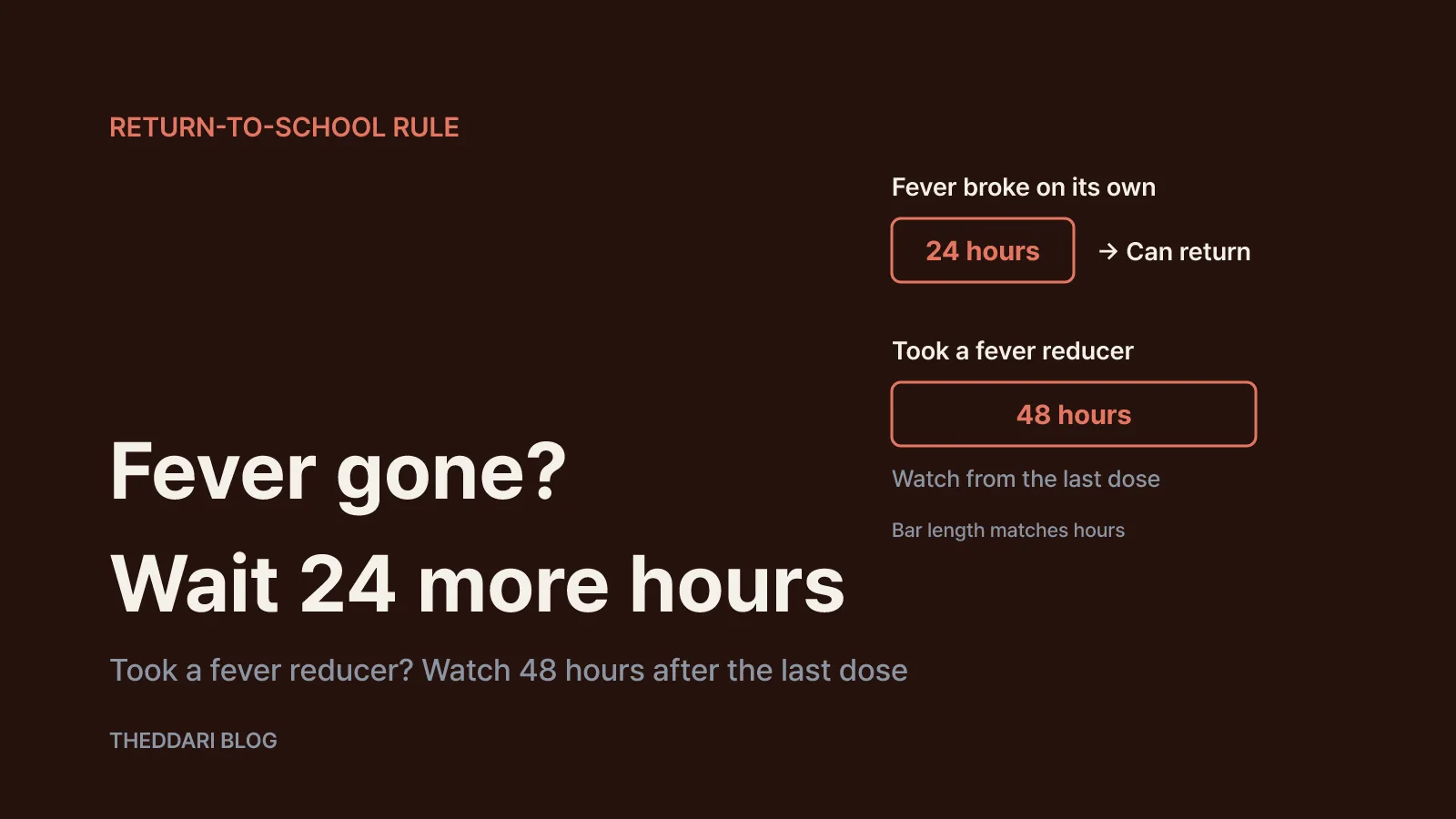
The KDCA recommends staying home from school, daycare and work until 24 hours after your fever breaks, when you are no longer considered infectious. If you used a fever reducer, monitor for 48 hours after the last dose (Korea.kr Q&A). The agency repeated this in February 2026, urging parents to keep children home for at least 24 hours after the fever is gone without medication (KDCA, Feb 24, 2026).
Here is a simple way to count:
- Fever broke on its own: start a 24-hour clock from the first normal reading. If your temperature is normal at 3 p.m. Monday and stays down, you can return after 3 p.m. Tuesday.
- Fever was brought down with medicine: a medicated temperature does not count. Watch for 48 hours from the last dose.
- Severe illness or weakened immunity: your doctor may set a longer period.
Starting Tamiflu does not mean you can go back the next day. Experts advising the KDCA specifically warned against children returning to school early just because they began treatment. Schools and daycares can exclude children with flu, so check whether they need a doctor's note.
Recovering at home
While you recover, avoid close contact with older relatives and other high-risk household members and leave home only when necessary, such as for medical care. The KDCA's basic precautions are to wash hands with soap for at least 30 seconds, cover coughs with a tissue or sleeve, wear a mask while symptomatic, and ventilate rooms for 10 minutes every 2 hours (KDCA, Nov 20, 2026). Use the same thermometer each time and note the time of every reading and every fever-reducer dose so the return date is easy to work out. See a doctor again if symptoms get worse or the fever returns.
It is not too late for household members to get vaccinated. As of 6 p.m. on November 19, 74.8% of adults 65 and older and 59.8% of children had received their free national flu shot. The KDCA says vaccination can cut the risk of severe illness and death to as little as one-fifth, depending on age, and the CDC stresses that antivirals are a second line of defense, not a substitute for the vaccine.