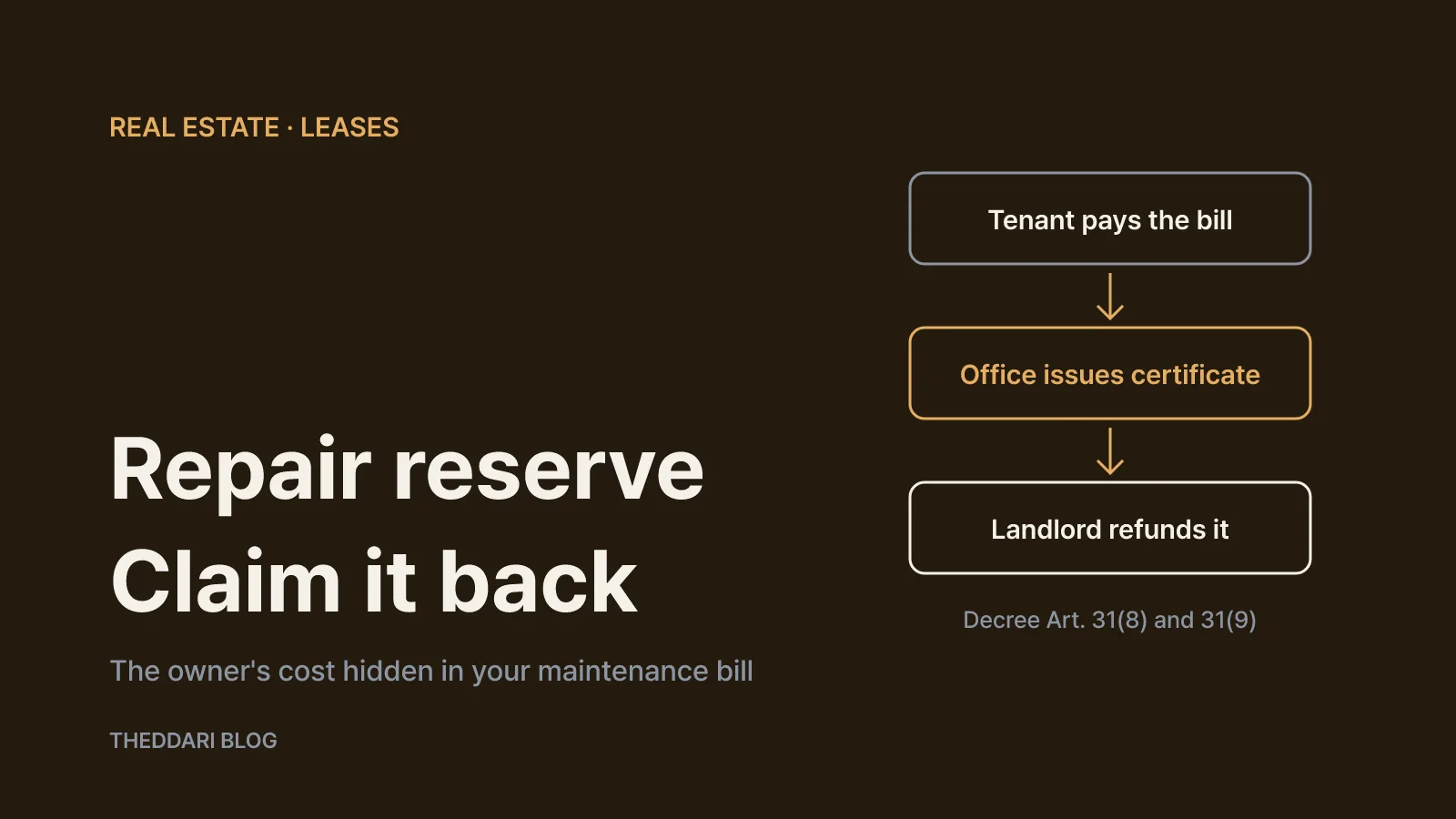
As of November 2026, a tenant renting an apartment in Korea, whether on jeonse (a lump-sum deposit lease) or wolse (monthly rent), can ask the landlord to refund the long-term repair reserve they paid through the monthly maintenance bill. The rule is in Article 31(8) of the Enforcement Decree of the Multi-Family Housing Management Act: when an occupant pays the reserve on the owner's behalf, the owner must return that amount. Article 31(9) adds that the management office must issue a payment certificate without delay when the occupant asks. In practice the steps are simple: get the certificate, check it against your bills, and settle the amount with the landlord when your deposit is returned.
This guide is written for renters, including foreign residents, who see a long list of Korean line items on their apartment bill and are not sure which ones they actually owe. The legal text comes from the Korean National Law Information Center, and the plain-language explanation comes from the Ministry of Government Legislation's Easy Law guide.
Why the repair reserve belongs to the owner
The long-term repair reserve (jangsu-seon chungdanggeum, often shortened to jangchunggeum) is money an apartment complex sets aside for big, infrequent jobs such as replacing elevators, redoing exterior walls or renewing pipework. According to the Easy Law guide, managers of apartment complexes with 300 or more households, complexes with elevators, or complexes with central heating, among others, must collect this reserve from the owner of each unit under a long-term repair plan (Articles 29(1) and 30(1) of the Act).
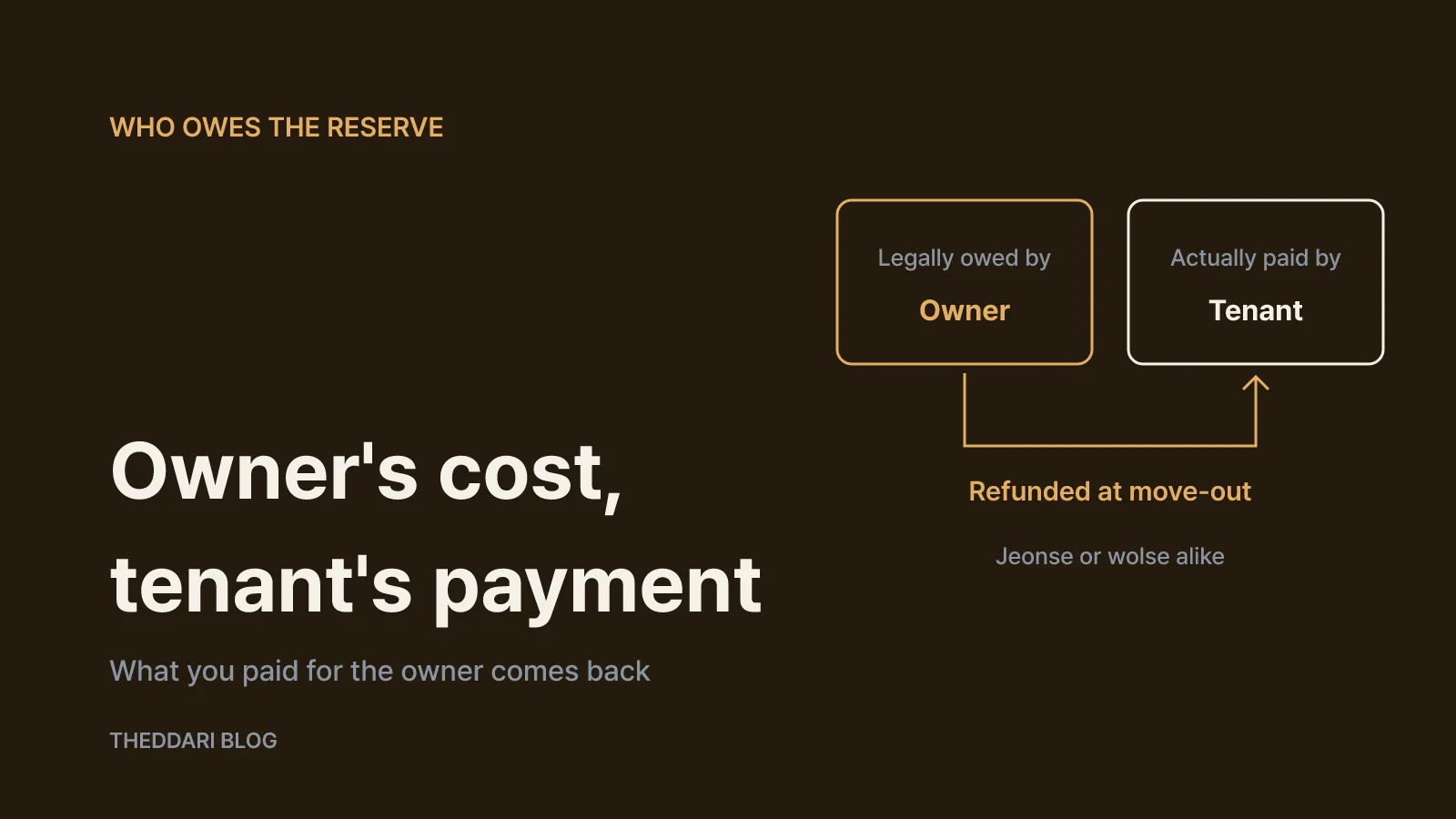
The key phrase is "from the owner". The reserve protects the value of the building, so the legal burden sits with the landlord. In reality, though, it appears as one line on the combined maintenance bill, and the person living in the unit usually pays the whole bill by automatic transfer. The Easy Law guide itself notes that tenants commonly pay it together with maintenance fees under the complex's management rules.
That is why the decree says the owner must return any reserve the occupant paid on their behalf. The text does not distinguish between jeonse and wolse, so the type of lease does not matter. A useful way to think about it: the reserve is not a usage charge you consume, like electricity, but money you advanced for the owner. If you do not raise it at move-out, the owner's cost simply stays with you.
Finding the reserve on your maintenance bill
Start with the line item names. Most bills show a separate line labelled 장기수선충당금 or 장충금. A legal Q&A column in the Korea Apartment News points out that Article 23 of the decree requires the reserve to be collected separately from general management fees, which is why it usually has its own row. Only that row counts toward your refund, not the bill total.
Watch out for 수선유지비 (repair and maintenance fee). The name looks similar, but it covers routine upkeep and is a general management fee that the occupant normally bears. Utility charges such as electricity, water, heating and gas are also yours. Leave all of these out of your claim.
The amount varies by complex and by unit. Article 31(3) sets the monthly charge per household as the total repair cost over the plan period divided by (total supply area × 12 × plan years), multiplied by the unit's supply area. Larger units pay more, and the monthly figure can change partway through your lease if the repair plan is revised. Multiplying today's figure by the number of months you lived there can therefore overstate or understate what you really paid.
If you moved into a brand-new building, check the first months too. Under Article 31(6), the reserve starts accruing from the month in which one year has passed since the building's use inspection or use approval. Early months without a reserve line should not be part of your claim.
Getting the certificate and checking the amount
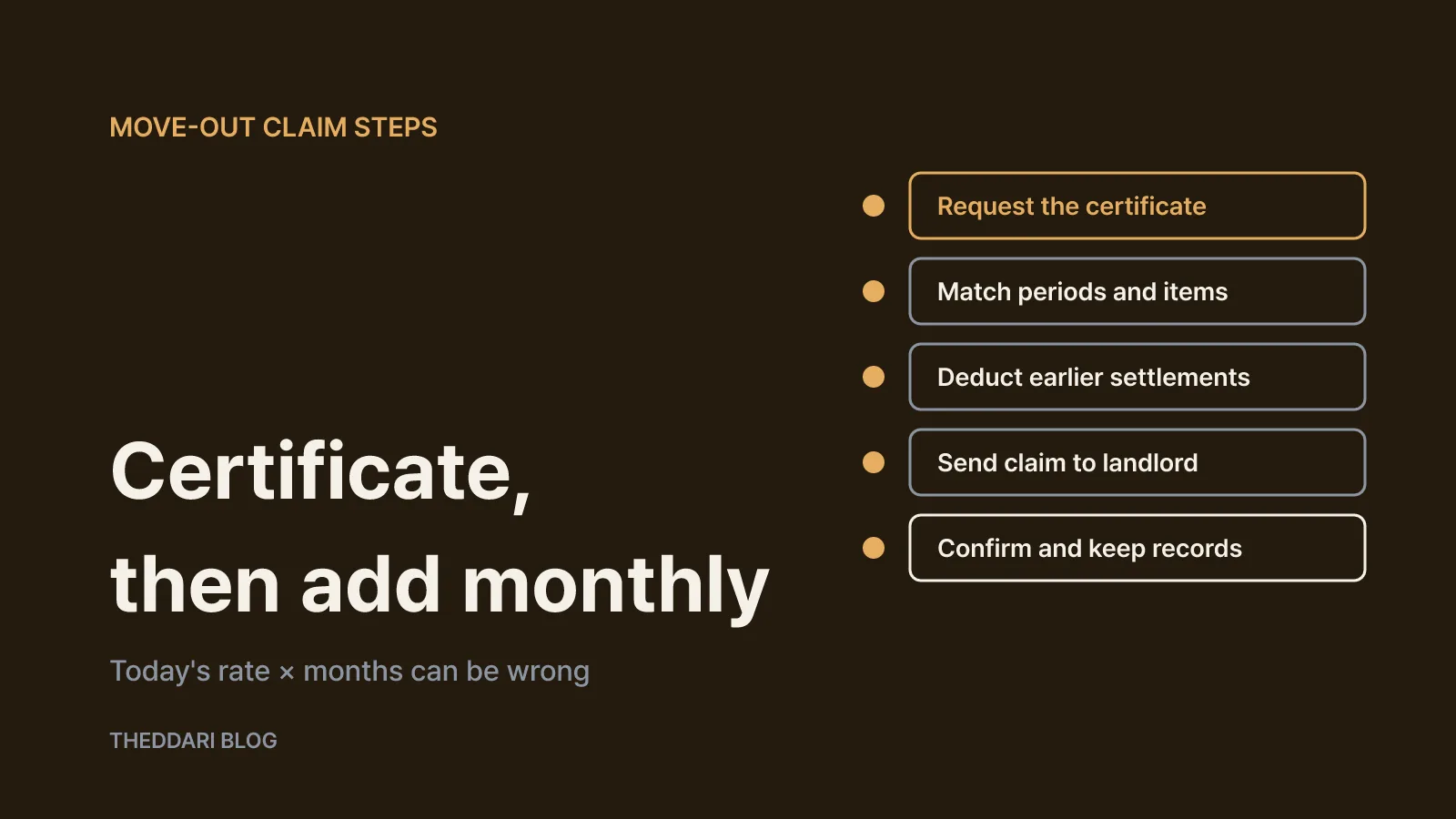
- Ask the management office for a payment certificate. Article 31(9) obliges the management body to issue a certificate without delay when the occupant requests one, so you do not need the landlord to do it. Ask as soon as your move-out date is fixed. The last month's maintenance fee is often settled on moving day, so confirm whether that final month is included.
- Match periods and line items. Check the unit number, the payment period and the monthly amounts against your lease dates. Make sure no months from before you moved in or after you left are included, and that the repair and maintenance fee has not been added in. Exclude any month that was billed but not yet paid.
- Check for earlier settlements. If you renewed the lease and settled the reserve at that point, claim only the period after the last settlement. Old transfer records or messages help avoid a dispute about double counting.
- Send the claim to the landlord. Share a copy of the certificate and the total, and agree whether it will be added to the deposit refund or paid separately. If a real estate agent is handling the final settlement, ask them to add a repair reserve line to the settlement sheet.
- Confirm payment and keep records. If the reserve is bundled into the deposit refund, note how much of the transfer was the reserve. Keep the certificate, the final bill and your messages together.
Add the amounts month by month. The figures below are hypothetical and only show the method. If you paid ₩12,000 a month for the first 12 months and ₩15,000 a month for the next 12, the total is ₩144,000 plus ₩180,000, or ₩324,000. Multiplying the current ₩15,000 by 24 months would give ₩360,000, which is more than you actually paid and can start an argument. Use the monthly figures on the certificate.
A short, factual message works best. For example: "For the move-out settlement, I am sending the repair reserve payment certificate from the management office. It covers [month/year] to [month/year], totalling ₩[amount]. Could we settle this together with the deposit refund?" Citing Article 31(8) of the decree in one line makes the request easy to understand.
When the landlord refuses to pay
First, read the special terms of your lease. A column by lawyer Lim Sang-young in Economist Korea explains that if the contract includes a clause saying the tenant bears the long-term repair reserve, that clause is valid and the tenant cannot claim a refund. Without such a clause, the column says a landlord who refuses without good reason can be pursued through a payment order or a civil lawsuit. If you are about to sign a new lease, checking the special terms for this wording is the most reliable protection.
The owner may also have changed during your lease. The same column says a tenant can ask the new owner to return the reserve paid during the tenancy, but how to split the periods before and after the sale is an easy point of disagreement. Ask the management office to break the certificate down at the ownership transfer date so you know which amount relates to which owner.
On timing, the column states that a claim can be made within 10 years of the lease ending. Even so, waiting rarely helps: contact details change and records become harder to collect, so settling it alongside the deposit is the practical choice.
Can you ask the management office or the residents' council instead? The default route is the owner. The Korea Apartment News column describes a Busan District Court ruling (case 2015Na10803) in which a tenant who paid the reserve through a combined bill, without any notice that it was legally the owner's obligation, was allowed to seek it back from the residents' council as unjust enrichment. That was one court's decision on its facts, so treat it as an exceptional option rather than the standard path.
If talking does not resolve it, gather the certificate, monthly bills, payment records and your messages in one place. Clear records make any legal consultation or payment order much quicker.
Move-out checklist for renters
- Requested the repair reserve payment certificate as soon as the move-out date was set?
- Certificate period matches the lease, with no repair and maintenance fee or utilities mixed in?
- Months with a different monthly amount added separately?
- Lease special terms checked for a clause about who bears the reserve?
- Periods split at the ownership transfer date if the landlord changed?
- Final month's maintenance settlement included?
- Deposit settlement sheet or transfer record shows the reserve as its own amount?
Officetels, shops and other buildings that are not multi-family housing may fall under different rules and use different line item names, so do not apply this guide to them directly; ask the management office what legal basis the charge has. For a standard apartment, one certificate and one message usually settle the matter.