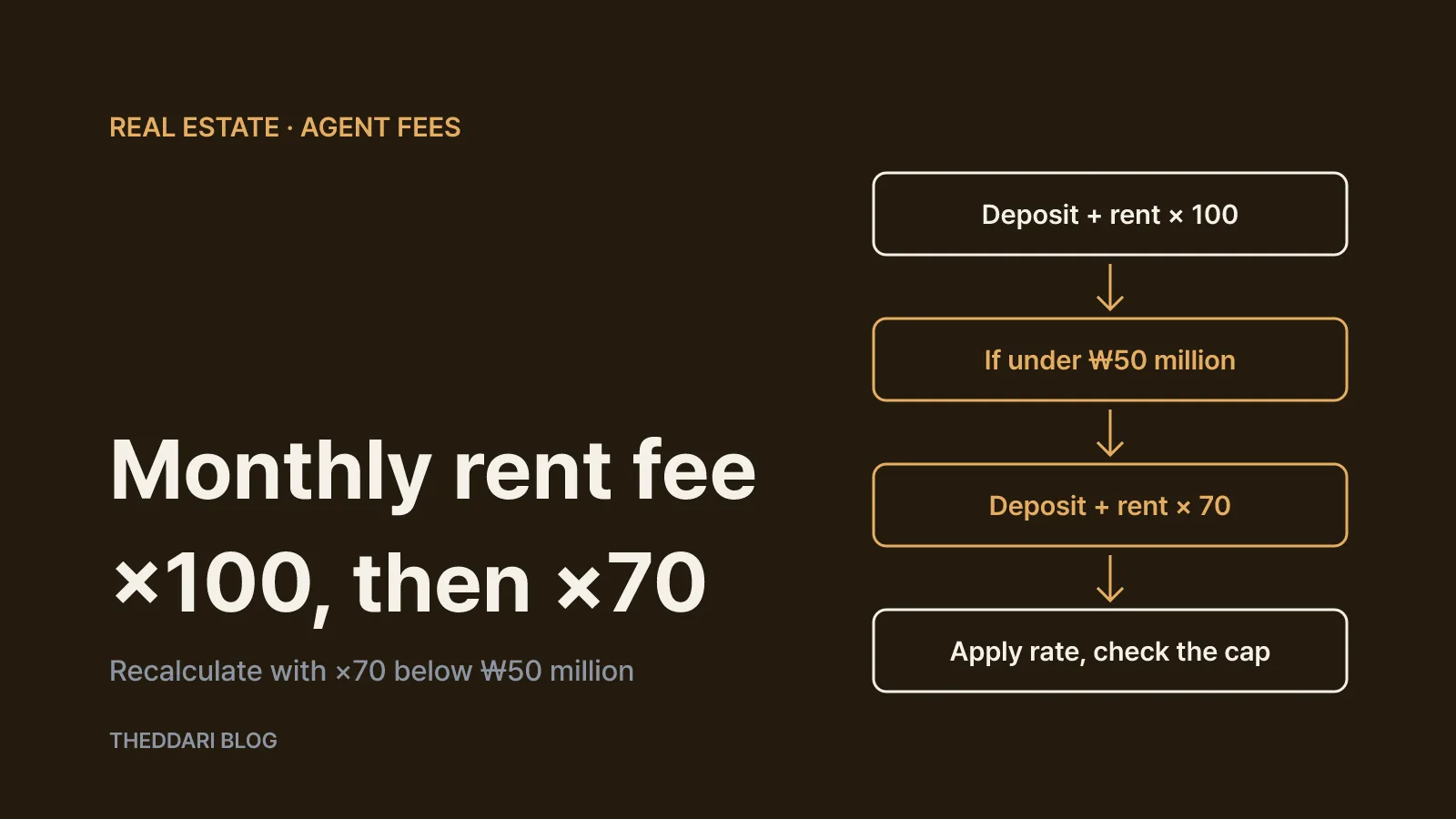
As of November 2026, the commission a licensed real estate agent in South Korea may charge for a home deal is capped at transaction value × maximum rate, and some price bands also carry a fixed ceiling. For a jeonse (lump-sum deposit) lease, the transaction value is simply the deposit. For a wolse (monthly rent) lease, you convert it first: deposit + monthly rent × 100. If that total is below ₩50 million, recalculate it as deposit + monthly rent × 70. The published rates are maximums, not fixed prices, and VAT is charged separately. The rules come from Article 20 of the Enforcement Rule of the Licensed Real Estate Agents Act and the Seoul Metropolitan Government fee table.
This guide is for anyone renting or buying a home in Korea through a budongsan (real estate office), including foreign residents who are signing their first Korean lease and want to check the figure an agent quotes.
The maximum rate table: sales and leases differ
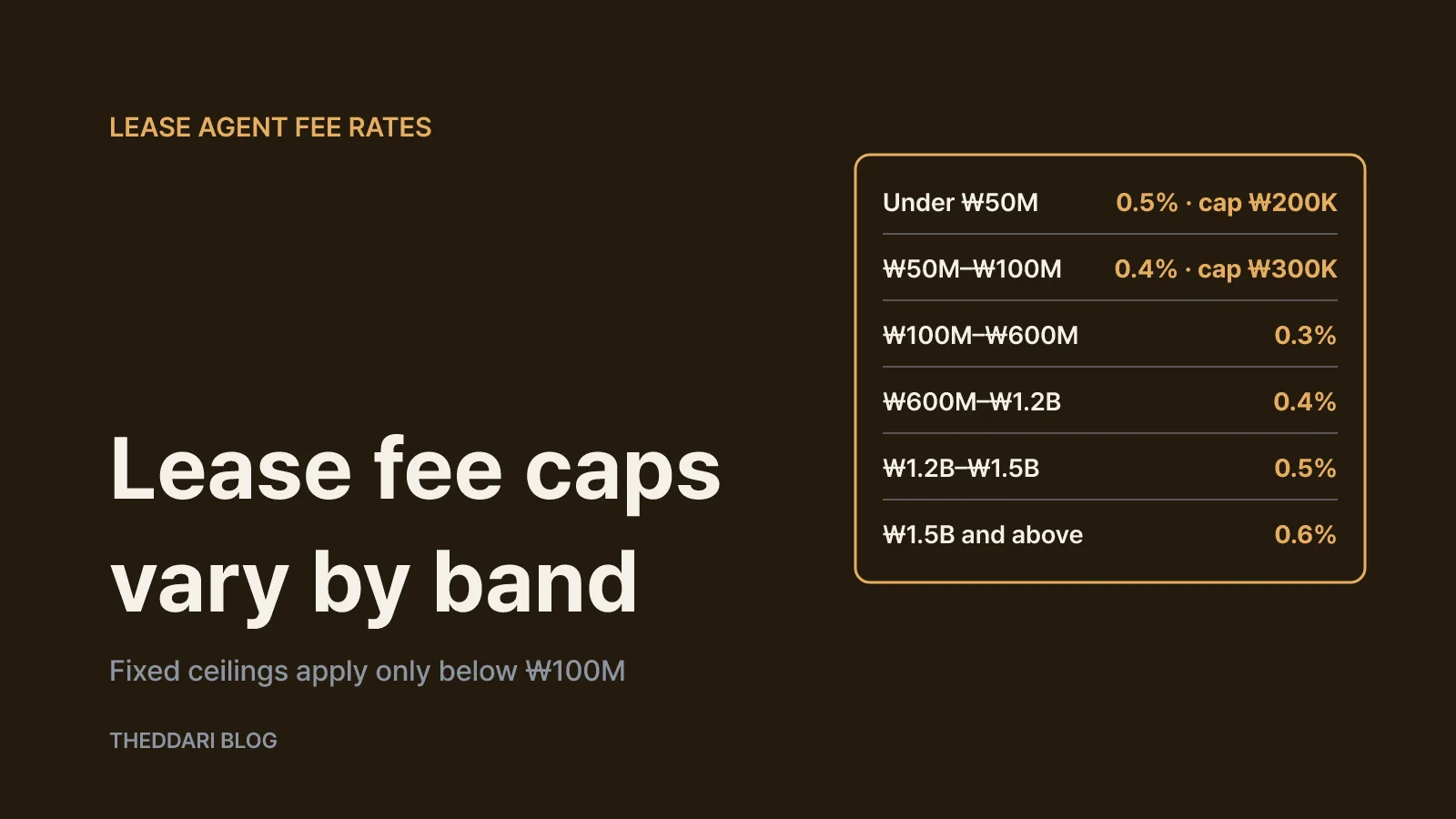
Korea uses separate tables for sales and for leases. A national ministry rule sets the ceiling, and each province or metropolitan city fixes its rates by local ordinance within that ceiling. The figures below appear on the government housing portal MyHome and in Seoul's ordinance table, in force since December 30, 2021.
Sale or exchange of a home
← Swipe to see more
| Transaction value | Max rate | Fixed ceiling |
|---|---|---|
| Under ₩50M | 0.6% | ₩250,000 |
| ₩50M to under ₩200M | 0.5% | ₩800,000 |
| ₩200M to under ₩900M | 0.4% | None |
| ₩900M to under ₩1.2B | 0.5% | None |
| ₩1.2B to under ₩1.5B | 0.6% | None |
| ₩1.5B and above | 0.7% | None |
Lease (jeonse or monthly rent)
← Swipe to see more
| Transaction value | Max rate | Fixed ceiling |
|---|---|---|
| Under ₩50M | 0.5% | ₩200,000 |
| ₩50M to under ₩100M | 0.4% | ₩300,000 |
| ₩100M to under ₩600M | 0.3% | None |
| ₩600M to under ₩1.2B | 0.4% | None |
| ₩1.2B to under ₩1.5B | 0.5% | None |
| ₩1.5B and above | 0.6% | None |
Three points matter when you read these tables. First, both the rate and the ceiling are upper limits. The rule says the actual fee is agreed between the client and the agent within that range, so you can negotiate. Second, the agent collects a fee from each side separately. The landlord and the tenant each pay their own share, and the ceiling applies to what one party pays. Third, if the property and the agent's office are in different regions, the agent must follow the ordinance of the region where the office is located (Article 20(3)). MyHome links to each region's table if you are dealing outside Seoul.
Watch the band edges, too. For leases, ₩600 million falls into the "₩600M and above" band at 0.4%. A ₩590 million jeonse is capped at 0.3%, or ₩1.77 million, while a ₩600 million jeonse is capped at ₩2.4 million.
How to convert a monthly rent lease
A monthly rent contract has two numbers, a deposit and the monthly rent, so it has to be turned into a single transaction value before you can apply the table. Article 20(5) sets out the method:
- First pass: deposit + (monthly rent × 100).
- If the result is ₩50 million or more, that is your transaction value.
- If the result is under ₩50 million, recalculate as deposit + (monthly rent × 70) and use that figure.
- Apply the lease rate for that band, then compare the result with the fixed ceiling and pay no more than the lower figure.
The ×70 step stops fees on small rentals from being inflated. Studio and one-room leases with small deposits usually fall below ₩50 million on the first pass, so the second step applies. If an agent skips it, the cap can look higher than it really is.
Maintenance fees are not part of the formula. The rule multiplies the monthly rent only, so if the contract lists rent and a building management fee separately, use the rent line.
Worked examples
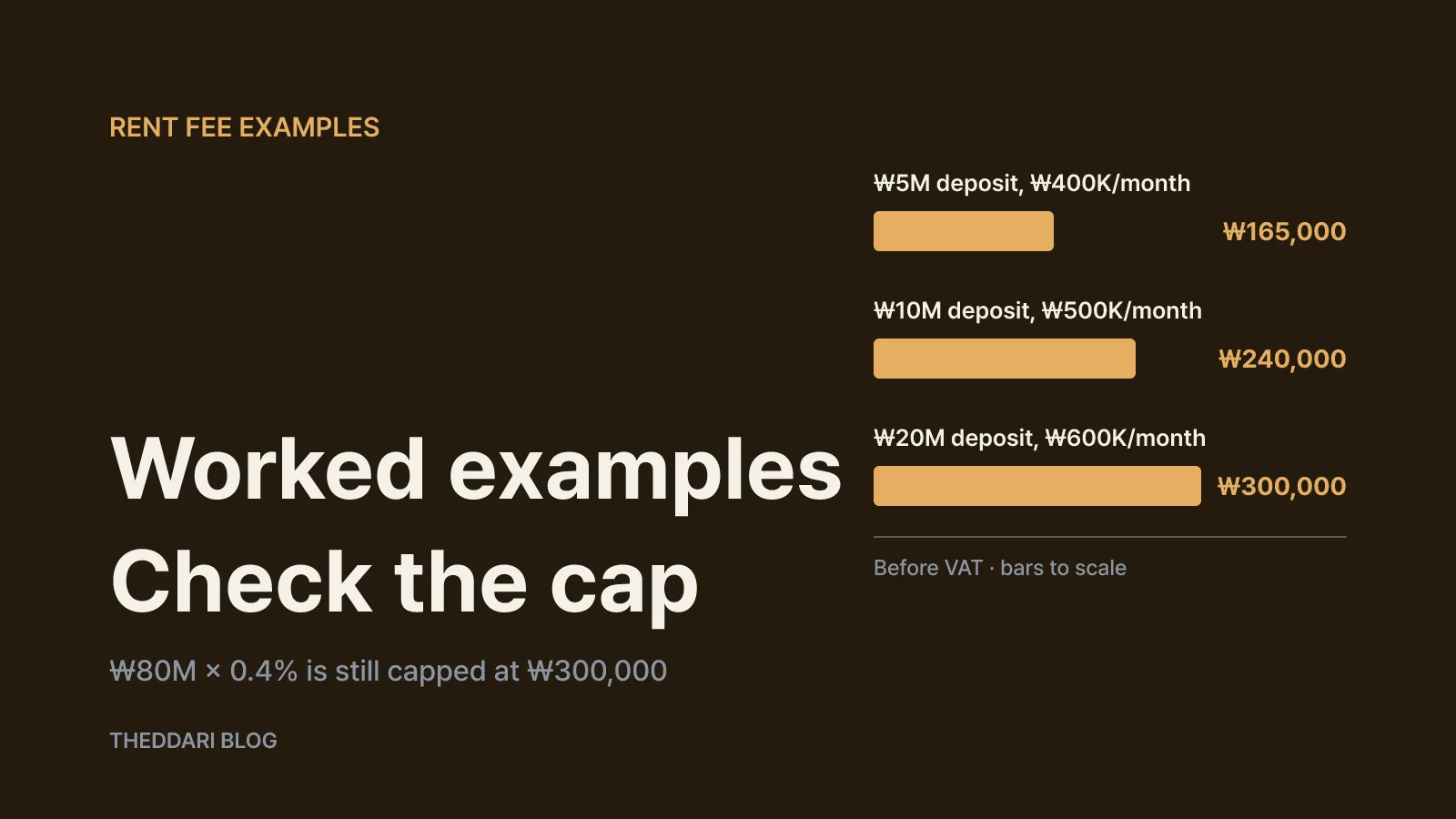
All figures are maximums before VAT. The actual fee may be lower by agreement.
← Swipe to see more
| Deal | Transaction value | Rate and ceiling | Maximum fee |
|---|---|---|---|
| ₩5M deposit, ₩400K/month | ₩45M (×100) → ₩33M (×70) | 0.5%, cap ₩200K | ₩165,000 |
| ₩10M deposit, ₩500K/month | ₩60M (×100) | 0.4%, cap ₩300K | ₩240,000 |
| ₩20M deposit, ₩600K/month | ₩80M (×100) | 0.4%, cap ₩300K | ₩300,000 (cap applies) |
| ₩300M jeonse | ₩300M | 0.3% | ₩900,000 |
| ₩180M purchase | ₩180M | 0.5%, cap ₩800K | ₩800,000 (cap applies) |
| ₩500M purchase | ₩500M | 0.4% | ₩2,000,000 |
| ₩1B purchase | ₩1B | 0.5% | ₩5,000,000 |
The first row shows why the ×70 rule matters. A ₩5 million deposit with ₩400,000 rent gives ₩45 million on the first pass, which is under ₩50 million. The recalculated value is ₩5M + ₩28M = ₩33M, and 0.5% of that is ₩165,000. Using ₩45 million instead would produce ₩225,000, which the ₩200,000 ceiling would cut back, so skipping the second step overstates your cap.
The third and fifth rows are cases where the fixed ceiling takes over. ₩80 million × 0.4% is ₩320,000, but the band ceiling is ₩300,000. A ₩180 million purchase at 0.5% would be ₩900,000, yet the cap is ₩800,000.
Seoul's guidance states that VAT is charged on top of the fee. The amount depends on the office's tax status, so ask for the total including VAT and how a receipt or tax invoice will be issued.
Officetels, presale rights and mixed-use buildings
Not every property uses the housing table:
- Residential officetels of 85㎡ or less exclusive area, with their own sink-equipped kitchen, flush toilet and bathing facilities, are capped at 0.5% for sales and 0.4% for leases.
- Other officetels, shops and land are capped at 0.9%, and the agent must post the rate they actually charge in their fee schedule (Article 20(7)).
- Mixed-use buildings use the housing table if residential space is half or more of the floor area, and the non-housing rate otherwise.
- Presale rights: the value is the amount paid to date, including loans, plus the premium.
- Exchanges use the value of the more expensive property.
Before you sign, and what to do about overcharging
Agree on the fee before you sign the contract. Article 17 of the Act requires agents to display their registration certificate and fee schedule where clients can see them, and failing to do so can bring a fine of up to ₩1 million. Put the transaction value, rate, cap and whether VAT is included in a text message. Under the Enforcement Decree, payment is due on the agreed date, or when the transaction price has been paid in full if nothing was agreed. Separate "actual expenses" may be charged only for specific items such as verifying title or guaranteeing the return of a down payment, and must be backed by receipts.
Article 33 bans agents from taking anything above the legal fee or expenses under any name, including a "gift" or "thank-you" payment. Under Article 49, the penalty is up to one year in prison or a fine of up to ₩10 million. Overcharging can also lead to suspension of the agent's licence or cancellation of the office's registration. The government's real estate misconduct reporting centre lists a case where an agent took ₩10 million as a "thank-you" payment when the legal cap was ₩1 million. If you have paid too much, keep the contract, receipts, transfer records and messages. You can contact the centre's hotline (1644-9782) or the real estate team at the local district office.