As of November 2026, the short answer is this: credit card revolving in South Korea, officially called the partial-payment carryover agreement (일부결제금액이월약정), lets you pay only part of this month's card bill and roll the rest into next month, but the rolled-over balance is a loan from the card company and it carries a fee. According to figures the Financial Supervisory Service (FSS) released in June 2026, average revolving fee rates at Korean card companies ranged from 15.1% to 18.3% at the end of May 2026 (Hankyoreh report). Revolving is not a mandatory part of getting a card, so if you never meant to use it, check whether it is switched on and cancel it.
This guide is written for anyone holding a Korean-issued credit card, including foreign residents who signed up through a Korean-language app and may have ticked more boxes than they intended. It walks through the regulator's own example of how balances grow, where to check your enrollment, what to ask before you cancel and which alternatives to compare. All figures come from Korean regulator materials and news reports of those materials.
Revolving is a loan, not a payment delay
It is easy to think of revolving as a feature that simply lets you pay a little less this month. In practice, every won you roll over is money borrowed from the card issuer, and a fee accrues on that balance. The FSS describes revolving as a high-interest, loan-type contract. Because the standard terms use the formal name, your card app or monthly statement may show the partial-payment carryover agreement rather than the word revolving (Dong-A Ilbo report).
The 15.1–18.3% range is an average per card company, so the rate applied to an individual can be higher or lower depending on their credit profile. When the Financial Services Commission (FSC) announced its revolving reforms in 2022, it warned that revolving fee rates are relatively high, that users' credit scores may fall, and that long-term use can pile up debt and raise the risk of delinquency (FSC press release). At the end of July 2022 the FSC counted 2.735 million revolving users with ₩6.67 trillion in carried-over balances.
The FSS also notes a recurring complaint: people who signed up for a new card believing revolving was required, even though they could comfortably pay their bills in full. If a card application screen lists revolving or the partial-payment carryover agreement, treat it as an optional product and read it before agreeing.
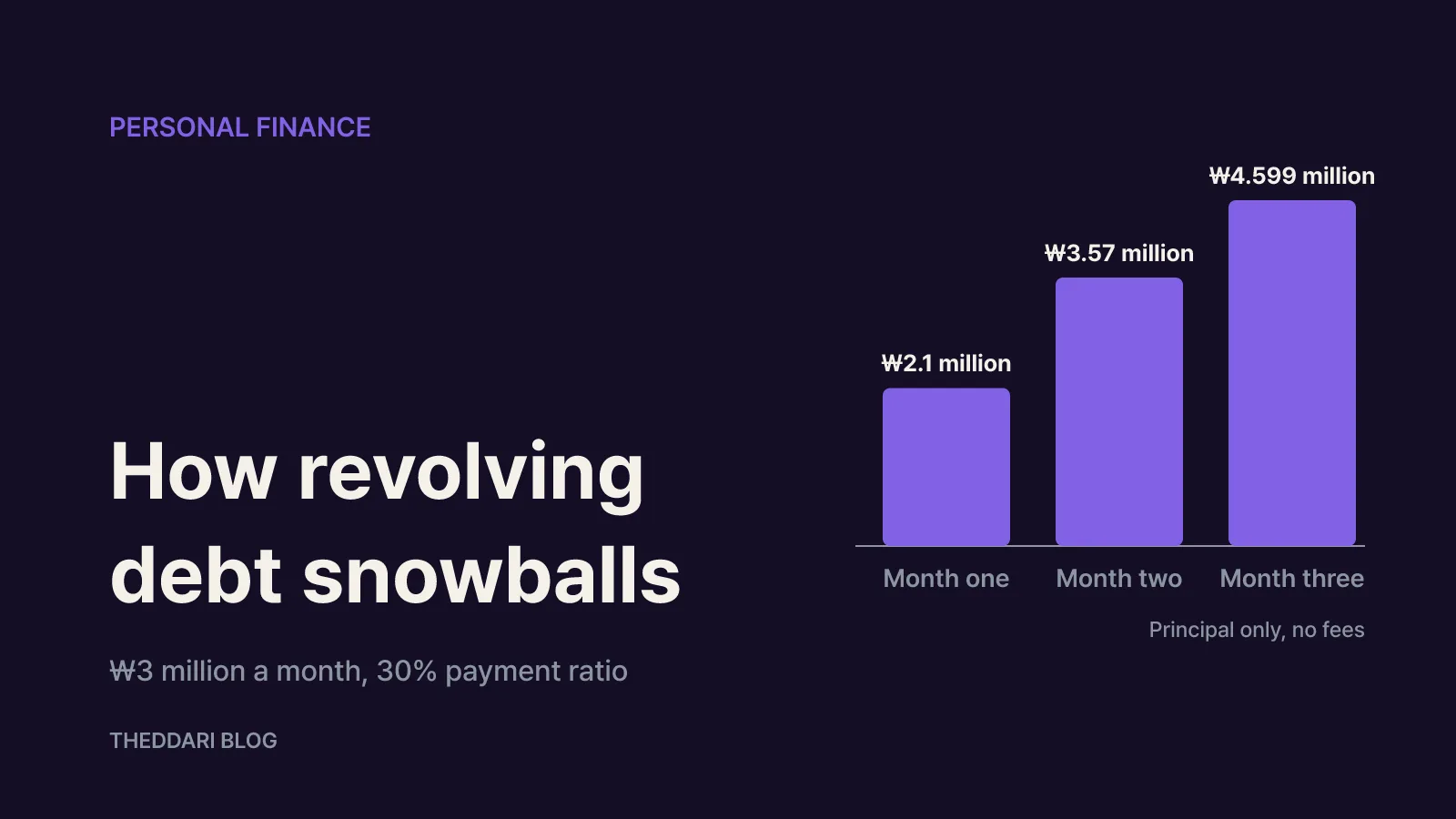
How a 30% payment ratio grows to ₩4.599 million in three months
The real danger is less the fee rate itself than the way balances stack up. The FSS example assumes you spend ₩3 million on the card every month and set your agreed payment ratio at 30%. The figures below count principal only and leave out fees.
- Month one: you pay 30% of ₩3 million, or ₩900,000, and ₩2.1 million rolls over.
- Month two: the ₩2.1 million carried over plus ₩3 million of new spending makes ₩5.1 million; you pay ₩1.53 million and ₩3.57 million rolls over.
- Month three: ₩3.57 million plus ₩3 million makes ₩6.57 million; you pay ₩1.971 million and ₩4.599 million rolls over.
In reality the fee is added on top, so the burden is larger than this. Note that the monthly payment itself also rose, from ₩900,000 to ₩1.971 million. A tool used to lighten one month's bill more than doubled the monthly outflow within three months.
The lower your payment ratio, the faster the carryover grows. The FSC reported that in 2022 about 90% of users had a minimum payment ratio of 10%, and it moved card companies to raise and differentiate that minimum based on factors such as unpaid loans at other financial institutions and the number of delinquencies over the past three months. The lowest ratio available to you therefore depends on the issuer and your credit standing. If you already use revolving, raising your agreed ratio and cutting new spending at the same time is the most direct way to stop the balance from growing.
Three places to check whether revolving is on
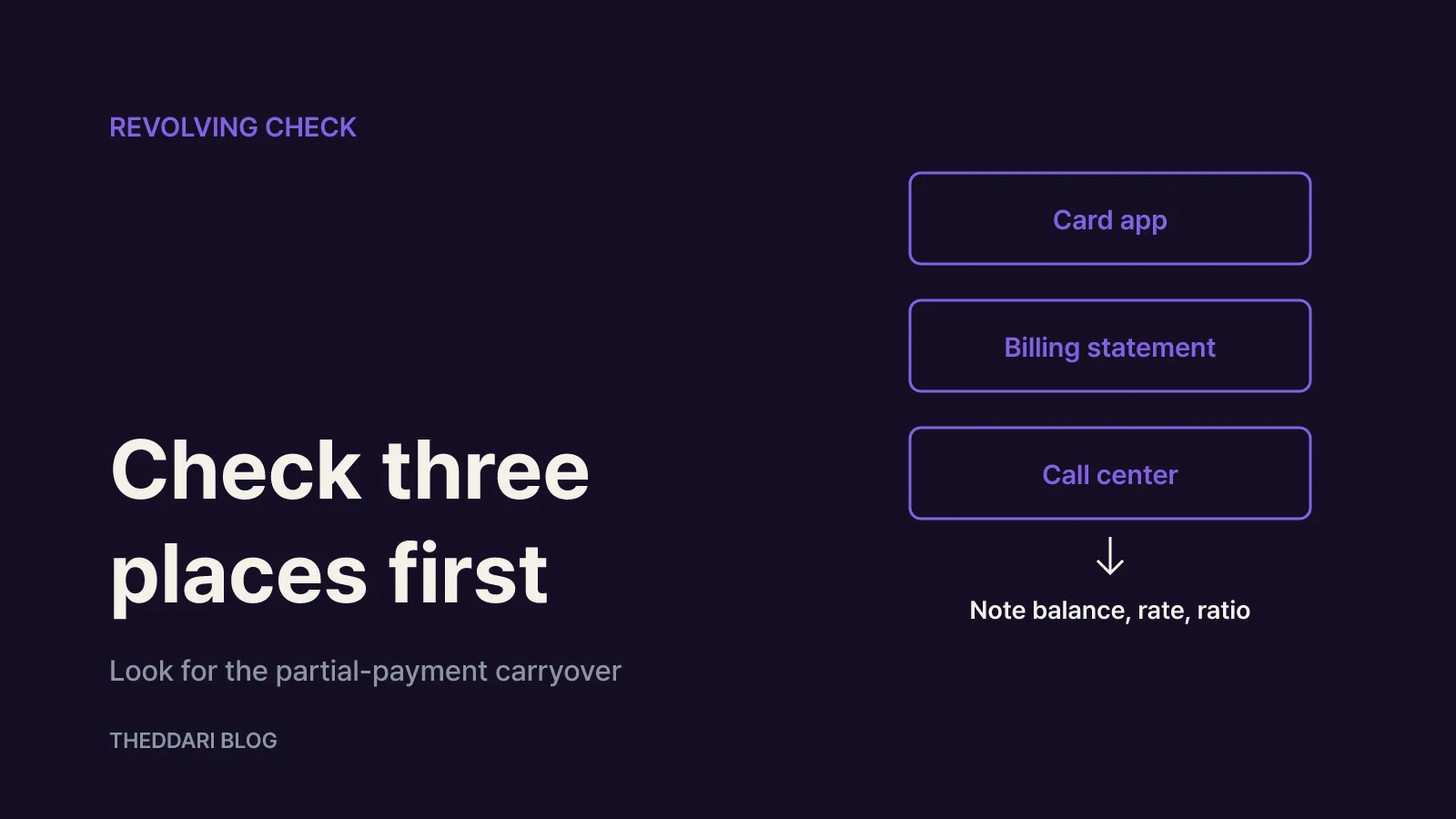
The FSS says some cardholders only later discover they were enrolled, and it recommends checking through the card company's call center, your billing statement or the mobile app, then cancelling if you have no intention of using it (Hankyoreh report).
- Card app: look in the payment or account management menu for revolving or the partial-payment carryover agreement, and note whether it is active and what payment ratio is set.
- Billing statement: look for a carried-over amount and a revolving fee line. The label may use the formal Korean name rather than revolving.
- Call center: if you cannot find the menu, ask an agent to confirm enrollment, your applied fee rate and your current carried-over balance in one call.
If you hold cards from several companies, check each one separately; cancelling with one issuer does not affect your agreement with another. Also keep revolving distinct from installment conversion (분할납부), which is a separate service for splitting a purchase you already paid in a lump sum.
Write down three numbers before moving on: the carried-over balance, the applied fee rate and the agreed payment ratio. They are what you need to plan the exit.
What to ask before cancelling, and how to pay it down
The FSS advice is to cancel revolving if you do not plan to use it. Cancelling does not erase an existing balance, though, so ask your card company these questions first:
- When and how will the existing carried-over balance be billed after cancellation?
- Does cancellation take effect immediately or from the next billing date?
- Until when will fees continue to accrue on the remaining balance?
Answers can differ by issuer, so note the date and what you were told. If the balance will be billed, make sure the linked bank account holds enough before the payment date to avoid an unexpected delinquency.
For repayment, keep it simple. Cut new card spending so the carryover stops growing, raise your payment ratio or prepay what you can, and if you carry revolving balances at several companies, reduce the one with the highest fee rate first. The FSC's 2022 reforms require card companies to provide a breakdown of how your revolving fee rate was calculated, so you can request it and see what drives your rate.
Alternatives to compare and where to find published rates
There may be months when paying the full bill is hard. Rather than defaulting to revolving, compare it with other options. The FSC requires revolving product explanations to show the rate levels of similar products, such as installment conversion and card loans, along with whether those rates are fixed or variable. Installment conversion splits an already-paid purchase into monthly principal payments for a fee over a set period, so it has a clear end date, unlike revolving, where new spending keeps joining the balance.
The Credit Finance Association of Korea (CREFIA) publishes average revolving fee rates by card company and by personal credit score band at gongsi.crefia.or.kr, updated monthly since the FSC shortened the cycle from quarterly. Comparing the average for your credit band with the rate you actually pay gives you a benchmark when you call your issuer.
Sales rules changed too. Under the 2022 reforms, card companies may not pitch revolving by telemarketing to low-credit customers who fall below card issuance standards, although those customers can still apply themselves, and they must make follow-up confirmation calls to people aged 65 or older and those aged 19 to 29 who signed up by phone. If you vaguely remember agreeing to something on a sales call, start there.
A final checklist: confirm enrollment at every card company; record the balance, fee rate and payment ratio; ask how the balance is handled on cancellation; compare revolving with installment conversion and card loans; and set a monthly cap on new card spending.