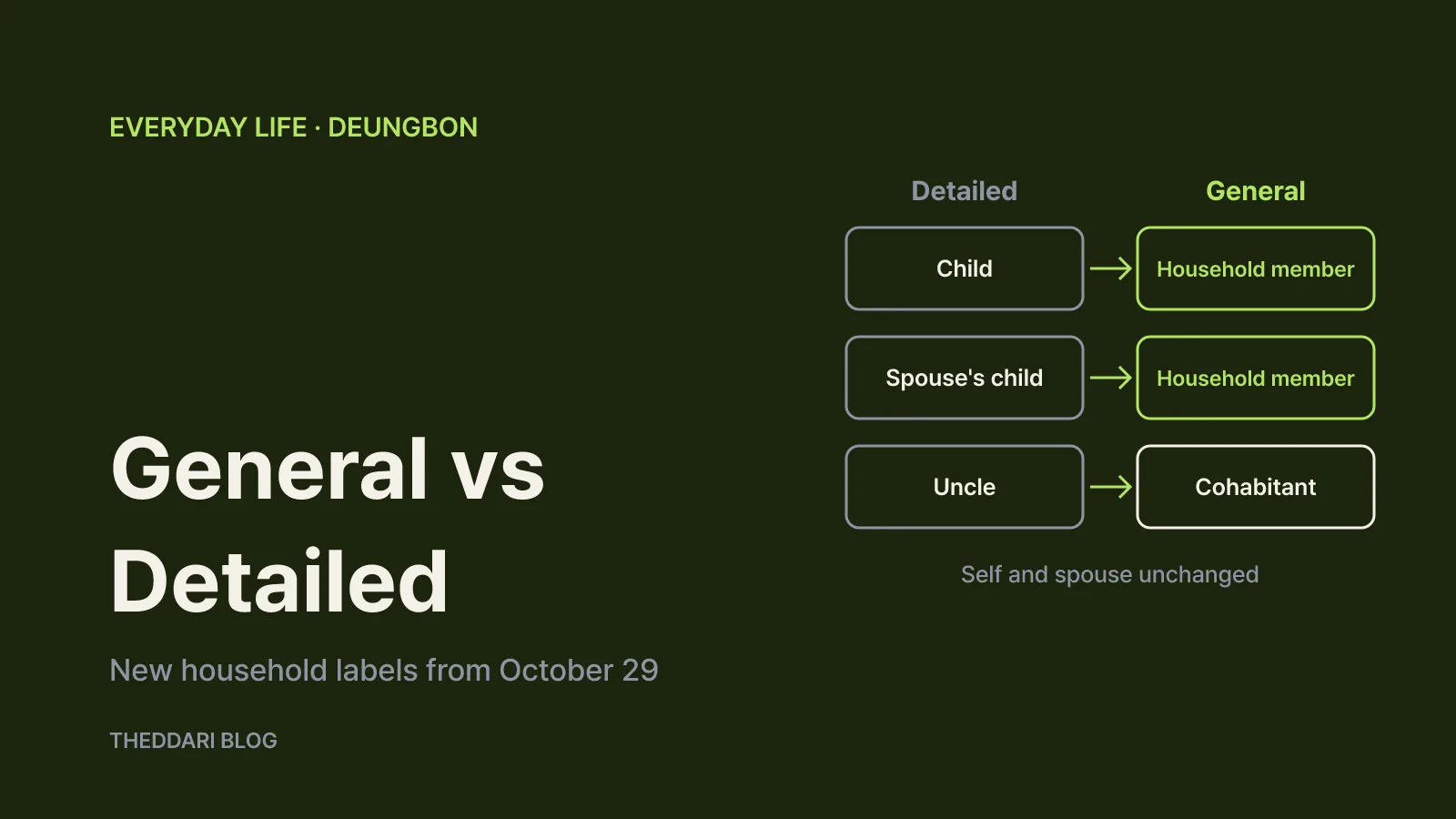
As of November 2026, when you request a Korean resident registration copy (주민등록표 등본, often called a deungbon) or its individual abstract (초본, chobon), you choose how the "relationship to the head of household" column is printed: General (일반) or Detailed (상세). Under the amended Enforcement Decree and Enforcement Rules of the Resident Registration Act, in force since October 29, 2026, the General format prints every family member other than the head of household and their spouse as "household member" (세대원) and everyone else as "cohabitant" (동거인). The Detailed format keeps the old style, with labels such as "child" or "spouse's child" (Ministry of the Interior and Safety press release). Unless the organization asking for the document says otherwise, request General. If you pick Detailed, you must fill in the "purpose of use" field.
This guide is written for anyone who handles Korean paperwork, including foreign residents who appear on a Korean household register, people married to Korean nationals, and anyone sending a deungbon to an employer, bank, school or landlord. It explains what changed, how the two formats look side by side, and how to request the right one on Gov24 or at a community service center.
What the General and Detailed formats actually show
The change was made to protect the privacy of blended families. Before October 29, a household copy could show labels such as "spouse's child", "stepmother" or "stepfather", so anyone who received the document for a simple address check could also infer that the head of household had remarried. The Ministry simplified the labels and kept a Detailed option for people who genuinely need the old wording.
The government's own example on Korea's policy briefing portal makes the difference easy to see (Korea.kr). The household contains the head (Kim Hun-min), his spouse (Choi Jeong-eum), his child Kim Se-jong (10), an uncle Kim Han-geul, and the spouse's child Lee Dae-wang (12).
← Swipe to see more
| No. | Detailed (old style) | General |
|---|---|---|
| 1 | Self · Kim Hun-min | Self · Kim Hun-min |
| 2 | Spouse · Choi Jeong-eum | Spouse · Choi Jeong-eum |
| 3 | Child · Kim Se-jong (10) | Household member · Lee Dae-wang (12) |
| 4 | Uncle · Kim Han-geul | Household member · Kim Se-jong (10) |
| 5 | Spouse's child · Lee Dae-wang (12) | Cohabitant · Kim Han-geul |
In the General format, the head's child and the spouse's child look identical. According to the briefing, family members under the Civil Act other than the spouse, such as children and parents, are grouped as "household member", and everyone else is shown as "cohabitant". That is why the uncle appears as a cohabitant in the official example. The "self" and "spouse" rows do not change in either format.
The Ministry describes the rule as applying to both the household copy and the individual abstract, so if you ask for the head-of-household name and relationship to appear on a chobon, you make the same General or Detailed choice.
The listing order changed too
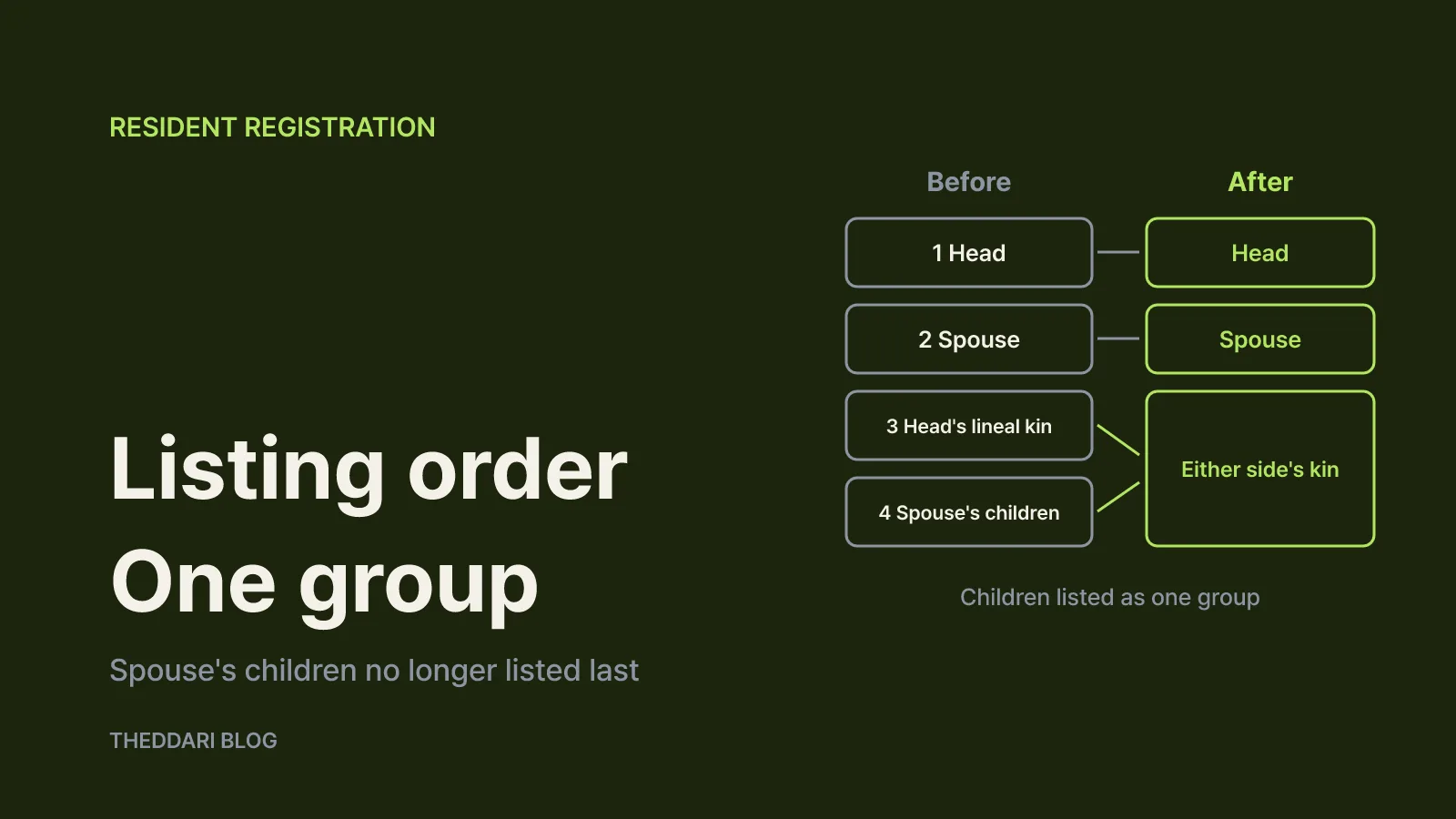
Relabeling alone would not have solved the problem, because the order in which people were listed also revealed family history. According to Korea's 110 government call center, the old ranking was: 1st the head of household, 2nd the spouse, 3rd the head's lineal ascendants and descendants, and 4th the spouse's children (110 Government Call Center). Even with neutral labels, an older child listed below a younger one hinted that the older child came from a previous marriage.
The new order is the head of household, the spouse, and then the lineal ascendants and descendants of either the head or the spouse as one group. In the General column above, 12-year-old Lee Dae-wang now appears before 10-year-old Kim Se-jong for exactly this reason.
Which format should you request?
Start with General. The Ministry advises everyone to use it unless the receiving organization has a specific requirement. A General copy still lists the names of the head, spouse, household members and cohabitants, and it still proves the address and that these people are registered as one household. For address checks, proof of living together or household composition, General is normally enough.
Choose Detailed only when the recipient needs the exact relationship labels. If an instruction sheet asks for a copy "with detailed relationship to the head of household" or "showing family relationships", Detailed is probably what they want. If the wording is vague, ask the person handling your file which format they accept before you issue it. The briefing itself stresses checking with the receiving organization first.
Remember that Detailed requires a short "purpose of use" entry (용도 및 목적). General does not, so choosing Detailed out of habit only adds a step.
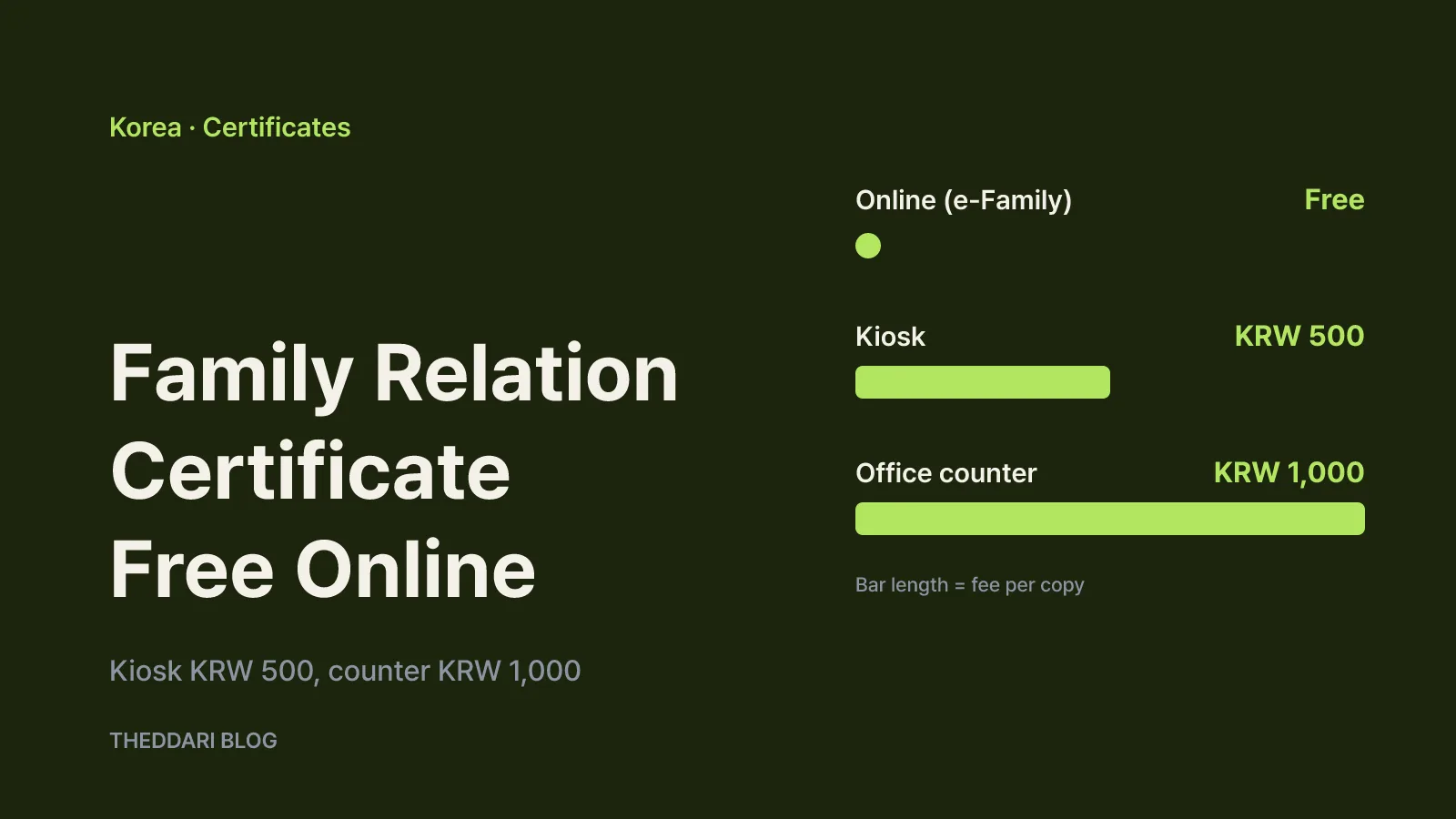
Also keep in mind that a deungbon is a residence record, not proof of family relationships. Relatives who live elsewhere do not appear on it. If you have been asked for a Family Relation Certificate (가족관계증명서), a Detailed deungbon will not substitute for it. Our Family Relation Certificate guide covers that separate document.
How to request it on Gov24 or in person
Gov24 lists three ways to apply for a household copy or abstract: online, in person, or at an unmanned kiosk (Gov24 service page). Issuing it online through Gov24 is free, while a community service center charges 400 won per copy (Gov24 FAQ).
- Confirm what the recipient wants: household copy or abstract, whether the relationship column should be included, and if so, General or Detailed.
- Pick the channel: for your own record or that of someone in your household, sign in to Gov24 and apply for free. If you are collecting it for someone else under a power of attorney, bring the delegation form (교부신청 위임장) to a city, county or district office or a community service center.
- Select the relationship format: when you choose to include the relationship to the head of household, tick General or Detailed. If you pick Detailed, complete the purpose field.
- Check the result: open the issued document right away and confirm the labels match what was requested. Reissuing with a different option is quicker than having the document rejected.
For help with the screens, the Gov24 help desk is 1588-2188 (extension 1), and the government call center is reachable by dialing 110.
Other changes that matter to foreign residents
The same amendment helps households that include foreign nationals. Until now, a foreign resident's name appeared in Korean on family registration documents but only in Roman letters on the resident registration copy, which made it hard to prove that both papers referred to the same person. A household copy can now show a foreign national's name in both Korean and Roman letters (Ministry of the Interior and Safety). If banks or offices have asked you to explain mismatched spellings, look for this option when you request the copy.
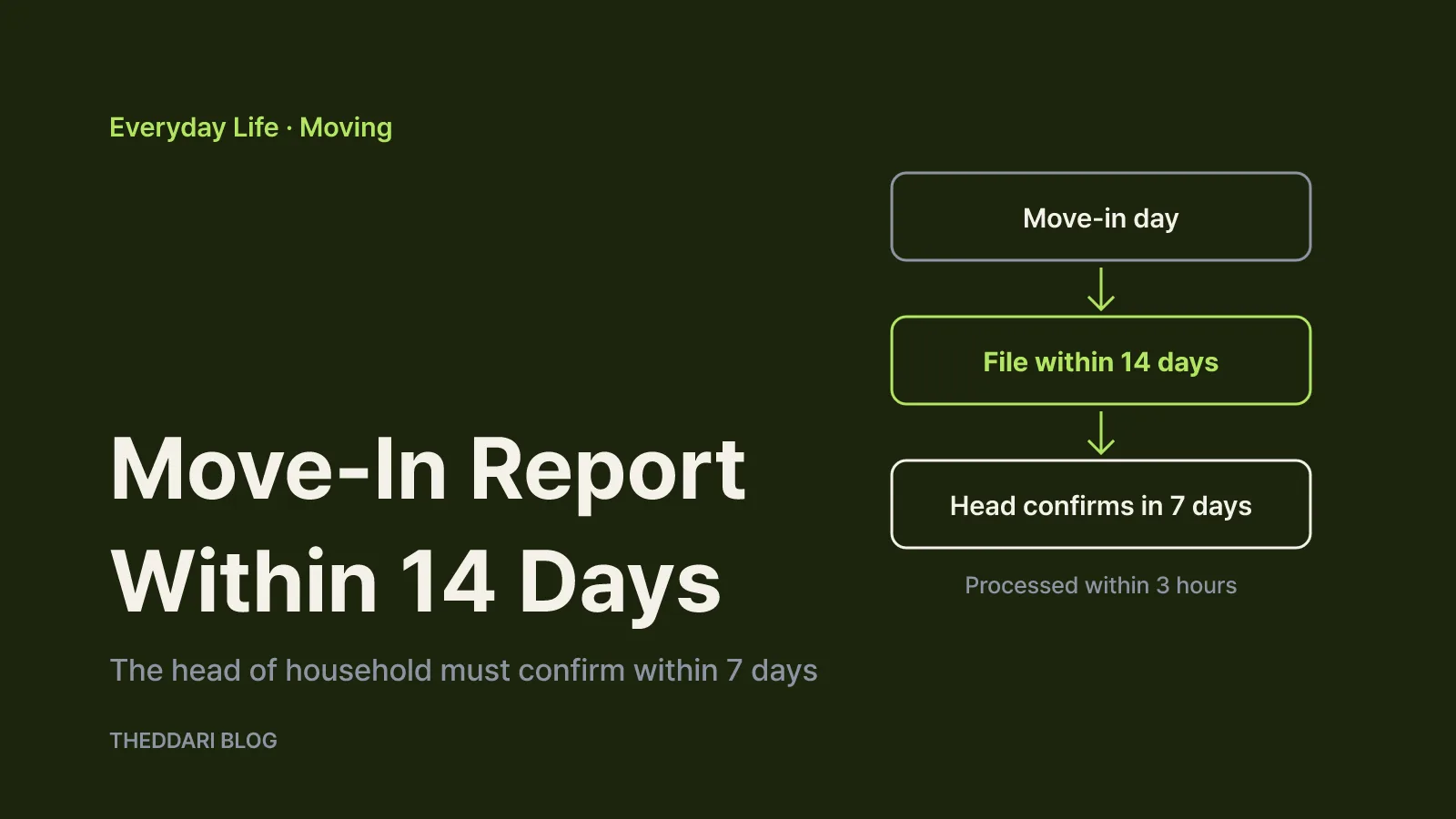
Move-in reporting was simplified as well. When you file a move-in report or apply for the move-in notification service, documents that officials can verify through shared administrative data no longer need to be brought in person. Our move-in report guide explains the deadline and online steps.
The amended rules were promulgated on April 28, 2026 and took effect after a six-month preparation period, during which the Ministry updated the resident registration system and signed a publicity agreement with partner agencies on September 9. Because the format is new, some staff may not recognize the "household member" wording yet. Knowing that General is now the government's default makes that conversation easier.