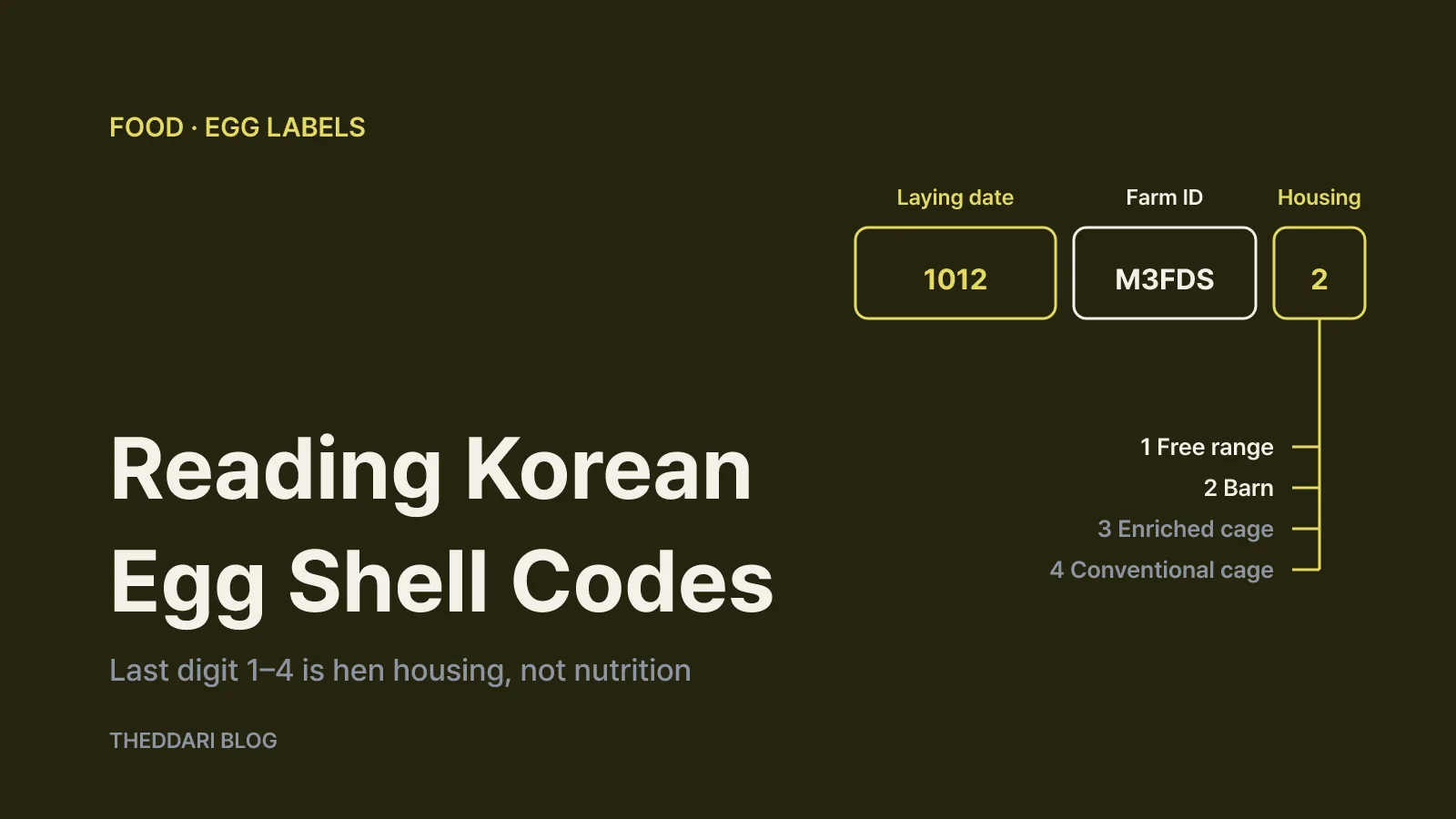
As of November 2026, every egg sold in Korea is stamped with a 10-character shell code that breaks down as 4 digits for the laying date, 5 characters for the producer (farm) ID and 1 digit for the hen housing system. The last digit runs from 1 to 4: 1 means free range, 2 means barn (floor-raised indoors), 3 means an enriched cage with 0.075 m² per hen, and 4 means a conventional cage with 0.05 m² per hen (Food Safety Korea, Korea.kr). That final digit tells you how the hens were kept, not how nutritious or high-grade the egg is. Freshness comes from the first four digits, and quality comes from a separate grade label.
If you live in Korea, shop at a Korean supermarket or simply wondered what the tiny print on your eggs means, this guide walks through the code one block at a time. It also covers a common misconception about the last digit, a quick way to use the laying date in the store, the planned September 2027 ban on cage-number-4 eggs, and the storage and cooking temperatures recommended by Korea's Ministry of Food and Drug Safety (MFDS).
How the 10-character code is structured
Food Safety Korea, the MFDS consumer portal, uses 1012M3FDS2 as its example. Split it 4-5-1 and it reads easily:
← Swipe to see more
| Position | Example | Meaning |
|---|---|---|
| First 4 digits | 1012 | Laying date (October 12) |
| Middle 5 characters | M3FDS | Producer (farm) ID |
| Last digit | 2 | Housing number (barn) |
Laying date. The first four digits are the month and day the hen laid the egg, written MMDD. October 12 becomes 1012; August 23 becomes 0823. There is no year, so around New Year it helps to read the date against when you bought the carton. According to the MFDS answer published by Korea's government call center, if eggs are collected within 36 hours of laying, the collection date may be recorded as the laying date (110 Government Call Center). In practice the printed date can differ from the actual laying time by about a day.
Producer ID. The middle five characters are a mix of letters and numbers taken from the farm's livestock business license or registration. You can enter them on Food Safety Korea under the hazard-prevention menu (egg farm information, search by producer ID) to see the farm's name and location. Two cartons from the same brand can carry different IDs, which simply means they came from different farms.
Housing number. The final digit, 1 to 4, describes the hens' living space. The 10-character format took shape when laying-date marking began on February 23, 2019. The call-center answer adds that from August 23, 2019, egg collection-and-sales and egg grading-and-packing businesses have been required to print the laying date, producer ID and housing number on the shell.
What housing numbers 1–4 mean, and what they don't
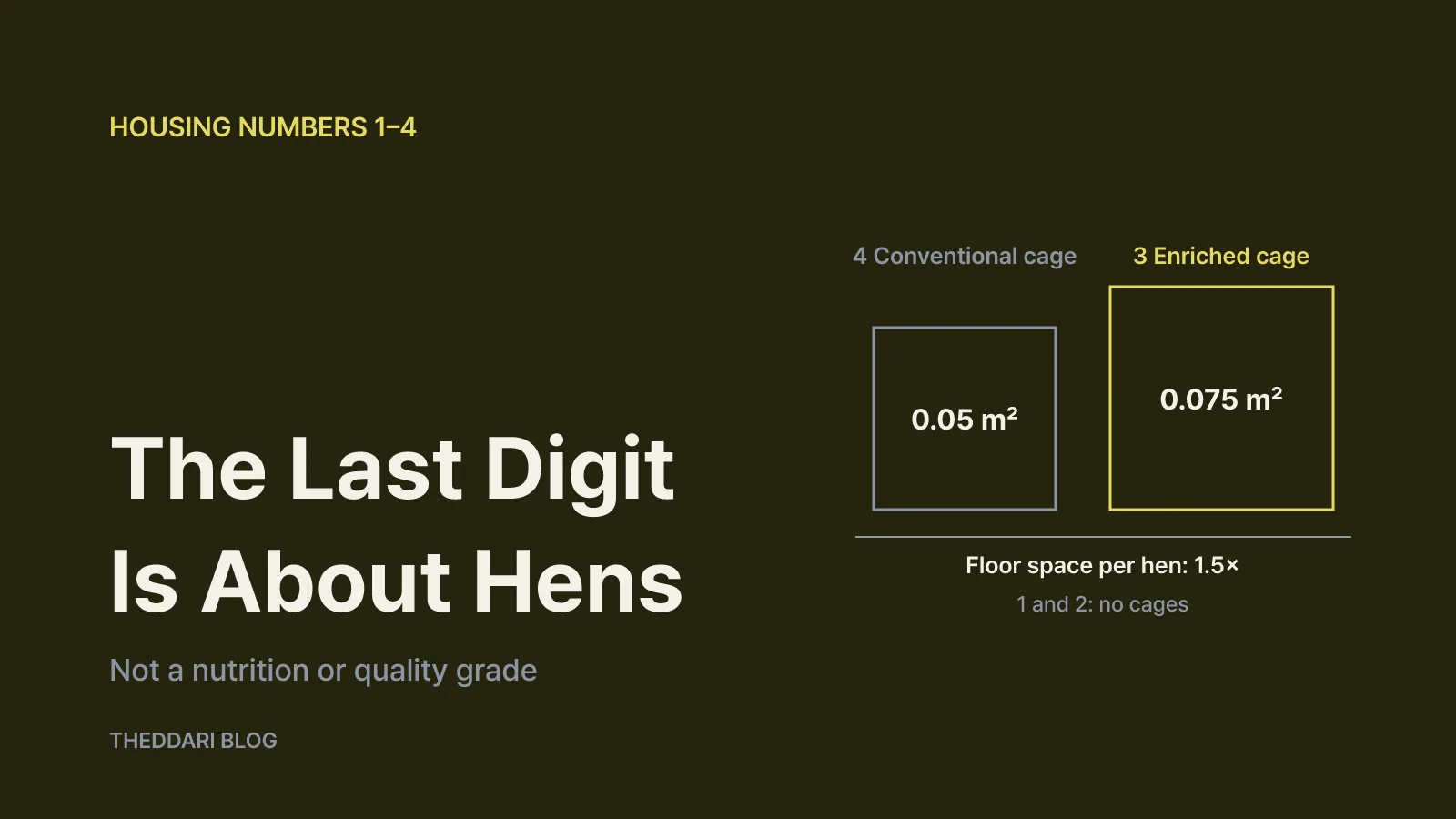
Based on the MFDS card news reposted on Korea.kr, the four categories are:
- 1 – Free range: hens can go outside the barn.
- 2 – Barn: hens live on the barn floor without cages.
- 3 – Enriched cage: 0.075 m² of floor space per hen.
- 4 – Conventional cage: 0.05 m² per hen.
The gap between 3 and 4 is easy to quantify: moving from 0.05 m² to 0.075 m² gives each hen 1.5 times the floor area. Food Safety Korea itself notes that a lower number means better housing for the birds.
The common misreading is that a number 1 egg must be more nutritious. A February 2026 article in Green Magazine, published by Korea's Rural Development Administration and based on MFDS material, states that the last digit has no direct link to an egg's quality or nutrient content (RDA Green Magazine). Management differs from farm to farm even within the same number, and the housing digit describes a production method. Choosing 1 or 2 is a reasonable animal welfare decision; choosing it for extra nutrition is not supported by that guidance.
If quality is what you care about, look for a grade mark instead. The same article explains that Korean eggs are graded 1+, 1 or 2 after an exterior check of the shell, a candling check that shines light through the egg, and a breakout check of the white and yolk. Participation in grading is voluntary for businesses, so not every carton shows a grade. A missing grade is not a red flag in itself; it just means the laying date is the main signal you can read yourself.
Using the laying date to judge freshness
Eggs lose freshness after laying, so when prices are equal, the carton with the more recent date is the simplest pick. Green Magazine notes that refrigerated eggs are generally recommended to be eaten within one month of the laying date.
A quick example: if today is November 16 and the shell starts with 1110, the eggs are six days old. Applying the one-month guideline for refrigerated eggs, aim to finish them by around December 10. If the carton also shows its own use-by date, follow whichever date comes first.
Once you crack an egg, its appearance offers another clue. The article suggests checking whether the yolk spreads out or looks cloudy. A fresh egg usually has a domed yolk with a thick ring of white around it, while a white that runs thin across the pan points to an older egg. These checks are about freshness only. A cracked shell or an off smell means the egg should not be used regardless of the date.
The planned September 2027 ban on number 4 eggs
According to the February 2026 Green Magazine article, an amendment to the enforcement decree of Korea's Livestock Industry Act means that eggs produced in conventional cages (housing number 4) are scheduled to be banned from sale from September 2027. As of November 2026, that is roughly ten months away.
For shoppers, this suggests two things. Number 4 eggs should gradually disappear from shelves, leaving 3 and below as the norm. The same article also reports a pilot quality-grade certification program meant to expand the supply of quality-managed eggs. Detailed implementation steps and any effect on prices should be checked against official announcements when they are finalized; no price forecast is offered here.
Storing and cooking eggs at home
A well-chosen carton can still go wrong in the kitchen. The MFDS guidance on Korea.kr boils down to the following:
- Store eggs pointed end down. The rounded end holds the air cell, which breaks more easily and can expose the contents to bacteria.
- Keep them refrigerated in a dedicated container, such as the original carton or an egg tray.
- Do not eat cracked eggs, which are easily contaminated.
- Do not eat eggs left at room temperature for a long time.
- Wash your hands with soap before and after handling eggs.
- Cook until the center reaches 75°C (167°F) for at least one minute, and boil eggs until fully set.
- Hold cooked egg dishes at 60°C (140°F) or above, or 5°C (41°F) or below, and eat them as soon as possible.
- Clean any utensils that came into contact with a broken egg thoroughly.
If you make a big batch of rolled omelet or scrambled eggs for lunch boxes, cool it and refrigerate it rather than leaving it on the counter. Soft-boiled or raw-egg dishes do not meet the 75°C guideline, so use only recently laid, clean, intact eggs for them and eat them right away.
A 30-second checklist for the store
- Check the shells and skip any carton with cracked or broken eggs.
- Read the first four digits and compare them with today's date. Remember there is no year.
- Pick a housing number that matches your priorities: 1 or 2 for animal welfare, 3 or lower if price comes first. It is not a nutrition score.
- Look for a grade mark (1+, 1 or 2) if the carton has one.
- Look up the middle five characters on Food Safety Korea if you want to know the farm.
- Refrigerate as soon as you get home, pointed end down, in a dedicated container.
With these six steps you can choose fresher eggs at the same price and read that last digit for what it actually means.