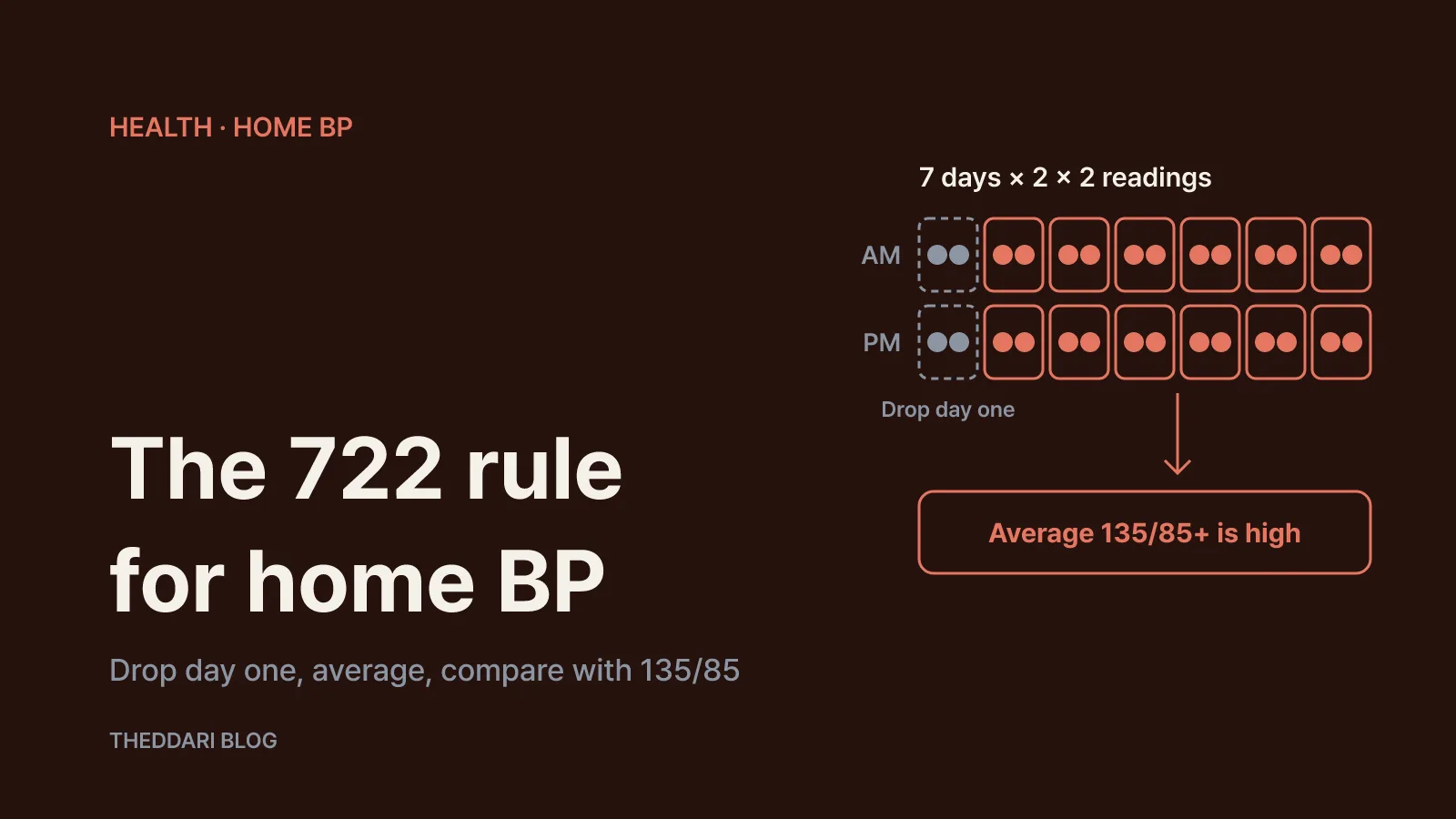
As of November 2026, the most widely used method for taking blood pressure at home is the "722" protocol: 7 consecutive days, 2 sessions a day (morning and evening), 2 readings per session. You discard the first day and average the rest. Under Korean guidance, and in most European and Asian guidelines, a home average of 135 mmHg systolic or 85 mmHg diastolic or higher counts as high blood pressure. That is lower than the familiar 140/90 clinic cut-off because readings taken at home tend to run lower than readings taken in a doctor's office (Korean Society of Hypertension Home Blood Pressure Forum).
If you live in the United States, note one difference up front: the 2018 ACC/AHA guideline, as summarized in a 2022 review of the 722 protocol, uses 130/80 as its home threshold. The measuring routine is nearly identical; the line you compare your average against depends on which guideline your clinician follows.
Blood pressure moves throughout the day, from day to day and across seasons, so a single reading taken whenever you remember tells you very little. The goal of a home log is not to diagnose yourself. It is to hand your clinician a week of numbers collected the same way every time.
What the 722 rule means and when to measure
The 2022 review compared home monitoring advice from Korea, Japan, China, Europe, the UK, Canada and others. Most recommend a seven-day schedule with morning and evening sessions, with three to five days as a bare minimum. The 722 label simply packages that advice.
- Morning: within one hour of waking, after using the bathroom, and before breakfast, smoking, caffeine or blood pressure medication (Seoul National University Hospital).
- Evening: before going to bed. The review notes that if bedtime is less than two hours after dinner, measuring before dinner is an alternative.
- Two readings per session: take them one to two minutes apart and write down both. The first reading of a session is more likely to be high, and a second one tempers that bias.
Seven days of two sessions with two readings each gives you 28 numbers. Korean guidance, as tabulated in the review, drops the first day because people are still getting used to the cuff and the routine, which leaves 24 readings to average. The review also suggests looking at the morning and evening averages separately, because a consistent morning rise is useful information when a clinician plans treatment.
Once blood pressure is diagnosed and well controlled, you do not need to run the full week constantly. The guidelines summarized in the review generally suggest one or two days a week or a month, with duplicate readings, and Taiwan's guidance repeats a full 722 cycle every three months for well-controlled patients.
How to prepare and sit for an accurate reading
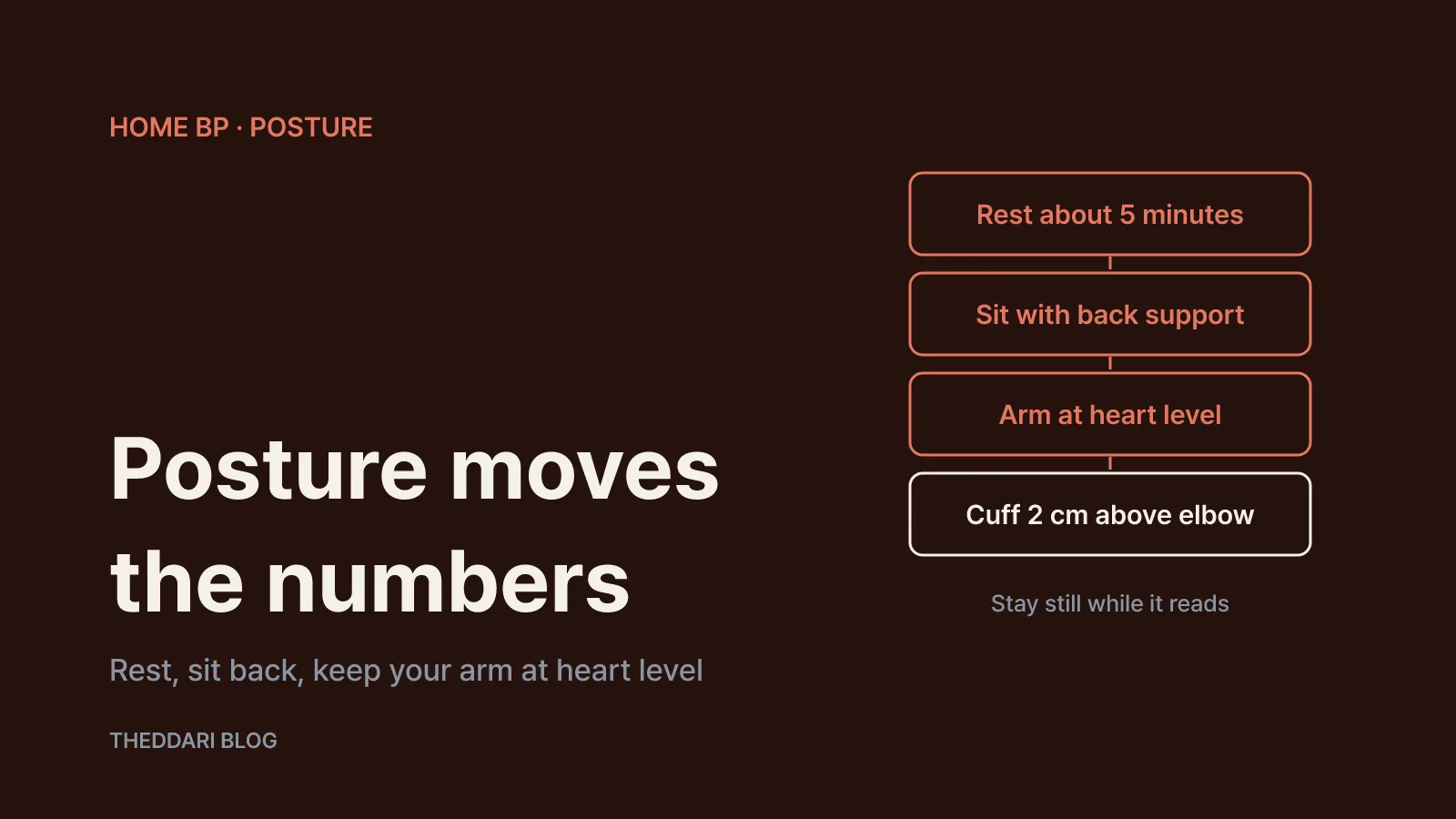
Posture and timing can move your numbers as much as anything else. Seoul National University Hospital's patient guide lays out the steps:
- Avoid bad timing. Wait one to two hours after exercise and at least 30 minutes after smoking, coffee or tea. Alcohol makes readings unreliable.
- Sit in a chair with back support and rest for about five minutes (at least one to two).
- Rest your arm on a table at heart level. A dangling arm gives a different reading.
- Wrap the cuff on your upper arm with its lower edge about 2 cm (roughly an inch) above the crease of your elbow. It should be snug, with room for about one finger underneath, but not loose.
- Stay still and quiet while the cuff inflates, then record both blood pressure and pulse.
On cold mornings it is tempting to measure the moment you sit up in bed. Using the bathroom first and then sitting down to rest matches the guidance better. Use the same chair, the same arm and roughly the same times each day so that your week is comparable. Avoid measuring over a rolled-up sleeve that squeezes your arm.
Choosing a monitor: upper arm over wrist, and the right cuff
The Korean Society of Hypertension position statement recommends automatic oscillometric monitors for home use and treats the upper arm as the standard site. Finger monitors are not recommended, because constricted small blood vessels and the distance from the heart distort the reading. Wrist monitors can be off if the wrist is not held at heart level or is bent, so the statement frames them as an option for people whose upper arm is hard to measure, such as some older adults or people with obesity.
Cuff size matters. According to Seoul National University Hospital, a cuff that is too small for your arm reads high. The bladder width should be about 40% of your upper-arm circumference and its length should cover 80% to 100% of the arm; the standard adult cuff is 13 cm wide and 22 to 24 cm long. Check the sizing chart before you buy.
The position statement advises choosing a device that has passed an international validation protocol. It also flags groups more likely to see errors: older adults, pregnant people, children, people with very thin or very thick arms and people with stiff arteries. Take a new monitor to your next appointment so your clinician can confirm it works properly. The review adds that automatic monitors are less reliable in atrial fibrillation, especially for diastolic values, and Taiwan's consensus suggests three or more readings per session in that case.
How to average your readings and read the 135/85 line
The math is simple:
- Cross out day one.
- Average all remaining morning readings, then all remaining evening readings.
- Average every remaining reading for your overall home average, calculating systolic and diastolic separately.
Judge by the average, not by any single number. One high reading does not mean you have hypertension, and one low reading does not mean you are fine. Under Korean guidance, the position statement and the Seoul National University Hospital guide, a home average at or above 135/85 mmHg counts as high, and crossing either number is enough. That level corresponds to 140/90 in the clinic. If your clinician follows the US guideline, the comparison line is 130/80.
When clinic and home readings disagree: white coat and masked hypertension
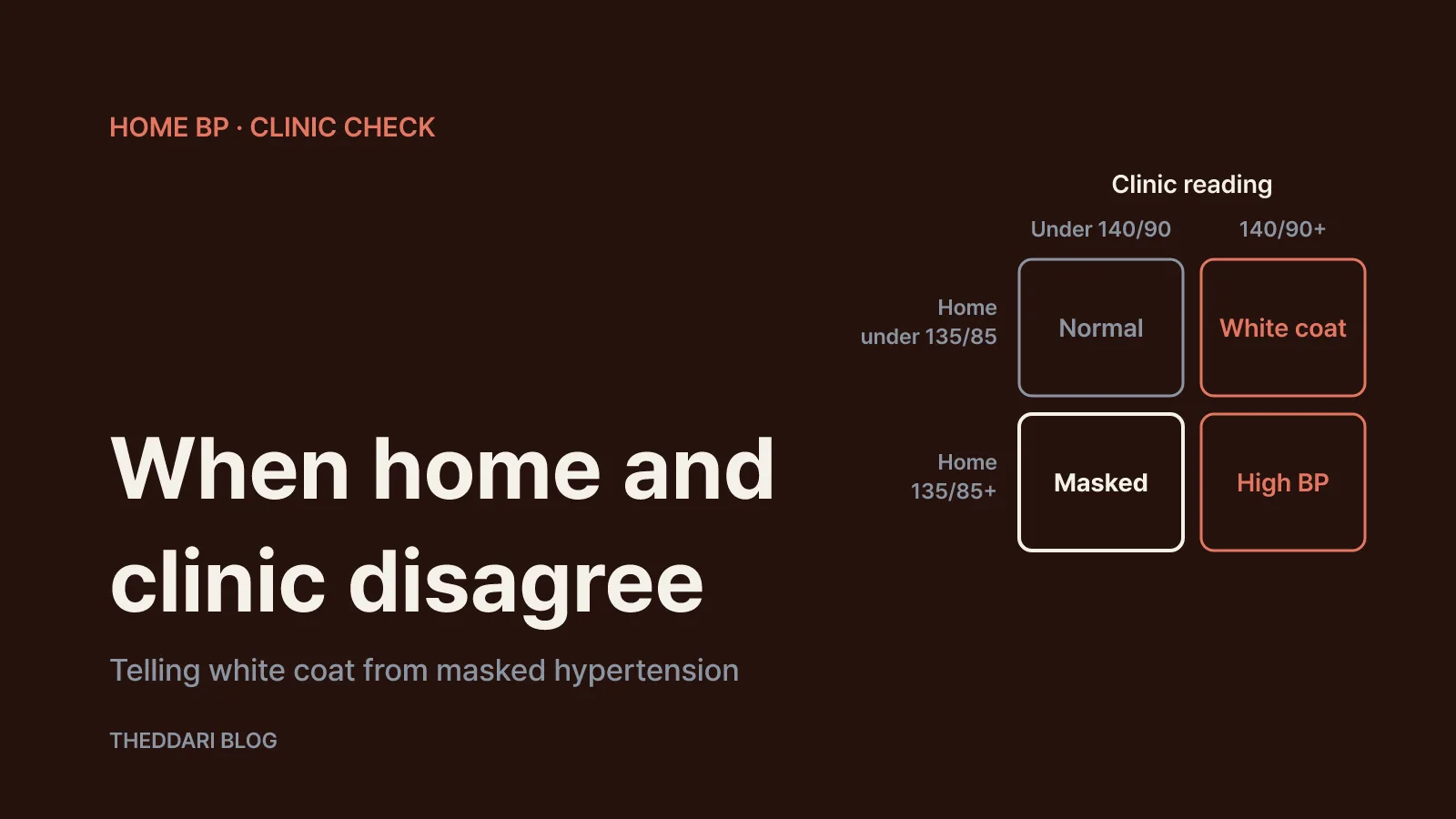
Home readings earn their keep when they do not match what the clinic sees. The hospital guide and the position statement describe two patterns:
- White coat hypertension: high in the clinic, normal at home. Anxiety around healthcare staff raises blood pressure, and the statement notes this effect can lead to a diagnosis and unnecessary medication for some people.
- Masked hypertension: below 140/90 in the clinic but a home average of 135/85 or more. It is easy to miss with office readings alone, and the statement describes a markedly higher risk of cardiovascular events in this group.
Neither pattern shows up reliably from one or two office visits, which is why a structured week of home readings matters. For people already on medication, the log also helps show whether treatment is too much or not enough. The statement is clear about the limits, though: home readings are resting readings and say little about blood pressure at work or during sleep. Ask about 24-hour ambulatory monitoring if those periods are a concern.
How to bring your log to an appointment, and when not to wait
Record the date, morning or evening, the time, both systolic/diastolic pairs and your pulse. A monitor's memory or an app works too, but a short note about coffee, poor sleep or a late dose helps your clinician interpret the numbers.
- Five to seven days before an appointment: run the 722 routine and bring the average with day one removed.
- After buying a new monitor: bring it along so it can be checked.
- If a reading is high: do not keep re-measuring until you get a lower number. Take the planned readings and log them as they are.
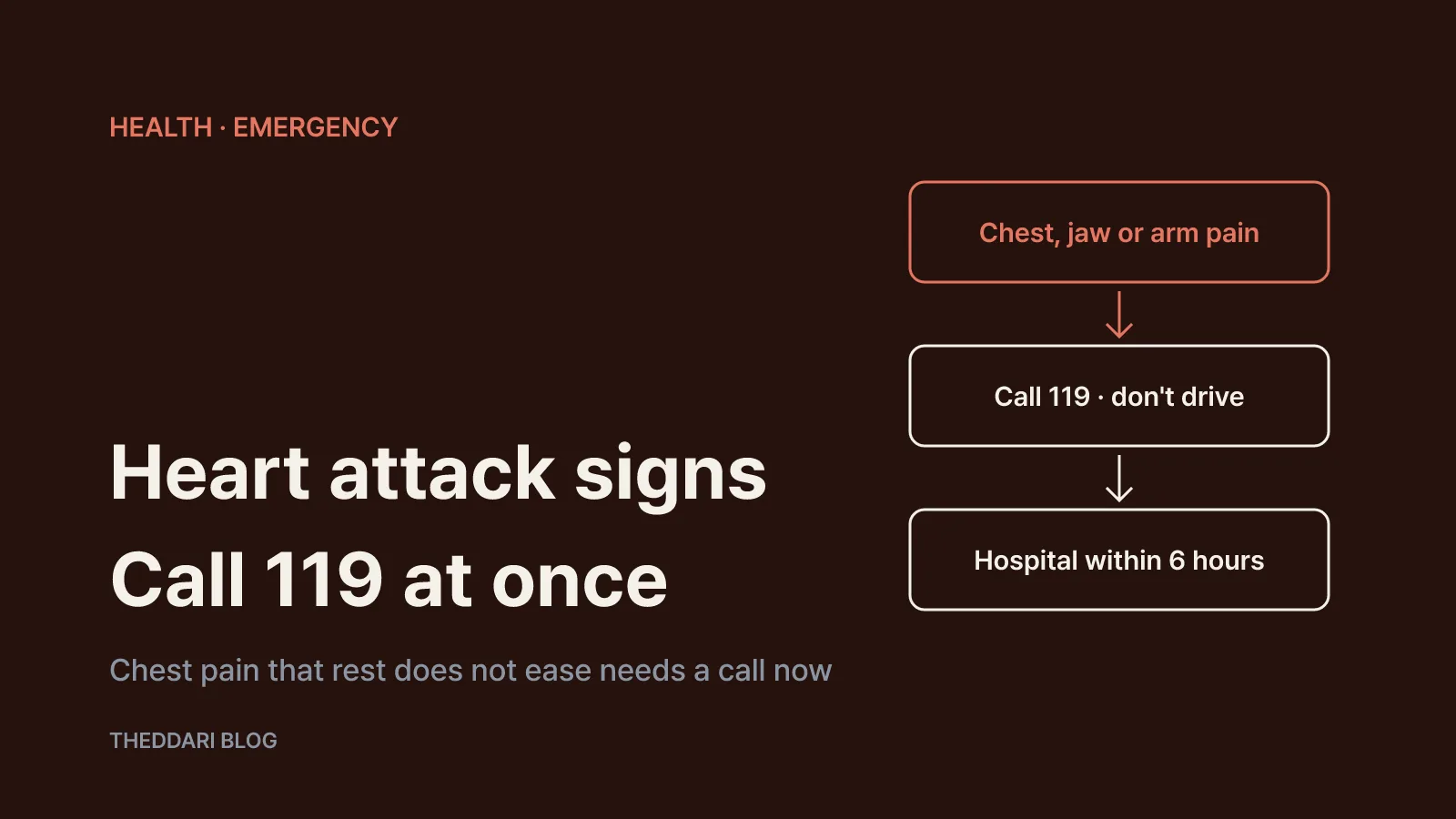
Crushing chest pain, weakness on one side of the body or slurred speech are emergencies regardless of what the monitor says. Call emergency services (119 in Korea, 911 in the US) instead of taking another reading. See our guides on heart attack warning signs and stroke warning signs.
A week of consistent numbers is worth far more than one dramatic reading. Same time, same position, same number of readings: get those three right and your log becomes something a clinician can trust.