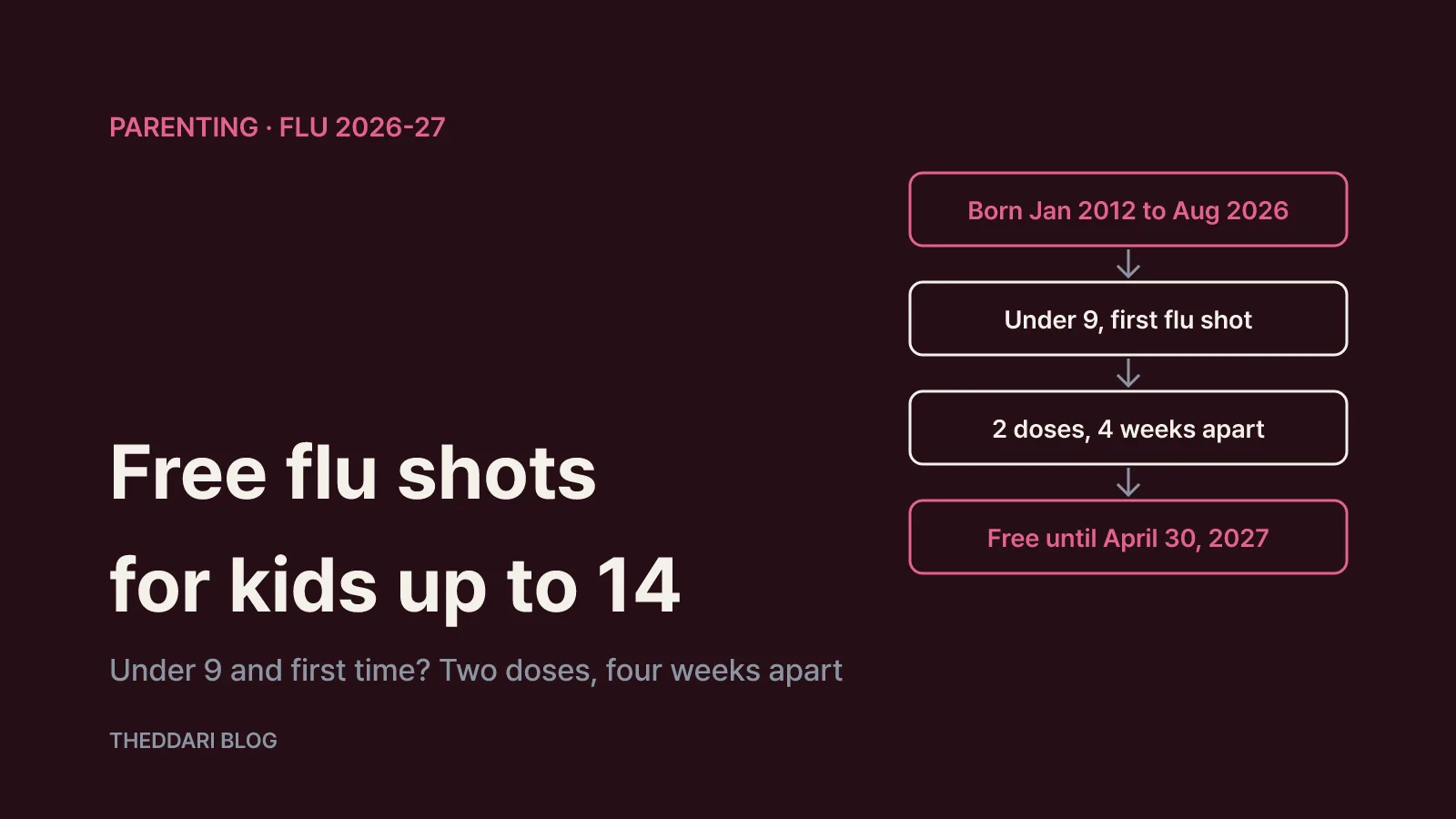
As of November 2026, every child in Korea born between January 1, 2012 and August 31, 2026 — roughly ages 6 months to 14 — can get a flu shot for free under the national immunization program for the 2026-27 season. The free window runs until April 30, 2027. Children aged 6 months to under 9 who have never had a flu shot, or who have had only one dose in total, need two doses at least four weeks apart. You can go to any participating clinic or public health center nationwide, regardless of your registered address (KDCA Vaccination Helper).
If you are a parent living in Korea and have not booked yet, timing matters. The Korea Disease Control and Prevention Agency (KDCA) reported in early November that flu cases had started rising again after a brief dip in October, with the highest rates among children aged 7 to 12 (KDCA, November 6, 2026). The steps below cover eligibility, dose count, scheduling and what to bring to the clinic.
Who qualifies: born January 1, 2012 to August 31, 2026
This season Korea widened the children's program from age 13 to age 14, which in Korean school terms reaches the second year of middle school (Seoul Health Portal). The simplest check is the birth date range rather than calculating ages. Children born in 2011 or earlier are outside the national program and would pay at a clinic, although some local governments run their own extra subsidies, so ask your district public health center if that applies to you.
Two details are easy to miss. First, the minimum age is 6 months. A baby born in late spring 2026 may not be 6 months old yet, but if the birth date is on or before August 31, 2026, the baby is still covered this season and can start on the day they reach 6 months. Second, if a child's birth date on the resident registration differs from the actual birth date, the program uses the actual birth date.
The vaccine used is an inactivated trivalent influenza vaccine. The Vaccination Helper site currently lists both the one-dose and two-dose groups as eligible from September 21, 2026 through April 30, 2027, so in November any eligible child can go right away.
One dose or two: the rule for children under 9
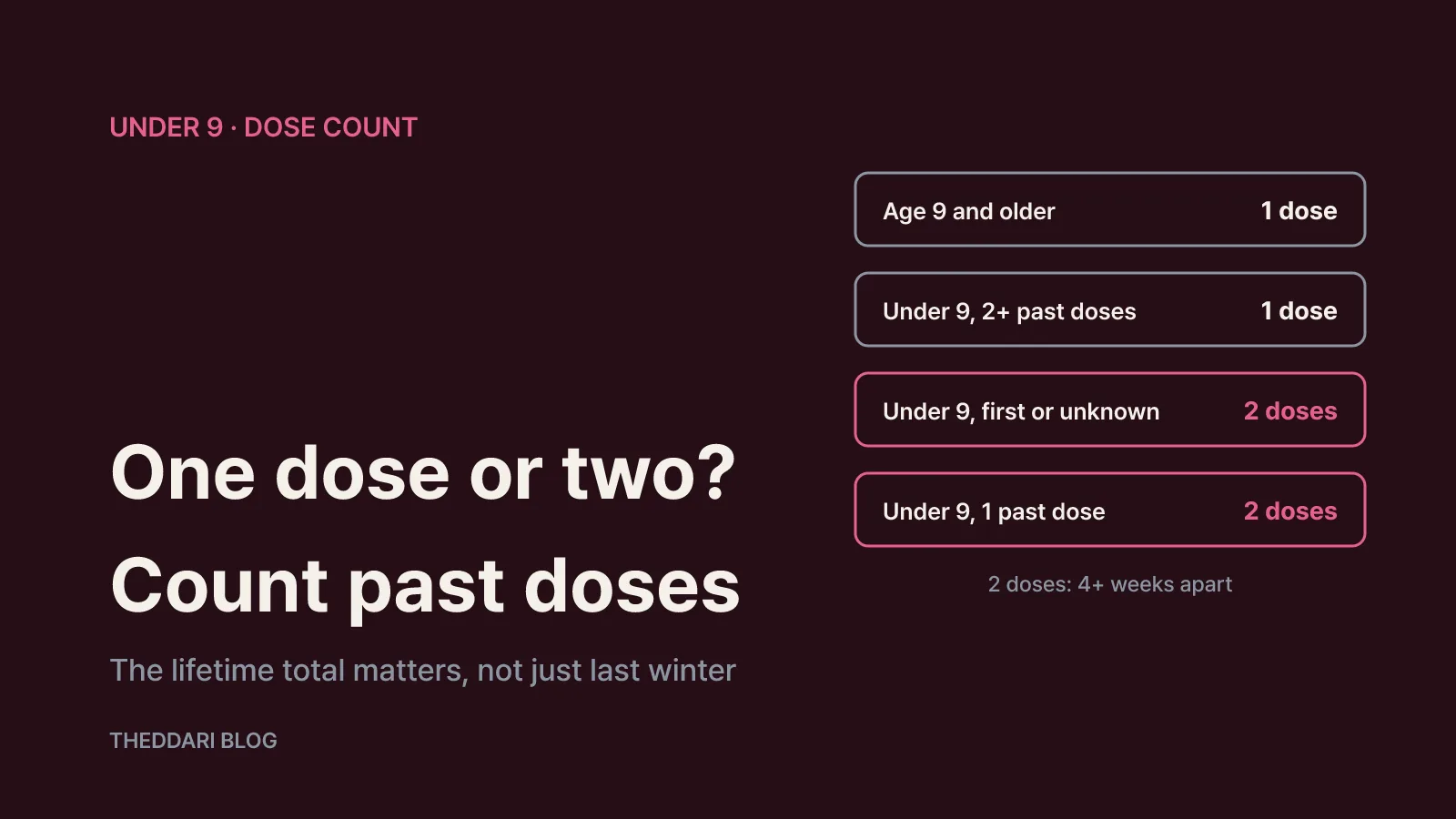
The default is a single dose. Children aged 6 months to under 9 get a second free dose in two situations (KDCA Vaccination Helper):
- This is their first flu vaccination, or their past vaccination history is unknown.
- They had received only one dose in total of flu vaccine by June 30, 2026.
The key is the lifetime total, not whether they were vaccinated last winter. A child who completed two doses a few seasons ago needs only one dose now, even after skipping a year. A child who got one dose last season and missed the second still counts as one dose in total, so they need two this season. Children aged 9 and older follow the basic one-dose rule.
"Unknown history" puts a child in the two-dose group, so it is worth checking records before you go. Korea's Vaccination Helper portal (nip.kdca.go.kr) has a vaccination record lookup, and many families also keep a paper child health booklet. The official guidance is that the final number of doses is confirmed with the doctor during the pre-vaccination screening.
In a typical family, a toddler getting a first-ever flu shot needs two doses, an older sibling born in 2019 with two past doses on record needs one, and a 2015-born child needs one because they are over 9. If you bring siblings together, plan for the younger one to return about four weeks later.
Counting the 4-week gap and the April 30 deadline
The two doses must be at least four weeks apart (Seoul Health Portal). Four weeks is 28 days, so add 28 to the first-dose date.
← Swipe to see more
| First dose | Earliest second dose (+28 days) |
|---|---|
| November 16, 2026 | December 14, 2026 |
| November 30, 2026 | December 28, 2026 |
| January 15, 2027 | February 12, 2027 |
| April 2, 2027 | April 30, 2027 |
The last row is the hard limit. Because the free program ends on April 30, 2027, a child in the two-dose group needs the first shot by April 2 at the latest for both doses to be free. Treat that as a mathematical cutoff, not a plan: winter is peak flu time, and a sick day can push a shot back, so earlier is safer.
The same math works for babies who turn 6 months mid-season. A baby born on July 15, 2026 turns 6 months on January 15, 2027; a first dose that day allows a second dose from February 12, comfortably inside the window. Setting a phone reminder 28 days after the first shot is the easiest way not to miss it.
Before the visit: finding a clinic, documents and stock
Free flu shots for children are available at participating clinics and public health centers anywhere in Korea, not just near your registered address. Use the Vaccination Management > Find a participating clinic menu on the Vaccination Helper site, or call your local public health center (KDCA).
Three things help avoid a wasted trip:
- Call ahead about stock. Vaccine supply differs by clinic and changes often; the Seoul city government specifically advised checking availability before visiting (Seoul Health Portal).
- Bring eligibility documents. For children, bring a health insurance card or another document that confirms the child's identity and eligibility.
- Note past flu doses. For children under 9, knowing the total number of earlier flu shots speeds up the one-or-two-dose decision at screening.
Public health branch offices and rural health posts are also listed as vaccination sites, but the guidance asks you to confirm availability before going. For questions about the program, contact your district public health center or the KDCA call center at 1339.
Why now: week 44 flu rates by age
The flu season started early this year. KDCA issued its 2026-27 influenza advisory on September 11, and by week 36 (August 30 to September 5) clinics were already seeing 25.3 influenza-like illness cases per 1,000 outpatients (Seoul Health Portal).
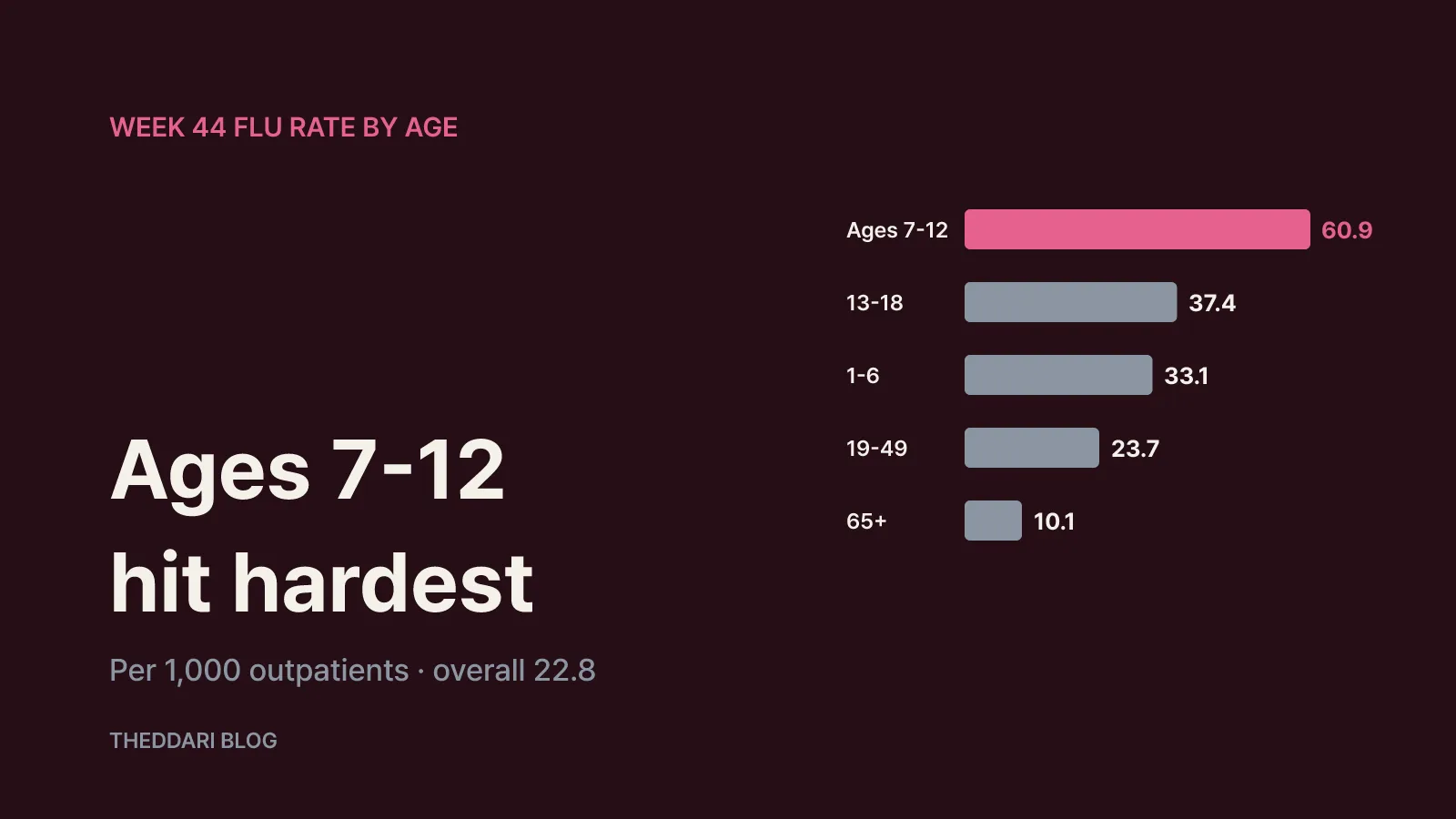
After easing in October, cases are climbing again. In week 44 (October 25 to 31) the rate reached 22.8 per 1,000 outpatients, up from 19.2 the week before. Children were clearly hit hardest (KDCA, November 6, 2026).
← Swipe to see more
| Age group | Week 44 rate (per 1,000 outpatients) |
|---|---|
| 7-12 | 60.9 |
| 13-18 | 37.4 |
| 1-6 | 33.1 |
| 19-49 | 23.7 |
| Under 1 | 20.6 |
| 50-64 | 13.1 |
| 65+ | 10.1 |
An influenza-like illness case here means a fever of 38°C (100.4°F) or higher plus a cough or sore throat. School-age children aged 7 to 12 were running at more than twice the overall rate. Hospital admissions at sentinel hospitals reached 461 that week, more than double the 174 recorded in the same week of 2025, and 64.9% of those admitted were 65 or older — a reminder that children can carry the virus home to grandparents.
There is still a gap to close: as of 6 p.m. on November 5, about 2.78 million children, or 56.1%, had been vaccinated. The dominant strain is A(H1N1)pdm09, which KDCA says is similar to this season's vaccine strain, with no mutations affecting antiviral resistance identified.
If your child already had the flu or is unwell
A common question is whether a child who already had the flu this season still needs the shot. KDCA's answer is yes: a person can be infected again by a different type of influenza in the same season, so children should get vaccinated promptly (KDCA, November 6, 2026). Decide the timing with the screening doctor once your child has recovered.
If your child has a fever, cough or sore throat, get them seen by a doctor first. KDCA urges quick diagnosis and treatment for suspected flu symptoms, and Seoul's guidance asks children with fever or respiratory symptoms to stay home from school or daycare and get care. If illness pushes a second dose past the 28-day mark, that is fine — four weeks is a minimum, so simply give it after recovery and before April 30.
Everyday habits still matter alongside the vaccine: hand washing, coughing into a sleeve, wearing a mask in crowded places and ventilating rooms often are the basic measures KDCA keeps repeating.
In short: check that the birth date falls between January 1, 2012 and August 31, 2026; if your child is under 9, count lifetime flu doses to see whether they need one or two; and if two, book the first dose soon and mark day 28 on your calendar. The free program ends April 30, 2027.