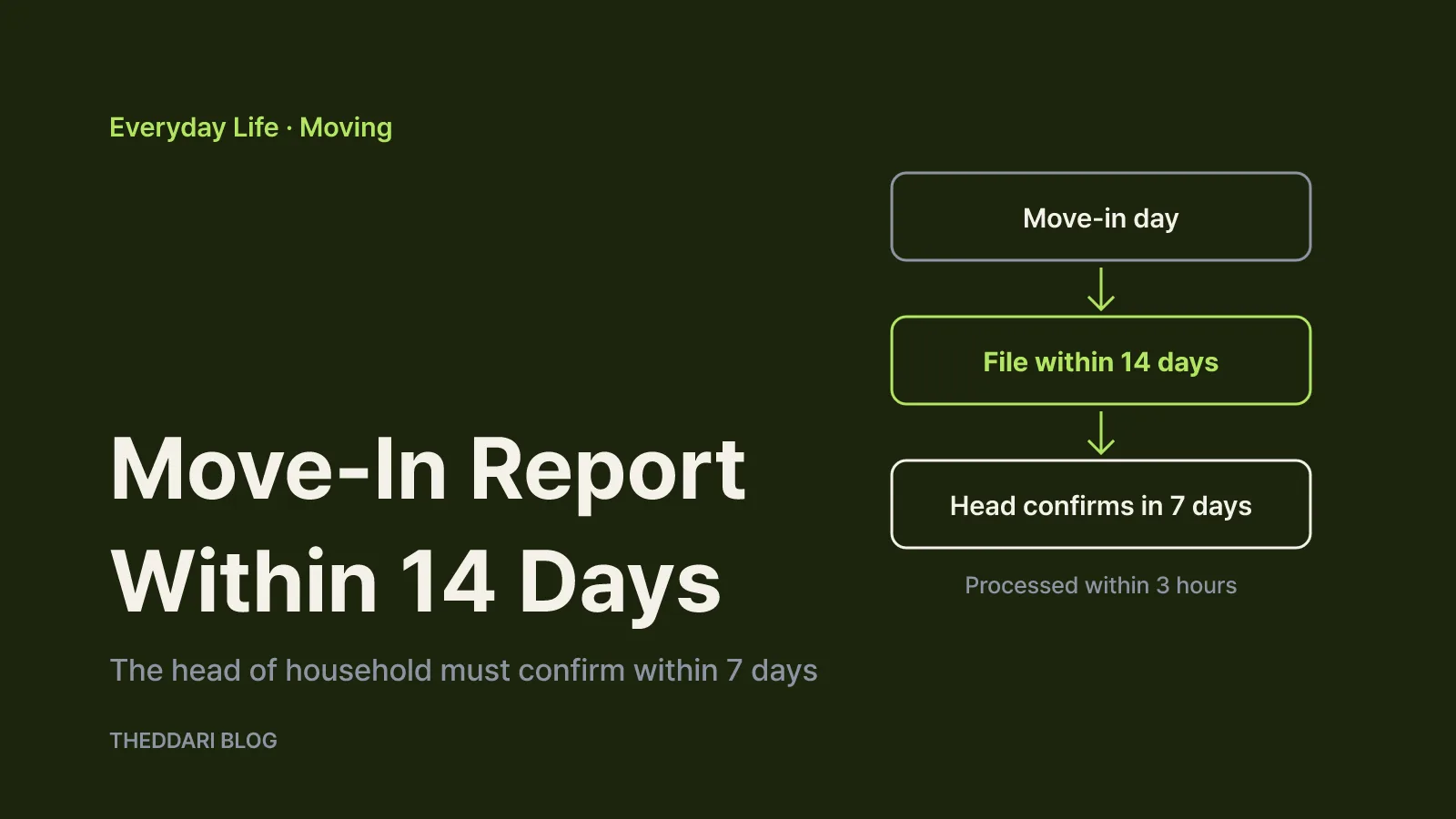
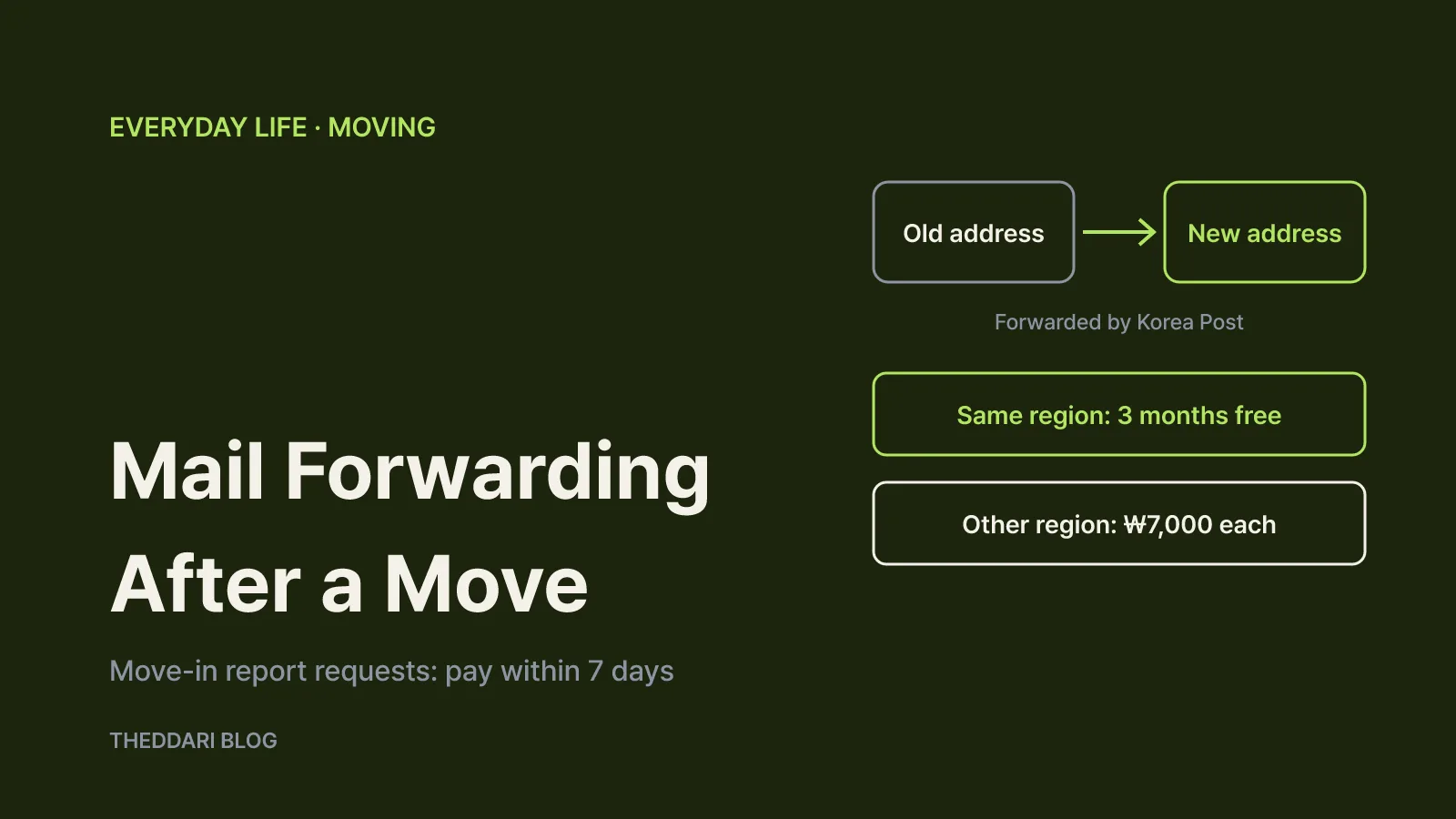
As of November 2026, if you move house in Korea and want letters sent to your old address to reach you at the new one, apply for Korea Post's residential relocation mail forwarding service (주거이전 우편물 전송서비스). Forwarding is free for the first three months when both addresses are in the same region, meaning the same province or metropolitan city, and costs ₩7,000 per person for three months when you move to a different region. You can request it while filing your move-in report on Gov24 or at a community service center, or afterwards through the ePOST website or a post office counter. The step people miss: a paid request made with the move-in report is cancelled automatically unless you pay within seven days, counting the report date and excluding Saturdays and public holidays.
This guide is based on the ePOST relocation service page and the Korea Post address relocation guide, both read directly. It applies to people registered at a Korean address who have completed a move-in report, whether you are a Korean national or a registered foreign resident handling Korean paperwork.
One service, two names, three ways to apply
The same service appears under two names. Community service centers and Gov24 call it "mail forwarding to the new address" (우편물 전입지 전송서비스), while post offices call it "residential relocation mail forwarding" (주거이전 우편물 전송서비스). Both redirect mail that still carries your old address to the address on your latest move-in report.
You have three routes:
- With your move-in report. Tick the mail forwarding option on the Gov24 move-in form or ask at the community service center counter. A government policy briefing article describes the Gov24 flow as four steps after identity verification: notices, basic details, previous address and current address. Free requests go straight to Korea Post; paid ones are settled on ePOST or at a post office.
- On ePOST after the report. Use this if you skipped the option or want a longer period. The menu path is Mail → Additional services → Relocation service. ePOST looks up your final registered address from the Ministry of the Interior and Safety system, so it only works after your move-in report has been processed.
- At a post office counter. Fill in a relocation notice form. This is the practical choice if someone is applying on your behalf.
Online applications require personal identity verification plus resident registration number verification, so you can only apply for yourself. ePOST does not accept applications for other household members or for minors. If your whole family moved, choosing everyone at the move-in report stage is usually the simplest option.
Fees: free within a region, ₩7,000 per person outside it
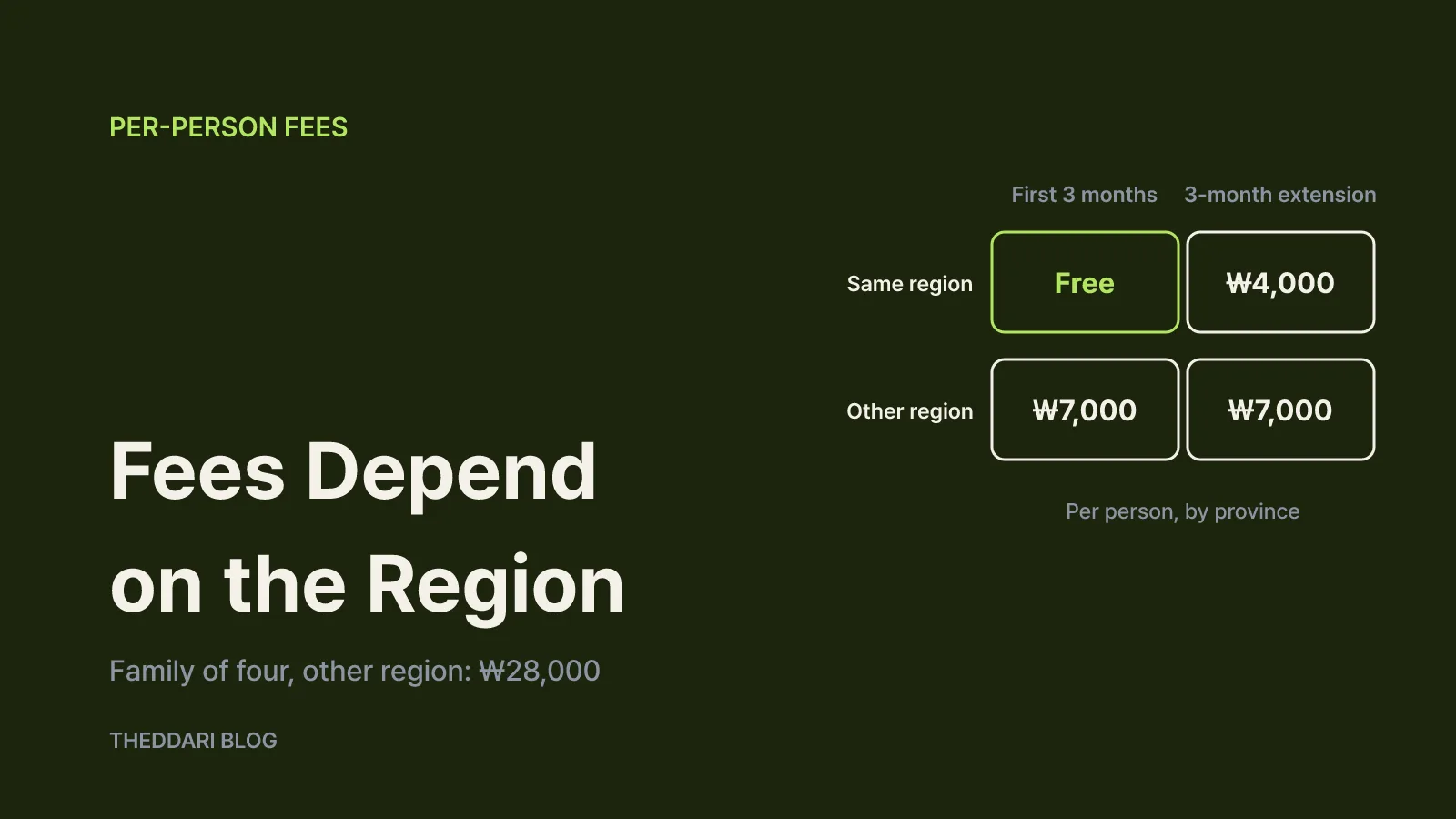
The fee depends on whether your old and new addresses fall in the same region and whether you are in the first three months or extending. Korea Post lists:
← Swipe to see more
| Applicant | Same region, first 3 months | Same region, each 3-month extension | Different region, first 3 months | Different region, each 3-month extension |
|---|---|---|---|---|
| Individual (per person) | Free | ₩4,000 | ₩7,000 | ₩7,000 |
| Organization or business | Free | ₩53,000 | ₩70,000 | ₩70,000 |
Note the words per person. A family of four moving from Seoul to Gyeonggi Province crosses regions, so forwarding for everyone costs ₩7,000 × 4 = ₩28,000 for the first three months. ePOST lets you pay for only some household members on a paid request from the move-in report, so you can leave out a child who rarely receives post. Cancelling a paid request, however, is all-or-nothing.
The free same-region period applies once per old address. ePOST also warns that if you cancel a free service after it has started and then reapply for the same old address, the new request becomes chargeable.
Regions follow province and metropolitan-city lines: moving between districts of Seoul stays in one region, while Seoul to Gyeonggi does not. When we checked in November 2026, ePOST's fee table listed 16 regions, grouping Gwangju and South Jeolla together, while the Korea Post guide page still listed them separately among 17. If you are moving between Gwangju and South Jeolla, rely on the amount shown at checkout or at the counter.
Applied with your move-in report? Watch the text and the 7-day window
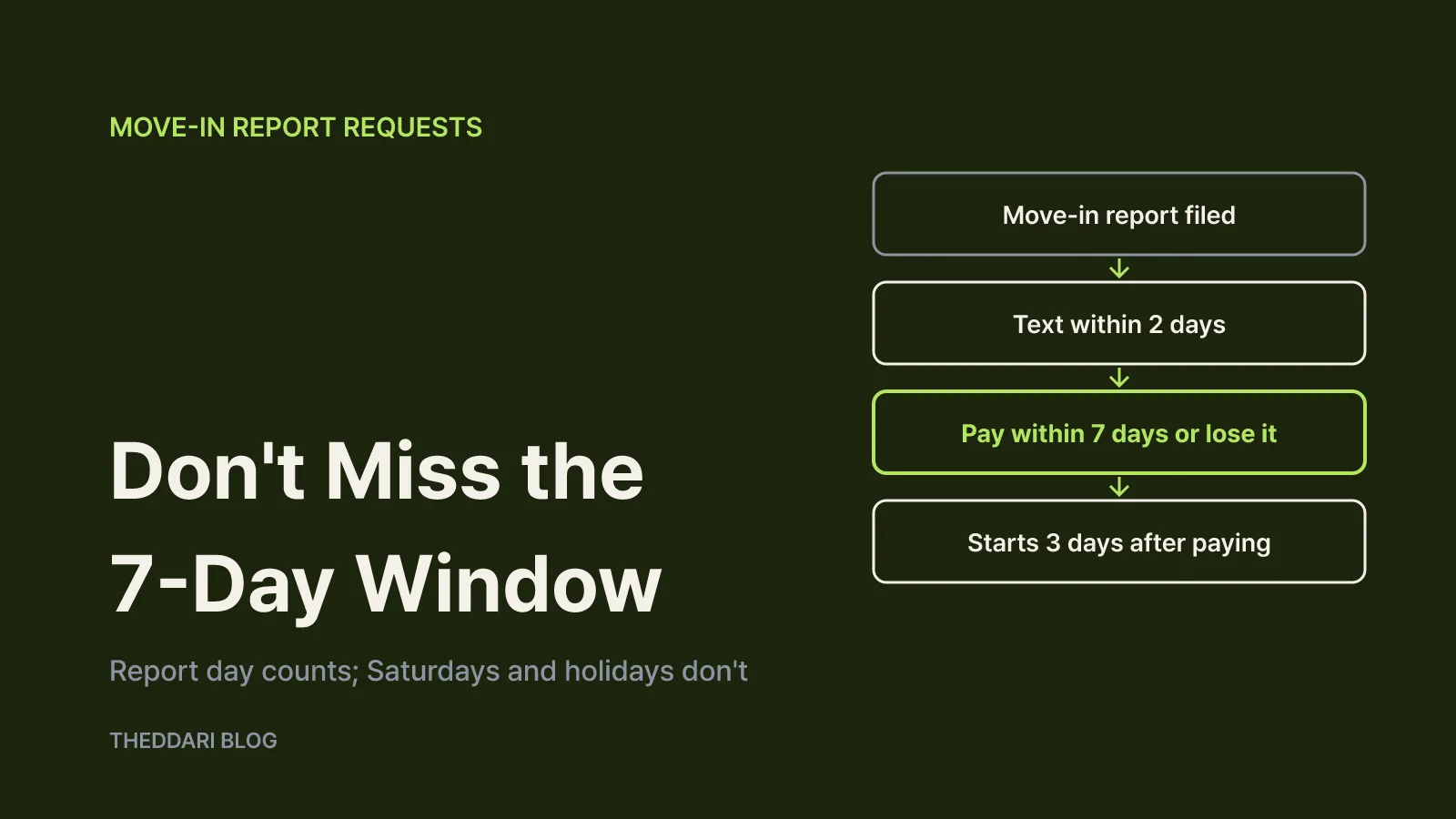
Ticking the box is not the end when a fee applies. Based on ePOST's instructions, the timeline runs like this:
- Report day. Your request reaches the Korea Post system the next day, so you cannot look it up or pay on ePOST until then.
- Within 2 days of the report. A text message arrives at the phone number you entered, with a 14-digit receipt number starting with N or 6.
- Within 7 days, counting the report date and excluding Saturdays and public holidays. Pay on ePOST with that number. Unpaid requests are cancelled automatically.
- 3 days after payment, excluding Saturdays and public holidays. Forwarding begins.
In practice, mail sent to your old address in the first week or two may not be forwarded yet. If an important registered letter or bill is due, tell the sender your new address directly.
Same-region moves that qualify for the free period do not trigger a text, because the request is registered automatically. Use ePOST's lookup menu for free requests to confirm it exists.
Applying later on ePOST or at a post office
Before applying separately, check whether you already have a request. ePOST notes that community center staff sometimes add forwarding to a move-in report even if you did not ask, and a second application creates a duplicate. If you received a payment text, simply pay. If not, check the free-request lookup first. Apply fresh only when neither exists.
On ePOST you can choose 3, 6, 9 or 12 months. Within the same region the first three months are free and anything beyond is charged, so six months costs ₩4,000 per person. Different-region requests are charged from the start.
At a counter, Korea Post lists these example documents:
- Proof of identity: resident registration card, driver's license or passport.
- Proof of relocation: a resident registration copy for individuals, or a business registration certificate or corporate register for organizations.
- For a proxy: a power of attorney plus the applicant's seal certificate or signature confirmation.
If you leave the start date blank on the paper form, forwarding begins three days after the day following receipt, excluding public holidays. If you paid by credit or debit card, bring the same card if you later withdraw the request.
Extensions, end dates and mail that is not forwarded
The standard period is three months. Unless you extend at least 3 days before it ends, mail to your old address is returned to the sender from the day after the end date. Set a reminder when you apply.
Extension routes differ slightly by source. ePOST says paid requests made with a move-in report can be extended only at a post office counter, while Korea Post's general page lists both counters and ePOST for extensions. For move-in-report requests, plan on visiting a counter; for direct ePOST requests, choosing 6 to 12 months upfront avoids the issue.
Some mail needs separate action:
- Court proceedings. If you are party to a lawsuit, report your new service address to the court under Article 185(1) of the Civil Procedure Act rather than relying on forwarding.
- Organization applications. When a company or organization applies, mail addressed only to an individual, without the organization's name, is not forwarded.
- After expiry. Mail is returned to the sender.
A checklist for the first weeks after moving
Forwarding does not change your address with anyone; it buys time while you update senders yourself.
- Select mail forwarding when filing your move-in report, and decide which household members to include.
- Check whether the move stays within one region (free for three months) or crosses regions (₩7,000 per person).
- For a paid request, watch for the 14-digit receipt number within 2 days and pay within 7 days, counting the report date and excluding weekends and holidays.
- Expect no forwarding for about 3 days after payment, and contact senders of urgent mail directly.
- Use the envelopes that arrive to list senders such as card companies, insurers and public agencies, then update each one.
- Set a reminder for 3 days before the end date and extend if needed.
- If you are involved in a lawsuit, notify the court separately.