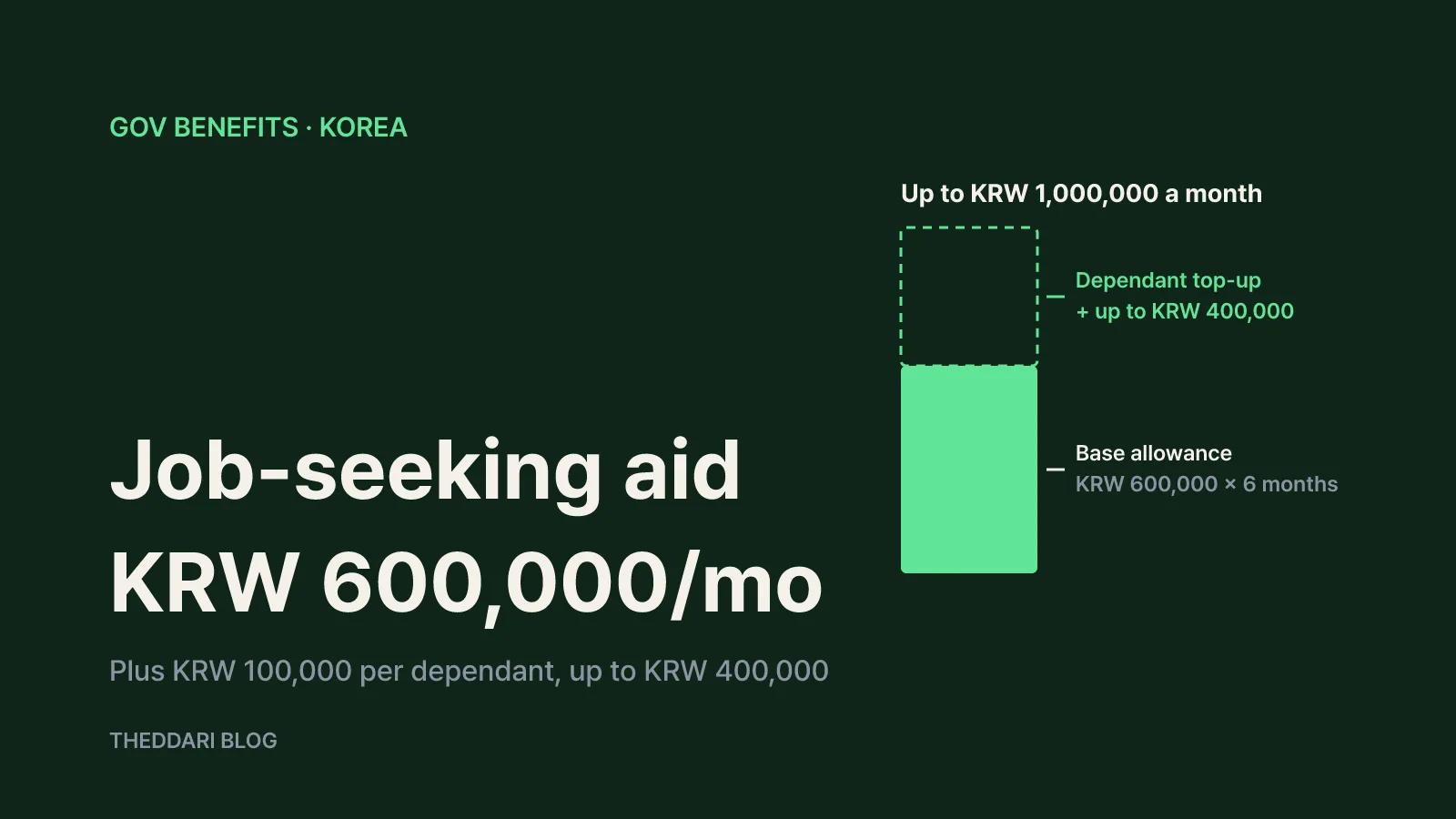
As of November 2026, Korea's National Employment Support Program (국민취업지원제도) pays Type I participants a job-seeking promotion allowance of KRW 600,000 a month for six months, or KRW 3.6 million in total. Each dependant aged 18 or under, aged 70 or over, or with a severe disability adds KRW 100,000 a month, up to KRW 400,000, so the monthly maximum is KRW 1 million. Unlike unemployment benefit, you do not need an employment insurance record to join. Applications are open year-round through Work24 or your local employment centre, but the money is tied to an activity plan you agree with a counsellor and must carry out every month.
This guide is written for English-speaking readers trying to understand the Korean programme itself, whether you are a Korean national reading in English or a family member helping someone apply. It follows the official guidance from the Ministry of Employment and Labor and Work24 and does not translate the scheme into any other country's system.
How much the allowance pays and for how long
The Ministry of Employment and Labor's 2026 infographic states that the job-seeking promotion allowance is KRW 600,000 a month from 2026. According to the Work24 allowance page, payments run for six months from the date you are notified that you qualify. You can spread them over as long as one year, but the total stays the same, so stretching the schedule does not increase what you receive.
A family allowance is added for dependants confirmed during the eligibility review: minors aged 18 or under, people aged 70 or over, and people with a severe disability. Each one adds KRW 100,000 a month, capped at KRW 400,000. A minor or older person who also has a severe disability can count twice, for KRW 200,000. A household member who is already a Type I participant, or who already counts for someone else's family allowance, is excluded.
← Swipe to see more
| Situation | Monthly amount | Six-month total |
|---|---|---|
| Base allowance | KRW 600,000 | KRW 3.6 million |
| One dependant | KRW 700,000 | KRW 4.2 million |
| Four or more dependants (cap) | KRW 1,000,000 | KRW 6 million |
The totals are simply the official monthly figures multiplied by six. Any single payment can be lower if you did not complete the planned activities or reported income during that cycle, which is why Work24 asks applicants to list household members accurately.
Type I eligibility: age, household income, assets and work history
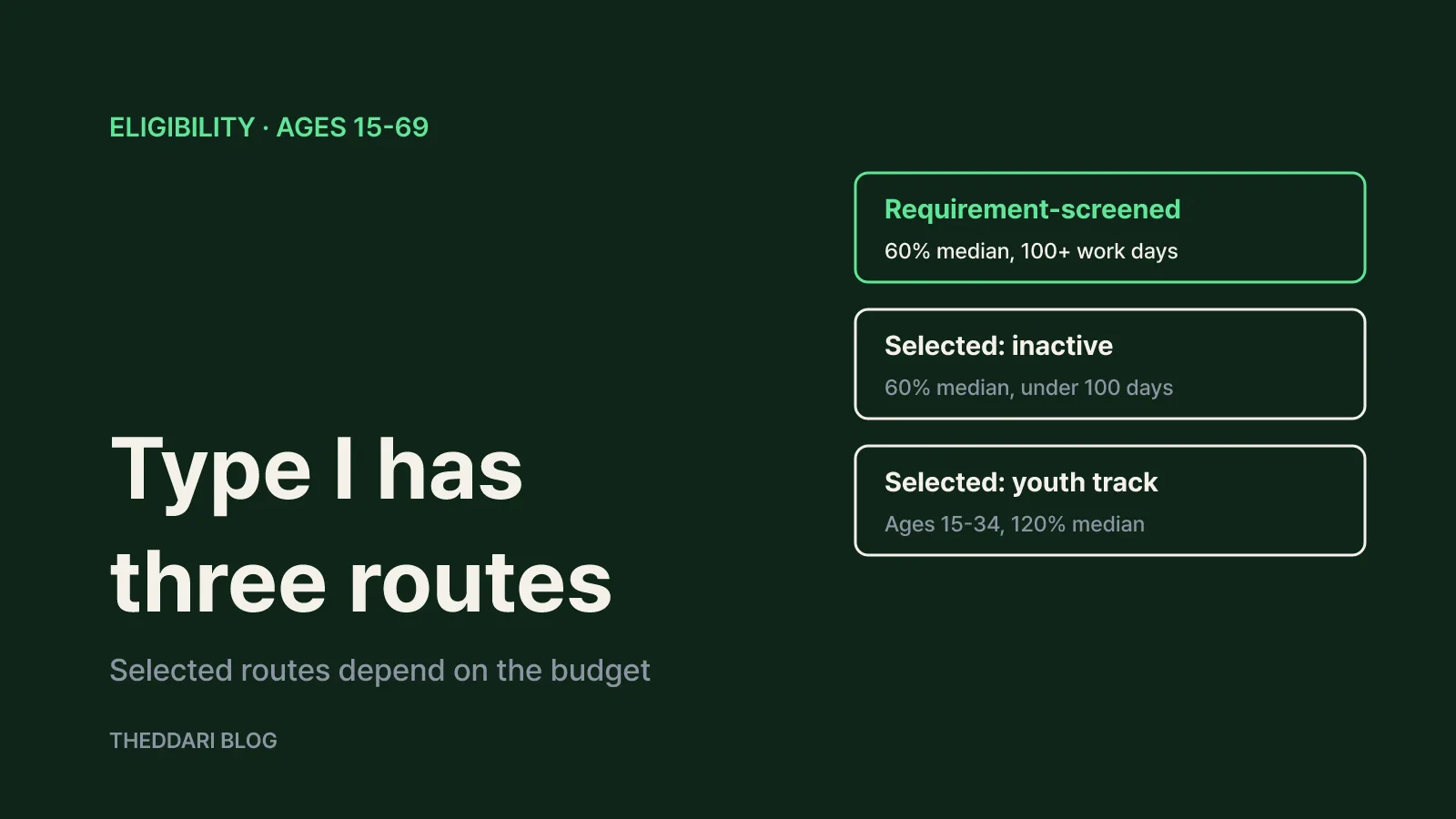
Only Type I participants receive the allowance. All Type I routes cover ages 15 to 69, and there are three of them:
- Requirement-screened: household income at or below 60% of the standard median income, combined household assets of KRW 400 million or less (KRW 500 million for those aged 15 to 34), and at least 100 days or 800 hours of work in the past two years.
- Selected (economically inactive): the same income and asset limits, but less than 100 days or 800 hours of recent work.
- Selected (youth track): ages 15 to 34, extended by time spent in mandatory military service up to age 37, with household income at or below 120% of the median and assets of KRW 500 million or less. Work history does not matter.
The word "selected" matters. Work24 warns that applicants without the work history, and young people in households between 60% and 120% of the median, may not be selected for Type I depending on the budget.
The standard median income is set each year by the Ministry of Health and Welfare. Work24 cites the 2026 figures as KRW 2,564,238 for a one-person household and KRW 6,494,738 for a four-person household. For a family of four, 60% works out to roughly KRW 3.9 million a month and 120% to roughly KRW 7.79 million (our calculation). Your own income is also tested separately: Work24 says that if your personal monthly average income exceeds KRW 1,538,543, which is 60% of the one-person median, you cannot join Type I.
The household normally means your spouse plus parents and children on your resident registration. Relatives living apart for military service, an overseas stay or divorce proceedings can be removed with evidence, while someone not on the register who genuinely shares your home and finances can be added. Pension income counts only for the five public pension schemes; the basic pension and industrial accident leave benefits are not included.
Exclusions to check before you apply
Meeting the income and asset limits is not enough. Under the Work24 exclusion list, you cannot join Type I if any of these apply:
- You already work 30 or more hours a week as an employee, or earn KRW 2.5 million or more a month from a business. Part-time work under 30 hours, or business income below that level, is treated as underemployment and is allowed.
- You receive the livelihood benefit under the basic living security system. The housing benefit does not block you.
- You are receiving unemployment benefit (job-seeking benefit), or it ended less than six months ago.
- You are in a government-funded direct job scheme, or left one less than six months ago, with some exceptions.
- You receive a national or local government allowance for job-seeking costs, or it ended less than six months ago.
- You are attending school or a private academy to enter higher education or earn a professional licence.
University and graduate students in the final semester of their last year, including those on leave, can take part if they submit enrolment and transcript records. Local youth allowances block Type I only when they impose job-seeking duties and pay an average of KRW 500,000 or more a month or KRW 3 million or more in total; in that case you wait six months after they end. Emergency welfare support can be received at the same time.
For non-Korean readers, the key point is that foreign nationals generally cannot participate. The exceptions are marriage immigrants and their foreign children who entered Korea later. Anyone who has already completed the programme must normally wait three years before applying again, although this can be shortened to between one and three years if participation ended because you found work or started a business.
Applying on Work24 and when the first payment arrives
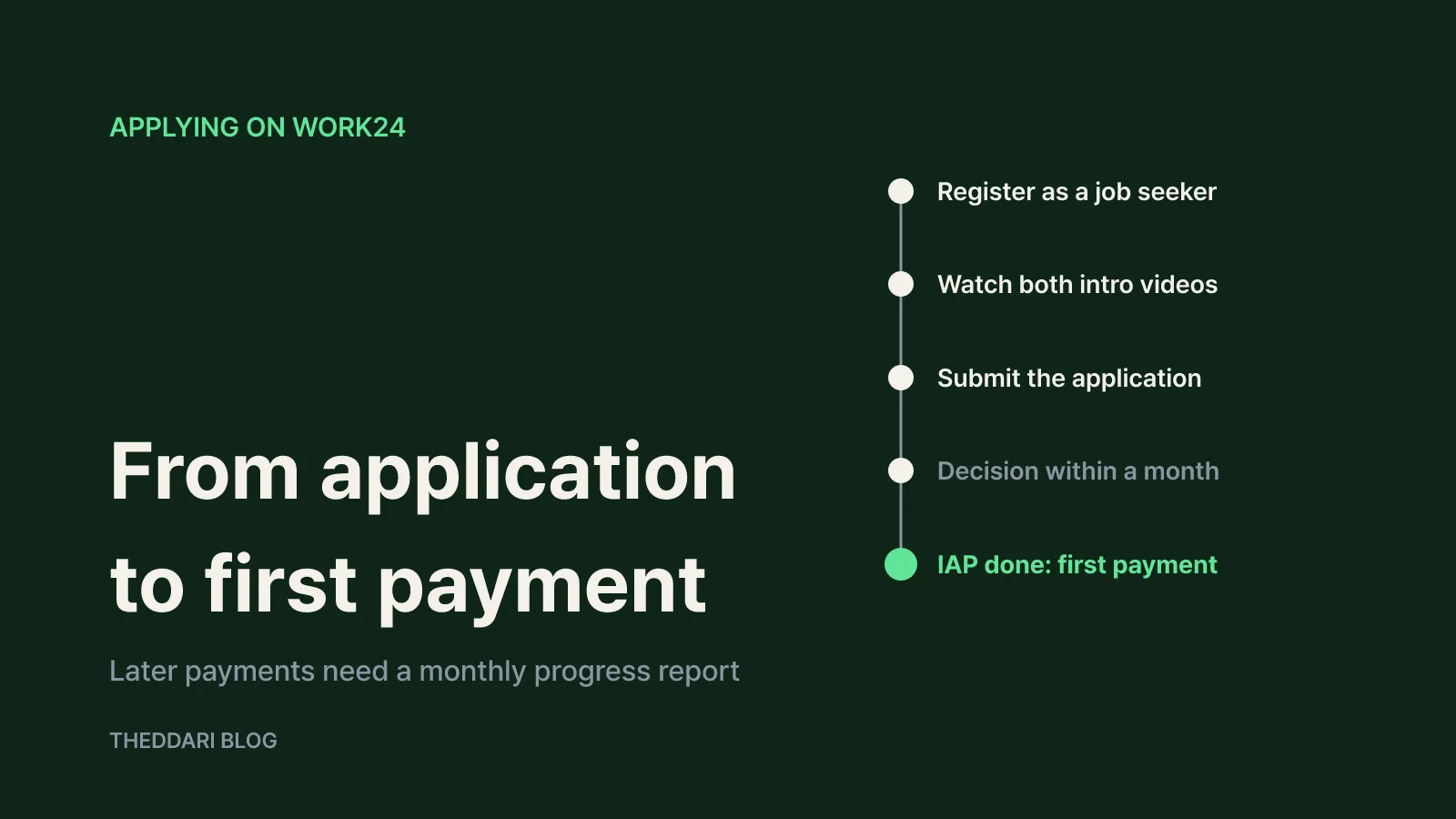
You can apply online or in person at any time. The online sequence is:
- Join Work24 and register as a job seeker. Registration must come first.
- Watch the two introductory videos. Both sessions are mandatory, and a self-check tool gives an early indication of eligibility.
- Submit the application. This includes the application form, consent for collecting personal data from household members, consent for shared administrative data and an eligibility confirmation. Household consent can be given by mobile phone verification.
- Wait for the decision. The employment centre confirms your household and checks income and assets through public records. Results are usually sent within one month, longer if you are asked for extra documents.
- Draw up your Individual Action Plan (IAP). After initial counselling and assessments, you and a counsellor agree on the job-seeking activities you will complete.
- Receive payments. The first instalment is paid on the day the IAP is completed. Later payments follow a one-month cycle from that date.
Most documents are pulled automatically. You will need to supply items public records do not capture, such as a lease contract for a rental deposit or a loan balance certificate for borrowing used to buy property. Only financial-sector loans linked to acquiring an asset count as debt.
If you are refused, you can request a review within 90 days of receiving the decision. If your bank account has been seized, you can open a protected account, known as a Happiness Guardian account, at a participating bank using your eligibility notice.
When payments are cut or stopped
From the second instalment onward, you must finish every activity in your plan and then file a progress report and a payment application. Activities outside the plan do not count, and programmes such as vocational training have their own attendance rules.
- Not following the plan without good reason can stop that cycle's payment.
- Completing only part of the plan can reduce the amount.
- Three stopped payments can cancel your remaining entitlement.
Any income you earn during a cycle, including part-time, freelance or very short jobs, must be reported, and the allowance may be reduced or withheld as a result. Fraud means repaying everything received, possible additional charges, up to one year in prison or a fine of up to KRW 10 million, and a five-year ban. Illness, pregnancy or caring for a sick relative can justify a suspension, but you must apply to rejoin within 30 days of the reason ending or support stops.
Finding work: the success allowance of up to KRW 1.5 million
The monthly allowance ends when you start a job, but the employment success allowance can follow: KRW 500,000 after six months of continuous work and KRW 1 million after another six months, KRW 1.5 million in total. It covers requirement-screened and economically inactive Type I participants, youth-track participants at or below 60% of the median, and Type II participants at or below 60% of the median or in priority groups such as single parents and North Korean defectors.
The job has to count as stable. Employees need at least 30 hours a week with employment insurance coverage; platform and freelance workers need average monthly earnings of KRW 2.5 million or more; founders need business registration, dedicated premises and sales. Two part-time jobs that only add up to 30 hours do not qualify.
If you miss the Type I criteria, young people, middle-aged job seekers and priority groups can still join Type II, which offers counselling, training and placement plus smaller payments: a participation allowance of KRW 150,000 plus KRW 30,000 to 100,000 depending on the programme, and KRW 20,000 per counselling visit for up to five visits. If you are unsure which type fits, the ministry's call centre on 1350 can confirm before you apply.