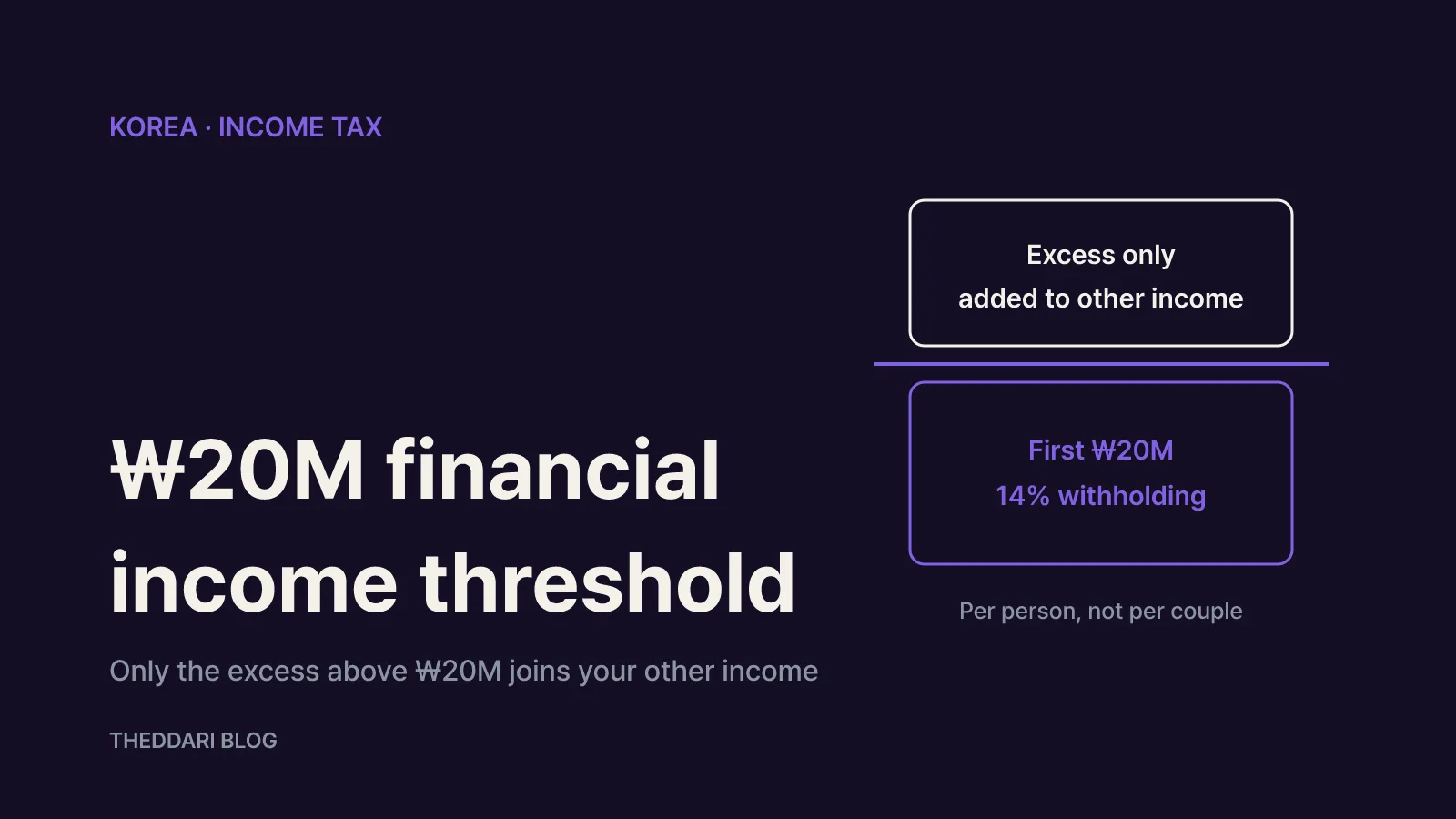
As of November 2026, the rule from Korea's National Tax Service (NTS) is straightforward: if the interest and dividends you personally receive in a calendar year total ₩20 million or less, the 14% income tax withheld by your bank or broker (15.4% including local income tax) settles the tax. Above ₩20 million, your financial income must be reported in the May comprehensive income tax return, but only the portion above ₩20 million is stacked on top of your salary, business or pension income and taxed at progressive rates. The first ₩20 million stays at 14% (NTS Tax Counseling Center Q&A on financial income).
This matters at year-end because timing decides which year the income belongs to. Deposit interest is counted on the day you actually receive it, not the day you opened the account. A time deposit that matures on December 30 adds to this year's total; one that matures on January 2 counts toward next year. This guide applies to individuals taxed as Korean residents, including foreign nationals who are tax residents in Korea.
What counts toward the ₩20 million and what does not
In Korea's Income Tax Act, "financial income" means interest income (Article 16) plus dividend income (Article 17). The NTS lists typical examples: interest on savings and time deposits at banks, securities firms, insurers, cooperatives and Korea Post; interest and discounts on government, financial and corporate bonds; and dividends on shares and equity contributions. Qualifying fund distributions and gains from derivative-linked securities are also listed as dividend income. For savings-type insurance, the gain above the premiums you paid is interest income, although certain long-term policies that meet the statutory conditions are excluded.
Several items stay outside the calculation:
- Tax-exempt and separately taxed financial income under the Income Tax Act and the Restriction of Special Taxation Act is not added to the ₩20 million total.
- Capital gains on shares and bonds are not financial income for this purpose. The exception is a repurchase arrangement at a pre-agreed rate, where the gain is taxed as interest.
- Your spouse's income is never combined with yours. The threshold applies per person.
- Interest on deposits held in the name of a clan association (jongjung) is always taxed separately, whatever the amount.
The important exception runs the other way. Financial income that was not withheld in Korea must be reported even if your total is under ₩20 million. Interest from a bank account abroad and dividends from foreign shares where no Korean tax was withheld are the common cases, which is particularly relevant if you keep accounts in your home country. Dividends to silent partners in a joint business, and interest on a private loan where the borrower did not withhold tax, are treated the same way. These must be filed and paid by May 31 of the following year.
How much more tax above ₩20 million? The comparison method
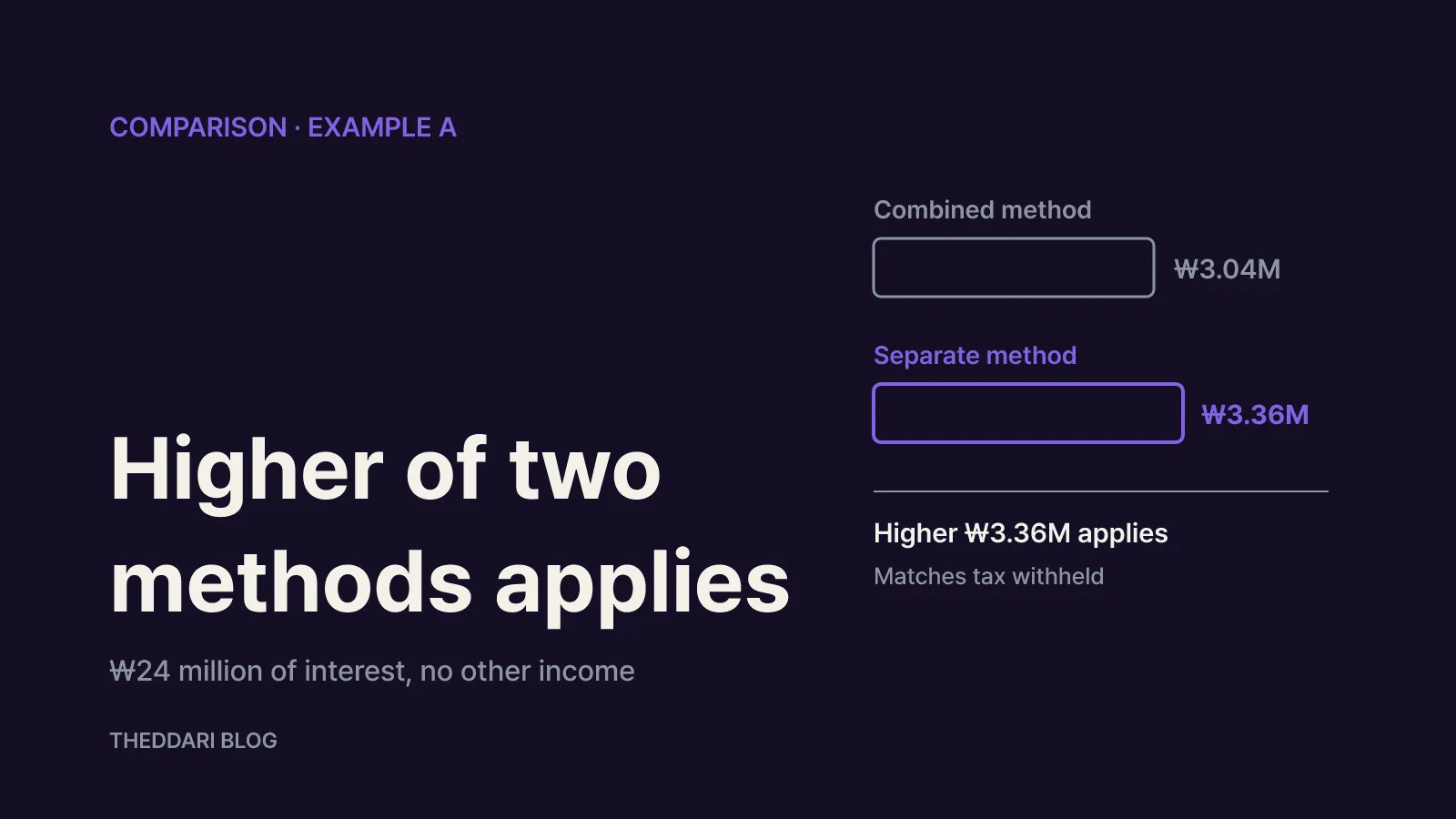
The common fear is that crossing ₩20 million by a single won triggers a large bill. In practice, the NTS calculates tax two ways and charges the higher of the two (Income Tax Act Article 62):
- Method 1 (combined): ₩20M × 14% + (financial income above ₩20M + dividend gross-up + other income − deductions) × basic rates
- Method 2 (separate): all financial income × withholding rate + (other income − deductions) × basic rates
Both methods keep the first ₩20 million at 14%, so there is no cliff at the threshold. Method 2 also acts as a floor, which stops someone with little other income from paying less than 14% by moving into a lower bracket. The 14% already withheld is credited, so what you actually pay in May is the calculated tax minus tax already paid.
The basic rates follow the NTS income tax rate table. The latest table posted by the NTS (tax years 2023–2025) runs from 6% on taxable income up to ₩14 million, 15% up to ₩50 million (progressive deduction ₩1.26 million), 24% up to ₩88 million (₩5.76 million) and 35% up to ₩150 million (₩15.44 million), then 38%, 40% and 42%, up to 45% above ₩1 billion. When you file for tax year 2026, confirm the rate shown in the Hometax return.
Two simplified examples, ignoring deductions and credits:
Example A — ₩24 million of interest, no other income
- Method 1: ₩20M × 14% = ₩2.8M, plus the ₩4M excess × 6% = ₩0.24M, giving ₩3.04M
- Method 2: ₩24M × 14% = ₩3.36M
- The higher figure, ₩3.36M, applies. That equals the tax already withheld, so nothing more is due. You still have to file in May because you crossed ₩20 million.
Example B — ₩60 million of other taxable income plus ₩30 million of interest
- Method 1: ₩2.8M + (₩10M excess + ₩60M) = ₩70M × 24% − ₩5.76M = ₩11.04M, giving ₩13.84M
- Method 2: ₩30M × 14% = ₩4.2M, plus ₩60M × 24% − ₩5.76M = ₩8.64M, giving ₩12.84M
- The higher figure, ₩13.84M, applies. The ₩1M gap is the ₩10M excess taxed at 24% instead of 14%. Local income tax is added at one-tenth of the income tax, the same ratio as the 1.4% added to the 14% withholding.
A quick rule of thumb: the extra national tax is roughly the excess multiplied by (your marginal rate − 14%). People with little other income often owe nothing more; high earners feel the difference.
Dividend-heavy portfolios add one more step. When dividends from Korean companies are taxed in the combined method, a gross-up amount is added to income and then credited back, to offset part of the corporate tax already paid. Donation tax credits remain available to someone whose only income is financial income above ₩20 million. Expenses, however, are not deductible from financial income.
Year-end checklist: when interest counts
Because the test uses income received in the calendar year, the receipt date drives everything. The NTS Q&A summarises the main timing rules (Enforcement Decree Articles 45 and 46):
- Savings and time deposit interest: the day interest is actually paid, including the day it is added to principal under the contract, the day of early termination and the day of renewal
- Savings-type insurance gains: the payout date or the cancellation date
- Registered bonds: the contractual payment date
- Fund distributions: the day paid, or the reinvestment date if the contract provides for it
- Dividends from distributable profits: the date of the shareholders' resolution
- Private loan interest: the agreed payment date, or the actual date if paid earlier
The trap is automatic renewal. If a time deposit rolls over at maturity, the interest is treated as received on the renewal date, even though you never withdrew it. Early termination likewise lands the interest on the termination date.
Before December 31, work through these steps:
- Add up the interest and dividends you have received since January, using statements from each bank or broker. The tax office only shows financial income data during the filing period, so institution records are the practical source.
- Flag anything still due to pay out before December 31.
- List products whose maturity or renewal date falls around the turn of the year.
- Check foreign accounts separately, because unwithheld foreign income must be filed regardless of the total.
- If you are close to ₩20 million, estimate the extra tax with the rule of thumb above.
Be cautious about breaking a deposit early just to move income into another year. An early-termination rate usually pays less than the contracted rate, and that loss can exceed the tax you were trying to avoid. Put both numbers side by side before deciding. Financial income can also feed into other systems such as national health insurance premiums, so check the National Health Insurance Service's own criteria if that applies to you.
Preparing for the May filing
If your financial income exceeded ₩20 million, report it in the comprehensive income tax return in May of the following year together with any other income. The obligation applies even if you have no other income, and salaried workers are not covered by their employer's year-end settlement for this. Your salary and the excess financial income are combined in the May return.
During the filing period, people required to file can view their financial income on Hometax under Tax Filing > Comprehensive Income Tax > View filing assistance data > Financial income details. At a tax office, you need your ID; a representative needs a power of attorney, your certified seal impression certificate and their own ID.
Three NTS points help when reconciling figures:
- If tax office data differs from your bank's records, file using the financial institution's figures. Missing, duplicated or incorrect payment statements can make the tax office data wrong.
- The tax office's financial income data is a filing aid only and cannot be used as proof of income for other agencies.
- Tax already withheld is credited, so keep every withholding statement.
Quick summary by situation
- Under ₩20 million, all withheld in Korea: nothing further to do.
- Under ₩20 million but with foreign interest or dividends: file the unwithheld part by May 31 of next year.
- Over ₩20 million with little other income: file, but extra tax may be zero or small.
- Over ₩20 million with substantial salary or business income: estimate the excess × (marginal rate − 14%) and review year-end maturity dates now.