As of November 2026, the short answer for anyone shopping in South Korea is this: treat the 소비기한 (use-by date) on Korean packaging as a real deadline and do not eat food after it passes. Korea switched from a sell-by system to use-by dates on January 1, 2023, and the new dates are set much closer to the point where a product actually stops being safe or acceptable. That makes them different from the quality-oriented dates many readers know from the United States. Below I walk through how the dates are calculated, which products still carry other labels, and a simple routine for checking your fridge, based on guidance from Korea's Ministry of Food and Drug Safety (MFDS).
Sell-by vs use-by in Korea: what actually changed
Under the old system, Korean packaging showed a 유통기한, which the MFDS Q&A defines as the period from manufacture during which a product may be sold to consumers. It was a seller-focused date. The 소비기한 that replaced it is the period during which the food can be eaten safely, provided the storage instructions on the label are followed. The new rule took effect on January 1, 2023, with a one-year grace period through December 31, 2023 so companies could use up old packaging.
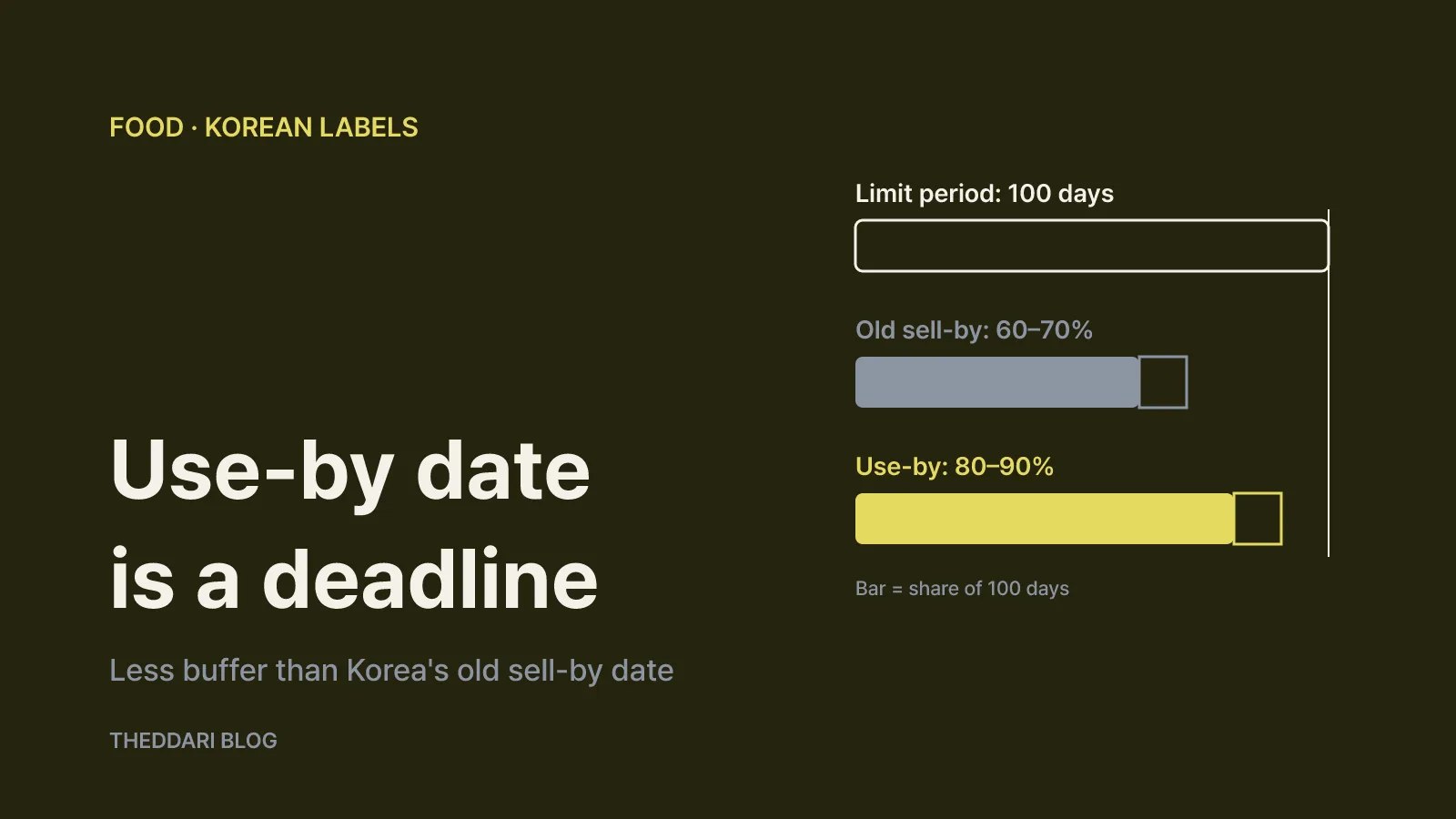
Both dates start from the same test. A manufacturer stores the product under controlled conditions and tracks sensory, microbiological, chemical and physical indicators until the first meaningful change in quality. That span is called the quality and safety limit period. The printed date is that period multiplied by a safety factor below 1. In general, a sell-by date sat at 60–70% of the limit, while a use-by date sits at 80–90%.
The ministry's own example makes the gap concrete. For a product whose limit period is 100 days, a 0.65 factor gave a sell-by date of 65 days, and a 0.85 factor gives a use-by date of 85 days. MFDS adds that unless a company had used a sell-by factor of 0.5 or lower, the new date cannot in theory be more than double the old one. A worked case in the second MFDS Q&A shows a 70-day limit period multiplied by 0.77 to reach 53.9, so that product was labeled with a 53-day use-by date.
The practical takeaway: the date on the pack got longer, but the buffer after the date got smaller.
Is food safe after the use-by date in Korea?
MFDS tells consumers to follow the labeled storage method strictly and not to eat products whose use-by date has passed. It specifically notes that the safety margin left after a use-by date is shorter than the margin that existed after the old sell-by date. The habit of eating something a day or two past the printed date came from the sell-by era and does not carry over.
For products that still show an older 유통기한, the ministry's position is similar. It acknowledges that such food is often edible for a while past the date, but says it cannot judge individual products or how they were stored, so it recommends eating them before the printed date.
Storage history matters as much as the calendar. Chilled or frozen products left at room temperature for hours, or carried around in a hot car, are outside the conditions the date was based on. MFDS states plainly that quality changes caused by mishandling are not covered by any date. Once a package is opened, neither date guarantees safety, so opened food should be eaten as soon as practical.
Why Korean plain milk still has a sell-by date
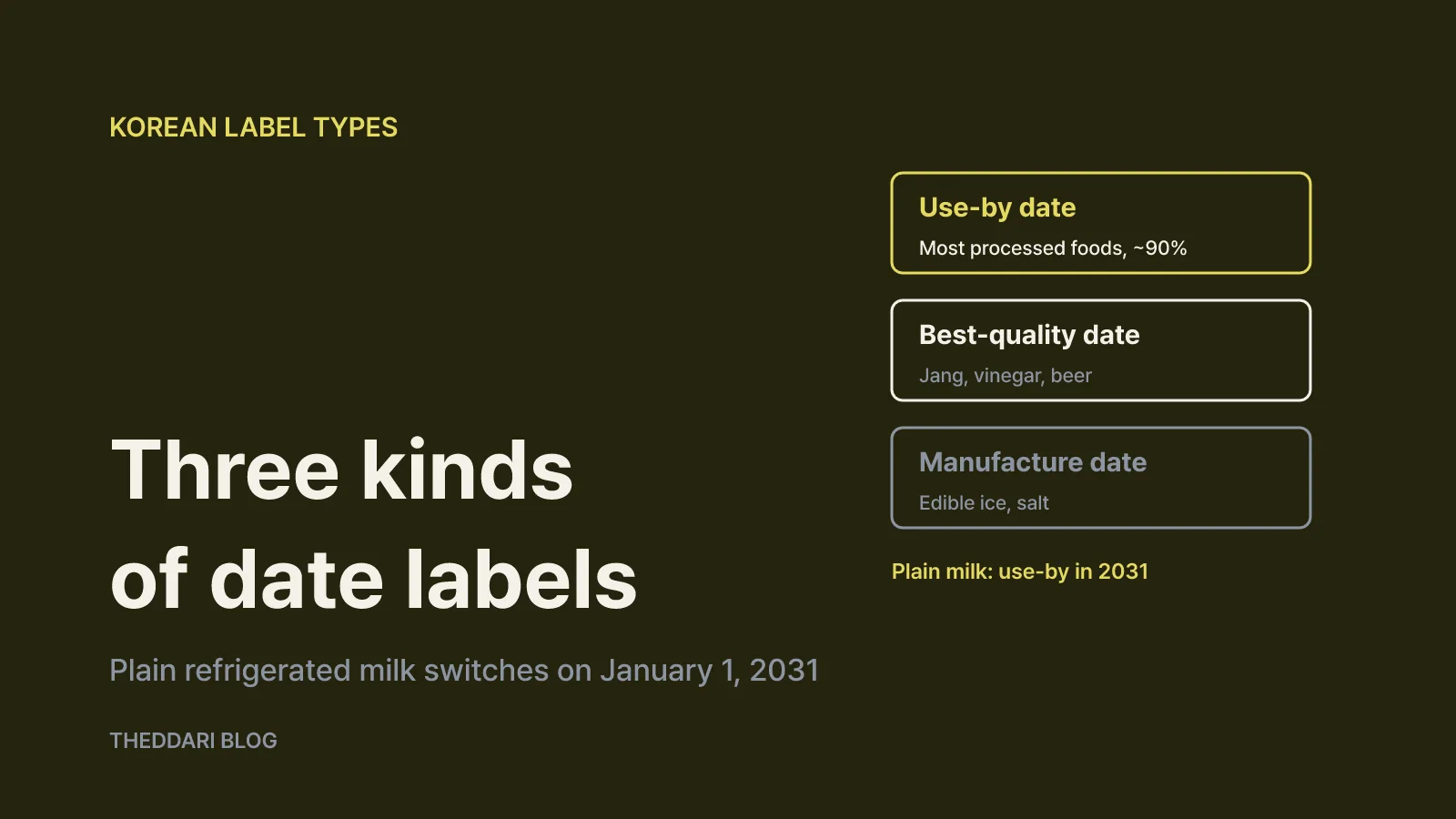
If you see 유통기한 on a carton of plain white milk next to 소비기한 on strawberry milk, the labels are not a mistake. Refrigerated milk (우유류) was given a delay so the cold chain could be improved, and it moves to use-by labeling on January 1, 2031. Fortified milk with added calcium or vitamins and flavored milk such as strawberry or banana milk have been under the use-by rule since January 1, 2023. A Korea Food Safety Information Service notice reported in August 2026 confirms the same schedule.
Not every product uses a use-by date. Korean labels fall into three groups:
- Use-by date (소비기한): most processed foods, about 90% of them, plus health functional foods.
- Best-quality date (품질유지기한): beer, fermented pastes and sauces (jang, excluding meju blocks), vinegar, pickled foods and similar items. This marks how long the product keeps its characteristic quality and is not a consumption deadline.
- Manufacture date (제조연월일): items such as edible ice and salt, which only show when they were made.
Fresh produce in its natural state, other than eggs, is not required to carry a use-by date, so you judge it by condition.
Storage rules that matter more than the date
Use-by dates are tested at the harshest temperature that the product's storage standard allows, then adjusted for ordinary consumer behavior. MFDS cites a 2022 survey of about 1,000 consumers: 56.6% got their groceries into the fridge in around 30 minutes and 36.6% in around an hour, so more than 93% finished within an hour. The reference values already assume a shopping trip of about one hour.
Anything beyond that is on you. A routine that fits the guidance:
- Pick up chilled and frozen items last and head straight home.
- Read the storage line before the date. The date only holds if that instruction is followed.
- Move opened food into airtight containers and finish it quickly.
- Buy short-dated products in small amounts. MFDS specifically asks shoppers not to stock up on them.
For a room-temperature rule of thumb, the USDA Food Safety and Inspection Service says a cold dish left above 40°F (4.4°C) for more than two hours, or one hour above 90°F (32.2°C), should not be eaten, regardless of the label.
How Korean dates compare with US labels
Readers used to American packaging should be careful here. FSIS explains that, except for infant formula, US federal rules do not require date labels, and phrases like "Best if Used By", "Sell-By" and even "Use-By" generally describe quality or inventory rather than safety. That is why US guidance says many foods remain wholesome past the date if handled properly.
Korea's 소비기한 is defined differently: it is the date until which the food can be eaten safely. Applying US logic to a Korean use-by date would remove most of the margin the label was designed around.
Imported food follows Korean rules once it is officially labeled for sale here. According to MFDS, a foreign "Sell by" date is shown as the 소비기한 on the Korean label, and "Expiration date", "EXP" or "E" are carried over as the 소비기한. Even a "Best before" date must be listed as the use-by date if the product falls under Korea's use-by category. When a Korean sticker is present, go by that.
A quick fridge-check routine
- Identify the label type. Use-by, sell-by or best-quality date?
- Recall the storage history. If it sat out or warmed up, discard it.
- Check whether it was opened. Opened food should be eaten well before the printed date.
- Then check the date. Past the use-by or sell-by date, do not eat it; before it, still skip anything that smells, looks or feels wrong.
Keeping short-dated items at the front of the fridge and new purchases at the back is the easiest way to waste less while staying inside the dates.