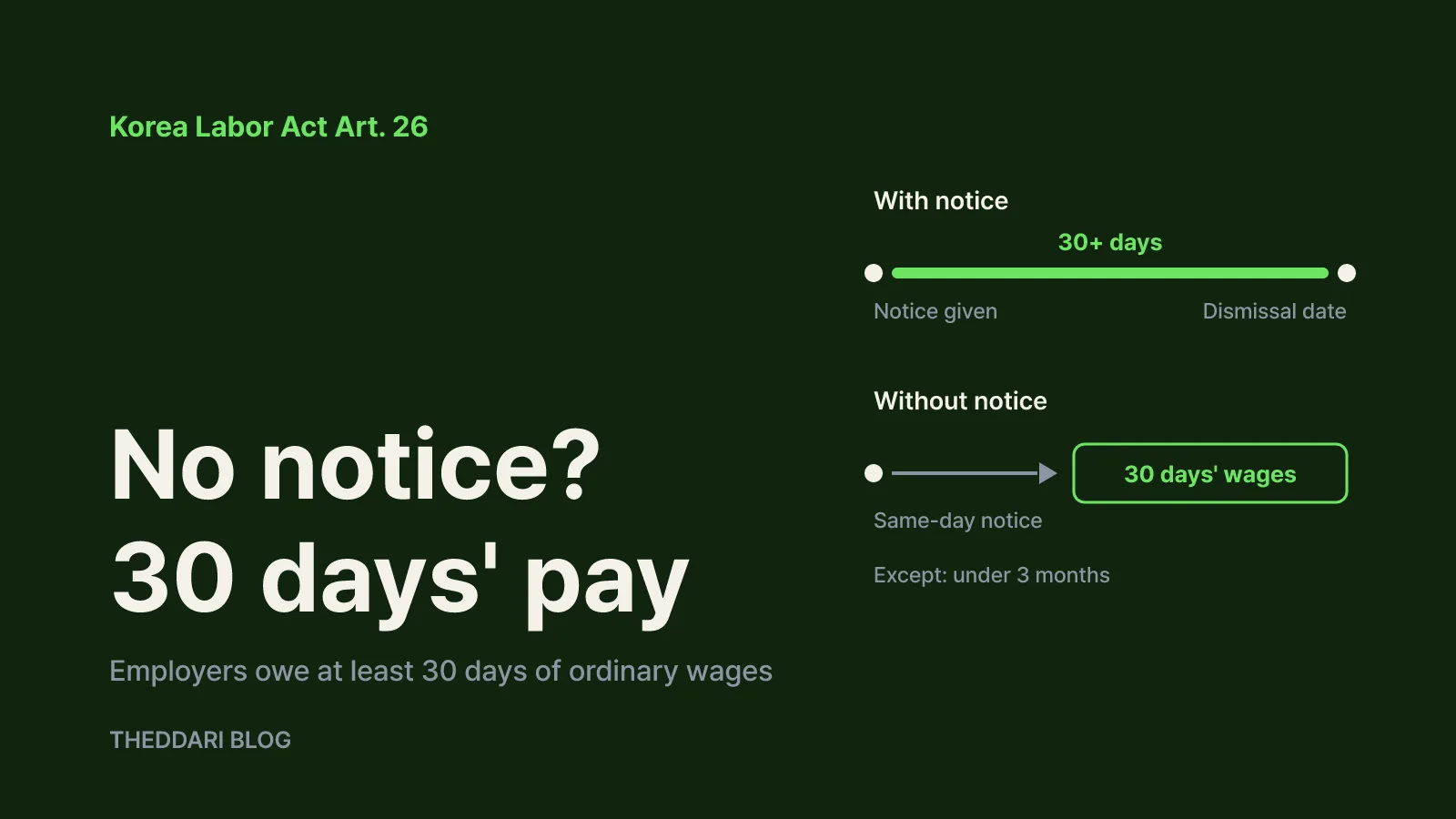
As of November 2026, the rule is straightforward: if your employer in Korea dismisses you without giving at least 30 days' notice, it must pay you at least 30 days of ordinary wages (often called dismissal notice pay, 해고예고수당). The obligation also applies to workplaces with fewer than five regular employees. It does not apply if you have worked there continuously for less than three months, if a natural disaster or similar unavoidable event makes it impossible to continue the business, or if you intentionally caused serious harm to the business in a way listed in a Ministry of Employment and Labor ordinance. The legal basis is Article 26 of the Labor Standards Act, in the version that took effect on October 8, 2026 (Act No. 21533).
This guide is written for employees in Korea, including foreign residents, who have been told to stop coming to work and want to know what they are owed. It covers when the payment arises, how to calculate it from a monthly or daily wage, how the three-month exception is counted, what changes at very small employers, and how to file a petition if the money never arrives.
When dismissal notice pay applies
Article 26 says an employer that intends to dismiss a worker must give at least 30 days' advance notice, and if it fails to do so, it must pay no less than 30 days' ordinary wages. The article explicitly includes dismissals for managerial reasons, so a redundancy or restructuring layoff is covered in the same way as a dismissal for conduct.
In practice, the employer has two options: announce a specific dismissal date at least 30 days ahead, or pay 30 days of ordinary wages instead. Same-day dismissals and one-week warnings fall short of the 30-day standard and trigger the payment. The statute refers to "30 days' ordinary wages or more" and contains no formula for paying only the missing days, so the first question is simply whether proper 30-day notice was given.
The form of the notice matters too. In a published answer, the Ministry of Employment and Labor (MOEL) states that a dismissal notice must specify the dismissal date, that a notice with an undefined period or attached conditions is invalid, and that once notice has been given it cannot be withdrawn without the worker's consent under Article 543(2) of the Civil Act (MOEL online counseling). A vague remark such as "we may need to let you go sometime next month" is unlikely to count as 30 days' notice.
Keep in mind that notice pay is a separate issue from whether the dismissal itself was justified. Receiving the payment does not make an unfair dismissal fair. At workplaces with five or more employees, the fairness of a dismissal is challenged through a separate remedy application to the Labor Relations Commission, while notice pay is claimed as unpaid money.
How to calculate the payment
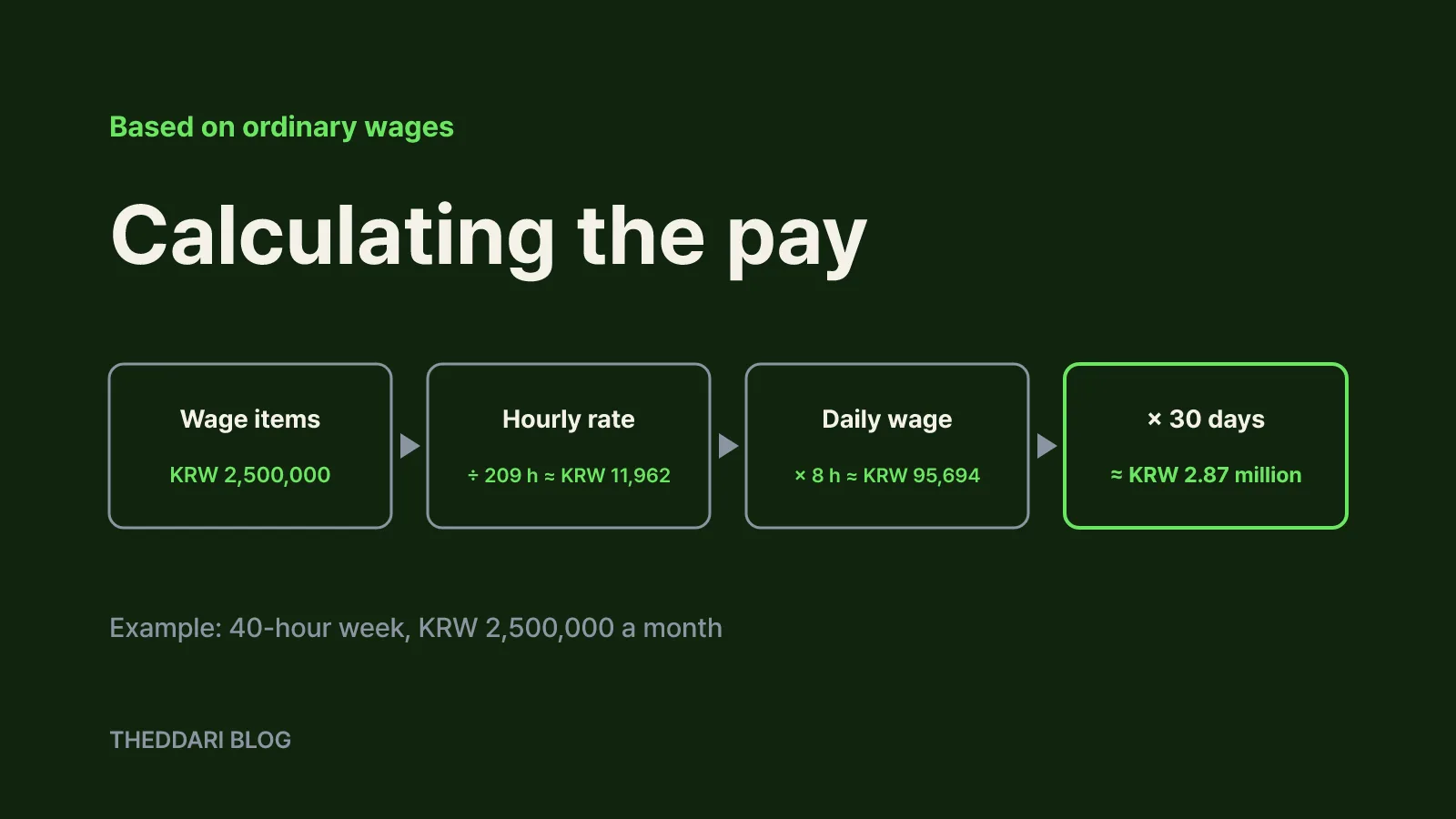
The base is ordinary wages (통상임금), not average wages. MOEL explains that ordinary wages are, in principle, calculated as an hourly rate under Article 6(2) of the Enforcement Decree of the Labor Standards Act, and gives these conversion formulas (MOEL online counseling):
- Daily wage: daily wage ÷ contractual working hours per day
- Weekly wage: weekly wage ÷ (contractual weekly hours + paid weekly holiday hours)
- Monthly salary: monthly salary ÷ {(contractual weekly hours + paid weekly holiday hours) × 365 ÷ 7 ÷ 12}
The standard hours include paid weekly holiday hours on top of contractual hours, and MOEL notes the figure can change if the workplace grants additional paid holidays by agreement.
A four-step approach keeps the math clean:
- Pick the wage items that count as ordinary wages: base pay plus allowances fixed in advance and paid regularly and uniformly for contractual work. Overtime pay that varies with actual extra hours stays out.
- Convert to an hourly rate using the formula above.
- Find the daily ordinary wage by multiplying the hourly rate by contractual hours per day, not by the hours you actually worked.
- Multiply by 30. That is the statutory minimum.
Here is a worked example. Suppose you work a standard 40-hour week (eight hours a day, five days) and the items that count as ordinary wages total KRW 2,500,000 a month. Adding eight paid weekly holiday hours gives (40 + 8) × 365 ÷ 7 ÷ 12 ≈ 208.6 hours, rounded to 209. The hourly rate is 2,500,000 ÷ 209 ≈ KRW 11,962, the daily ordinary wage is about KRW 95,694, and 30 days comes to about KRW 2,870,813, or roughly KRW 2.87 million.
For a daily-wage worker on eight-hour days earning KRW 100,000 a day, the hourly rate is KRW 12,500, the daily ordinary wage is KRW 100,000 and the 30-day figure is KRW 3 million. Part-time staff who work only two or three days a week are the tricky case, because the amount depends heavily on how contractual daily hours are set. MOEL itself notes that its online counseling is a general channel and cannot give case-specific figures, so if your schedule is irregular, bring your contract and timesheets to the regional labor office for a check.
The three exceptions and how three months are counted
The proviso to Article 26 limits the exceptions to three situations:
- The worker has been employed continuously for less than three months.
- A natural disaster, calamity or other unavoidable reason makes it impossible to continue the business.
- The worker intentionally caused serious disruption or property damage to the business, in a case falling under grounds set by MOEL ordinance.
The first exception was added by the January 15, 2019 amendment, and MOEL states it applies to employment contracts signed after that amendment. For the third, an employer's allegation of loss is not enough: the harm must be intentional and fit the grounds listed in the ordinance.
How the three months are counted comes from an MOEL interpretation. A worker hired on January 1 with a three-month probation was dismissed after working on March 31. MOEL read "less than three months" literally and concluded that a dismissal within January 1 to March 30 would not carry a notice duty, but a worker who actually worked on March 31, the day that completes the third month, does not fall under the under-three-months exception (MOEL interpretation 1330, May 4, 2021). It also relied on an earlier view that a final day on which the worker reports and works counts as a working day.
The takeaway: calling a period "probation" does not create an exception. What matters is actual continuous employment. If you are dismissed right around your three-month mark, check your attendance records for the exact last day you worked.
Small workplaces, probation and part-time staff
The Labor Standards Act generally covers workplaces with five or more regular employees; at four or fewer, only the provisions listed in Annex 1 of the Enforcement Decree apply. MOEL lists the main provisions that still apply at such small workplaces, including written working conditions (Article 17), dismissal notice (Article 26), final settlement of money owed (Article 36), wage payment (Article 43), breaks (Article 54) and holidays (Article 55) (MOEL online counseling).
What does not apply at four or fewer employees is the restriction on dismissal without just cause (Article 23(1)), written notice of dismissal grounds (Article 27) and the unfair dismissal remedy application (Article 28). So at a very small business you generally cannot challenge the reason for dismissal before the Labor Relations Commission, but you can still claim notice pay if you were not given 30 days' notice.
← Swipe to see more
| Workplace | Dismissal notice (Art. 26) | Just cause, written notice, remedy |
|---|---|---|
| 5+ regular employees | Applies | Applies |
| 4 or fewer | Applies | Does not apply |
| Under 3 months' service | Exception | Depends on size |
Probationary employees and part-timers are judged the same way: if they are workers under the Act and have three or more months of continuous service, the notice rule applies. For part-timers, the dispute is usually about the amount, not the entitlement.
What to do after being told you are dismissed
Start collecting evidence on the day you are told:
- Record the notice date and dismissal date through texts, messenger chats, emails or recordings.
- Confirm your continuous service from your start date and last working day.
- Gather wage documents such as your contract and pay statements showing base pay, fixed allowances and weekly contractual hours, then run the four-step calculation.
- Work out the headcount, since five or more regular employees opens the door to an unfair dismissal claim as well.
- Ask the employer in writing for payment, showing your calculation, and keep a copy.
If the employer refuses, you can file a petition with MOEL. According to MOEL, you can apply online via MOEL website → Civil Petitions → Apply → Form-based petitions → Unpaid wage petition, or visit the regional labor office that covers the workplace. General counseling is available at MOEL's main line, 1350, on weekdays from 9 a.m. to 6 p.m. If you are also owed severance pay or unpaid wages, list everything in one petition.
Finally, watch out for an employer that frames the exit as a "recommended resignation." If you sign a resignation letter and leave by agreement, the dismissal notice rule may not come into play, so establish whether you are being dismissed or asked to resign before signing anything.