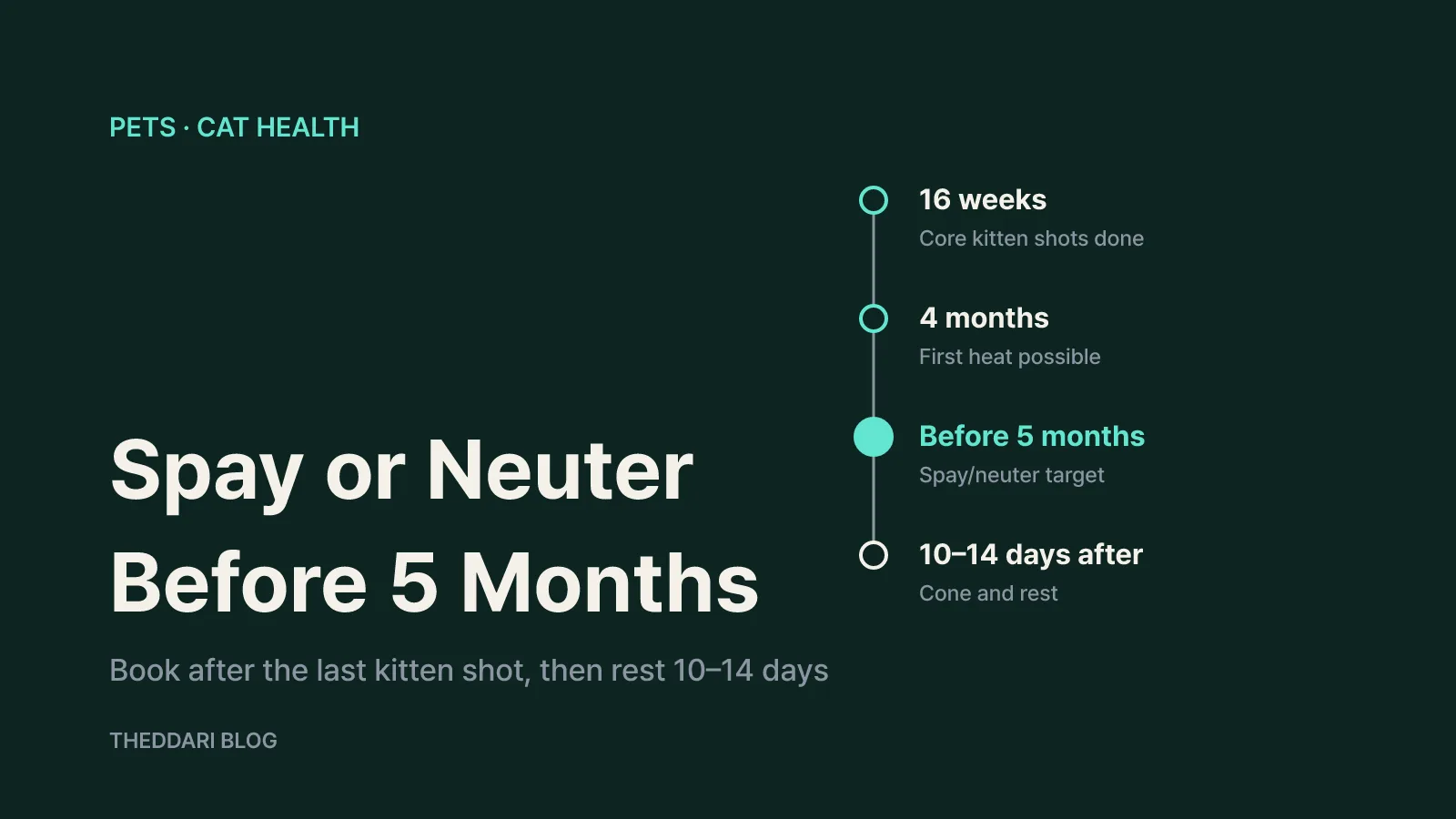
As of November 2026, the short answer is this: if you are not planning to breed your cat, aim to have your kitten spayed or neutered before 5 months of age. The American Association of Feline Practitioners (AAFP) supports sterilization by 5 months in its position statement on pediatric sterilization, and it asks veterinarians to warn owners that a cat can be reproductively active as early as 4 to 5 months without necessarily showing obvious signs. The traditional advice of waiting until six months, or until after a first heat, leaves a window in which an unplanned pregnancy can happen.
This guide covers the three questions most owners have when booking the appointment: why 5 months, how to pick the date, and what to do at home afterward. It draws on published guidance from veterinary associations and spay/neuter clinics. Your own veterinarian will confirm the final date after checking your kitten's weight and health.
Why "fix by five" became the standard
The recommendation comes from the Veterinary Task Force on Feline Sterilization, a group of practitioners, shelter veterinarians, researchers and behavior experts that met in January 2016. According to the American Animal Hospital Association's overview of the Fix by Five initiative, the task force concluded that, "given the known benefits of sterilization and the lack of evidence for harm related to age at which the procedure is performed," veterinarians should recommend sterilizing cats by five months. AAHA, the AVMA, the AAFP and the Association of Shelter Veterinarians, among others, have endorsed it.
The task force pointed to four findings:
- Unlike some dog breeds, cats show no evidence of behavioral, orthopedic, cancer-related or other medical problems from being sterilized before sexual maturity.
- Cats can reach sexual maturity, and females can become pregnant, by five months.
- Mammary cancer is the third most common cancer in cats, and most feline mammary tumors are malignant. Spaying before five months significantly reduces it.
- Sexual behaviors such as urine spraying, roaming, fighting and heat-related yowling are common reasons cats are surrendered to shelters.
The mammary cancer numbers deserve attention. AAHA's owner guide on spay and neuter timing notes that mammary cancer is fatal in about 90% of cats. VCA Animal Hospitals' page on spaying cats says cats spayed before their first heat have less than a 0.5% chance of developing breast cancer, and that spaying eliminates ovarian and uterine cancer risk and prevents pyometra, a life-threatening uterine infection. That is why "before the first heat" is the milestone that matters.
A first heat can arrive at 4 months
AAHA explains that female kittens may enter their first heat as young as four months, though most start around five or six months. Some kittens are simply early, which is why the AAFP stresses that cats can be fertile without obvious signs. If you wait until you hear the first round of yowling, you may already be late.
An indoor-only lifestyle lowers the risk, but move faster if any of these apply:
- You have an intact male and an intact female in the same home.
- Your cat can slip out through a window screen or a frequently opened door.
- You have several cats, and one cat's heat cycle stresses the others.
Sometimes surgery ends up happening during a heat. The Spay-Neuter Assistance Program (SNAP) warns that a female spayed while in heat can still mate during recovery; she cannot become pregnant, but mating can cause infection or inflammation at the incision. Keep her fully separated from intact males until she has healed.
Common reasons owners wait, and what the evidence says
"Isn't anesthesia riskier for a young kitten?" AAHA's Fix by Five article says many current anesthetic drugs are safe in cats as young as six to eight weeks and certainly safe at four to five months. With reversal agents, cats can be fully recovered from anesthesia within 30 to 45 minutes. Surgery in kittens under five months is quicker and easier because there is less fat and less potential for bleeding, and published data show no difference in major complications and fewer minor complications.
"Will early neutering narrow a male cat's urethra and cause blockages?" This is a long-standing myth. The same source reports that urethral diameter is the same in cats castrated at seven weeks, cats castrated at seven months and intact cats, and there is no evidence that neutering before five months increases urinary obstruction.
"Shouldn't she have one heat first?" AAHA notes that animals do not think about motherhood the way people imagine. Because spaying before the first heat gives the greatest protection against mammary cancer, waiting for a heat has no known benefit.
"Isn't it expensive?" AAHA points out that emergency surgery for a uterine infection can cost several thousand dollars, and that a routine tomcat neuter usually costs far less than cleaning up after a male who marks indoors. Prices vary by clinic, weight and pre-anesthetic testing, so ask what is included before you compare quotes.
"Will my cat gain weight?" Weight is easier to manage than an unplanned litter. At the follow-up visit, ask your veterinarian for a target weight and a feeding amount for your cat's next life stage, and keep daily play sessions going once the incision has healed.
Timing surgery around kitten vaccines
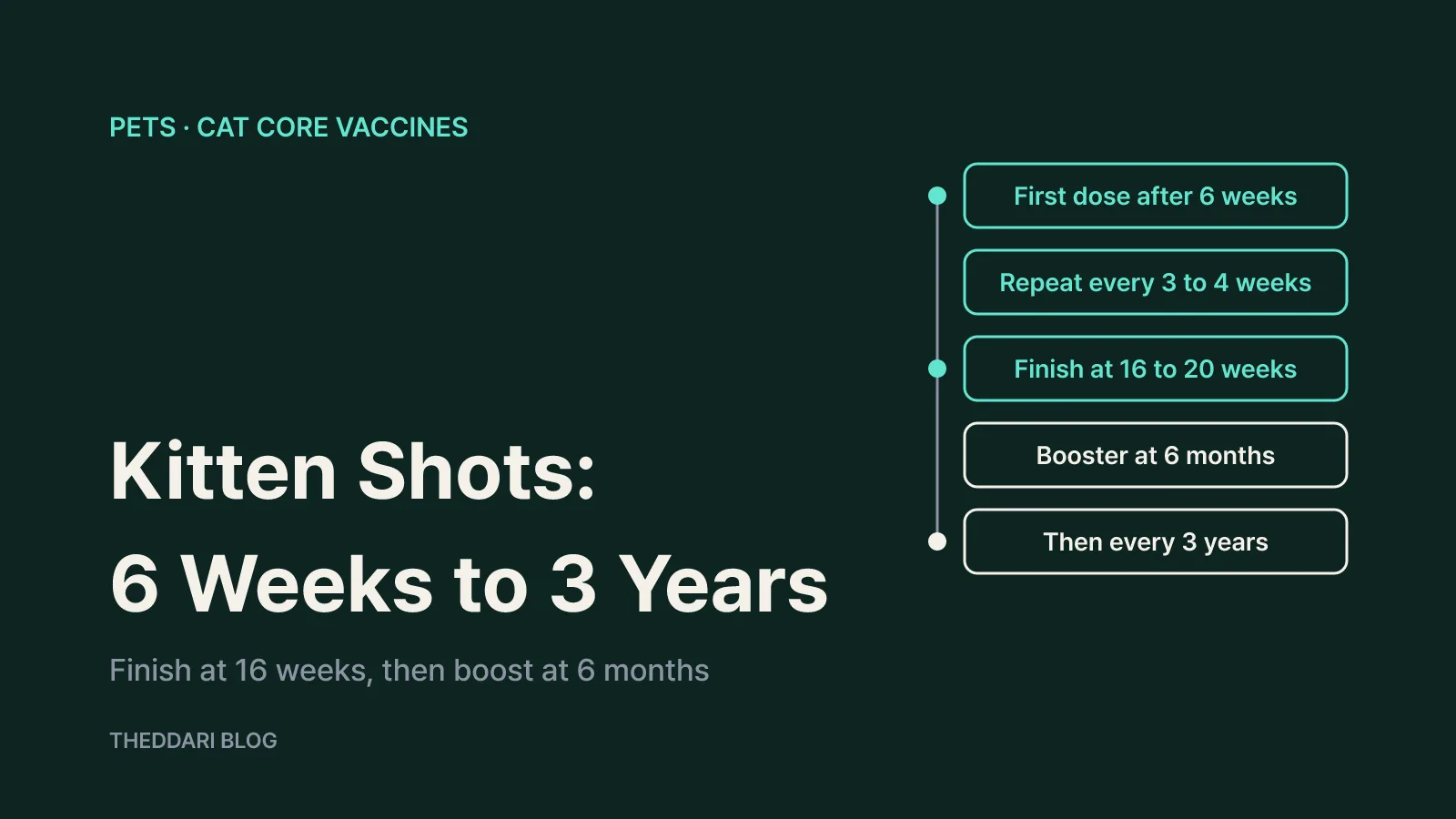
The easiest way to hit the target is to schedule from the last kitten vaccine. AAHA recommends that clinics add one more appointment two to three weeks after the final routine kitten vaccination; doing so places the surgery between four and five months of age. Kitten core vaccine series typically finish around 16 weeks, so that appointment lands comfortably inside the window.
Before you book, gather the following:
- Date of birth or estimated age from your breeder, shelter or first vet visit.
- Vaccine and deworming records, so you can count two to three weeks from the final shot.
- Fasting instructions, since clinics differ on when food and water should be withheld; ask specifically about kitten guidance.
- A recovery room and a properly sized cone for the following one to two weeks.
- A day you can be home for the surgery day and the next morning.
AAHA notes that shelters can safely sterilize kittens as young as eight weeks. For a pet kitten in a home, finishing vaccines first and aiming for four to five months is the most straightforward plan.
The first 10 to 14 days at home

Always follow the discharge sheet from your own clinic first. The common steps below follow SNAP's post-operative instructions.
Surgery evening
- Keep your cat indoors in a quiet, warm space where you can check on her often.
- Offer about one quarter of the usual meal that evening and build back up over the next two feedings. Skipping the evening meal is fine, but your cat should be eating the next day.
- Never give human pain relievers. SNAP warns that Tylenol (acetaminophen) is toxic to animals and aspirin can be deadly after surgery. Use only what your veterinarian prescribes.
Days 1 to 14
- Restrict activity: no running, jumping or rough play with other pets for 10 to 14 days. Blocking the top of the cat tree helps.
- Use an e-collar: keep a cone on for 10 to 14 days so your cat cannot lick or chew the incision.
- Check the incision daily: a little crusting right after surgery is normal; ongoing drainage or swelling needs a recheck.
- Keep it dry: no baths for 10 to 14 days. If needed, gently clean around, not on, the incision with a damp cloth.
- Swap the litter for males: SNAP notes that male cat neuters do not require sutures, so it suggests shredded newspaper or paper pellets instead of clay litter for 10 to 14 days to keep dust out of the incisions.
Whether stitches need removing depends on the clinic. Dissolvable sutures do not; skin sutures come with a removal date.
When to call the vet right away
Contact your clinic or an emergency hospital if you notice:
- Continuing discharge from the incision or swelling that grows
- An incision that opens, or a cat that has gotten the cone off and worked at the stitches
- No appetite after the day following surgery
- Repeated vomiting or diarrhea
- Unusual lethargy or a change in breathing
The takeaway: do not wait for the first heat to decide. Book the spay or neuter for two to three weeks after the last kitten vaccine, before five months, then commit to 10 to 14 days of quiet, a cone and daily incision checks. Most kittens bounce back quickly.