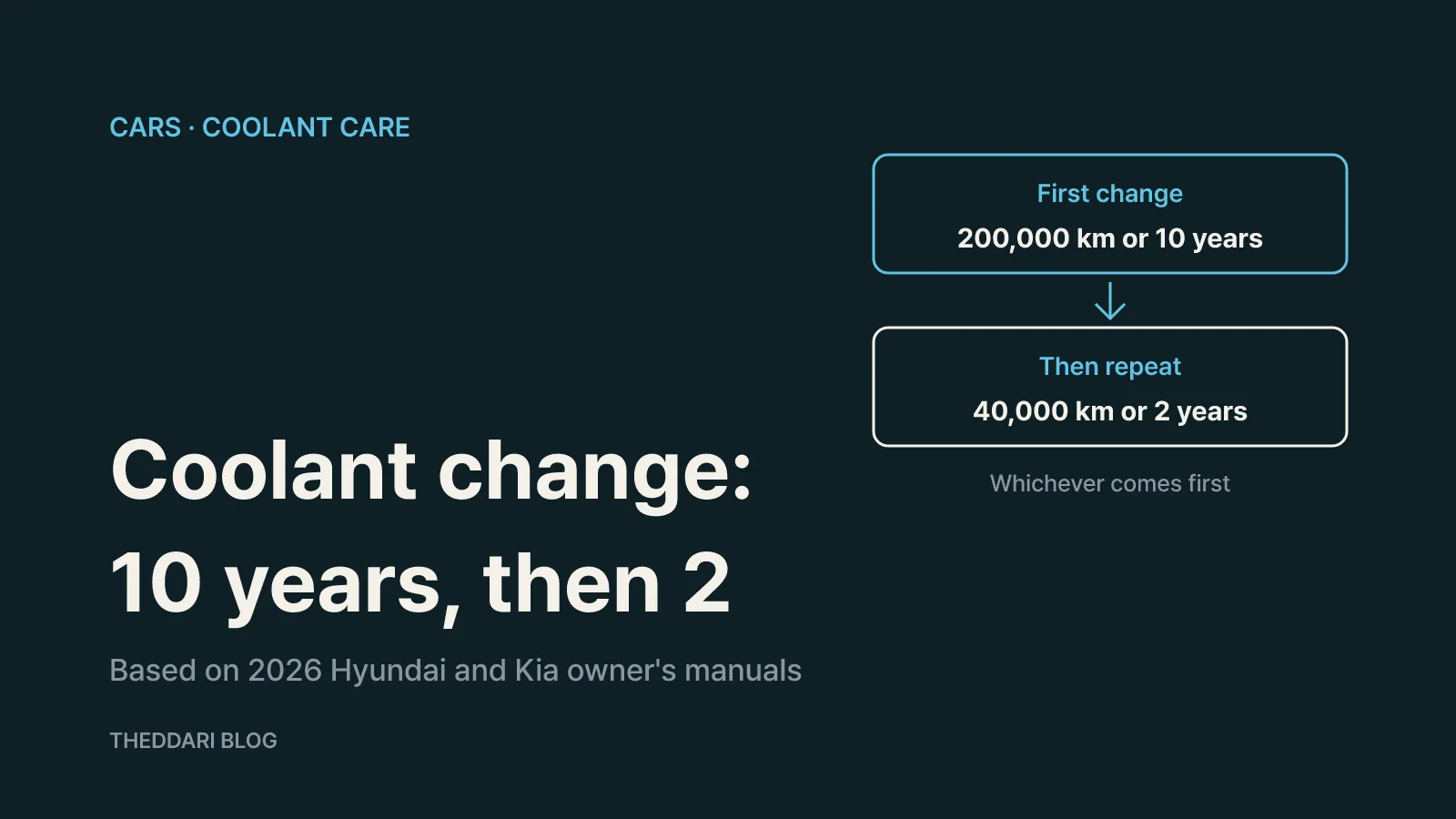
As of November 2026, the maintenance schedules in Hyundai's and Kia's web owner's manuals give a clear answer to "how often should I change my coolant?": the first change is due at 200,000 km (about 124,000 miles) or 10 years, and after that every 40,000 km (about 25,000 miles) or 2 years, whichever comes first. The familiar "flush it every two years" advice only applies once the factory fill has been replaced. Separately, the coolant level is listed as a daily check item, so a quick look at the reservoir and the antifreeze ratio before the first hard frost is still worth doing.
This guide is based on Hyundai's DN8 2026 normal-conditions schedule, Kia's NQ5 2026 normal-conditions schedule, Hyundai's DN8 coolant check and refill page and the US-English LX3 2026 Engine Coolant page. DN8, NQ5 and LX3 are the model codes used in the manual web addresses. Schedules vary by model, model year, market and manufacturer, so treat your own manual's table as the final word.
What the manuals actually say about coolant intervals
The schedules do not list "antifreeze" as a separate line. The relevant row is "coolant level check and replacement". Because engine coolant is antifreeze concentrate mixed with water, the replacement interval on that row is your antifreeze change interval.
← Swipe to see more
| Item | Hyundai DN8 2026 | Kia NQ5 2026 |
|---|---|---|
| Coolant level check | Daily check | Daily check |
| First replacement | 200,000 km or 10 years | 200,000 km or 10 years |
| After the first replacement | Every 40,000 km or 2 years | Every 40,000 km or 2 years |
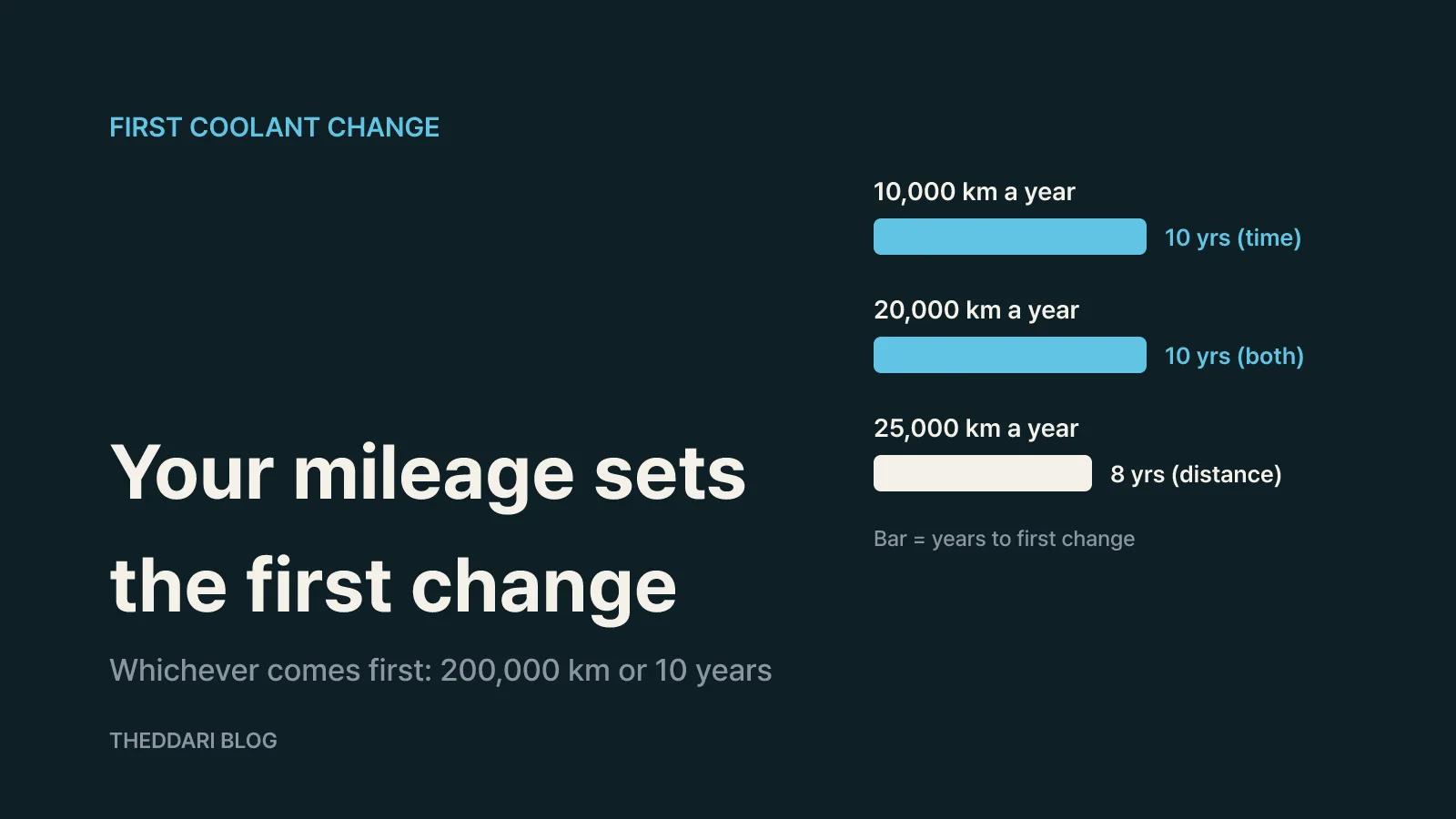
Both manuals state that for items listed with both distance and time, you service the part at whichever point arrives first. That means your annual mileage decides when the first change is due. Dividing 200,000 km by typical yearly distances gives a simple picture:
- 10,000 km a year: reaching 200,000 km would take 20 years, so the 10-year limit comes first.
- 20,000 km a year: both limits land at the same time, in year 10.
- 25,000 km a year: you hit 200,000 km after 8 years, so distance comes first.
The later 40,000 km or 2-year cycle works the same way. At 10,000 km a year the 2-year mark arrives first; at 30,000 km a year you reach 40,000 km in roughly 16 months. The manuals do not spell out the exact start date for the 10-year count, so if you are unsure, check your service records with a dealer.
If you bought the car used, find out whether the coolant has already been replaced once. A car past its first change is on the shorter 2-year or 40,000 km cycle. If the records are missing, have the coolant condition and concentration checked before deciding.
Check the coolant level before winter
Even when a change is years away, the level needs attention. The LX3 manual tells owners to check antifreeze protection and coolant level at least once a year, before the winter season or before traveling to a colder climate. The DN8 manual lays out the routine:
- Turn the engine off and let it cool completely. Coolant level changes with temperature, so a reading taken hot is not meaningful.
- Open the hood and read the marks on the side of the coolant reservoir. With the engine cool, the level should sit between MIN and MAX.
- If it is close to MIN, prepare coolant according to the mixing table below.
- Open the reservoir cap and fill to the MAX line.
- Close the cap fully. The graphic on the cap should sit level and the small tabs should be properly seated.
A cap that is not fully closed can let coolant overflow while driving and overheat the engine. After topping up, check for leaks and recheck the level a few days later, adding more if needed.
Opening the cap is the step that hurts people. Never remove the reservoir cap, radiator cap or drain plug while the engine and radiator are hot; pressurized coolant and steam can blow out and cause serious injury. The LX3 manual describes the safe method: wrap a thick towel around the cap, turn it counterclockwise slowly to the first stop, step back while pressure releases, and only then press down and keep turning to remove it.
While the hood is open, look at the hoses too. The LX3 manual asks owners to check the condition and connections of all cooling and heater hoses and to replace any that are swollen or deteriorated.
Antifreeze-to-water mix ratios by temperature
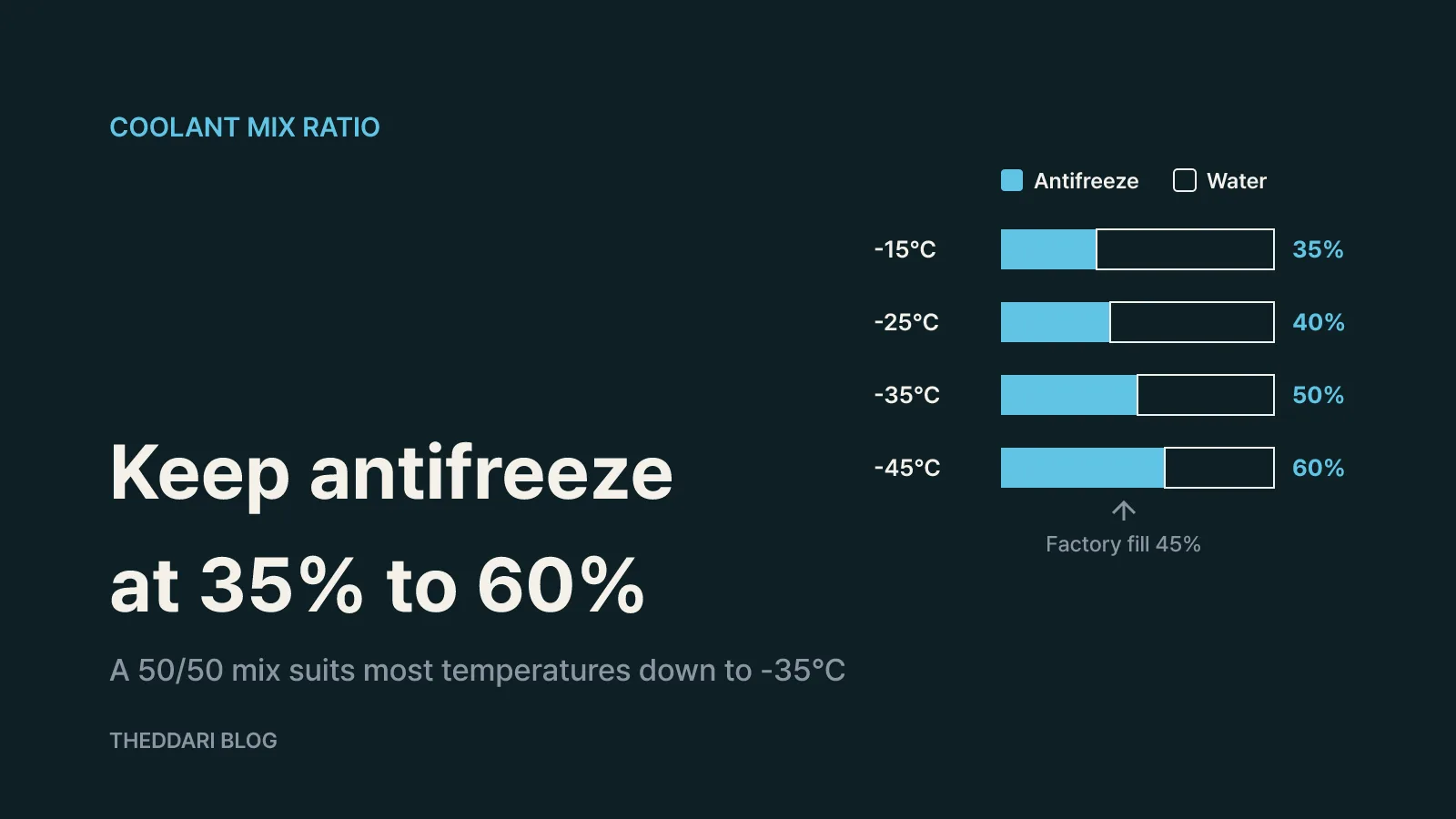
The DN8 and LX3 manuals give the same mixing table:
← Swipe to see more
| Ambient temperature | Antifreeze | Water |
|---|---|---|
| -15°C (5°F) | 35% | 65% |
| -25°C (-13°F) | 40% | 60% |
| -35°C (-31°F) | 50% | 50% |
| -45°C (-49°F) | 60% | 40% |
According to the DN8 manual, the factory fill is a 45% mixture, which sits between the 40% and 50% rows. Both manuals say not to use coolant with less than 35% or more than 60% antifreeze. Too weak a mix invites corrosion and overheating; too strong a mix also reduces cooling performance, so "stronger is safer" is not what the manufacturer recommends.
If you are unsure, the LX3 manual suggests a 50/50 mix: equal parts are the easiest to measure, and the result suits most temperatures down to -35°C (-31°F). When you are only topping up, mixing the new coolant within the table's range keeps the overall concentration from drifting.
Water quality matters. The US-English manual says to use only deionized, distilled or soft water and never to mix hard water into the factory fill. The Korean-language DN8 page allows tap or distilled water but rules out salty water or groundwater. Distilled water satisfies both instructions.
Refill mistakes to avoid
The warnings in the manuals boil down to a short list:
- Mixing different products. Avoid combining antifreeze, rust inhibitors and off-the-shelf long-life coolant. If you do not know what is already in the system, ask a workshop to match it.
- Alcohol or methanol coolant. Do not use it on its own or mixed with the specified coolant. The engines use aluminum parts and need a phosphate-based ethylene glycol coolant to prevent freezing and corrosion.
- Topping up with plain water and forgetting about it. Water alone can push the concentration below 35%. If you had to do that in a pinch, get the concentration checked before deep winter.
- Putting coolant in the washer reservoir. Sprayed on the windshield, it can badly obscure your view and damage paint and trim.
- Spilling. Wrap a thick towel around the cap before refilling so coolant does not run onto parts such as the alternator.
- Driving with no coolant. The manuals warn this can damage the water pump or seize the engine.
When coolant keeps dropping or the engine overheats
If the level falls noticeably again after a top-up, the manuals send you to a dealer for a cooling system inspection rather than another refill.
If the temperature gauge needle passes into the red while driving, Hyundai's QZ 2026 overheating procedure says to:
- Pull over somewhere safe as soon as possible.
- Shift to neutral, apply the parking brake and switch off the air conditioning.
- Check whether coolant or steam is escaping from the coolant tank. If it is, stop the engine and call for service.
- If nothing is escaping, keep the engine running to cool it. If the gauge does not drop, turn the engine off and wait until it has cooled.
- Once cool, check the level and look for leaks at the radiator hose, heater hose connections and water pump. Refill only if there is no leak or other fault; otherwise do not drive and have it inspected.
The same page warns against switching the engine off immediately after stopping, because coolant temperature can spike, and against pouring cold coolant quickly into an overheated engine, which can crack it. Add coolant slowly, a little at a time. Frequent overheating means the whole cooling system needs a check.
Before winter, the checklist is short: confirm from your records whether the car is before or after its first coolant change, read the reservoir level with the engine cold, and top up only with a matching product mixed within the 35% to 60% range.