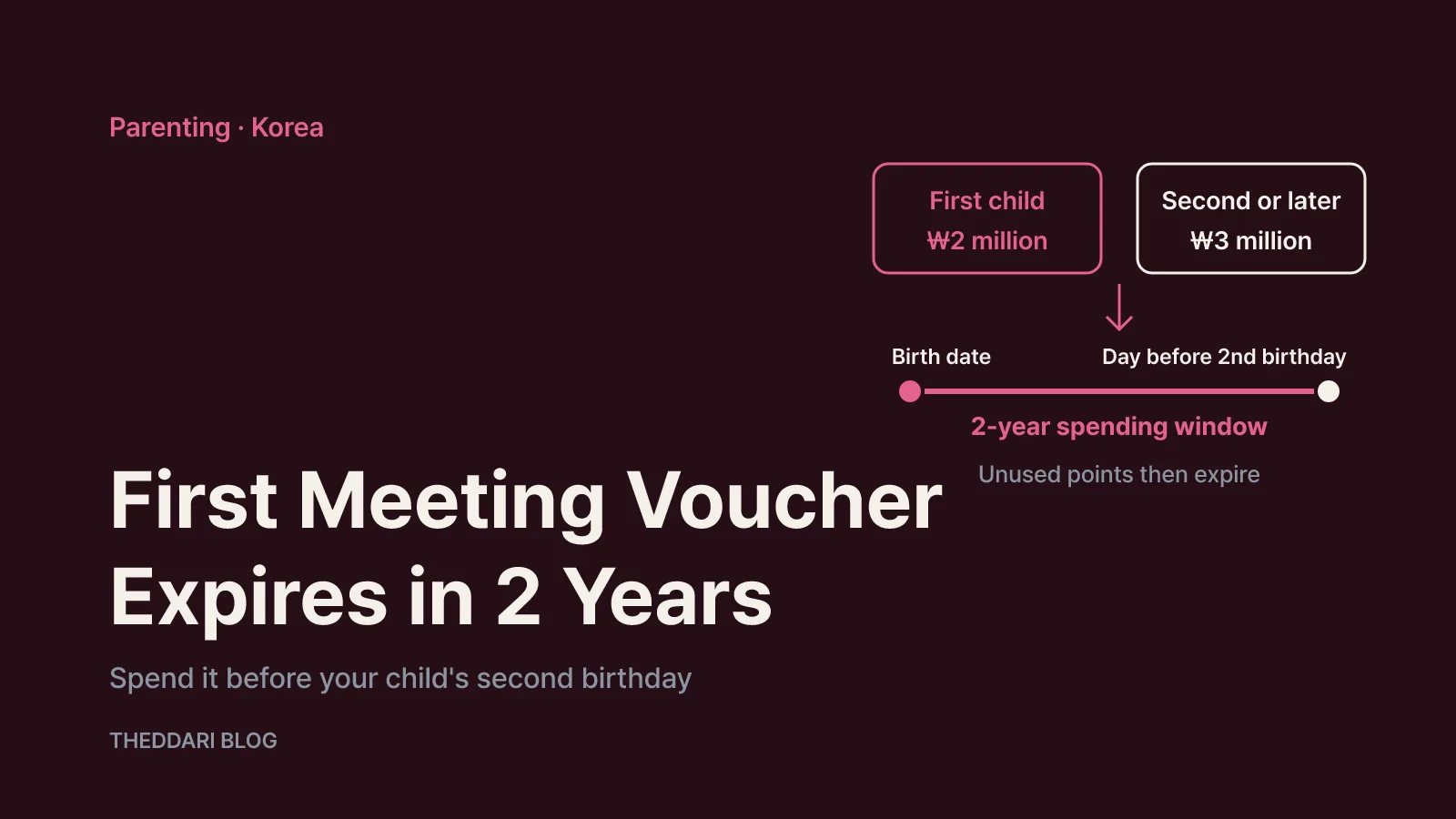
As of November 2026, Korea's First Meeting Voucher (첫만남이용권) gives every child born on or after January 1, 2024 ₩2 million for a first child and ₩3 million for a second or later child, loaded as points onto a parent's National Happiness Card. The points can be used for two years from the child's registered date of birth, and anything left after that date is deleted automatically. A local government notice gives a concrete example: a baby born on January 1, 2025 can use the voucher until December 31, 2026, and the remaining balance disappears at 00:00 on January 1, 2027. If your child was born in late 2024 or early 2025, this winter is the time to check what is left.
This guide cross-checks the Government24 service page for the First Meeting Voucher, the Jungwon-gu (Seongnam) district office guide, and the Korea.kr policy briefing on the 2027 reform. Everything below applies to children born in 2024 or later.
What the First Meeting Voucher pays and who qualifies
The voucher is a one-time childbirth benefit run by the Ministry of Health and Welfare's birth policy division, based on Korea's Framework Act on Low Birth Rate in an Aging Society. Its stated purpose is to ease the cost of raising a child in the first years of life. The official notices do not list any household income or asset test. The child needs to have had a birth report filed and to have received a resident registration number.
← Swipe to see more
| Item | Children born on or after Jan 1, 2024 |
|---|---|
| First child | ₩2,000,000 in points |
| Second or later child | ₩3,000,000 in points |
| How it is paid | National Happiness Card in the name of the parent named on the application |
| Usable period | From payment until two years after the registered birth date |
| Application window | No fixed window, but you must apply before the usage period ends |
| Where to apply | Local community service center for the child's address, Bokjiro, or Government24 |
The Jungwon-gu guide describes eligible children as Korean nationals whose birth has been reported, who hold a resident registration number, and who live in Korea. Families with dual-nationality children, babies born abroad, or children in care facilities may be asked for extra documents so officials can confirm eligibility.
One line on Government24 can confuse readers. Its eligibility text still carries the older wording that a child must be within one year of the registered birth date, followed by a note that children born on or after January 1, 2024 can apply and use the voucher within two years. For any child born from 2024 onward, use the two-year rule.
How to calculate the expiry date: the day before the second birthday
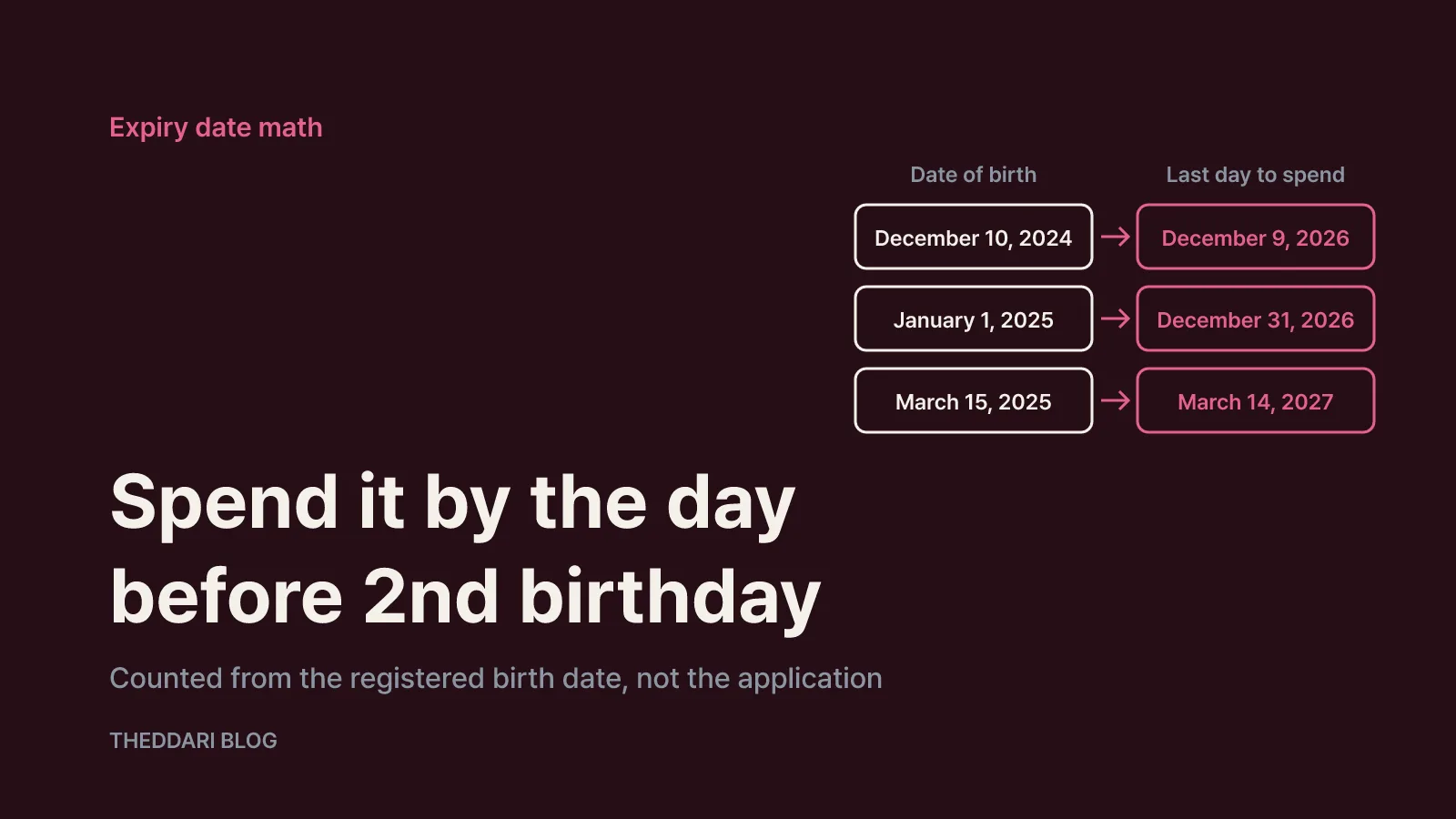
The clock starts on the child's registered date of birth, not on the day you applied or the day the points arrived. If you applied a few months after the birth, your real spending window is shorter than two years.
Applying the official example (born January 1, 2025, usable through December 31, 2026, deleted at 00:00 on January 1, 2027), the last day you can spend the points is the day before your child's second birthday. Calculated the same way:
← Swipe to see more
| Date of birth | Last day to spend | Points deleted |
|---|---|---|
| December 10, 2024 | December 9, 2026 | 00:00, December 10, 2026 |
| January 1, 2025 (official example) | December 31, 2026 | 00:00, January 1, 2027 |
| March 15, 2025 | March 14, 2027 | 00:00, March 15, 2027 |
Do not leave a large balance for the final day. A declined payment, a refund, or a re-charge can push the transaction past midnight. Aim to finish one to two weeks before the deadline. The official notices describe automatic deletion after the end date and do not mention any refund or extension process.
Applying if you have not claimed it yet
Filing the birth report does not trigger payment on its own; you need to submit a separate application. There is no formal deadline, but the Jungwon-gu notice warns that you should apply well before the usage period ends because the local government needs time to approve payment and the card company may need time to issue a new card. Applying together with the birth report loses the least time.
There are two ways to apply:
- In person: a parent, or someone acting for them, applies at the community service center (eup/myeon/dong office) for the child's registered address.
- Online: through Bokjiro or Government24. Online applications are only available when the child's guardian is a parent. Grandparents or other guardians must apply in person.
Bring an ID card and either the social security benefit application form or the integrated childbirth services application form. If someone applies on your behalf, they need a power of attorney, their own ID, and the parent's ID. The points go onto the National Happiness Card of the single parent named on the form, so choose whoever does most of the baby shopping. If you already hold a National Happiness Card from pregnancy medical-cost vouchers, ask whether it can be used.
Where you can and cannot use the voucher
The voucher works at almost every type of merchant, including online stores, except for a list of excluded business categories. According to the Jungwon-gu guide, payments are blocked at:
- Entertainment bars and similar adult entertainment venues
- Gambling businesses
- Massage and similar hygiene services (hair salons are allowed)
- Leisure businesses
- Adult goods stores
- Duty-free shops
- Online gift certificates (e-commerce vouchers)
The gift certificate rule matters most near the deadline. Converting leftover points into gift cards to stretch the expiry date does not work, because e-commerce gift certificates are excluded. Spend the balance on things you will actually use, such as diapers, next-season clothing, or a replacement car seat. A child's haircut is fine since hair salons are an exception, but postpartum massage or sauna payments can be refused based on the merchant's business category.
Does the 2027 Child Welcome Grant change your current points?
The Ministry of Health and Welfare's 2027 budget proposal, published on Korea.kr in September 2026, introduces a new Child Welcome Grant (아이맞이지원금) and a Basic Child Allowance. The headline points are:
- For children born in July 2027 or later, a Child Welcome Grant of ₩10 million to ₩20 million
- Standard regions: ₩10 million for a first child, ₩12 million for a second, ₩15 million for a third or later child
- Designated priority regions: an extra ₩5 million
- ₩613.1 billion in newly allocated funding
The same briefing states that eligibility and payment criteria may change as the policy is implemented, so the amounts and timing are not final until the budget and related laws pass. For children already born in 2024 or 2025, the practical takeaway is simple: the proposal targets births from July 2027, so existing First Meeting Voucher points still follow the two-year rule. Waiting for a possible cash conversion is a quick way to lose the balance. If you are expecting a baby in the first half of 2027, the birth date may decide which scheme applies, so check the Ministry's final notice around your due date.
A five-step checklist before your points expire
- Find your last spending day: take your child's registered birth date and mark the day before the second birthday.
- Confirm the payment was approved: check your application history on Bokjiro or Government24, or ask the community service center. If you never applied, apply now.
- Check the balance: use the app, website, or customer center of the card company that issued your National Happiness Card.
- List real purchases: clothes for the next season, diapers and wipes, baby food ingredients, or a larger item such as a car seat.
- Finish one to two weeks early: avoid excluded categories and gift certificates, and do not leave everything for the final night.
Families who received ₩3 million for a second or later child are more likely to have a sizable balance left. Checking once around the first birthday and again a few months before the deadline helps you avoid rushed purchases you do not need.