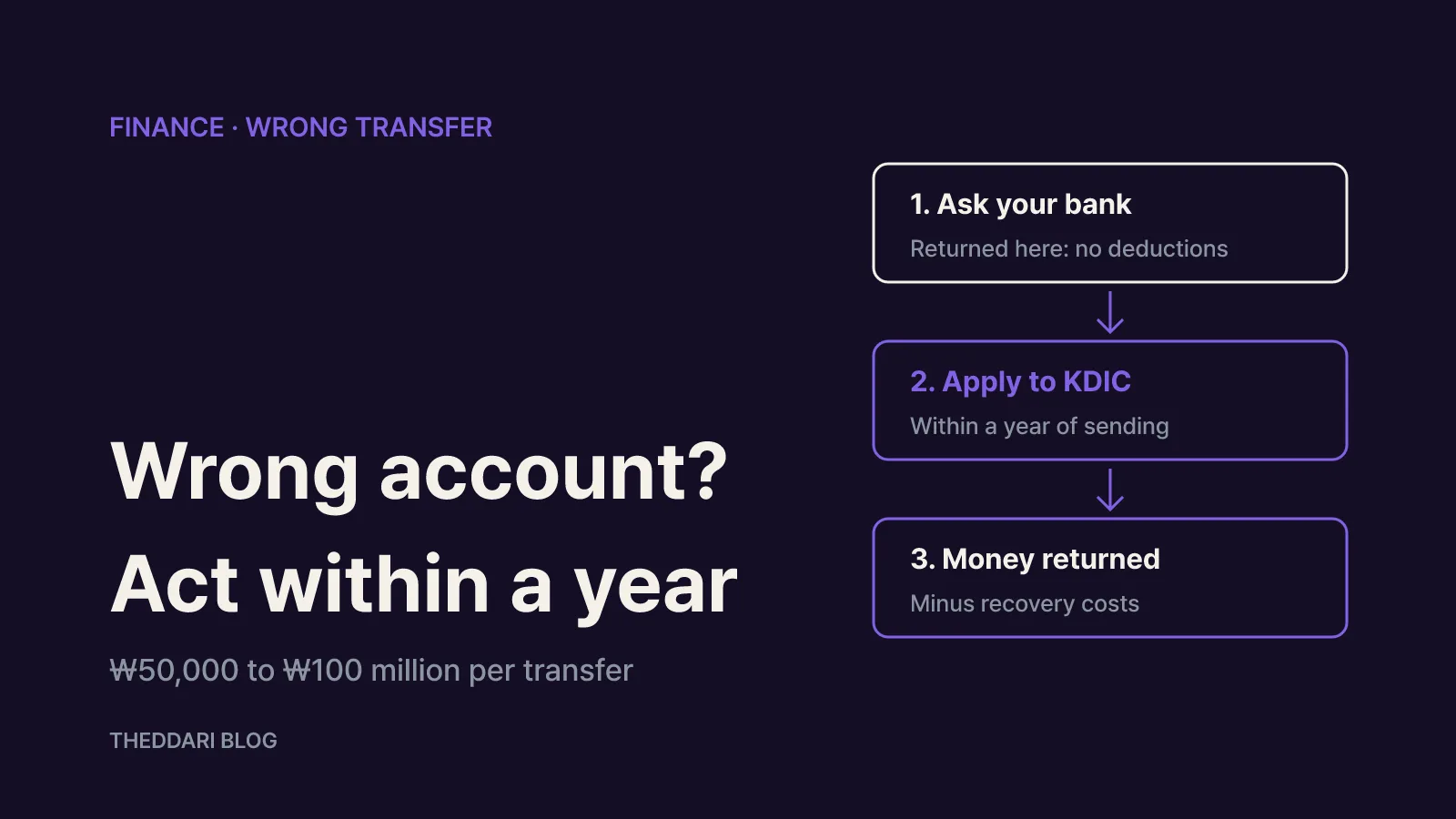
As of November 2026, if you send money to the wrong person in South Korea because you entered the wrong bank or account number, there is a two-step route to get it back. First, ask the bank, brokerage or payment app you sent the money from to request a return. If that fails, apply to the Korea Deposit Insurance Corporation (KDIC) under its Mistaken Remittance Return Support program within one year of the transfer. Each transfer must be between ₩50,000 and ₩100 million, and money recovered through KDIC is paid out after recovery costs are deducted. This guide walks through eligibility, documents, costs and the cases the program will not cover, based on official KDIC and government guidance.
Who can use KDIC's mistaken transfer return program
The program is set out in Article 39-2 of the Depositor Protection Act. In practice, KDIC buys your legal claim for the return of the money (an unjust-enrichment claim) and then pursues the recipient itself: first by asking for a voluntary return, then through legal steps such as a court payment order if needed (Government24).
All three of these conditions must be met:
- Amount: ₩50,000 to ₩100 million per mistaken transfer. The whole claim for that transfer is used, so you cannot apply for only part of it.
- Deadline: within one year of the transfer date. The day of the transfer itself is not counted.
- Prior request: you already asked the sending institution or payment app to recover the money and it was not returned.
You also cannot apply if you have already started or completed a lawsuit or provisional seizure over the same transfer. If the amount is above ₩100 million or more than a year has passed, you would need to look at a civil claim instead.
Covered institutions include banks (including foreign bank branches and state-run lenders), investment firms, merchant banks, savings banks, credit unions, community credit cooperatives (Saemaul Geumgo), agricultural and fisheries cooperatives, forestry cooperatives and Korea Post. Insurers are excluded. Registered prepaid payment providers such as Toss and Kakao Pay are also covered, but only for certain transfer methods (KDIC FAQ).
Step 1: Ask your own bank to request a return
As soon as you notice the mistake, contact the institution you sent the money from. Most Korean banking apps have a mistaken transfer return request menu, or you can call customer service. Your bank then contacts the recipient through the receiving bank. If the recipient responds and sends the money back at this stage, you get the full amount with no recovery costs deducted.
KDIC will not accept an application unless this step has been tried first. Keep a record of when you made the request and what happened, for example that the recipient could not be reached or refused. Do not wait too long, though: if the bank reports that the money was not returned, move on to Step 2 so the one-year window does not run out.
Step 2: Apply through KDIC's Financial Safety Portal
There are two ways to apply:
- Online through the Mistaken Remittance Return Support menu on KDIC's Financial Safety Portal, using a PC browser or the portal's mobile app.
- In person at the customer help desk on the first floor of KDIC's head office. The call center number is 1588-0037.
For an individual applying for themselves, the documents are short:
← Swipe to see more
| Method | Documents |
|---|---|
| Online | Proof of the transfer, your joint certificate (gongdong injeungseo) |
| In person | Proof of the transfer, your ID |
Proof of the transfer is usually a transfer confirmation you can download from your banking app showing the recipient account, amount and time. Applications made by a representative need more paperwork. For a company, that means the company's seal certificate, business registration and a power of attorney stamped with the company seal. For a minor, a parent applying on their behalf needs items such as a power of attorney, a detailed family relation certificate, a basic certificate, a parental agreement and the parent's seal certificate.
After you apply, KDIC identifies the recipient and asks them to return the money. If they do not, it moves to a court payment order. KDIC's FAQ says that when the money can be recovered through a voluntary return or a payment order, it expects repayment around two months after the application is received.
How much you actually get back after recovery costs
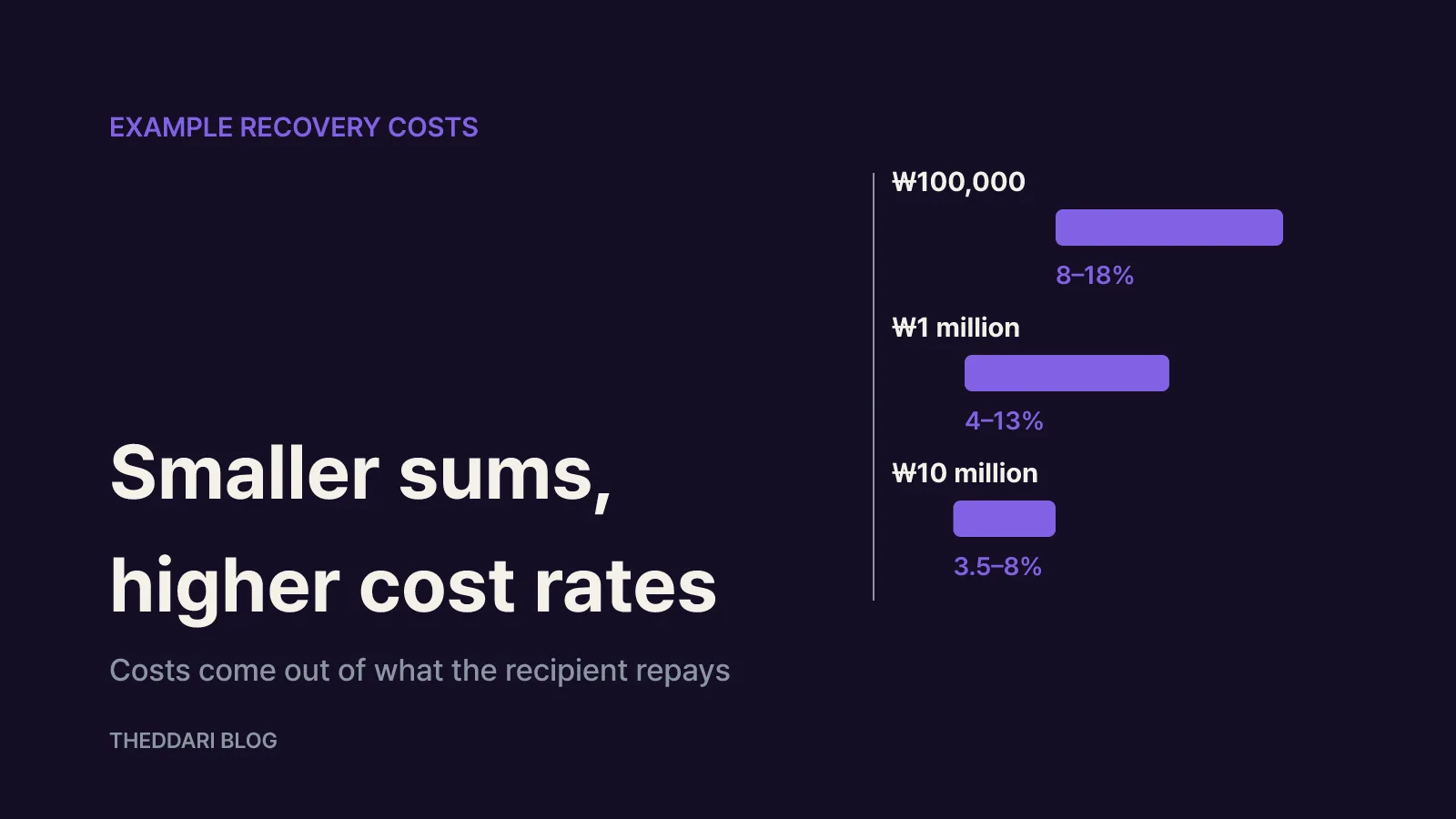
This is the part people most often misunderstand. When KDIC recovers the money, you receive the amount returned by the recipient minus recovery costs such as mail notices, text messages and payment order costs. KDIC publishes these example cost rates (Financial Safety Portal):
← Swipe to see more
| Amount sent by mistake | Example recovery cost rate |
|---|---|
| ₩100,000 | 8–18% |
| ₩1 million | 4–13% |
| ₩10 million | 3.5–8% |
Smaller transfers carry a higher percentage because some costs, such as postage and court delivery fees, do not shrink with the amount. These are examples only; the actual cost depends on how far the recovery process goes and why a contract might be terminated. A recipient who repays after the first notice costs less to deal with than one who forces a payment order.
One more detail matters. Once you have signed the claim purchase contract with KDIC, if you collect any of the money directly from the recipient or choose to cancel, the contract is terminated only after you repay the recovery costs KDIC has already incurred. If the recipient contacts you after you apply, tell KDIC before settling privately.
When KDIC will not help: scams, frozen accounts and phone-number transfers
Even if you meet the basic conditions, KDIC cannot help when:
- The receiving account is linked to a crime, including voice phishing or other telecom financial fraud, or there is reason to suspect it.
- The receiving account is seized or provisionally seized, or subject to compulsory execution or tax collection.
- The recipient cannot be identified by real name, has died, has no address in Korea, is a closed or suspended company, or is in rehabilitation or bankruptcy proceedings.
- The account was opened outside a covered institution or at a covered institution's overseas branch.
- You did not ask your bank first, or have already taken legal action.
Voice phishing is handled under a separate special act, not this program. KDIC's FAQ directs scam victims to report the fraud to their bank so the receiving account can be frozen quickly. If you were tricked rather than mistaken, call your bank first.
For app-based transfers, the method matters. If you sent money through an app like Toss by entering the recipient's account number, the transfer is covered. If you sent it by phone number or another non-account method, KDIC cannot obtain the recipient's real-name details under current law, so it is excluded (KDIC FAQ). In that case, the app's own return request process is your main option.
The contract can also be terminated after you apply, for example if a payment order cannot be delivered to the recipient or the recipient files an objection to it. You would then need to consider civil action yourself.
Checklist for the day you notice the mistake
- Save the transfer confirmation showing the recipient account, amount and time.
- Request a return through your bank or app. A return at this stage carries no deductions.
- If you suspect a scam, report it to your bank immediately so the account can be frozen.
- Check how you sent it. For app transfers, an account-number transfer is covered and a phone-number transfer is not.
- Check the amount and date. It must be ₩50,000 to ₩100 million and within one year, counting from the day after the transfer.
- Apply on the Financial Safety Portal once the bank confirms non-return, with a joint certificate online or ID in person.
- If the recipient contacts you after you apply, tell KDIC before accepting money directly.
The simplest way to think about this program is as a one-year safety net. Meet the deadline and you can hand recovery to KDIC without filing a lawsuit yourself; miss it, or start legal action first, and the option disappears. Because a return through your own bank is free, the best move is still to file that request the same day you spot the error.