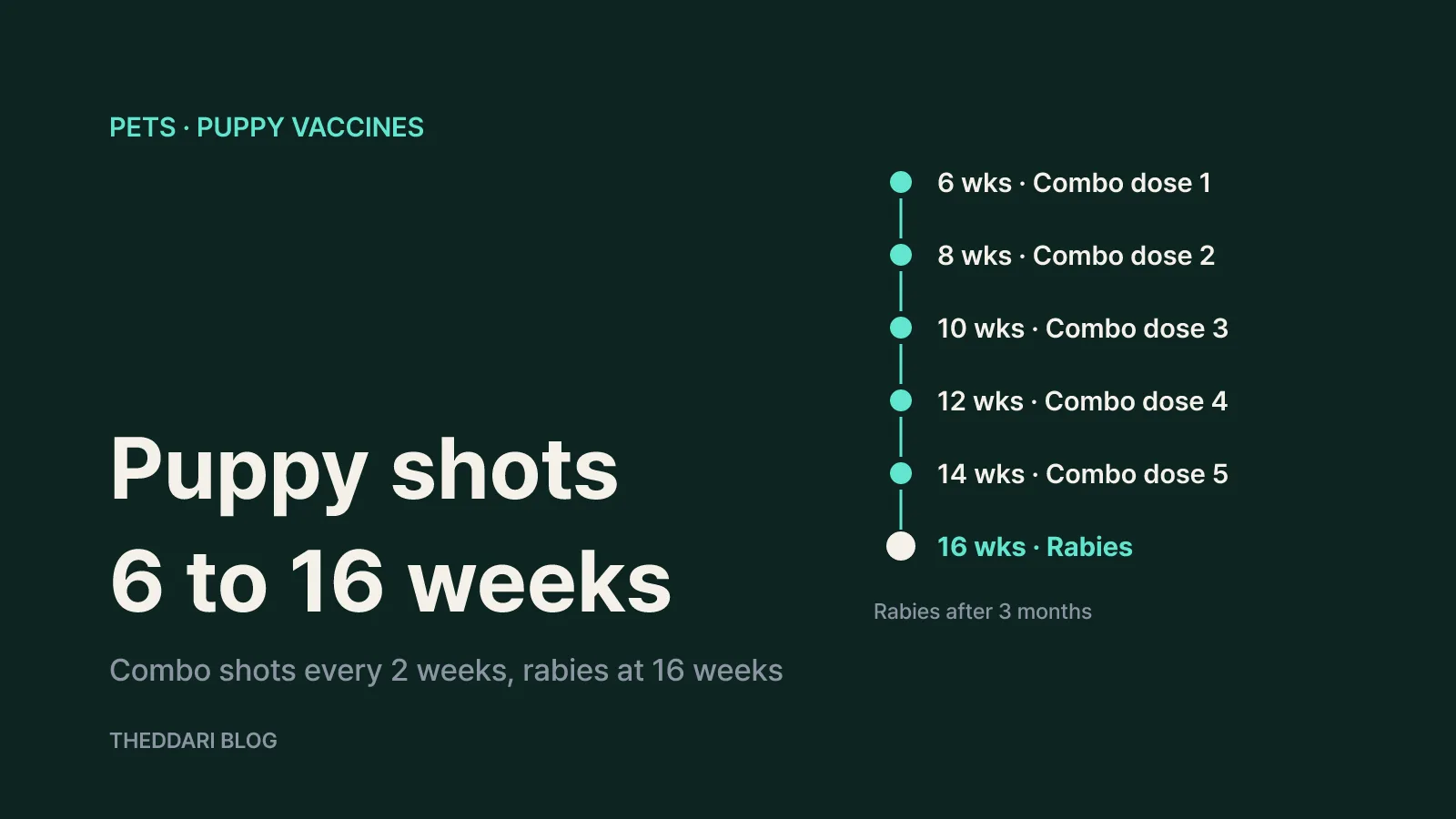
As of November 2026, the short answer is this: puppies start their combination vaccine at around 6 weeks of age and get repeat doses every 2 to 4 weeks until about 16 weeks, and rabies is given once the puppy is at least 3 months old. The 2022 AAHA Canine Vaccination Guidelines, updated in 2024, call for at least 3 doses of a combination vaccine between 6 and 16 weeks. Korea's National Institute of Animal Science publishes a tighter version of the same idea: a combination shot every 2 weeks at 6, 8, 10, 12 and 14 weeks, then rabies at 16 weeks.
Where owners get confused is what happens after the puppy series. Korean municipal guidance lists annual boosters, while AAHA recommends a 3-year interval for the core viral vaccines and yearly boosters for leptospirosis. This guide lines up both schedules so you know which questions to bring to your veterinarian. The schedules below are general public guidance; your vet decides what your puppy actually receives based on an exam.
The puppy vaccine schedule from 6 to 16 weeks
AAHA's core and noncore vaccine table sets out the puppy series for dogs 16 weeks old or younger:
- Distemper, adenovirus, parvovirus (with or without parainfluenza): at least 3 doses of a combination vaccine between 6 and 16 weeks, given 2 to 4 weeks apart.
- Leptospirosis (killed, 4-serovar): two doses 2 to 4 weeks apart, starting at 12 weeks of age.
- Rabies: as required by law where you live.
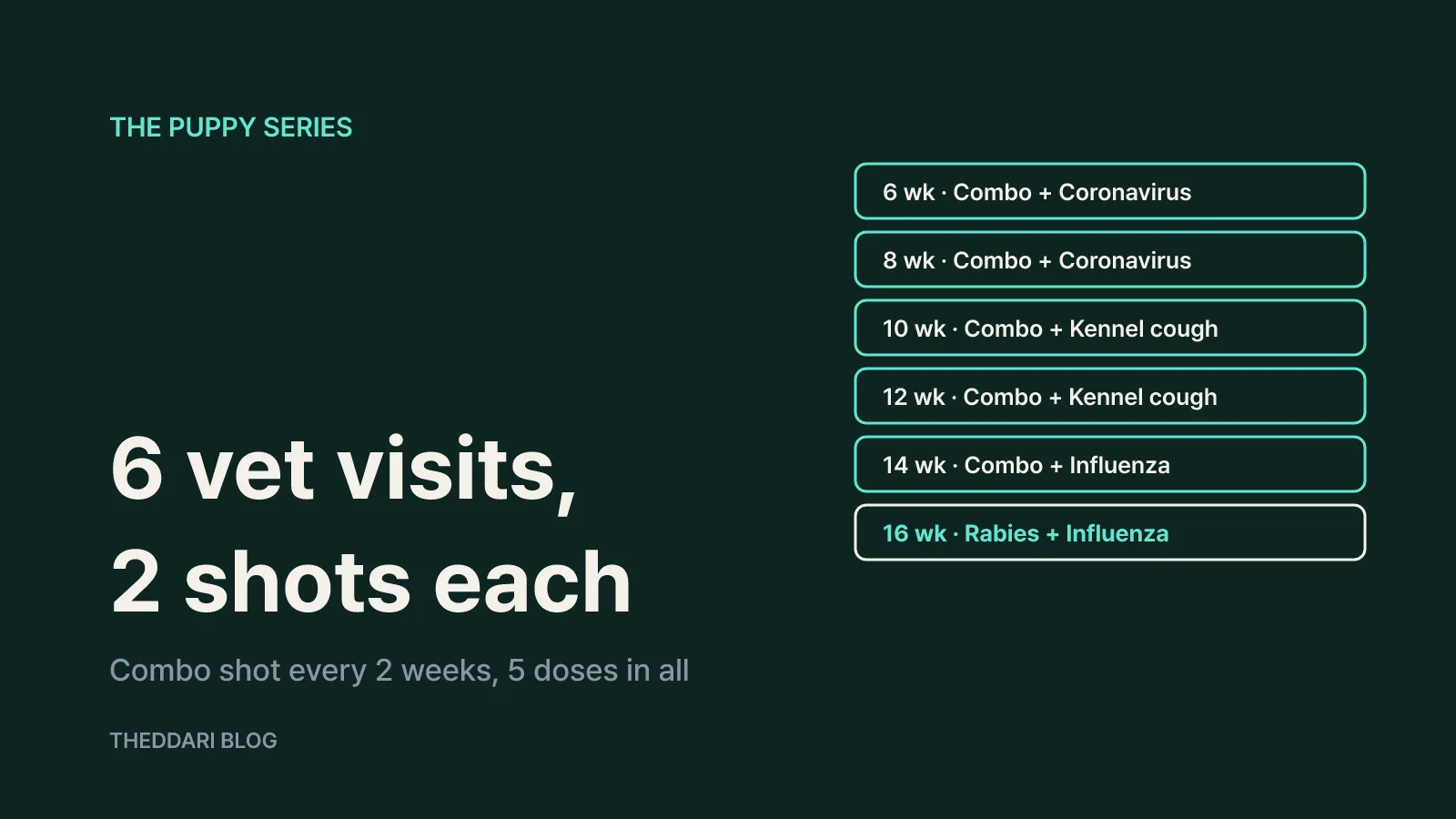
The Korean public schedule from the National Institute of Animal Science spells out every visit:
- Visit 1 (6 weeks): combination vaccine dose 1 + canine coronavirus vaccine dose 1
- Visit 2 (8 weeks): combination dose 2 + coronavirus dose 2
- Visit 3 (10 weeks): combination dose 3 + kennel cough (Bordetella) dose 1
- Visit 4 (12 weeks): combination dose 4 + kennel cough dose 2
- Visit 5 (14 weeks): combination dose 5 + canine influenza dose 1
- Visit 6 (16 weeks): rabies + canine influenza dose 2
The two approaches agree on the logic. Puppies get repeated combination doses a few weeks apart through the 16-week mark, and rabies comes after 3 months. The Korean version simply uses the shortest 2-week interval and adds respiratory and intestinal vaccines into the same visits. A Changwon city animal shelter guide shows the wider range clinics work within: first combination shot at 6 to 8 weeks, then 2 to 4 more doses at 2- to 4-week intervals.
Count from your puppy's birth date, not the day you brought it home. If the breeder or shelter already gave one or two doses, bring the record with the dates and vaccine names so your vet can continue the series instead of guessing.
Core vs. noncore: what each puppy vaccine covers
AAHA splits dog vaccines into two groups. Core vaccines are recommended for every dog regardless of lifestyle unless there is a specific medical reason not to vaccinate: distemper, adenovirus, parvovirus, parainfluenza in some combinations, leptospirosis and rabies. Leptospirosis was added as a core vaccine for all dogs in the 2024 update. Noncore vaccines depend on lifestyle, location and exposure risk: Bordetella (a main cause of kennel cough), canine influenza, Lyme disease and the Western diamondback rattlesnake toxoid.
The Korean combination shot is usually written as DHPPL: distemper, hepatitis (caused by canine adenovirus), parvovirus, parainfluenza and leptospirosis in one injection. The Korean schedule also includes canine coronavirus, kennel cough and influenza vaccines in the puppy series. Under the AAHA framework, the respiratory shots are lifestyle choices rather than universal ones. If your puppy will go to daycare, boarding, grooming salons or dog parks, those vaccines are worth keeping; for a mostly at-home dog, ask your vet whether each one is needed.
Rabies timing: after 3 months, then yearly or as local law requires
Rabies is the one vaccine where the law, not just medical advice, sets the timing. In the United States AAHA defers to local and state law. In Korea, the national livestock disease control system states that rabies vaccine is given to animals 3 months of age or older and repeated every year. If a dog was vaccinated before 3 months, a second dose must be given 12 months later, followed by yearly boosters. Small companion dogs receive 1 ml in the thigh muscle, and cats also get yearly boosters.
The same Korean guidance asks owners to keep dogs and cats away from wild animals such as raccoon dogs on outings, and to report suspected rabies to a vet or animal disease office. If a person is bitten by a suspect animal, wash the wound under strong running water and soap right away, disinfect it, and seek medical care.
Booster shots after the puppy series: every year or every 3 years?
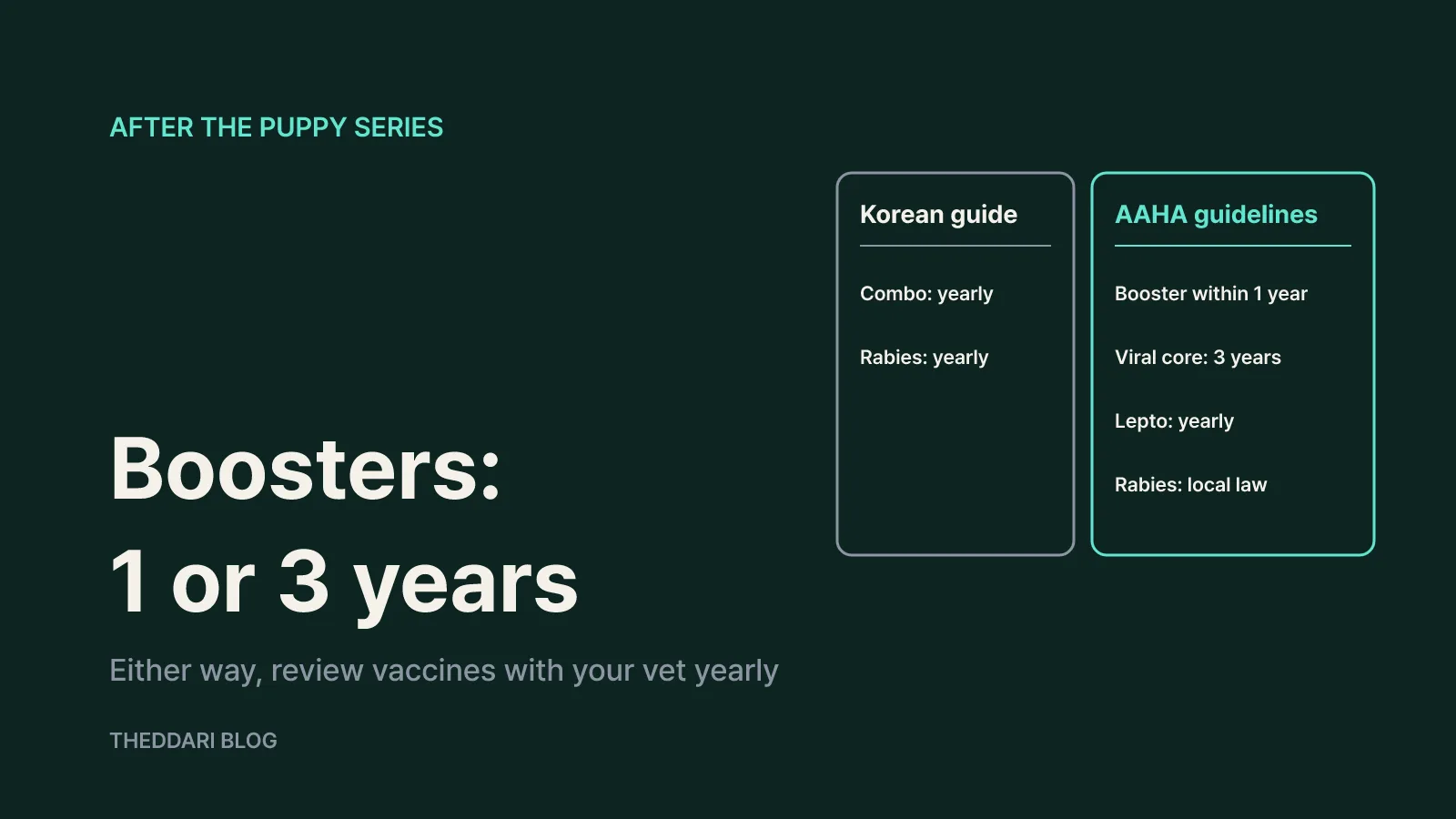
Once the 16-week series is done, boosters keep immunity up. This is where sources differ:
- AAHA: one combination booster within 1 year of the last puppy dose, then distemper, adenovirus and parvovirus every 3 years. Leptospirosis gets one booster within 1 year and then annual boosters. Canine influenza, Bordetella and Lyme are also annual.
- Changwon animal shelter (Korea): DHPPL, coronavirus and kennel cough boosters once a year after the initial series; rabies every 6 to 12 months.
- Korean livestock disease system: rabies boosters once a year.
The gap mostly comes from how vaccines are packaged. The core viral components can run on a 3-year cycle, but leptospirosis needs yearly boosters. If your clinic uses a combination product that includes leptospirosis, an annual visit follows naturally. If you want the 3-year approach for the viral components, ask your vet which products they stock and how the components can be separated.
AAHA stresses that its tables are general recommendations, not universal prescriptions, and that every dog should be reassessed at least once a year to decide what it needs. So both systems land on the same habit: a yearly vaccine review with your vet. The Changwon guide also suggests yearly health checks from about 7 years of age, which makes it easy to combine the two visits for senior dogs.
Late, missed or unknown puppy shots
Life happens: a puppy gets sick, you move, or a rescue arrives with no paperwork. Start by finding the last vaccine date and product name. For dogs older than 16 weeks with no reliable history, AAHA recommends 2 doses of the combination vaccine 2 to 4 weeks apart and 2 doses of leptospirosis 2 to 4 weeks apart regardless of age, followed by a booster within a year. AAHA's guidance for overdue or unknown histories is that the benefits of vaccinating far outweigh the risks, summed up as "when in doubt, vaccinate," and it tells clinics to check manufacturer instructions for overdue doses.
If your puppy seems lethargic or has vomiting or diarrhea on the day of an appointment, call the clinic before going in and ask whether to postpone. After a shot, contact the clinic right away if you notice facial swelling, repeated vomiting or anything clearly unusual, and agree on the next date together.
A simple checklist for puppy vaccine visits
- Get the exact birth date and mark weeks 6, 8, 10, 12, 14 and 16 on a calendar.
- Collect prior records with dates and vaccine names, and keep a photo of them on your phone.
- Book the next visit before you leave so the 2- to 4-week spacing does not slip.
- Flag rabies separately: the first dose after 3 months and the first booster date.
- Describe your dog's lifestyle (daycare, boarding, travel, hiking) so noncore vaccines are chosen for a reason.
- Plan a yearly review whether your dog ends up on annual or 3-year boosters.
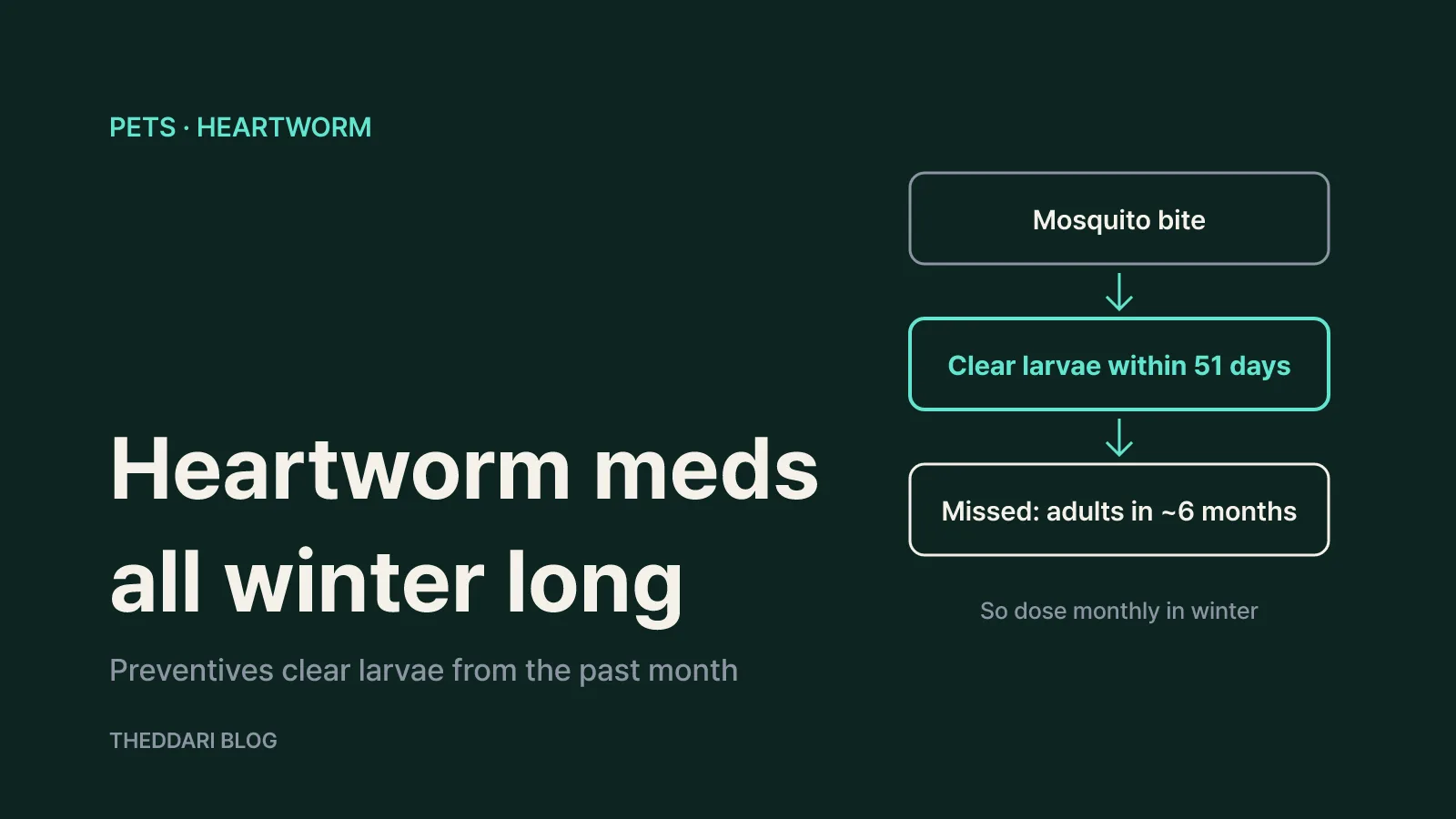
- Pair parasite prevention such as heartworm and deworming with vaccine visits so nothing gets missed.
In short: combination shots from 6 weeks, repeated every 2 to 4 weeks through about 16 weeks; rabies after 3 months; then a booster within a year and a yearly check-in with your vet to set the long-term rhythm.