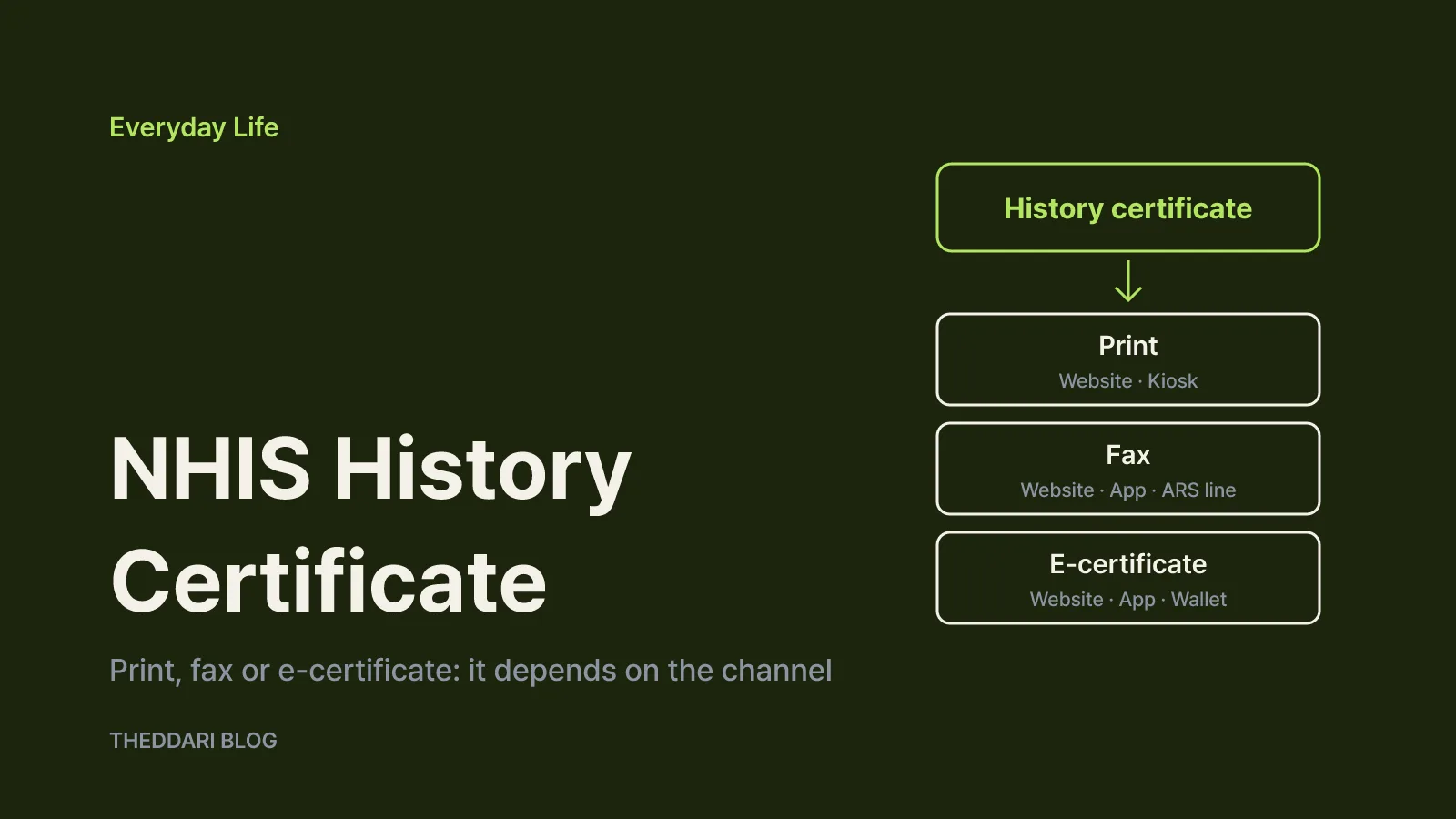
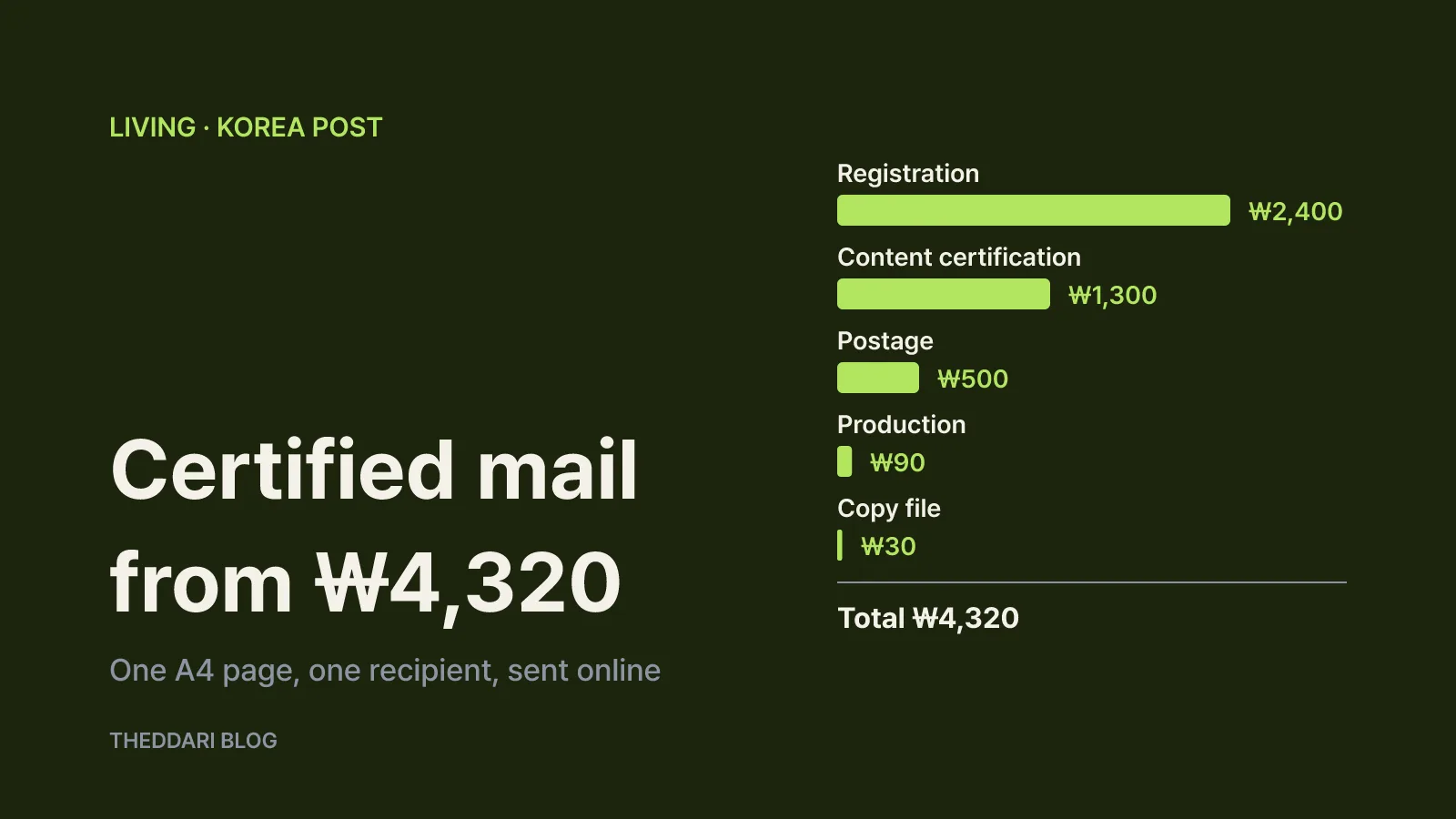
As of November 2026, sending content-certified mail (naeyong jeungmyeong, 내용증명) in Korea costs ₩4,320 when you upload a one-page A4 letter to Korea Post's ePost website and send it to one recipient by standard registered mail. If you go to a post office counter instead, bring the original plus two copies. The post office keeps one copy for three years from the day after sending. If the date the other party received the letter matters, add delivery certification for ₩1,600.
Tenants asking for a deposit back, people chasing an unpaid loan, and shoppers cancelling a door-to-door sales contract all end up looking for this service. The figures below come from Korea Post's postal fee schedule, the ePost online fee table and the Enforcement Rules of the Postal Services Act, all in Korean.
What content-certified mail proves, and what it does not
Content-certified mail is a registered-mail service in which the post office officially certifies what document you sent, to whom, and when. The clerk checks that the original and copies match and stamps the date and office name, so a later claim like "I never got that" or "the letter said something else" is much harder to sustain.
It is evidence, not enforcement. The ePost service guide states plainly that the post office certifies only the fact of sending, and that sending it does not by itself create a legal effect. Nobody is forced to pay because they received one.
Timing matters too. According to the Korea Consumer Agency, a notice generally takes effect when it reaches the recipient under the Civil Act. A request to withdraw from a mail-order, door-to-door or installment contract, however, takes effect from the sending date. The agency gives 14 days for telephone and door-to-door sales and 7 days for online or TV shopping and installment purchases as example withdrawal periods, so posting within the window is what counts.
Ordinary registered mail only records acceptance and delivery; it says nothing about the contents. Think of it this way: content certification proves what you sent, and delivery certification proves when it arrived. The Gov24 service page recommends combining the two.
How the ₩4,320 online fee adds up
The price is a stack of fees. Korea Post's fee schedule, in force since June 1, 2025, sets registration at ₩2,400 per item and certification at ₩1,300 for the first page plus ₩650 for each additional page. Online orders also pay production and copy-file fees because the post office prints and seals the letter for you.
← Swipe to see more
| Item (one page, small envelope) | Fee |
|---|---|
| Registration | ₩2,400 |
| Content certification | ₩1,300 |
| Postage (standard, up to 25g) | ₩500 |
| Production | ₩90 |
| Copy file | ₩30 |
| Total, standard registered | ₩4,320 |
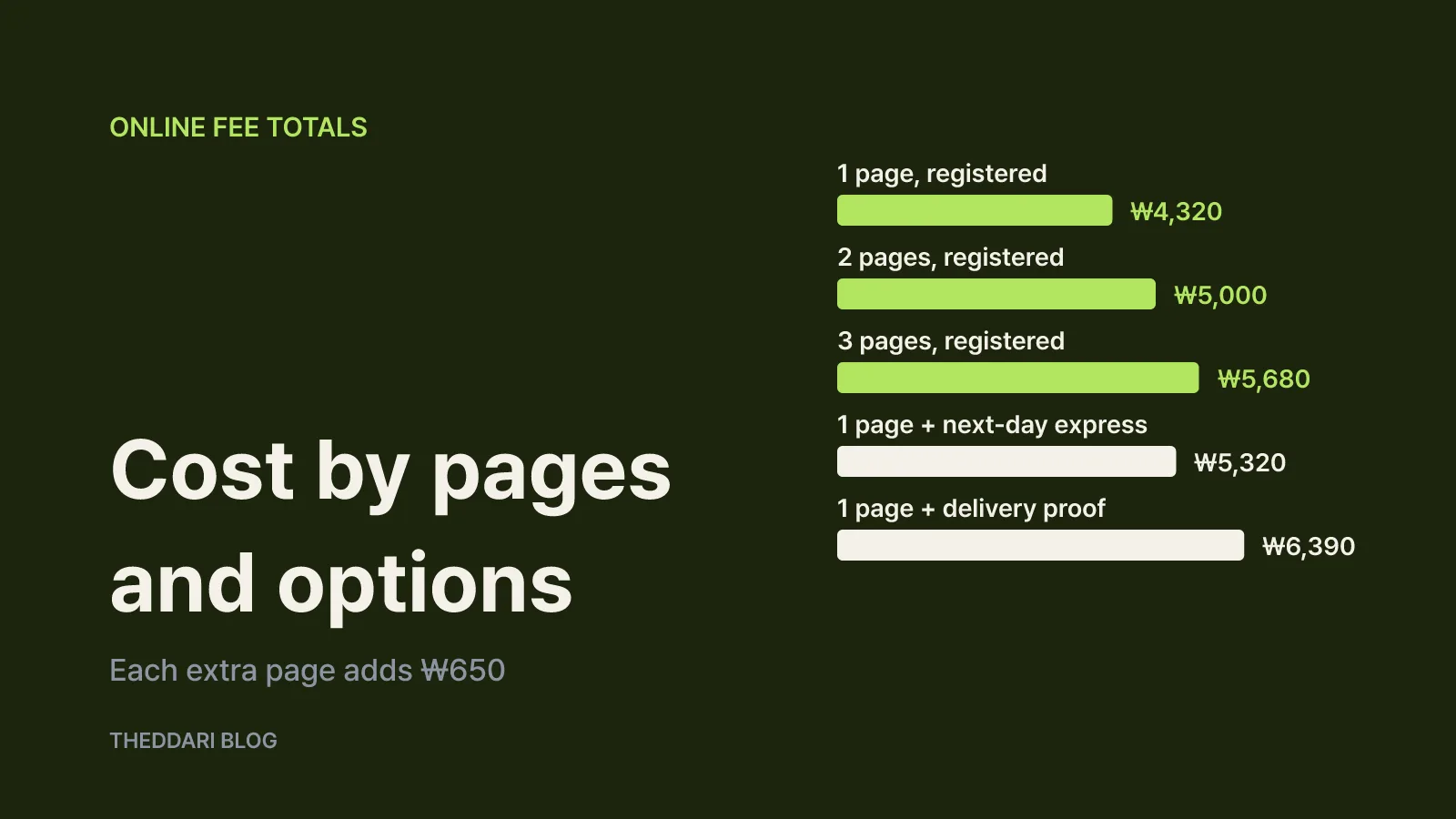
Using the same ePost table, two pages come to ₩5,000 and three pages to ₩5,680. From four pages postage moves to the 50g band (₩520), and from seven pages a large envelope applies. Double-sided printing counts as two pages under Article 53 of the enforcement rules, so squeezing text onto the back does not save money.
Optional extras: next-day express adds ₩1,000 (₩5,320 for one page). Delivery certification adds ₩1,600 plus ₩470 return postage, bringing a one-page standard letter to ₩6,390. At a counter there are no production or file fees, but postage depends on the envelope and you print and copy everything yourself; the structure is postage + ₩2,400 + ₩1,300 for the first page + ₩650 per extra page.
Sending it online through ePost
The ePost guide says online content certification is available 24 hours a day, including for non-members. The menu path is ePost → Mail (우편) → Certification services (증명서비스) → Content certification (내용증명). The site is in Korean, so a browser translator helps.
- Prepare the file. Per Gov24, the editor accepts Hangul (HWP), Word, PowerPoint, PDF and Excel files. Use portrait A4 with margins of 15mm top, 40mm bottom and 15mm left and right.
- Enter sender and recipient details exactly as they appear in the letter. Article 51 requires names and addresses to match across the original, copies and envelope.
- Choose delivery. Standard registered mail arrives within three days from the day after acceptance; next-day express arrives the following day.
- Decide on delivery certification now if the receipt date matters.
- Preview and pay. Double-check amounts, dates and account numbers. After acceptance you cannot change names, addresses or text (Article 50).
Online letters are kept as electronically signed, tamper-protected files for three years, so you can look them up and re-certify them online. Mail merge for two or more recipients is available but limited to five pages including the stamps.
Preparing three copies for a post office counter
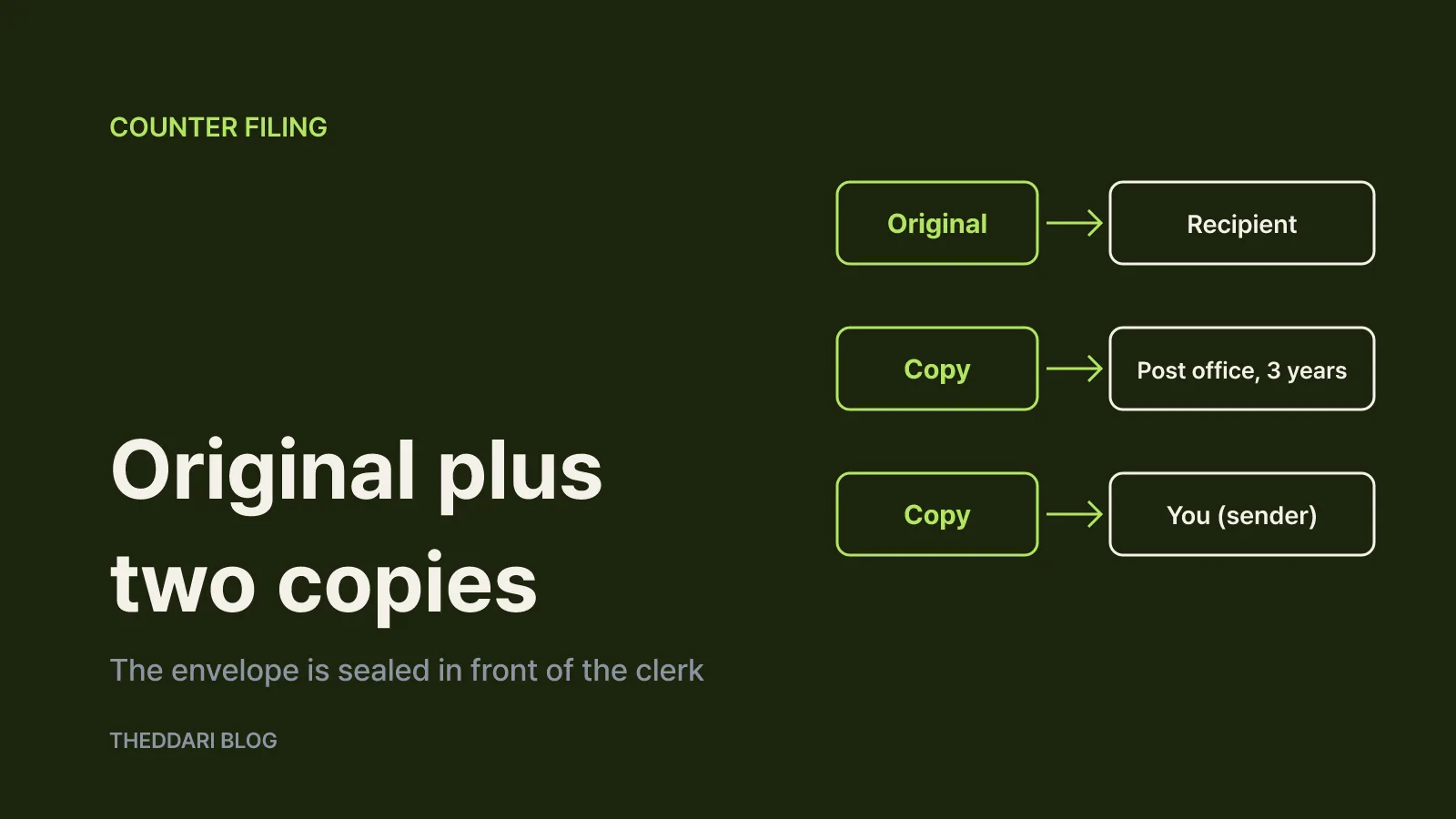
Article 48 of the enforcement rules requires the original and two copies. The original goes to the recipient, the post office keeps one copy and you get the other back. If you do not need your own copy, one copy is enough.
- Paper: A4 (210 × 297mm); copies must be photocopies of the original (Article 49).
- Language: Korean, Chinese characters or another language written legibly; numbers, brackets and common unit symbols are fine (Article 46).
- Corrections: note "correction", "insertion" or "deletion" and the number of characters in the margin, then stamp, thumbprint or sign. Leave corrected text readable (Article 50).
- Envelope: write both names and addresses, matching the letter, and leave it unsealed.
The clerk compares the documents, records the sending date, links the original and copies with a date stamp or punched holes, and you seal the original into the envelope in front of the clerk (Article 52). If you paid by card or the charge came through a phone bill, the Korea Consumer Agency advises sending the withdrawal notice to the card or telecom company, and any payment gateway, as well as the seller.
Delivery proof, re-certification and the three-year window
The post office keeps its copy for three years from the day after sending. During that time the sender or recipient can prove identity with the registered-mail receipt or ID and request:
- Re-certification if your copy is lost or damaged, for half the certification fee (₩650 for a one-page letter). For ePost letters, search by registration number and print it yourself; postal delivery costs extra.
- Viewing the stored copy at the sending office, also for half the certification fee.
- Post-sending delivery certification from two days after delivery, for content-certified mail up to three years old. ePost members only, ₩1,600 per item.
Keep the receipt, registration number and your copy together. Without the registration number, tracking down re-certification later is harder.
Checklist before you send
There is no mandatory format, but a letter that may later be read as evidence should include: a one-line subject; both parties' names, addresses and contacts matching the envelope; the facts in date order; a specific demand with an amount, deadline and method; the step you will take if the deadline passes, stated factually without threats; and the date with your signature or seal.
Before paying, confirm three things: the numbers match your contract and receipts; every necessary recipient is included; and you chose delivery options based on whether the sending date (withdrawals) or the receipt date (termination notices) is what counts.