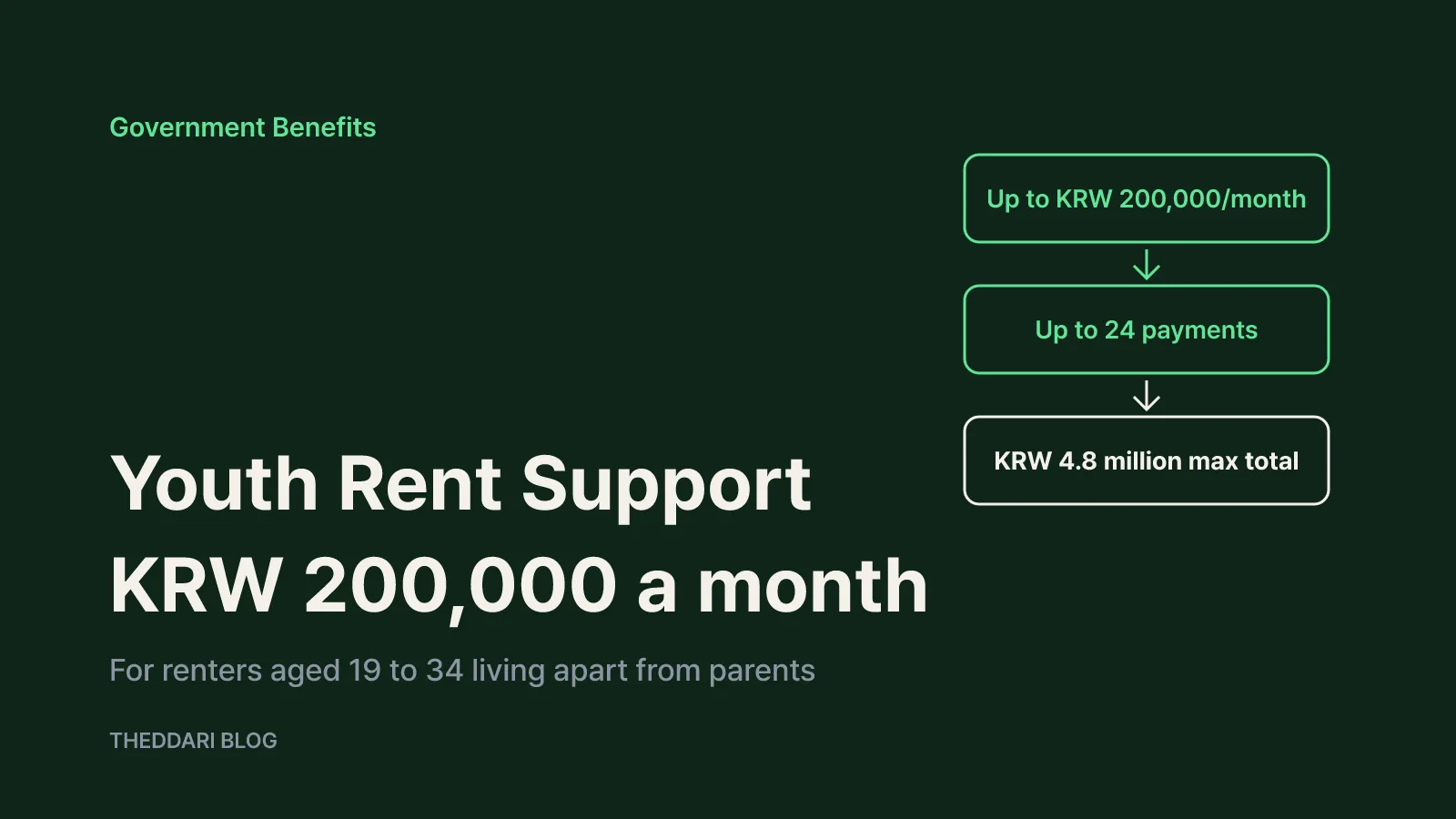
As of November 2026, Korea's Youth Monthly Rent Support program (청년월세 지원) pays up to KRW 200,000 a month for up to 24 monthly payments, once in a lifetime, to renters aged 19 to 34 who do not own a home and live separately from their parents. The payment can never exceed the rent you actually pay, and deposits and maintenance fees are not covered, so the maximum total is KRW 4.8 million. The 2026 intake ran from March 30 to May 29 and is closed. The important change is that the Ministry of Land, Infrastructure and Transport turned what used to be a temporary scheme into an ongoing program that recruits new recipients every year, so checking eligibility and preparing paperwork now puts you in a better position for the next round.
This guide is based on the Bokjiro 2026 application notice, the ministry announcement republished on Gov24 and a district office program page. No 2027 notice had been published when this was written, so every date and birth-year range below refers to the 2026 round.
Who qualifies: age, home ownership and two income tests
Eligibility is checked in three layers. The first is age and living situation. Applicants must be 19 to 34; in the 2026 round that meant people born between 1991 and 2007. You must be registered at an address separate from your parents, you must not own a home, and the young person has to apply in their own name.
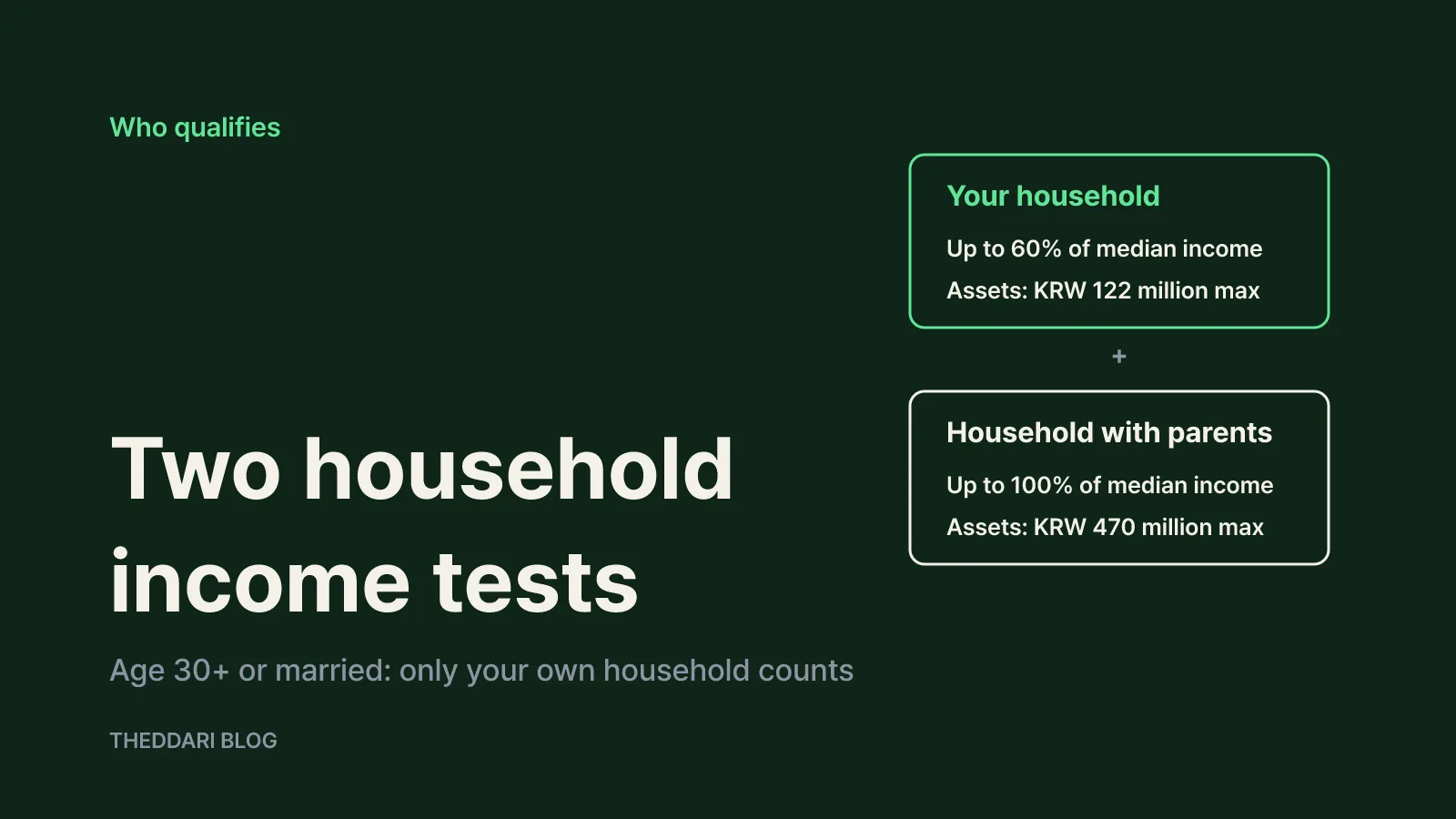
The second layer is the young person's own household: you plus a spouse or other family registered at the same address. That household must be at or below 60% of Korea's standard median income, with assets of no more than KRW 122 million. A Kyunghyang Shinmun report translated that into a monthly income of about KRW 1.54 million or less for a single-person household in 2026.
The third layer is the original household, which adds your parents. It must be at or below 100% of the standard median income with assets of no more than KRW 470 million; the same report put this at about KRW 5.36 million a month for a three-person original household. This is where many applicants get confused. If you are 30 or older, married, or a single parent living and budgeting separately from your parents, only your own household is assessed. Bokjiro's notice reflects the same rule: unmarried applicants under 30 add their separately living biological parents as household members, while applicants 30 and over do not. Deceased parents are not entered.
Two other points matter. Starting in 2026, the earlier requirement to hold a housing subscription savings account was dropped. On the other hand, people living in public rental housing and those already receiving a similar rent subsidy are excluded, according to press coverage of the announcement. Past participation also counts: recipients of the first round (August 2022 to December 2024) can only receive whatever remains of their 24 payments, and recipients of the second round (February 2024 to December 2027) can apply only after that round ends.
Because the income thresholds are tied to the standard median income published each year, the KRW 1.54 million and KRW 5.36 million figures are 2026 numbers. Check the amounts in whichever year's notice you apply under, and use the self-assessment calculator on Bokjiro or the MyHome portal before filing.
How the 2026 timeline worked, from filing to payday
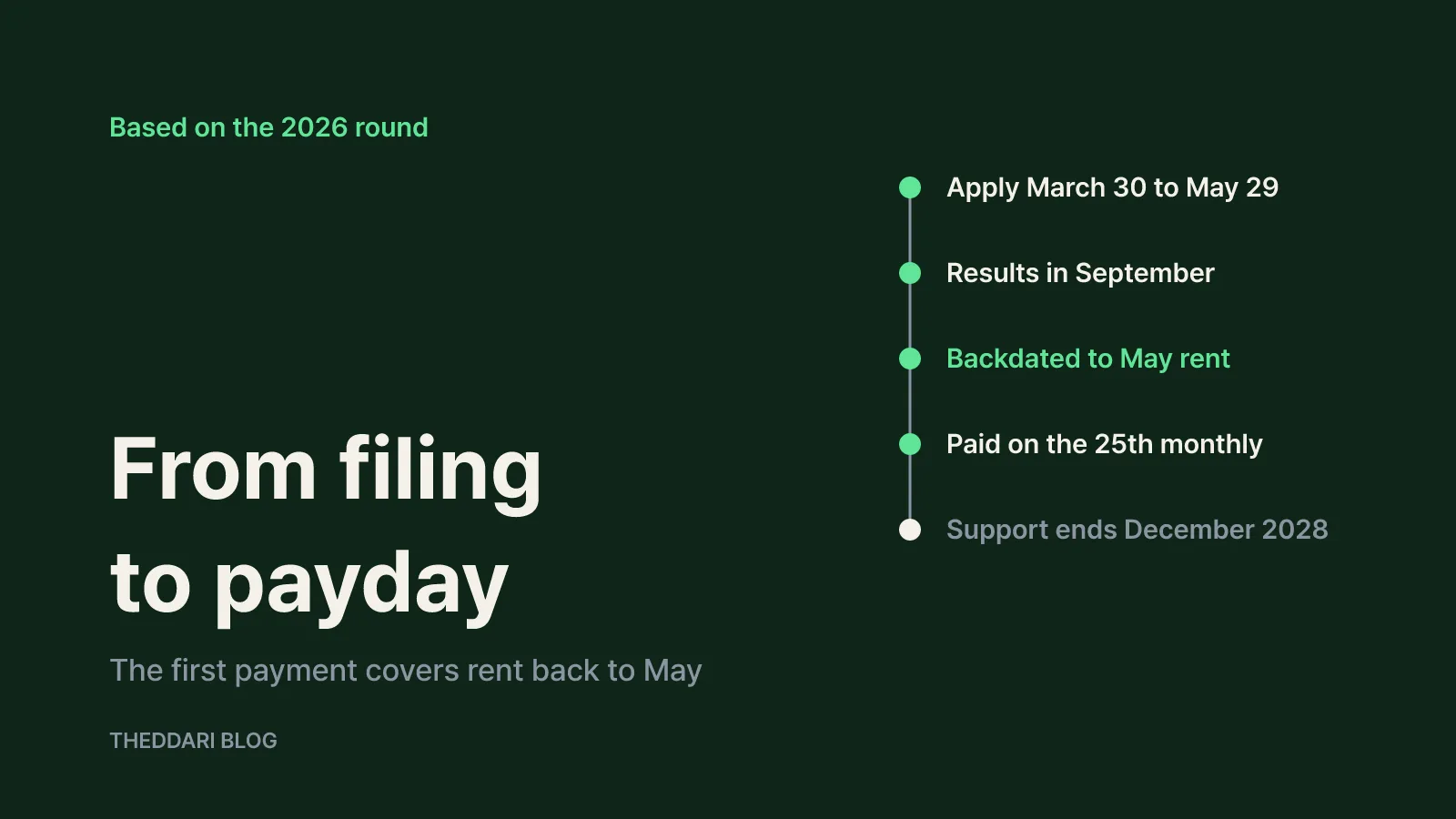
The 2026 window opened at 9 a.m. on March 30 and closed at 4 p.m. on May 29. Applications went through the Bokjiro website or the local community service center at your registered address. About 60,000 new recipients were planned nationwide, with quotas set by region; the Yeongdo District office in Busan, for example, listed 100 places.
Income and asset checks ran from March through August, and results came out in September. In Yeongdo the announcement date was September 14 and the first payment was made on September 25. That first transfer was backdated to May rent, regardless of when in the window you applied. After that, money arrives in your own bank account on the 25th of each month, or on the preceding day when the 25th falls on a Saturday or public holiday.
The payment period also has a hard end. According to Bokjiro, 2026 recipients are supported only until December 2028. If payments are suspended and you do not reach 24 payments by then, you would have to reapply in a regular window from 2029 onward and pass a fresh income and asset review to collect the remaining payments. In practice, avoiding interruptions is how you protect the full amount.
Remember that the subsidy is capped by your actual rent. With rent of KRW 150,000 you receive KRW 150,000; with rent of KRW 500,000 you still receive KRW 200,000. If your lease bundles maintenance fees with rent, make sure the rent figure is stated clearly in the contract.
Documents and the online application on Bokjiro
Online, you run a quick self-check on Bokjiro and then choose the youth rent support menu. A participant's account on Korea.kr describes entering date of birth, whether you live with your parents, marital status, previous support and home ownership before applying. Filing online removes the need for separate application, income-and-asset declaration and pledge forms; at a community service center you fill in the forms kept there.
The core documents listed by local governments are:
- A copy of your lease bearing a fixed-date stamp (확정일자), with your move-in registration completed.
- Proof of rent transfers for the most recent three months, such as transfer confirmations. Cash payments are hard to prove, so switch to bank transfers.
- A copy of your bankbook for the payout account, which should be in your own name.
- Detailed family relation certificates for you and each parent, with full resident registration numbers shown, three copies in total.
- Debt evidence, if you have debt; only loans for buying a home or paying a rental deposit are recognized.
- Sublease papers, if you sublet: the sublessor's lease, the building register and the building layout.
The two most common problems are a missing fixed-date stamp and transfer records that do not match the lease, for example rent sent to a relative of the landlord. If you are waiting for the next round, start paying the amount stated in the lease into the landlord's account now. Questions on rules and documents go to the ministry's dedicated line, 1599-0001; Bokjiro website help is 1566-0313.
Moving, lease changes and what stops payments
If you move during the support period, the change of registered address pauses payments. Submit the new lease through a change request and the remaining payments resume. Yeongdo's guidance stresses that a change request is also required when the lease changes at the same address, such as a new rent, deposit or an extension.
Payments are suspended if you move back in with your parents, become a homeowner, enlist in the military, stay abroad for more than 90 days, or move without filing a change request. When one of these happens you must file a suspension notice with your local government. Failing to report changes, or reporting them inaccurately, can lead not only to suspension but also to recovery of payments and penalties under the relevant laws.
A simple routine helps: file a change request the same month your lease or rent changes, submit the new lease as soon as you complete move-in registration and the fixed-date stamp after a move, and tell your local office ahead of long trips abroad or enlistment. Because 2026 recipients face a December 2028 cutoff, every month of interruption can become a payment you never receive.
What to prepare now for the next round
As of November 2026, the dates and quota for 2027 had not been announced. Since the ministry has said it will recruit new recipients every year, watch Bokjiro's notices and the MyHome portal. In 2026 the announcement came in mid-March and filing began at the end of March, but there is no guarantee the next round follows the same calendar.
Three preparations make sense now. Get a lease with move-in registration and a fixed-date stamp, and build at least three months of rent transfers. Confirm you can obtain detailed family relation certificates for yourself and your parents, and work out whether your age or marital status means your parents' income will be counted. If you received support in an earlier round, ask the call center how many payments remain and when you can apply. If you are close to the age limit, check the birth-year range in the notice for the year you apply.