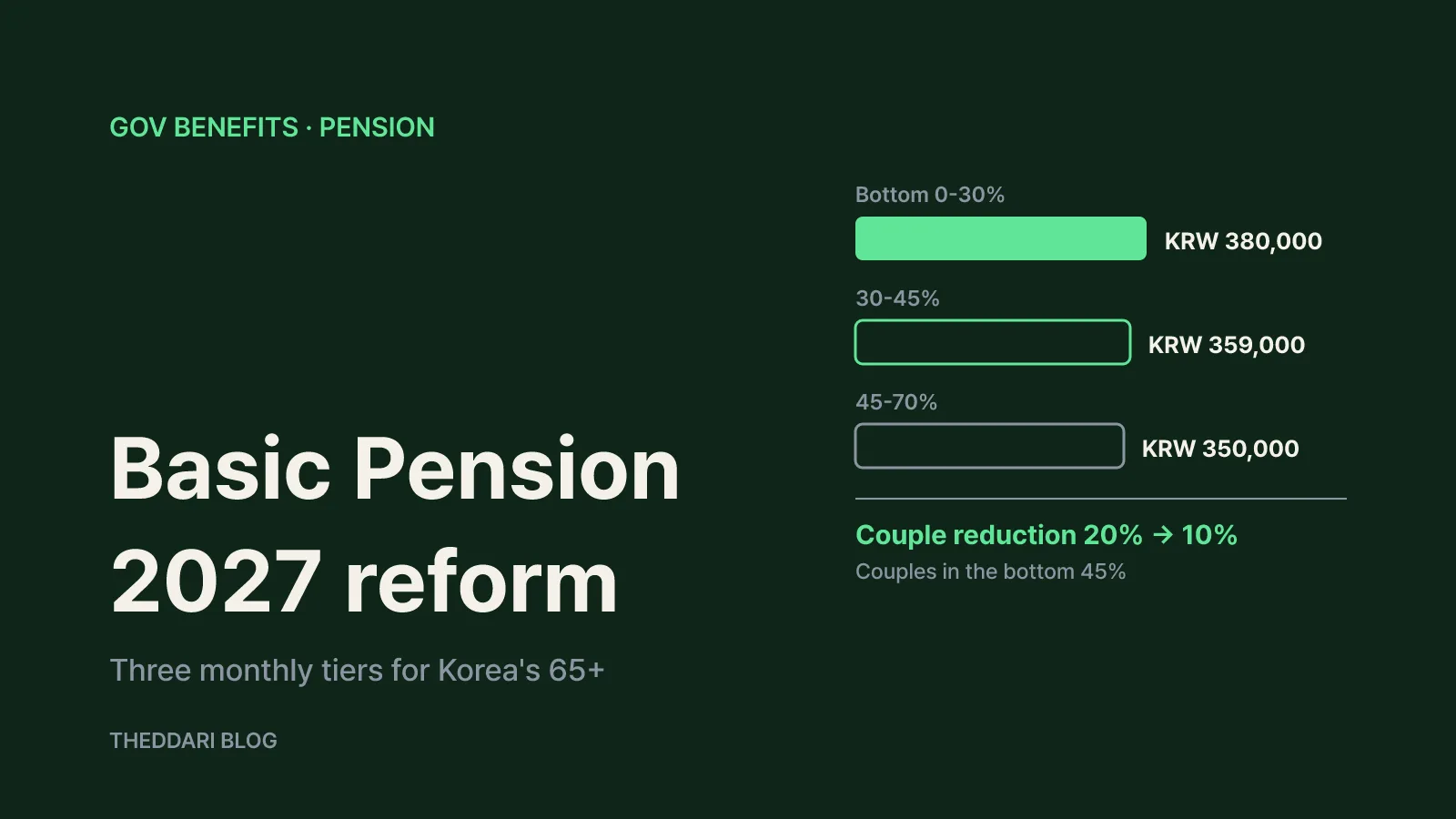
As of November 2026, the South Korean government has proposed a 2027 overhaul of the Basic Pension (기초연금), the tax-funded monthly payment for people aged 65 and over. The short answer: the program would still cover roughly the bottom 70% of older adults by income, but the monthly amount would depend on which income tier you fall into. The bottom 30% would receive KRW 380,000, the 30-45% tier KRW 359,000 and the 45-70% tier KRW 350,000. Lower-income married couples would also see the couple reduction cut from 20% to 10% (Ministry of Health and Welfare budget release, Yonhap).
This is a government proposal approved by the Cabinet on September 1, 2026. It still needs an amendment to the Basic Pension Act and approval of the 2027 budget by the National Assembly. Until then, eligibility is decided under the 2026 rules: a monthly recognized income at or below KRW 2,470,000 for a single older person or KRW 3,952,000 for a couple (Ministry of Health and Welfare 2026 threshold release).
This guide is written for residents of Korea and for adult children abroad who help parents in Korea with paperwork. It separates what is already in force from what is still on the table.
The 2027 proposal: three payment tiers instead of one
Today, everyone who qualifies starts from the same standard amount. For 2026 that is up to KRW 349,700 a month for a single recipient (Gov24 Basic Pension page). The proposal splits recipients into three groups (Yonhap):
- Bottom 0-30% (about 3.48 million people): KRW 380,000 a month, roughly KRW 30,000 more than now.
- 30-45% (about 1.74 million people): KRW 359,000 a month, reflecting inflation.
- 45-70% (about 2.9 million people): KRW 350,000 a month, effectively frozen at the 2026 level.
According to reporting on the ministry briefing, the 30% and 45% cut-offs sit at about 20% and 40% of the standard median income, or roughly KRW 550,000 and KRW 1,090,000 a month (Money Today). The income here is recognized income, not take-home pay. The detailed tier criteria are expected to be set at the end of the year.
The planned start date is April 2027 (Money Today), so January to March 2027 would still follow the current method. The Basic Pension budget rises 11%, from KRW 23.1 trillion in 2026 to KRW 25.7 trillion in 2027 (Ministry of Health and Welfare).
Just as important is what the proposal leaves out. An earlier idea to tie eligibility to the standard median income, which would have gradually narrowed coverage, is not part of this plan (Yonhap). Nothing in the proposal removes current recipients from the program.
Couple reduction: from 20% to 10% for lower-income couples
When both spouses receive the Basic Pension, each payment is currently reduced by 20%, regardless of income. That is why the 2026 maximum for a couple is KRW 559,520: two times KRW 349,700, minus 20% (Gov24). Under the proposal, couples in the bottom 45% (about 2.34 million recipients) would see that reduction drop to 10% (Yonhap).
The ministry gave these couple examples (Ministry of Health and Welfare):
← Swipe to see more
| Couple income tier | 2026 | 2027 proposal | Change |
|---|---|---|---|
| Bottom 0-30% | KRW 560,000 | KRW 684,000 | +KRW 124,000 |
| 30-45% | KRW 560,000 | KRW 646,000 | +KRW 86,000 |
KRW 684,000 is two payments of KRW 380,000 less 10%. KRW 646,000 is the rounded result of two payments of KRW 359,000 less 10% (KRW 646,200). Couples in the 45-70% tier keep the 20% reduction. If only one spouse is 65 or older, or only one spouse qualifies, the couple table does not apply in the same way, so work out which situation your household is in first.
Public-service pensioners and livelihood benefit recipients
People receiving occupational pensions for civil servants, private school teachers, military personnel or special post office staff, and their spouses, are generally excluded today, with limited exceptions such as those who took a lump-sum retirement payment (Gov24). The proposal would pay up to KRW 380,000 a month to about 110,000 of these pensioners and spouses who fall within the bottom 45% (Ministry of Health and Welfare). Because data systems must be linked first, this group is scheduled to start in July 2027 rather than April (Money Today).
If a household also receives the livelihood benefit under the National Basic Livelihood Security system, the increase may not translate into more money. The Basic Pension counts as income when the livelihood benefit is calculated, and the proposal does not change that (Yonhap). The government said the maximum livelihood benefit for a one-person household rises by KRW 55,000 a month in 2027 and that the issue is expected to be discussed in the National Assembly.
Checking eligibility under the current 2026 rules
Eligibility still turns on the selection threshold. For 2026 it is KRW 2,470,000 a month for a single older person and KRW 3,952,000 for a couple, up 8.3% from KRW 2,280,000 and KRW 3,648,000 in 2025 (Ministry of Health and Welfare). The three core conditions are (Gov24):
- Age 65 or over. In 2026 that starts with people born in 1961.
- Household recognized income at or below the threshold. The household means the older person and their spouse.
- Not an occupational pension recipient or the spouse of one, apart from listed exceptions.
The threshold is announced each year by the Minister of Health and Welfare; the 2026 figures were released on January 1, 2026. The 2027 threshold has not been announced yet, so anyone who narrowly missed the 2026 line should check again once it is published. As of September 2025, about 86% of actual recipients had recognized income below KRW 1.5 million a month.
How recognized income is calculated
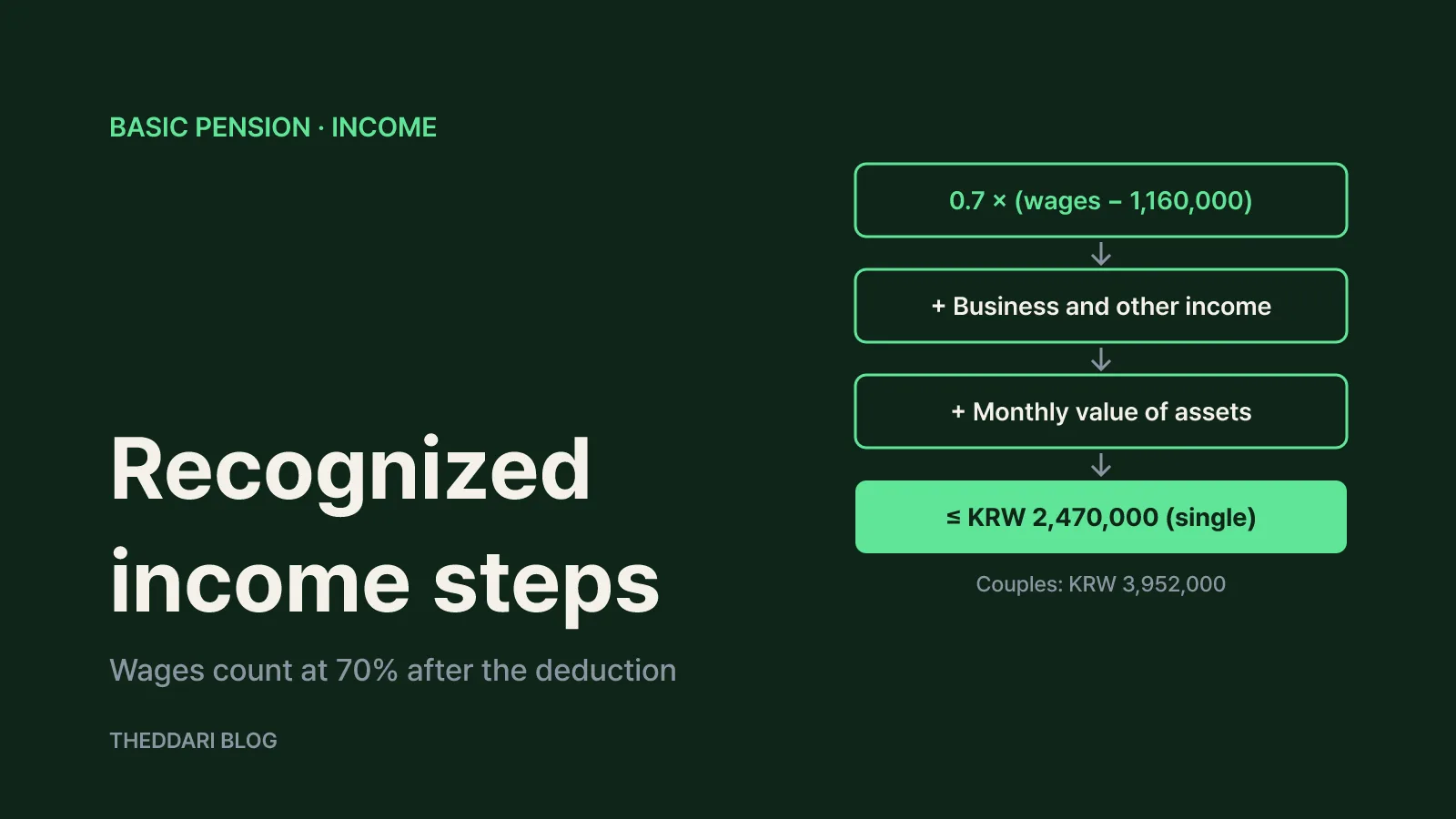
Recognized income is monthly assessed income plus the monthly income value of assets (Gov24). Work through it in four steps.
Step 1: earned income. Subtract KRW 1,160,000 from regular wages, then count only 70% of what remains: 0.7 x (wages - KRW 1,160,000). Someone earning KRW 2,000,000 a month is counted at KRW 588,000. Wages of KRW 1,160,000 or less count as zero.
Step 2: other income. Add business income, property income, public transfer income and the imputed value of rent-free housing. There is no KRW 1,160,000 deduction here, so the same amount can count very differently depending on whether it is a wage or business income.
Step 3: assets. From general property, subtract the basic property allowance: KRW 135 million in large cities, KRW 85 million in small and mid-sized cities, and KRW 72.5 million in rural areas. Subtract KRW 20 million from financial assets, deduct debts, apply the property conversion rate and divide by 12.
Step 4: luxury cars and memberships. These are taken out of general property and their full value is added separately, which is why a single expensive vehicle can push a household over the line.
The official figure is only set after the authorities check public income and asset records, so treat your own calculation as a guide to whether applying makes sense.
How to apply and what to bring
The Basic Pension is not automatic; you must apply. Applications are accepted regardless of registered address at a local community service center, a National Pension Service branch, or online through Bokjiro (www.bokjiro.go.kr) (Ministry of Health and Welfare). People with limited mobility can ask the National Pension Service for a home visit by calling 1355. New applicants can apply from one month before the month of their 65th birthday.
Bring an ID card, the social welfare service application form, an income and asset report, financial information consent forms for both the applicant and spouse, and a copy of the bankbook (Gov24). If an earlier application was rejected, check again: the threshold has risen each year, and anyone whose income or assets have fallen can reapply at any time. Help is available from the Health and Welfare Call Center at 129 and the National Pension Service at 1355.
What to watch before the reform is final
- National Assembly decision: the KRW 380,000 tier and the 10% couple reduction depend on the law amendment and the budget. Amounts or coverage could change.
- 2027 selection threshold: this decides who falls inside the bottom 70%.
- Tier criteria: the exact 30% and 45% lines decide whether someone receives KRW 380,000 or KRW 359,000.
- Implementation notices: check ministry and National Pension Service guidance before April 2027 (July for occupational pensioners).
The practical step right now is to confirm eligibility under the 2026 rules and apply if you have not. The proposed increases only reach people who are already in the program.