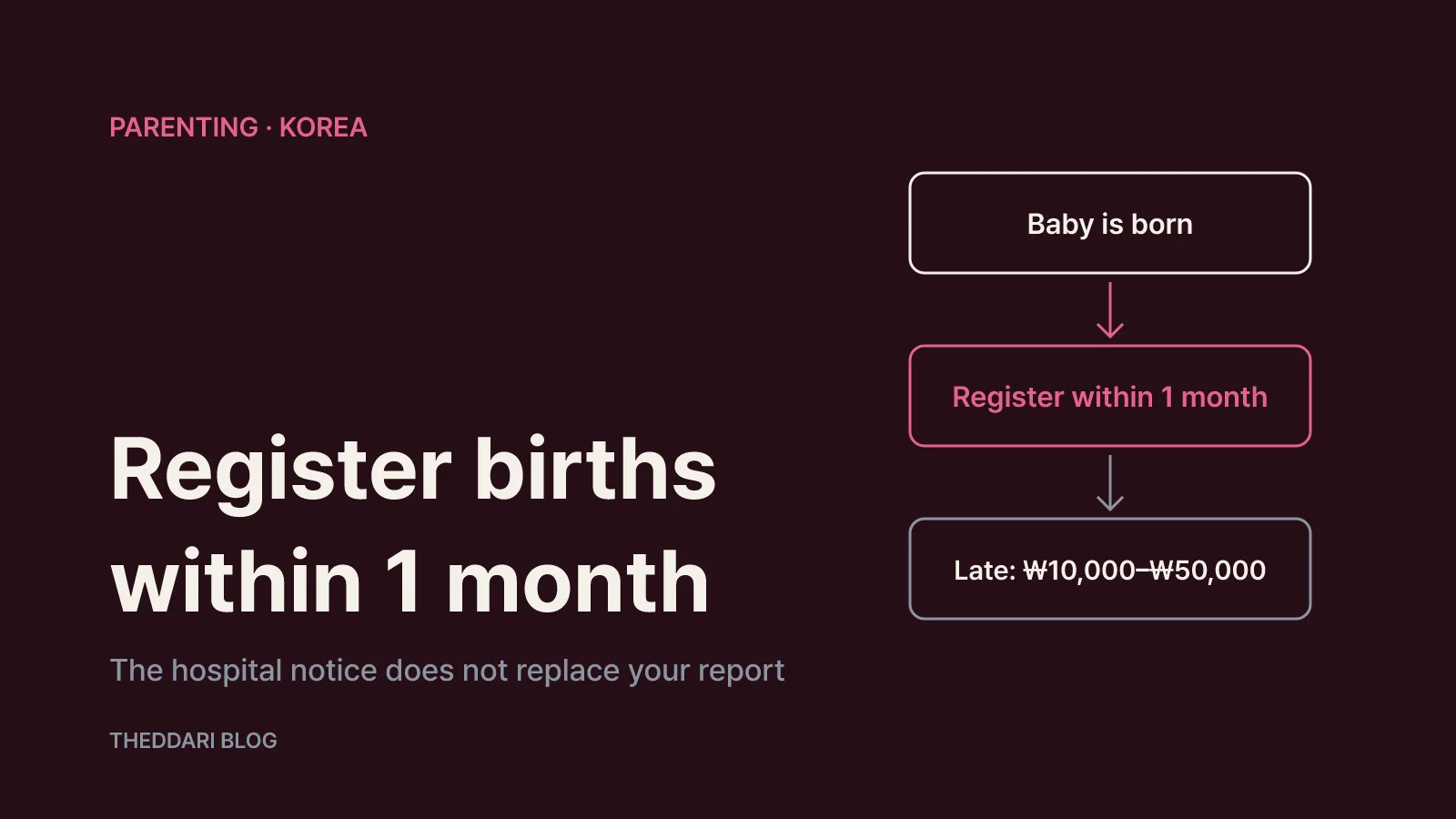
As of November 2026, a birth in South Korea must be reported within one month of the date the baby is born (Korea Ministry of Government Legislation, Easy Law). If the person responsible misses that deadline without a legitimate reason, they can be fined up to ₩50,000. The actual amount follows a five-step scale based on how late the report is, starting at ₩10,000 for a delay of under seven days (Supreme Court e-Civil Service Center). Since July 19, 2024, hospitals also send birth information to the authorities under the birth notification system, but that notice does not count as your birth report. This guide is written for parents in Korea, including international couples and Korean nationals abroad, who want the rules in one place.
The one-month deadline: who files and where
Birth registration (출생신고) is the report that places a newborn on the family relations register and the resident registration system. Article 44(1) of the Act on the Registration of Family Relationships sets the filing window at one month after birth. Between hospital discharge, a postpartum care center stay and choosing a name, that month tends to disappear quickly, so it helps to decide early which parent will handle the filing.
Who must file depends on the parents' marital status (Easy Law: how to report a birth):
- Child born to married parents: either the father or the mother
- Child born outside marriage: the mother
- If the parents cannot file: a relative living with the child, followed by the doctor, midwife or other person who assisted with the delivery
If no one files within the month and the child's welfare may be at risk, a public prosecutor or the head of the local government can file instead. That is a safeguard, not a substitute for parents filing on time.
You have several filing locations. A report can be made where the child was born, or at the city, district, town or township office covering the child's registration base, or the filer's address or current location. In cities, the community service center covering the area where the child's resident registration will be made also accepts birth reports. Korean nationals living abroad can use the overseas family registration office. Online filing is also available through the Supreme Court's eFamily portal; check its online filing guide for birth reports before you start, because you will need an approved authentication method and digital copies of the attachments.
Late filing fines: ₩10,000 to ₩50,000 by delay
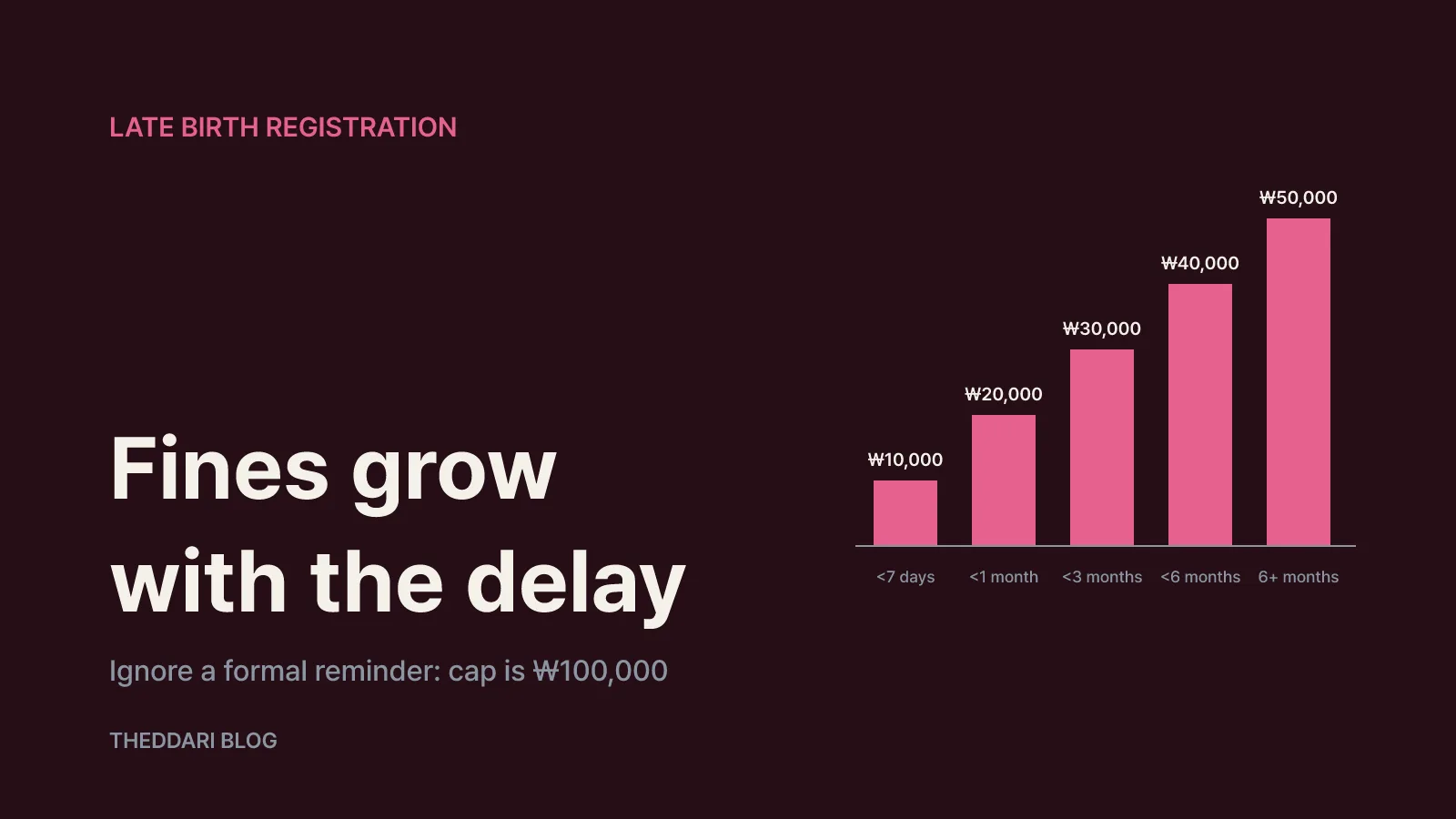
Article 122 of the Act sets a fine of up to ₩50,000 when the person obliged to file misses the deadline without a legitimate reason. ₩50,000 is only the ceiling. The Supreme Court's published schedule ties the amount to the length of the delay (Supreme Court fine procedure):
← Swipe to see more
| Length of delay | Filing deadline missed (Art. 122) | Official reminder deadline missed (Art. 121) |
|---|---|---|
| Under 7 days | ₩10,000 | ₩20,000 |
| 7 days to under 1 month | ₩20,000 | ₩40,000 |
| 1 month to under 3 months | ₩30,000 | ₩60,000 |
| 3 months to under 6 months | ₩40,000 | ₩80,000 |
| 6 months or more | ₩50,000 | ₩100,000 |
The right-hand column applies when the local office has set a deadline in a formal reminder under Articles 38 or 108 and the filer still does not comply; that ceiling is ₩100,000. The practical lesson is simple: if you realize you are late, file immediately rather than waiting for a letter, because every step up the scale costs more.
The office that accepts the report, or issued the reminder, imposes and collects the fine. When a community service center accepts a birth report, its head collects on behalf of the city or district. A legitimate reason removes the fine altogether, so if the delay was caused by something like the mother or baby being hospitalized, explain it when you file and bring supporting documents.
Why the hospital notice does not replace your report
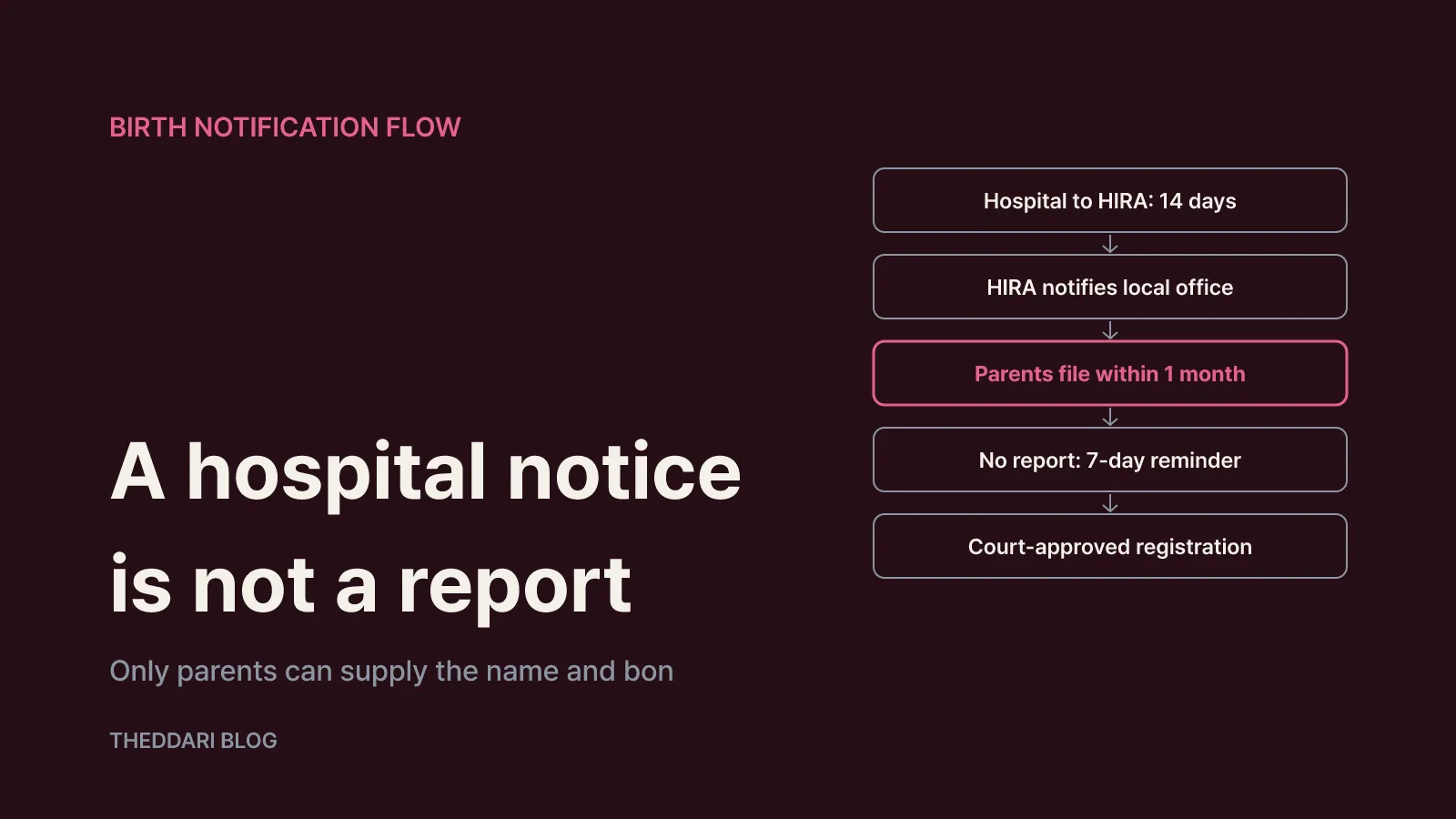
The birth notification system took effect on July 19, 2024, so that every baby born in a hospital or clinic is officially known to the state (Korea.kr policy briefing). The sequence works like this (Easy Law: birth reporting and notification):
- At birth, medical staff record the mother's name and resident registration number, the baby's sex, number of babies, date and time of birth, birth order and the facility name.
- Within 14 days of birth, the head of the facility submits the information to the Health Insurance Review and Assessment Service (HIRA).
- HIRA notifies the head of the city, town or township covering the mother's address without delay.
- After the one-month window, that office checks whether a birth report was filed.
- If not, it immediately tells the person obliged to file to do so within 7 days.
- If there is still no report, or no obligated person can be identified, the office records the birth ex officio with permission from the supervising court.
The hospital sends a notification, not a birth report. The one-month deadline and the Article 122 fine still apply to parents, and only you can supply details such as the child's name, family origin (bon) and registration base. If you receive a 7-day reminder, focus on filing within that window; court-approved ex officio registration takes longer and can delay other paperwork that depends on your child being registered.
The protected birth system started on the same day. It lets a pregnant woman in crisis give birth in a hospital without revealing her identity, using a pseudonym and a management number after counseling, with a reflection period of at least seven days after delivery. The counseling line for women facing a crisis pregnancy is 1308.
Documents and what the form asks for
For an in-person filing, Easy Law lists these attachments:
- Birth certificate issued by the medical facility
- The filer's identification
- Marriage certificates of the parents (not required when the office can check them through shared administrative data)
- Proof that the mother was a Korean national at the time of birth, where relevant
- Proof of the other nationality if the child holds dual nationality
Under Article 44(2), the form records the child's name, bon, sex and registration base; whether the child was born to married parents; the date, time and place of birth; the parents' names, bon, registration base and resident registration numbers (or, for a foreign parent, name, date of birth, nationality and alien registration number); any agreement made at marriage registration for the child to take the mother's surname and bon; and any foreign nationality the child holds.
International couples should read the Easy Law section on children of one Korean and one foreign parent before filing, because the outcome differs depending on whether the parents are married and whether the Korean parent is the father or the mother. If a child dies before the birth is reported, the birth and death must be reported together (Article 51).
Received a fine? Reductions and 30-day objections
The local office may cut the scheduled fine by half after considering the motive and outcome of the delay, but only when the person being fined attaches a written statement explaining the reason. Medical records or a hospitalization certificate make that statement more persuasive.
If you disagree with the fine, you must submit an objection to the same office within 30 days. If the office considers the objection unfounded, it refers the case to the family court with jurisdiction over your address, which decides it as a non-contentious case. With amounts between ₩10,000 and ₩50,000, a reduction request is often the more practical route, but the objection process exists if you had a clear legitimate reason.
A simple one-month plan
- Before discharge: get the birth certificate and decide which parent will file.
- First two weeks: settle the name, including any Chinese characters, and the bon.
- By the end of week three: file at a local office or through eFamily, leaving time to fix missing documents.
- After filing: confirm the child appears in resident registration, then move on to birth-related benefit applications.
- If you are already late: file right away and prepare a written explanation if there was a genuine reason.