As of November 2026, a tenant in Korea who has signed a lease with a deposit above ₩10 million (₩10,000,000) can ask a tax office to show the landlord's unpaid national taxes without the landlord's consent, as long as the request is made by the day the lease term begins. You pre-apply on Hometax, the National Tax Service (NTS) portal, wait for a text message, then visit the tax office and read the record on screen. Unpaid local taxes are a separate request handled by city, county or district offices. Before a contract is signed, or when the deposit is ₩10 million or less, the landlord's consent is still required.
This guide is based on the NTS Hometax notice, Article 97 of the Enforcement Decree of the National Tax Collection Act and a Ministry of the Interior and Safety press release. It matters most for jeonse leases, where a tenant hands over a large lump-sum deposit instead of paying monthly rent, but it applies to monthly-rent (wolse) leases and commercial leases too.
Why the lease start date is the deadline that counts
The right comes from Article 109 of Korea's National Tax Collection Act. According to a government policy briefing, from April 3, 2023 tenants could apply at any tax office nationwide instead of only the office covering the property, and a tenant who has already signed a lease could apply without consent until the lease term starts.
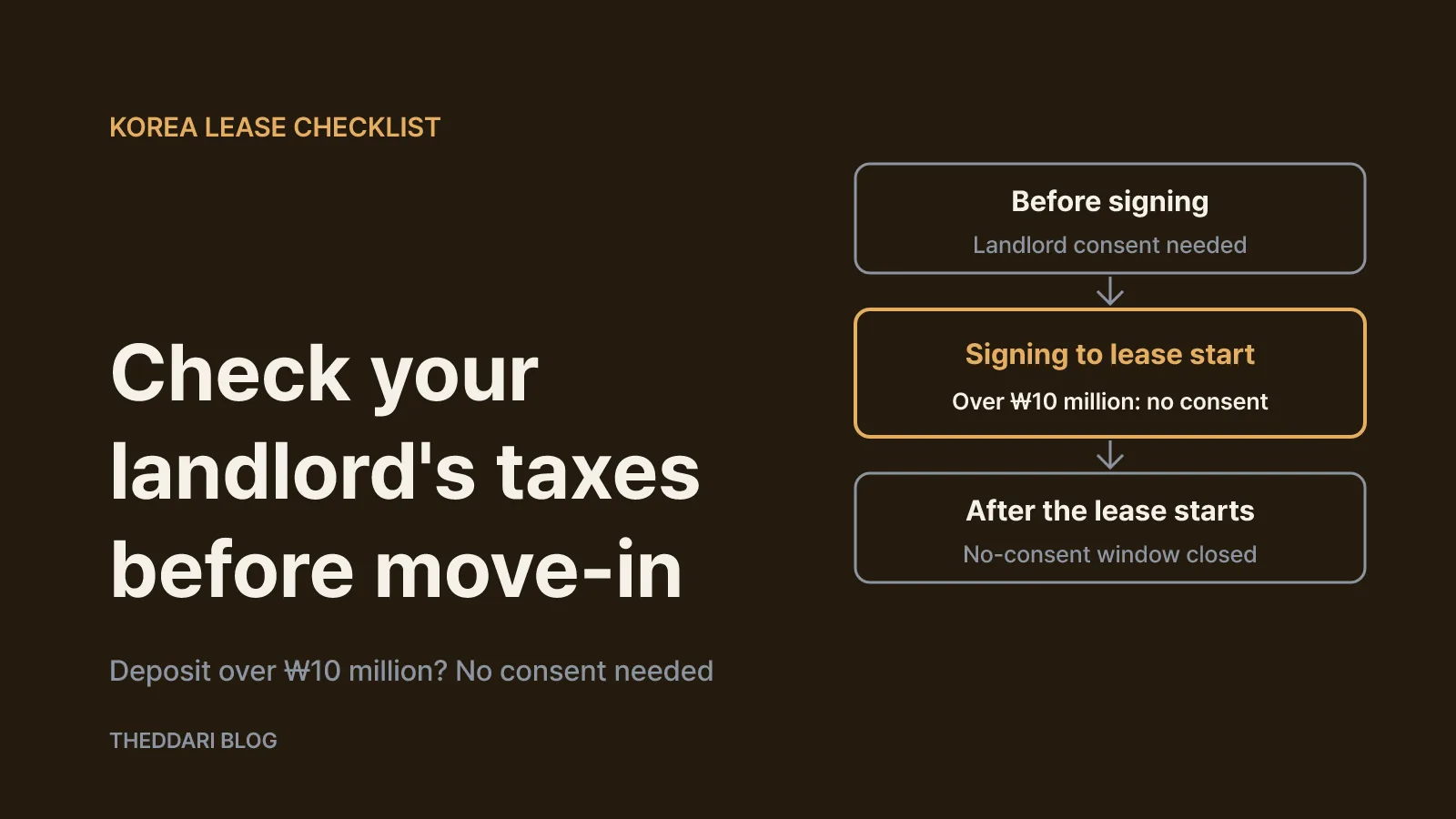
The rules break down by stage:
- Before you sign: you need the landlord's consent, shown by their signature on the application (or a separate consent form) plus a copy of their ID.
- After signing, up to the lease start date, deposit above ₩10 million: no consent needed. Paragraph 2 of Article 97 of the Enforcement Decree sets the threshold at ₩10 million.
- After signing, deposit of ₩10 million or less: consent is still required. A deposit of exactly ₩10 million does not qualify for the no-consent route.
- After the lease start date: the no-consent window has closed.
Use the start date written in the contract, not the day the moving truck arrives. In many Korean leases the final balance payment falls on the same day the term begins, so plan to finish the check a few days before you hand over the balance.
The process is not anonymous. When a tenant views the record without consent, the tax office notifies the landlord. Mentioning during negotiations that you will run this check before moving in usually avoids friction later.
Applying on Hometax and viewing at the tax office
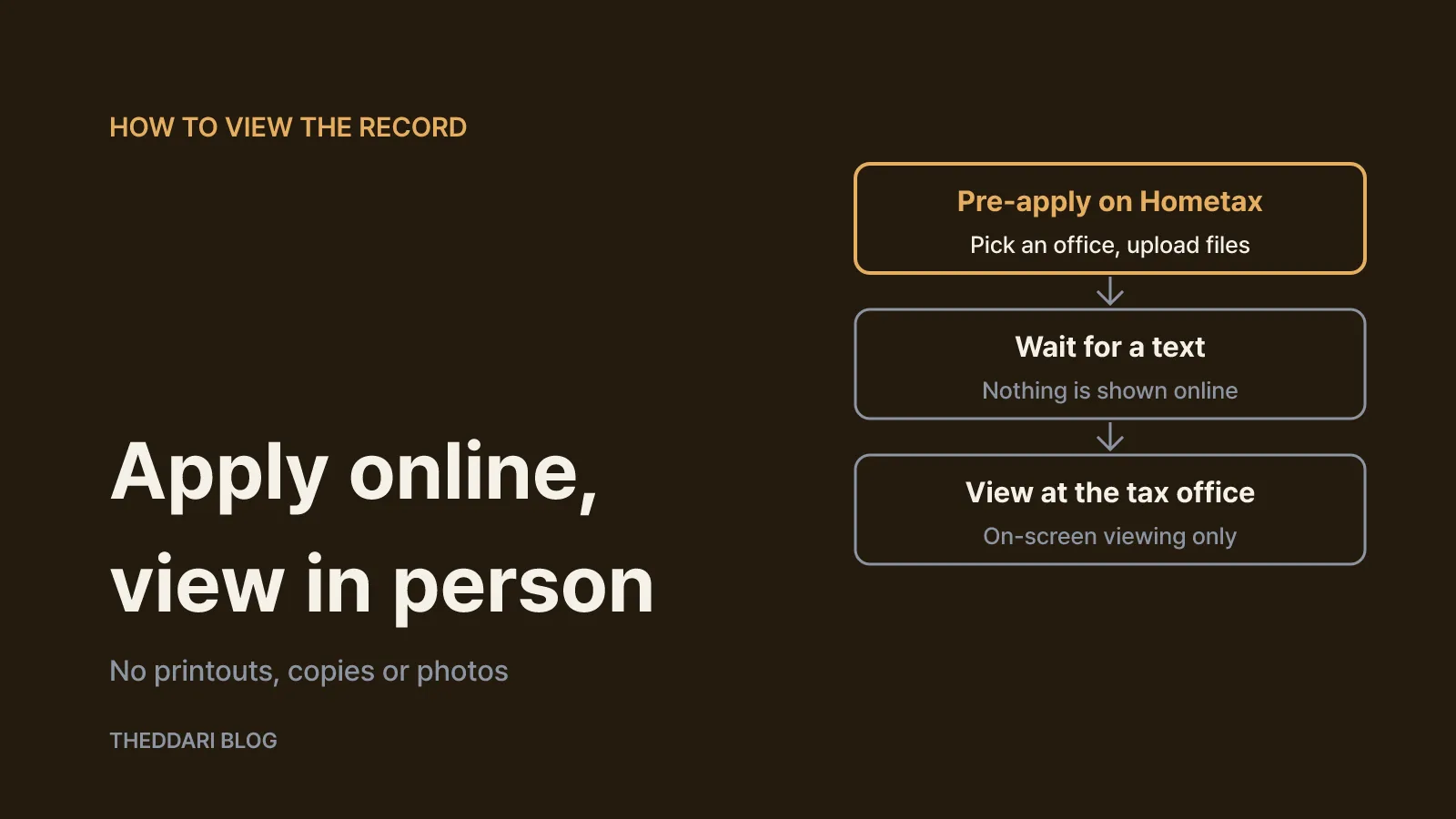
To cut waiting times at tax offices, the NTS opened a Hometax pre-application screen on June 30, 2023. The NTS notice describes these steps:
- Log in to Hometax.
- Open the Application/Submission menu and go to the shortcut for major tax document applications.
- Choose the application to view unpaid national taxes for a residential or commercial lease.
- Fill in the form, convert the supporting documents to files and submit them. You choose the tax office you will visit, and it does not have to be the one covering the property.
- When a text message says the record is ready, visit that office and view it.
Nothing is delivered online. The record can only be viewed at the office. Printouts, copies and photos are not allowed, so ask the officer before taking handwritten notes of the tax types or amounts you see.
You can also apply in person without using Hometax. The policy briefing reported that after a walk-in application, staff looked up the record and sent a text within three hours. Because a visit is unavoidable either way, apply right after signing rather than the day before your balance payment.
Documents and who can apply for you
Under Article 97, the application form must come with two kinds of proof: evidence of the landlord's consent, or, if you apply without consent, evidence that a lease contract has been signed; and proof of the applicant's identity.
← Swipe to see more
| Item | With landlord consent | Without consent |
|---|---|---|
| Application form | Signed by the landlord, or with a consent form | Required |
| ID | Copies for landlord and applicant | Applicant's copy |
| Lease contract | Bring it if relevant | Copy required |
The contract copy should clearly show the deposit, the lease term, the landlord's name and the address, because the office uses it to confirm that the deposit is above ₩10 million and that the term has not started.
Only the prospective tenant can use the Hometax route. A family member or other proxy must visit a tax office with a power of attorney and their own ID. The policy briefing said that one family member living in the same household as the tenant may apply with a power of attorney when necessary. For joint tenants or leases in a company's name, check first with the NTS call centre (126 from any phone in Korea) or the office you plan to visit.
Reading the result: the 30-day and 60-day gap
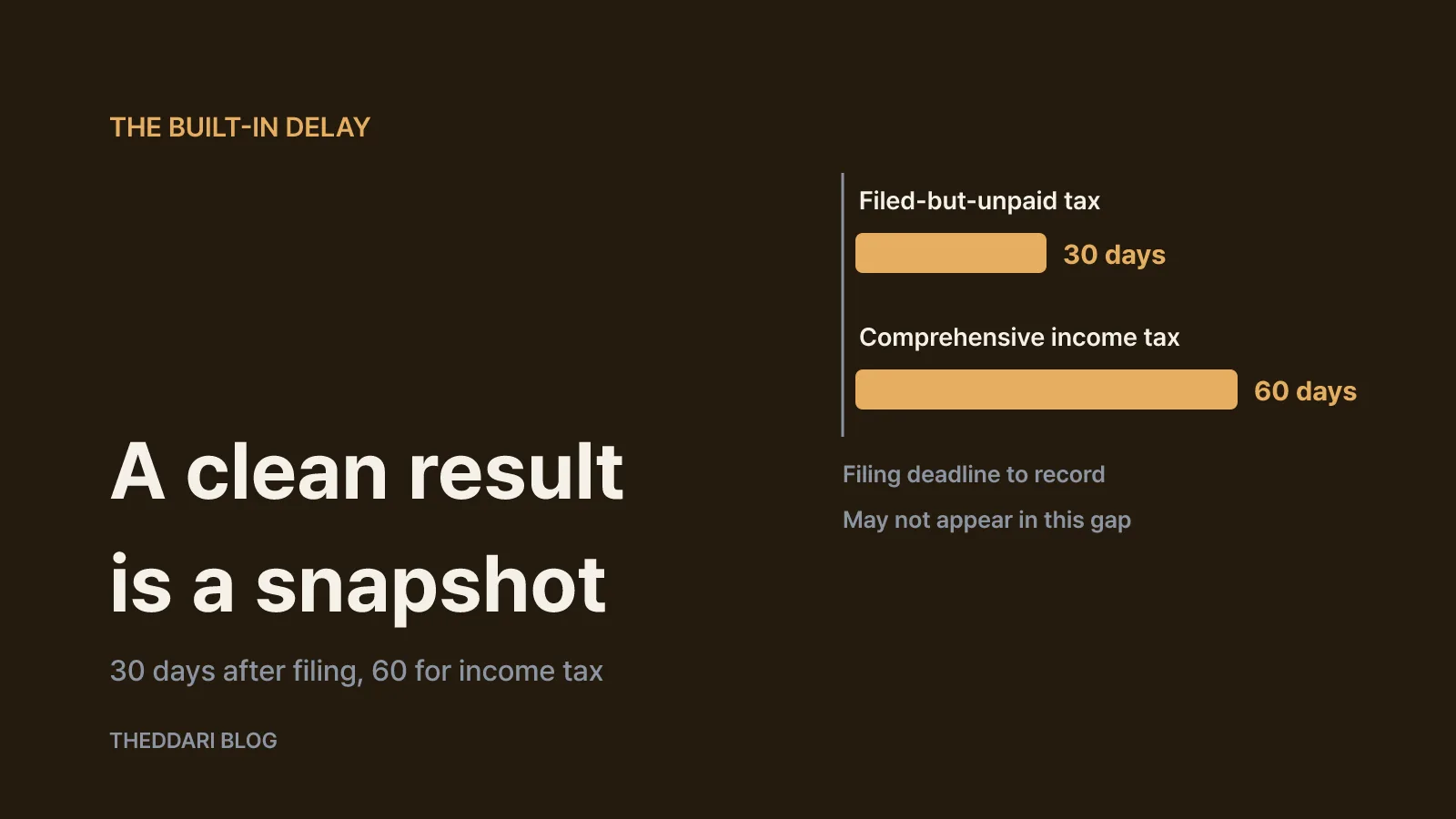
The record covers three kinds of national tax: amounts already in arrears, taxes that have been billed but are not yet due, and taxes the landlord filed but did not pay. The last category has a built-in delay.
Paragraph 3 of Article 97 says that filed-but-unpaid tax becomes viewable once 30 days have passed from the filing deadline, or 60 days for comprehensive income tax. If you check shortly after a filing deadline, tax that was filed but not paid may not appear yet. A clean result is a snapshot of what was viewable that day, not proof that no tax is outstanding.
Two habits narrow the gap on a large deposit:
- If weeks separate your viewing and your balance payment, plan a second check closer to the payment, remembering the no-consent route ends on the lease start date.
- Ask your licensed agent about a special clause requiring the landlord to clear any national or local tax arrears found before the balance is paid. Clause wording and effect vary by contract, so have it reviewed by a professional.
Unpaid local taxes need a separate request
The tax office record does not include local taxes such as property tax and acquisition tax, which fall under a different law and different offices. The Ministry of the Interior and Safety announced that from April 1, 2023 tenants could view a landlord's unpaid local taxes at any local government in the country without separate landlord consent.
Bring your contract copy and ID, as with national tax. Local governments differ on which department takes the request and who may apply as a proxy, so check the office's website or call ahead, and confirm that the request falls within the same post-signing, pre-start-date window. A complete check means two stops: a tax office for national tax and a city, county or district office for local tax.
What to do if the record shows unpaid tax
Unpaid tax does not automatically mean you should walk away. The policy briefing describes the system as a chance to decide, before moving in, whether to continue with a contract when the unpaid amount is large relative to your deposit. Work through it in order:
- Gauge the size: note the tax types and rough amounts, within what the office allows, and weigh them against your deposit, the property's value and any mortgages on the registry.
- Ask the landlord: find out when they will pay, and if they say it is settled, ask for a tax payment certificate.
- Reorder the payment: with your agent, put in writing that the balance will be paid only after the arrears are cleared.
- Get advice: if the amount is large or the landlord avoids the question, consult a lawyer about cancelling the contract and recovering the down payment.
Three points carry the whole process: the no-consent window closes on the lease start date, filed-but-unpaid tax appears only after 30 days (60 for comprehensive income tax), and national and local taxes are checked at different offices.