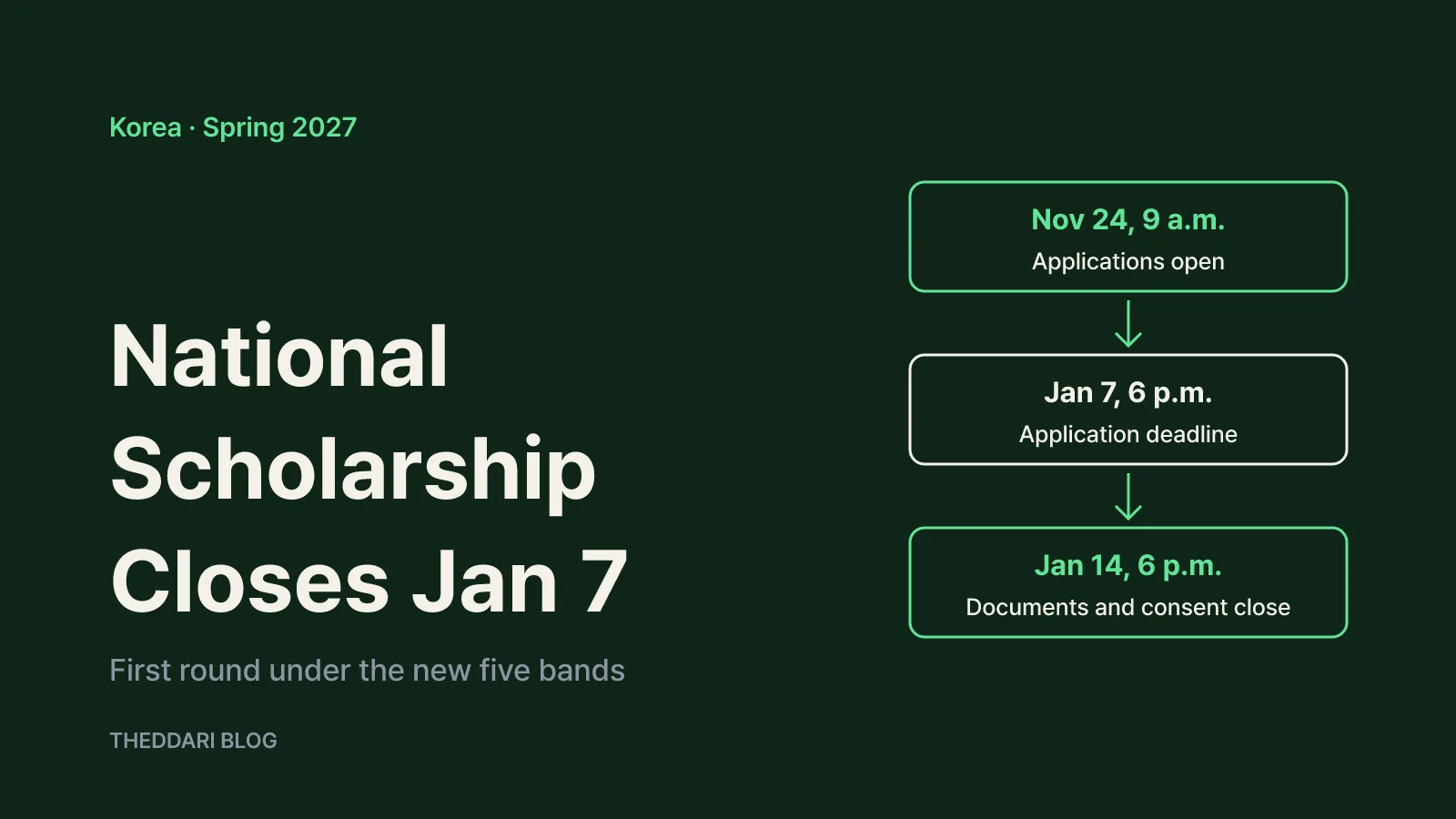
As of November 2026, the answer is straightforward: the first-round application for Korea's National Scholarship (국가장학금) for the spring 2027 semester opens at 9:00 a.m. on Tuesday, November 24, 2026 and closes at 6:00 p.m. on Thursday, January 7, 2027 (Korea time). Supporting documents and the household information consent can be completed until 6:00 p.m. on Thursday, January 14, 2027. This round also introduces a new way of labelling income levels: the familiar 1–10 brackets are being replaced by five bands named ga to ma (가–마). The dates below come from university notices that republish the Korea Student Aid Foundation (KOSAF) announcement, including Hongik University's notice and Catholic Kwandong University's notice.
Key dates and the 6 p.m. cutoff
The online application is open 24 hours a day during the window, including weekends and public holidays. The catch is the final day: on January 7 the system closes at 6 p.m., not midnight. The same 6 p.m. cutoff applies on January 14 for documents and consent.
← Swipe to see more
| Step | Window (Korea time) |
|---|---|
| Student application | Nov 24, 2026, 09:00 – Jan 7, 2027, 18:00 |
| Documents and household consent | Nov 24, 2026, 09:00 – Jan 14, 2027, 18:00 |
| Second round (new, transfer and returning students) | To be announced |
Every enrolment status can apply in this round: current students, incoming freshmen, transfer students, readmitted students and students returning from leave. A second round for new, transfer and returning students will be announced later, but applying now gets you a result sooner.
Timing matters for a practical reason. According to the Catholic Kwandong notice, calculating a student's income band takes roughly eight weeks. Hongik's notice adds that applications are processed in the order received and that late-window applications pile up. If your result arrives after the tuition payment deadline, you may have to pay tuition out of pocket first and receive the scholarship afterwards. If you want the award reflected on the February tuition bill, aim to finish in late November or early December.
From ten brackets to five bands: what each band pays
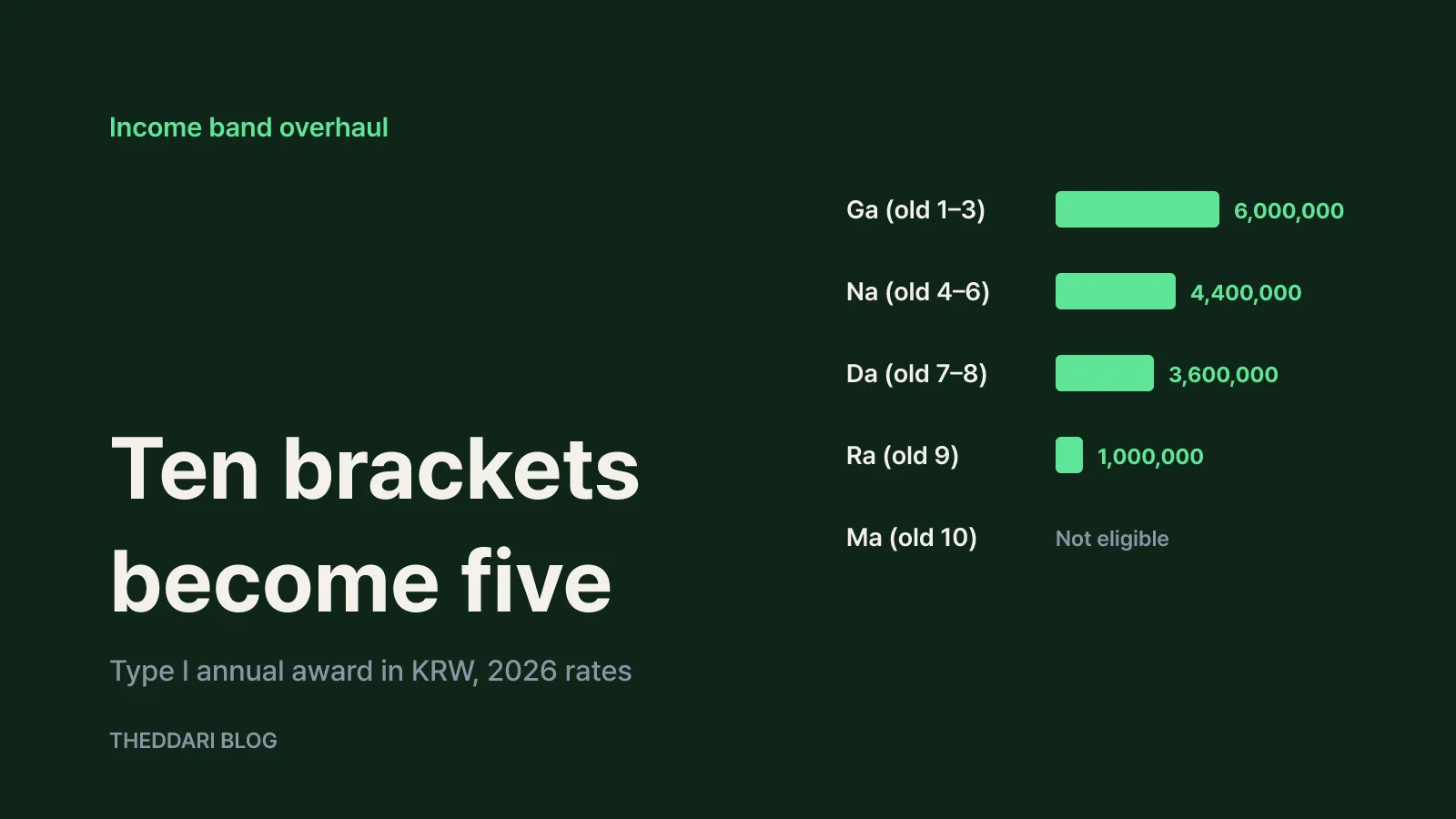
Starting with spring 2027, KOSAF's student aid income brackets are being consolidated from ten into five bands, ga through ma. A KOSAF restructuring notice posted by Korea National Sport University explains the logic: old brackets that already received the same scholarship amount are merged into one band, so old brackets 1–3 become band ga, and the ten-bracket system is being retired. The new calculation applies from late November 2026, which means this application round.
Combining KOSAF's bracket page with the 2026 award amounts reported by Yonhap News gives this picture (annual amounts in Korean won):
← Swipe to see more
| New band | Old brackets | Type I (annual) | Multi-child: 1st & 2nd child | Multi-child: 3rd child or later |
|---|---|---|---|---|
| Ga | 1–3 | KRW 6,000,000 | KRW 6,100,000 | Full tuition |
| Na | 4–6 | KRW 4,400,000 | KRW 5,050,000 | Full tuition |
| Da | 7–8 | KRW 3,600,000 | KRW 4,650,000 | Full tuition |
| Ra | 9 | KRW 1,000,000 | KRW 1,350,000 | KRW 2,000,000 |
| Ma | 10 | Not eligible | Not eligible | Not eligible |
Students from basic livelihood recipient households and near-poverty households remain eligible for full tuition. Remember that the table shows annual figures, not per-semester amounts; the amount applied in a given semester is best confirmed from your selection result and tuition bill.
One caveat deserves emphasis. These figures are the 2026 award rates mapped onto the new band names. Renaming the bands does not cut anyone's award, but the final 2027 rates should be confirmed in KOSAF's 2027 basic plan and application announcement. Band thresholds are also re-published each semester, so what counts is the band you are assigned this time, not the bracket you had last year.
What to prepare and how to apply
Applications are made on the KOSAF website or the KOSAF mobile app. Hongik's notice lists three things to have ready:
- An electronic signature in the student's own name: a joint certificate, financial certificate or private certificate.
- A bank account in the student's own name for the payment.
- The parents' resident registration numbers, or the spouse's number if the student is married.
The fields most often filled in wrongly are enrolment status and university name. An incoming spring 2027 freshman selects new student, an incoming transfer selects transfer, and someone already enrolled selects current student. Universities warn that a wrong choice can cause review errors or a missed assessment.
After submitting, open the application status page and confirm it reads completed. An application left unfinished is not reviewed at all. To change anything, you must cancel and reapply within the window. Some universities, Hongik among them, select their own institutional scholarships only from first-round National Scholarship applicants, so check your school's scholarship notices as well.
Household consent and documents: where applications stall
Submitting the form is only part of the process. Unmarried students need their parents, and married students their spouse, to complete a household information consent so that income and assets can be checked to calculate the band. Each family member has to verify their own identity, so if a parent lacks a digital certificate or is hard to reach, plan ahead.
The consent and document deadline, January 14, is a week later than the application deadline, but it is safer to treat it as a backstop rather than spare time. The eight-week calculation only moves smoothly once consent and any requested documents are in place. Documents are requested only from certain households depending on their circumstances, so check the document status menu once or twice after applying.
In short, an assessment needs three things: a completed application, documents where requested, and household consent. Missing any one of them can stop the review even if you applied on time.
Current students: the second round and the two-relief limit
For current students, the key rule is that the first round is the default. A current student who misses it can still apply in the second round, and this is accepted as a "relief application" up to two times during their studies. Relief is applied automatically, but according to the Catholic Kwandong notice, a third late application is rejected for not meeting the application period.
Applying late also has a cash-flow cost: second-round applicants cannot receive the advance deduction. The advance deduction subtracts the scholarship on the tuition bill itself. Without it, the student pays tuition first and receives the scholarship later.
Students who entered or transferred in the 2026 academic year should note that from 2027 they are treated like any other current student. Waiting for the second round, as they may have done as freshmen, would use up one of their two relief chances.
After applying: band notice, work-study and help
Once the application is in, work through these points:
- National Work-Study: if you want a spring 2027 work-study placement, apply on the same KOSAF website or app; the window is the same as the scholarship's.
- Band notice: your result will be issued under the new ga–ma labels. If your household situation has changed, look for the update request option under the income bracket menu on the KOSAF site.
- Tuition bill: check that the advance deduction appears on the bill and contact your university's scholarship office if it does not.
- Institutional scholarships: some schools use first-round applications to screen for their own awards.
KOSAF's call center is 1599-2000 (weekdays 09:00–18:00, in Korean). Traffic spikes near the deadline, so the simplest plan is to apply in the first week after the window opens on Tuesday, November 24.