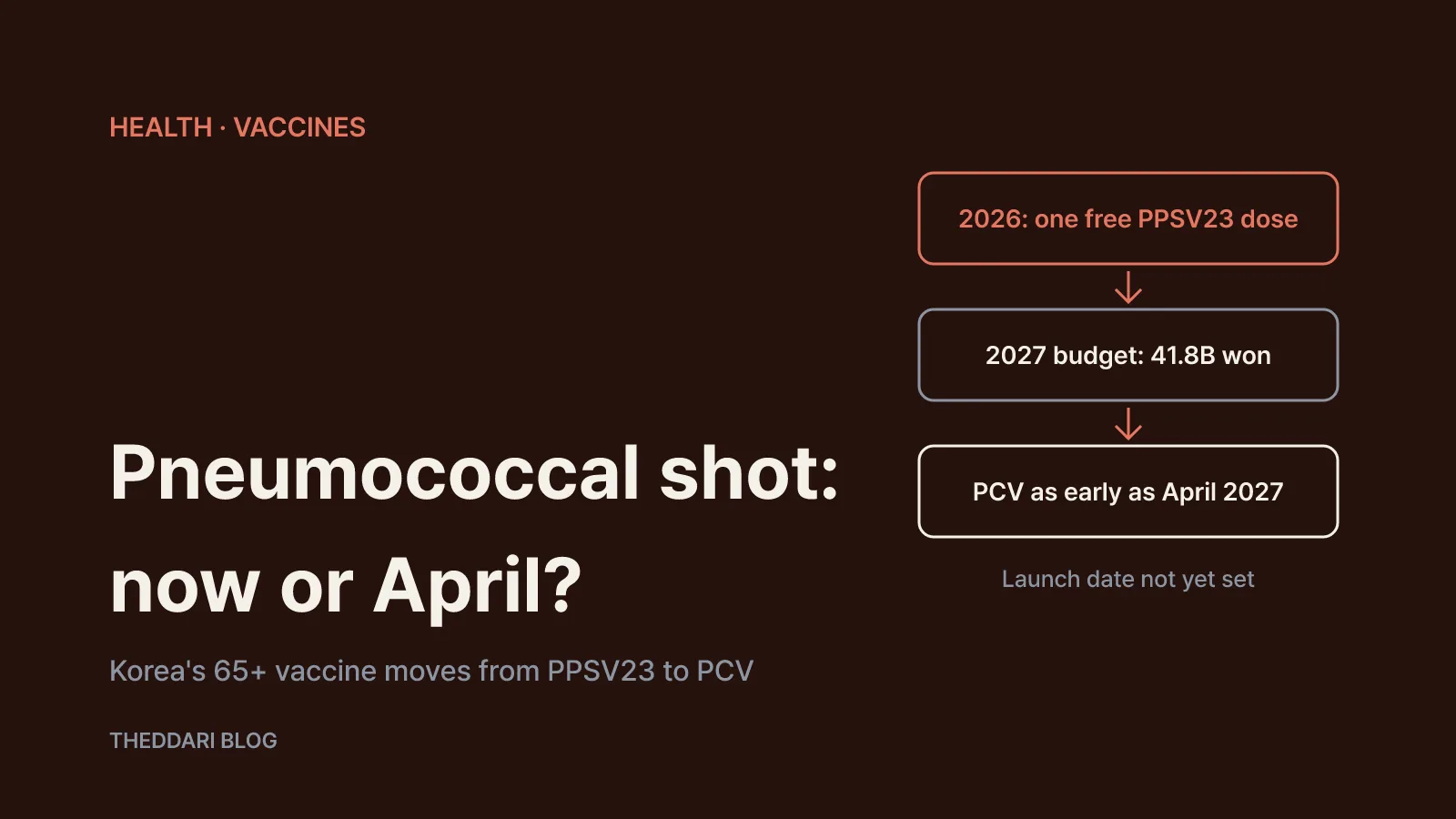
As of November 2026, Korea's free pneumococcal vaccine for older adults is one dose of PPSV23, the 23-valent polysaccharide vaccine. If you were born on or before December 31, 1961 and have not had PPSV23 since turning 65, you can get it at no cost at a public health center or a participating clinic, according to the KDCA immunization portal. The twist is that the Korea Disease Control and Prevention Agency (KDCA) has budgeted to replace that vaccine with a pneumococcal conjugate vaccine (PCV) in 2027 (KDCA press release, Sept. 1, 2026), and its commissioner told lawmakers the switch could start as early as April 2027 (Money Today, Oct. 7, 2026).
That leaves many older residents, and adult children managing a parent's checkups, asking the same thing: get the free PPSV23 now, or wait a few months for the conjugate vaccine? There is no single right answer, but the public record makes the trade-offs fairly clear. This guide separates what is confirmed from what is still undecided, so you can take the right questions to a doctor.
Who qualifies for the free shot in 2026
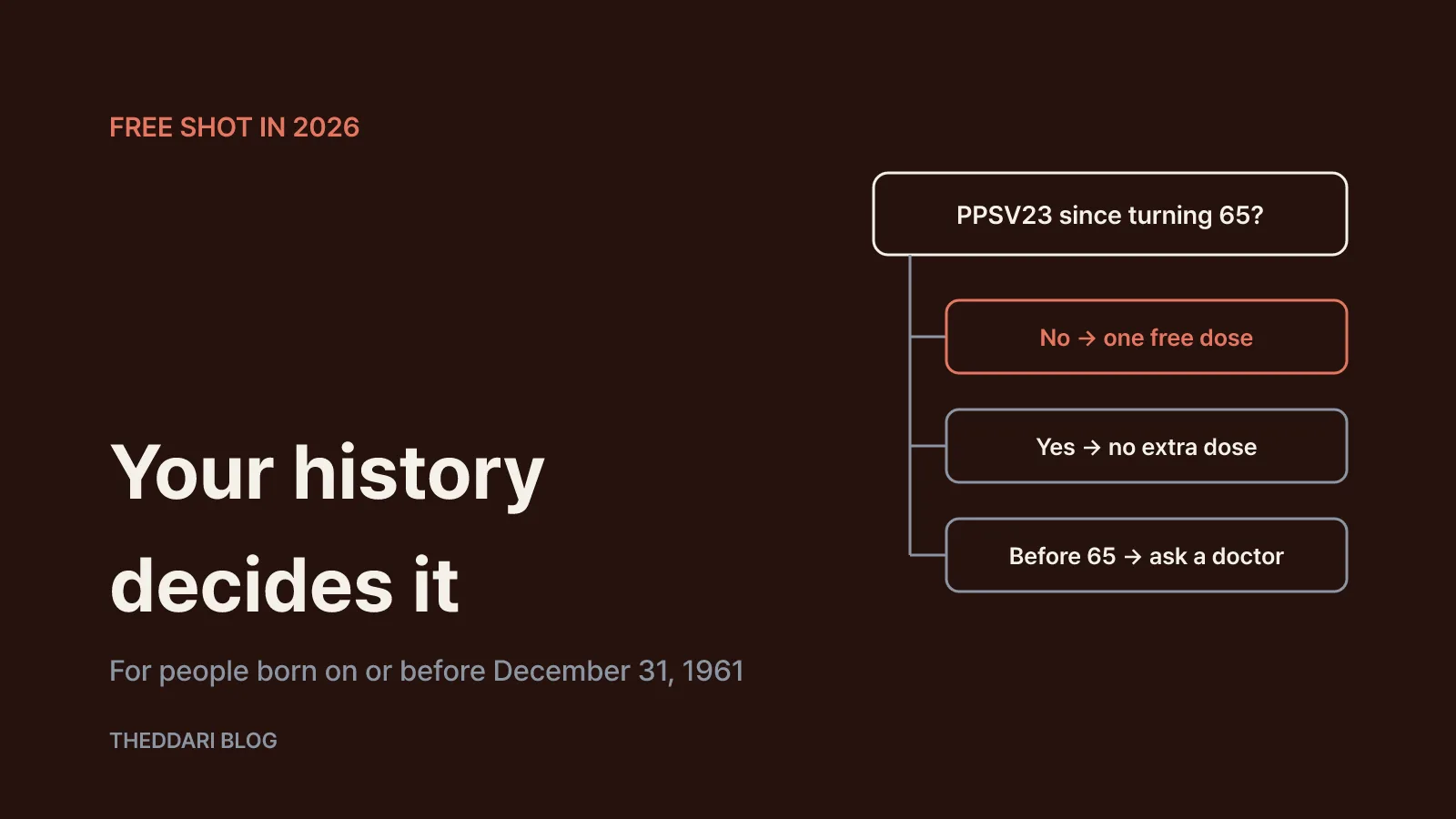
The KDCA program summary is short. The target group is adults 65 and older, defined for 2026 as people born on or before December 31, 1961. The program runs year-round, covers one dose of PPSV23, and is delivered through public health centers (including branch offices and rural clinics) and contracted private clinics. If you go to a clinic that is not part of the program, the cost is not covered.
The government services portal Gov24 spells out the selection rule: eligibility is checked against the date of birth on the resident registration record, and the person must have no PPSV record at age 65 or older. In practice there are three cases:
- No PPSV23 since turning 65: eligible for one free dose.
- Already had PPSV23 at 65 or older: no further dose is needed, and no cost support is given.
- Had PPSV23 before age 65: discuss with a doctor whether another dose is needed.
Two details trip people up. First, the cutoff is written as a birth-date boundary rather than an exact age, and the notices do not say whether someone born in 1961 can be vaccinated before their 65th birthday. Call the clinic first if that applies to you. Second, Gov24 warns that some public health centers may not be able to vaccinate depending on local circumstances, so check before you go. If you are not a Korean national, confirm eligibility with the clinic or the KDCA call center (1339) in advance, since the rule is tied to the registration record.
PPSV23 vs. PCV: what the switch changes
Both vaccine types protect against pneumococcal bacteria, but they train the immune system differently. In its 2027 budget release, KDCA says conjugate vaccines offer broader protection against pneumonia and build long-term immune memory, giving longer-lasting protection than the polysaccharide vaccine. The stated goal of the switch is to better prevent pneumococcal infection and severe illness in older adults.
That does not mean PPSV23 is ineffective. In written answers to lawmakers reported by Medical Newspaper (Bosa), KDCA stressed that the current vaccine remains effective and safe. The figures it cited for preventing invasive pneumococcal disease in people 65 and older were 34.0 to 73.1 percent for PPSV23 and 36.0 to 75.0 percent for PCV. Because those ranges overlap, the stronger case for PCV rests on durability, which KDCA put at 10 years or more, and immune memory rather than on a dramatically higher headline number.
Why this matters at all: KDCA notes that invasive pneumococcal infections are more common after 65, and that when an older adult develops pneumococcal bacteremia the death rate reaches 60 percent, rising to 80 percent for meningitis.
For readers familiar with US practice, the CDC's recommendations, updated February 25, 2026, already center on conjugate vaccines. The CDC advises PCV15, PCV20 or PCV21 for all adults 50 and older who have never had a conjugate vaccine. A single dose of PCV20 or PCV21 completes the series, while PCV15 is followed by one PPSV23 dose a year later. Korea's planned switch moves in a similar direction, but Korean eligibility and free coverage follow KDCA rules, not US schedules.
Get it now or wait? Four things to weigh

None of these points tells you what to do. Together, they frame the conversation you should have with a doctor.
1. April 2027 is a forecast, not a date. The commissioner said that once next year's budget is finalized and procurement contracts are signed, PCV shots could begin "as early as April." He also said the actual start date would be announced only after the 2027 budget is finalized. The program budget rises from 13.6 billion won in 2026 to 41.8 billion won in the 2027 government proposal, but no launch notice has been published.
2. Taking PPSV23 now may rule you out of the free PCV. The commissioner said vaccine demand was estimated for people newly turning 65 and older adults with no prior vaccination. KDCA also said whether to give PCV to people who already had the polysaccharide vaccine will be reviewed over the medium to long term, pointing out that the UK does not recommend an extra conjugate dose for prior PPSV recipients and Japan limits support to age 65 plus high-risk 60 to 64 year olds. If those plans hold, someone who gets PPSV23 this winter may not be covered for a free PCV next year. The final rules will be in the launch notice.
3. Waiting means going without protection for a while. Holding out until April means spending the rest of winter and early spring unvaccinated, and longer if the launch slips. KDCA specifically tells older adults with underlying conditions to discuss vaccine choice and timing with the screening doctor first. If you have a chronic illness or a recent history of pneumonia, raise this exact question at your next visit.
4. You can pay for PCV now. Only PPSV23 is covered today, so a conjugate vaccine means paying out of pocket, and prices vary by clinic. The notices do not say how a self-paid PCV after 65 affects eligibility for free PPSV23. Since the Gov24 rule mentions only PPSV history, bring your records and ask at screening.
How to get vaccinated and what to expect
There is no application form. You go to a participating site, by walk-in or by booking ahead by phone.
- Find a clinic: use the clinic finder on the KDCA immunization portal to locate providers in the older adult pneumococcal program.
- Bring ID: any document that confirms your identity.
- Pick a good day: go when you feel well, after checking that the clinic can vaccinate.
- Screening: a doctor's pre-vaccination check is mandatory. Mention past pneumococcal shots, current medicines and chronic conditions.
Afterward, KDCA advises staying at the clinic for 20 to 30 minutes to watch for reactions, keeping the injection site clean, and avoiding alcohol, strenuous exercise and showering on the day of the shot while resting for at least half a day. For questions, contact your local public health center, the KDCA call center at 1339, or the Health and Welfare call center at 129.
What to watch for in 2027
The direction is set, but the details are not. Three announcements will settle most of the uncertainty:
- Launch date and the 2027 birth-date cutoff. The current notices cover only the 2026 cutoff of December 31, 1961.
- Rules for prior PPSV23 recipients. KDCA has framed extra support as a longer-term review item.
- Updated program pages. When the KDCA portal and Gov24 change the covered vaccine from PPSV23 to PCV, the switch is live. Until then, the free vaccine at participating clinics is PPSV23.
KDCA is also pursuing high-dose or adjuvanted flu vaccines for people 75 and older from 2027, though Bosa reported that this item was not included in the government's budget proposal. Check this season's flu shot schedule separately.