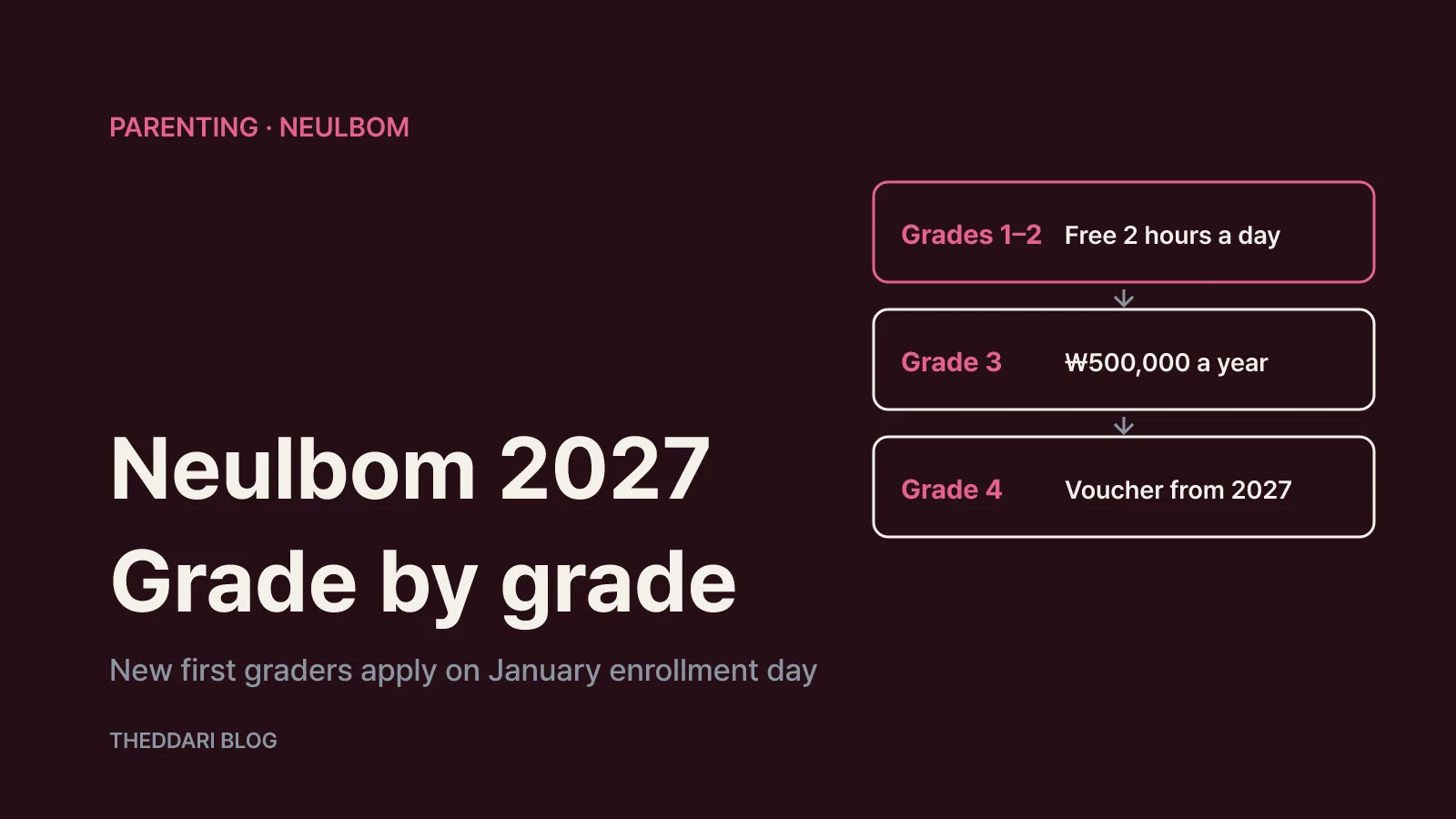
As of November 2026, a child entering a Korean public elementary school in March 2027 can join a free after-school program for two hours every school day, and most schools collect first-grade applications at the preliminary enrollment day in early January. The Ministry of Education has said it will keep funding this two-hour program for grades 1 and 2 so that young children can effectively stay at school until about 3 p.m., and that the after-school program voucher introduced for third graders in 2026 will extend to fourth graders in 2027 (Ministry of Education, April 2026). The part that is not guaranteed is a place in the longer care room that runs into the evening: each school sets its own capacity and selection criteria.
If you are a foreign or returning family, the naming can be confusing. Since 2026 the government has described the old Neulbom School policy as part of a wider 'Ondongne' (whole-neighborhood) elementary care and education system in which schools and local governments share the work (Korea.net policy briefing). Schools and city websites still commonly say 'Neulbom' (늘봄) and refer to a Neulbom support office (늘봄지원실). The Daegu city childcare portal, for example, still lists eligibility and application periods under a 'Neulbom School' menu. Whatever the letter from school calls it, it is the same system.
What each grade gets in 2027
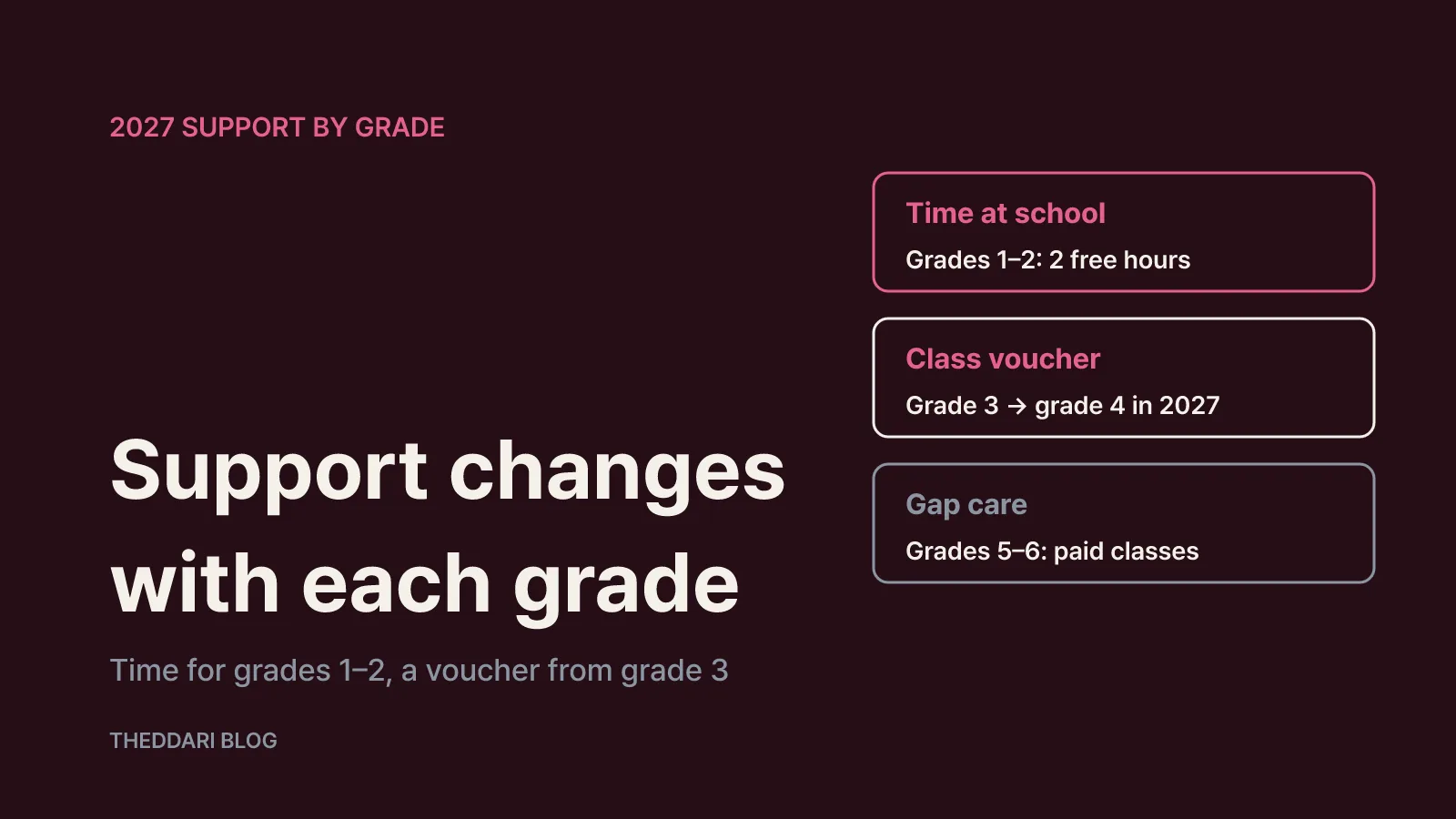
The key idea is that support changes shape as children get older. Grades 1 and 2 receive guaranteed time at school. From grade 3, the support becomes a voucher that parents can spend on after-school classes of their choice.
← Swipe to see more
| Grade | Support for the 2027 school year | What to check |
|---|---|---|
| 1–2 | Free tailored program, two hours every school day | Program timetable |
| 3 | After-school program voucher (₩500,000 a year in 2026) | How to claim it, what it covers |
| 4 | Added to voucher eligibility from 2027 | Your provincial office's 2027 guidelines |
| 5–6 | Paid after-school classes; care depends on the school | Gap-care selection rules |
The grade 1–2 program focuses on adjusting to school life, play and hands-on activities, and any student who wants to join can do so (Daegu city childcare portal). There is no lottery for this part.
For older children, the ministry reported that 57.2% of third graders were receiving the voucher as of March 2026, and that regions wishing to do so could cover up to 70% of third graders by the end of 2026. The same announcement states that eligibility will widen to fourth graders in 2027. Provincial offices are already preparing: on November 23, the Jeonbuk Office of Education told elementary principals that its 2027 guidelines extend the after-school voucher to grade 4 (Newspim). The 2027 amount and permitted uses for fourth graders will be set in each office's guidelines, so check your school's notice after December.
Care rooms for upper grades are now aimed at filling gaps rather than serving everyone. In 2025, only 6.0% of third graders, 2.2% of fourth graders, 1.0% of fifth graders and 0.8% of sixth graders used school care, which is why policy for older children shifted toward class choice (Korea.net policy briefing).
When to apply for first grade
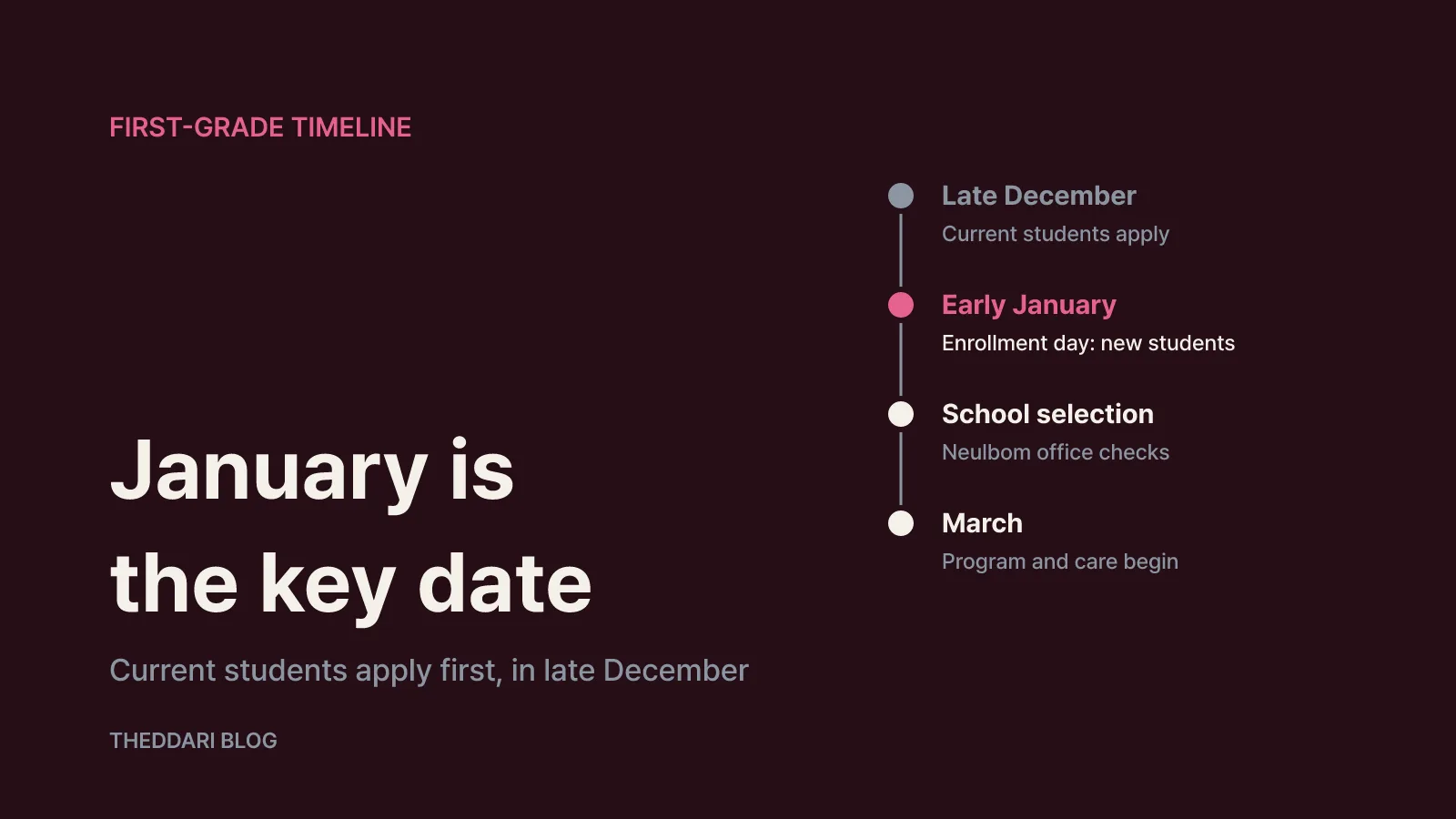
Exact dates vary by school, but the pattern is consistent. Daegu's guidance says current students apply at the end of December every year, new students apply in early January at the preliminary enrollment day (예비소집), and transfer students and emergency care requests are accepted year-round, with the caveat that schools may adjust the period.
A practical sequence for a family with a child starting school in March 2027:
- Late December: If an older sibling is already in elementary school, the current-student application usually arrives first.
- Early January, preliminary enrollment day: Many schools hand out the Neulbom notice and form here. Mark whether your child will join the free two-hour program and which care hours you need.
- School selection: The Neulbom support office checks eligibility and selects care-room students. When results are sent differs by school.
- March: The program and care start with the new school year.
If you cannot attend enrollment day in person, ask whoever attends to bring back the Neulbom form and the list of supporting documents, and watch the school website's notice board. If you miss the window, contact the school's Neulbom or after-school office straight away about remaining places.
The free program and care rooms are separate choices
Parents often think of 'applying for Neulbom' as one step, but you are really choosing two different things:
- Tailored program (grades 1–2): two hours a day, free, open to every student who wants it.
- Care (morning, afternoon, evening): for students who need care, but the school selects users based on space and staff. Gap care for grades 3–6 is offered to children such as those from low-income or dual-income households, according to each school's criteria.
In Daegu's guidance, the documents are a Neulbom application form and whatever proof the school requires for care. Because each school defines that proof, check how it wants facts such as both parents working to be shown, and get the paperwork early.
Care normally runs Monday to Friday until 6 p.m. Morning care (7–9 a.m.) and evening care (6–8 p.m.) may be offered depending on demand, so if you need those hours, say so during the school's demand survey.
What is free and what you pay for
'Neulbom is free' is only half true. The free part is the two-hour daily program for grades 1 and 2. Everything else splits like this:
- After-school classes (grades 1–6): skill and subject classes charge fees. Third graders can use the voucher toward them.
- Meals and snacks during care: families pay, except legally defined low-income households — basic livelihood recipients, protected single-parent families, near-poverty households and students recommended by the principal — whose costs are fully covered (Daegu city childcare portal).
When the school sends a long list of classes, mark which are the free tailored program and which are paid electives before you estimate the monthly cost.
Using the grade 3–4 after-school voucher
The third-grade voucher is worth ₩500,000 a year for students who want it. To reduce school paperwork, six provincial offices — Busan, Incheon, Sejong, North Chungcheong, North Jeolla (Jeonbuk) and South Jeolla — began a pilot in March 2026 that links the voucher to the ZeroPay mobile payment system, while other offices run their own versions (Korea.net policy briefing). Sign-up screens and payment steps therefore differ by region.
Jeonbuk says it will post its 2027 after-school guidelines and forms on its Neulbom support center website on December 18. Other offices tend to publish around the winter break, so bookmark your provincial Neulbom support center.
Options outside school are growing too. The ministry planned at least 15 more education-office 'Ondongne' care and education centers in 2026, along with more staff to help children get home safely and more school bus routes. If your child misses a care-room place or needs holiday or evening cover, look at local community care centers in parallel.
Checklist before enrollment day
- Decide whether your child will join the free two-hour program.
- Write down which days you need care and the latest pickup time.
- Note whether you need morning (7–9 a.m.) or evening (6–8 p.m.) care for the demand survey.
- Prepare the care documents your school requests.
- If you are a legally defined low-income household, confirm meal and snack support.
- If a sibling is entering grade 3 or 4, watch for the voucher notice.
- Arrange a proxy and a way to see school notices if you cannot attend.
Two dates matter most: late December for current students and early January for new students. Keep the free program and the care room as two separate boxes on the form, and most of the March confusion disappears.