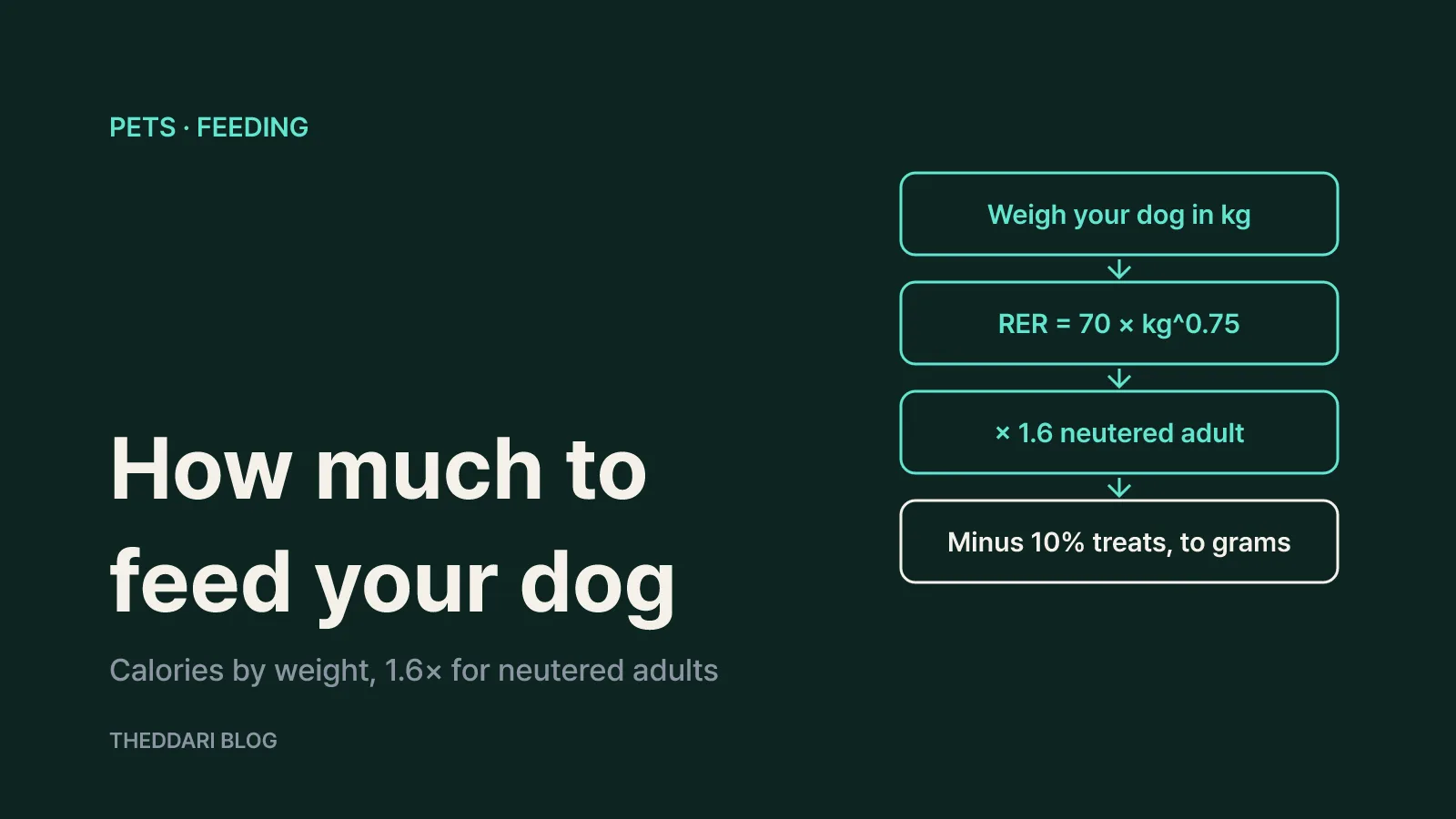
As of November 2026, the standard veterinary way to answer "how much should I feed my dog?" is a three-step calculation. First find the resting energy requirement, RER = 70 × body weight in kg^0.75. Then multiply it by a life-stage factor: 1.6 for a typical spayed or neutered adult and 1.8 for an intact adult, according to the Merck Veterinary Manual's maintenance energy table. Finally, divide the result by the calories in your dog's food. An 11 lb (5 kg) neutered adult has an RER of about 234 kcal and a daily target of about 374 kcal.
The feeding chart on the bag is an average for a weight band. It cannot know whether your dog is neutered, how far you walk, or how many treats your household hands out. Running the numbers once gives you a baseline for judging whether the bag's suggestion fits. These figures are a starting point for healthy dogs; if your dog has a medical condition or eats a prescription diet, your veterinarian's feeding instructions come first.
Step 1: Calculate resting energy (RER) from body weight
RER is the energy a dog uses at rest in a comfortable environment. If you know your dog's weight in pounds, divide by 2.2 to get kilograms, as PetMD's calorie guide shows. Then apply 70 × kg^0.75.
You may also see a shortcut, 30 × kg + 70. Today's Veterinary Nurse explains that the linear version only works between roughly 2 and 45 kg and recommends the exponent formula for every patient. Its example is a 1.36 kg (3 lb) dog: the exponent formula gives 88.2 kcal, while the shortcut gives 110.8 kcal, overestimating by 22.6 kcal a day. For a toy breed, that gap matters.
To get kg^0.75 on a phone, rotate the calculator to scientific mode, enter the weight, press x^y and enter 0.75. Or use the reference values below, each calculated with 70 × kg^0.75 and rounded.
← Swipe to see more
| Weight | RER (kcal/day) |
|---|---|
| 2 kg (4.4 lb) | about 118 |
| 5 kg (11 lb) | about 234 |
| 10 kg (22 lb) | about 394 |
| 20 kg (44 lb) | about 662 |
| 30 kg (66 lb) | about 897 |
Weigh your dog on the same scale at the same time of day so readings are comparable. For small dogs, weighing yourself holding the dog and subtracting your own weight works if the scale reads to a tenth of a unit.
Step 2: Multiply by the right life-stage factor
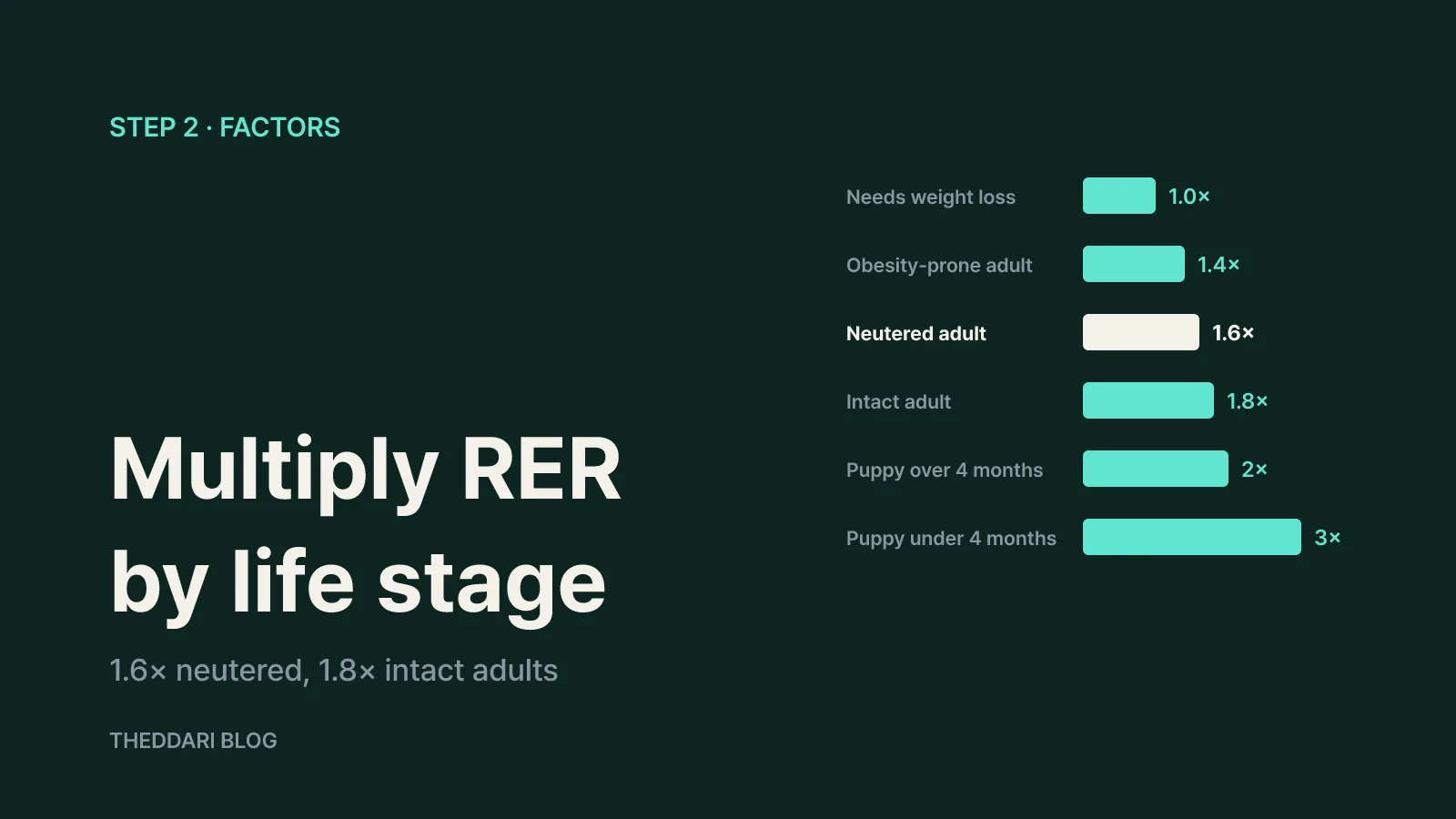
RER multiplied by a factor gives the maintenance energy requirement (MER), sometimes called the daily energy requirement (DER). These are the common starting factors from Merck and PetMD.
← Swipe to see more
| Dog | Factor | 5 kg example | 10 kg example |
|---|---|---|---|
| Spayed or neutered adult | RER × 1.6 | about 374 kcal | about 630 kcal |
| Intact adult | RER × 1.8 | about 421 kcal | about 709 kcal |
| Obesity-prone adult | RER × 1.4 | about 328 kcal | about 552 kcal |
| Needs to lose weight | RER × 1.0 | about 234 kcal | about 394 kcal |
| Puppy under 4 months | RER × 3 | use current weight | use current weight |
| Puppy over 4 months | RER × 2 | use current weight | use current weight |
PetMD notes that calorie needs drop after spaying or neutering, probably because sex hormones help maintain muscle mass and activity. If you keep feeding the pre-surgery amount, weight tends to creep up over the following months. Simply recalculating with 1.6 instead of 1.8 trims the target by roughly a tenth.
Puppies need far more energy than adults of the same size, and because they gain weight quickly, recalculate often using their current weight. PetMD specifically warns against using an adult calorie calculator for a puppy. Very active dogs can need 2× RER for light exercise or 3× for moderate exercise, but a dog that gets two neighborhood walks a day usually starts at the standard adult factor.
Step 3: Convert calories to cups or grams and leave room for treats
Look for the calorie statement on the bag or the manufacturer's site, usually listed as kcal/kg and kcal per cup. Then work through the numbers. Using an 11 lb (5 kg) neutered adult eating a dry food with 3,800 kcal/kg:
- Daily target: 234 × 1.6 ≈ 374 kcal
- Treat budget: Today's Veterinary Nurse advises that treats make up no more than 10% of daily calories, so about 37 kcal
- Food budget: 374 − 37 = 337 kcal
- Grams: 337 ÷ 3.8 kcal/g ≈ 89 g a day
- Meals: about 44 g per meal if you feed twice daily
If the same food lists 363 kcal per cup, 337 kcal works out to a little under one cup a day. On days with no treats, the full 374 kcal is about 98 g. If you mix in canned food, subtract the calories in the portion of the can from the dry food budget, which is exactly how the Today's Veterinary Nurse worked example balances kibble, canned food and treats.
Measuring cups are less consistent than they look, because kibble size and scooping habits change the weight of a "cup." For the first week, weigh the daily portion on a kitchen scale, then mark that level on your scoop. In multi-person households, portioning the whole day's food into a container each morning prevents accidental double feeding.
Treat the result as a starting point and adjust every two weeks
Every formula describes an average dog. Merck states that any calorie calculation is only a starting point to be adjusted based on how the animal responds. PetMD sets the typical range at 25% below to 25% above the calculated MER, so for a 374 kcal target, individual needs could fall anywhere from about 280 to 470 kcal.
Start with the calculated amount and check the scale. The Today's Veterinary Nurse weight-loss example schedules a weight check two weeks after the plan begins, and that interval works well at home too.
- Weight steadily rising and ribs hard to feel: reduce the portion slightly and audit treats first.
- Weight steadily falling or hip bones becoming prominent: increase slightly, and book a vet visit if there is also reduced appetite, vomiting or diarrhea.
- Weight stable and energy good: you have found your dog's real maintenance amount.
RER × 1.0 is a common starting point for weight loss, but abrupt restriction carries its own risks. If you suspect your dog is overweight, ask your veterinarian to score body condition and set a goal weight and pace before cutting food.
Four common calculation mistakes
Using the linear shortcut for tiny dogs. Below about 2 kg it inflates the answer. The exponent formula works at every size, so you never need to switch methods.
Forgetting treats and table food. Dental chews, jerky, training rewards and scraps all count. Once treats pass 10% of the day, a perfectly weighed bowl no longer reflects what your dog actually eats. Check the kcal per treat and decide on a daily number in advance.
Switching foods without recalculating. Calorie density varies between foods, so the same cup can deliver a different amount of energy. Redo the gram or cup math whenever the bag changes.
Using the wrong stage. Puppies need growth factors, and adults should not stay on them once growth ends. When to move from puppy to adult food depends on breed size, so settle the timing with your veterinarian at a routine visit and recalculate on the day you switch.